SETTING UP A HELICOPTER TRANSMITTER
By James Wang | heloeditor@gmail.com

IT IS ALWAYS A PLEASURE to visit different RC flying fields and attend fun-flys because it gives me an opportunity to observe all kinds of helicopters, watch how people fly, and chat with them to learn from their experiences.
I notice that novices often need help with the mechanical and transmitter setup. They encounter servos that bind because of incorrect mechanical travel range, a nonoptimal gyro gain setting, controls that are overly sensitive or too slow, and other issues. If the transmitter and the mechanical setup are not optimized, the model will not fly properly, despite having a well-designed helicopter kit.
Control System Setup and Servos
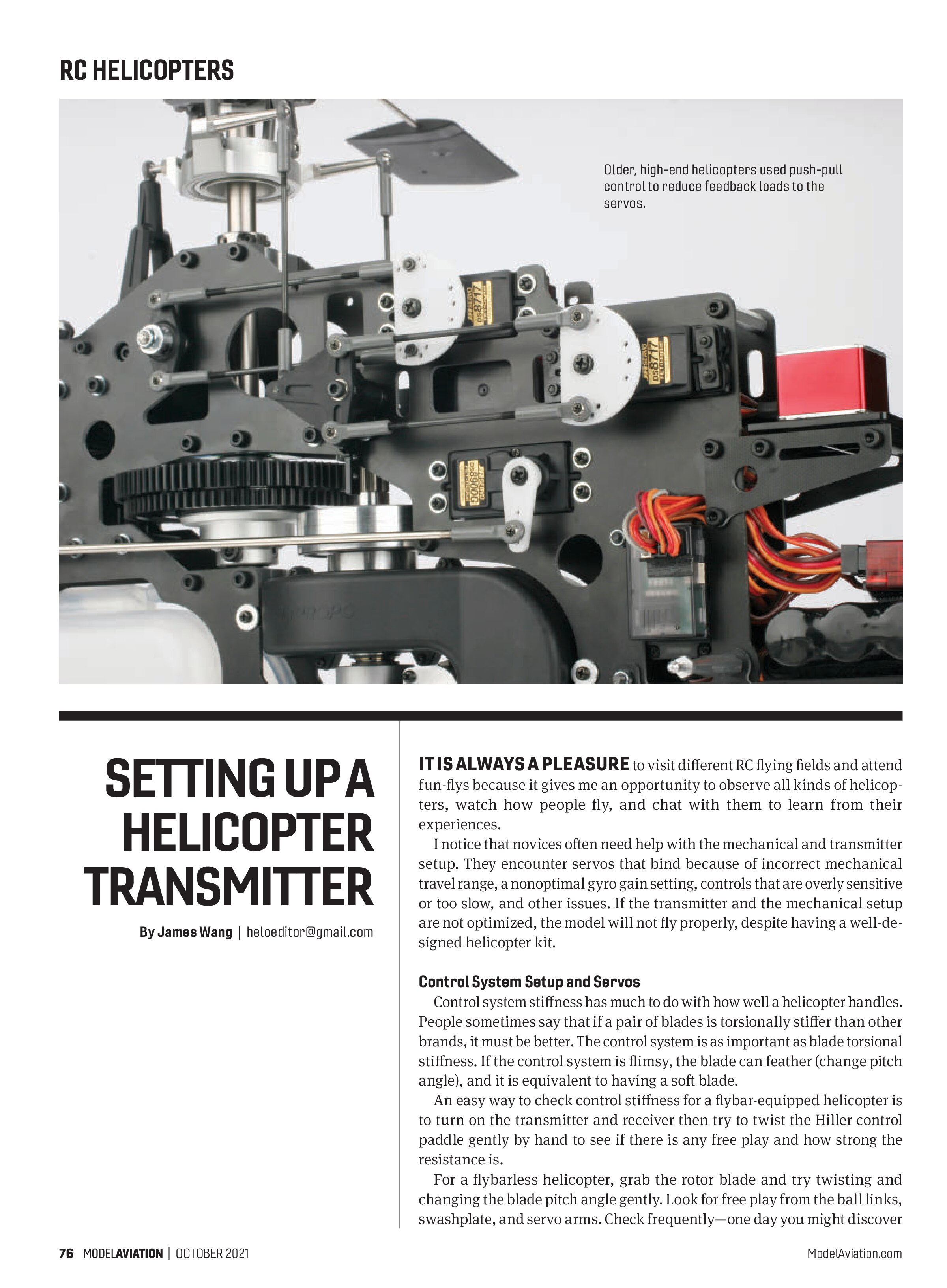
Control system stiffness has much to do with how well a helicopter handles. People sometimes say that if a pair of blades is torsionally stiffer than other brands, it must be better. The control system is as important as blade torsional stiffness. If the control system is flimsy, the blade can feather (change pitch angle), and it is equivalent to having a soft blade.
An easy way to check control stiffness for a flybar-equipped helicopter is to turn on the transmitter and receiver then try to twist the Hiller control paddle gently by hand to see if there is any free play and how strong the resistance is.
For a flybarless helicopter, grab the rotor blade and try twisting and changing the blade pitch angle gently. Look for free play from the ball links, swashplate, and servo arms. Check frequently—one day you might discover