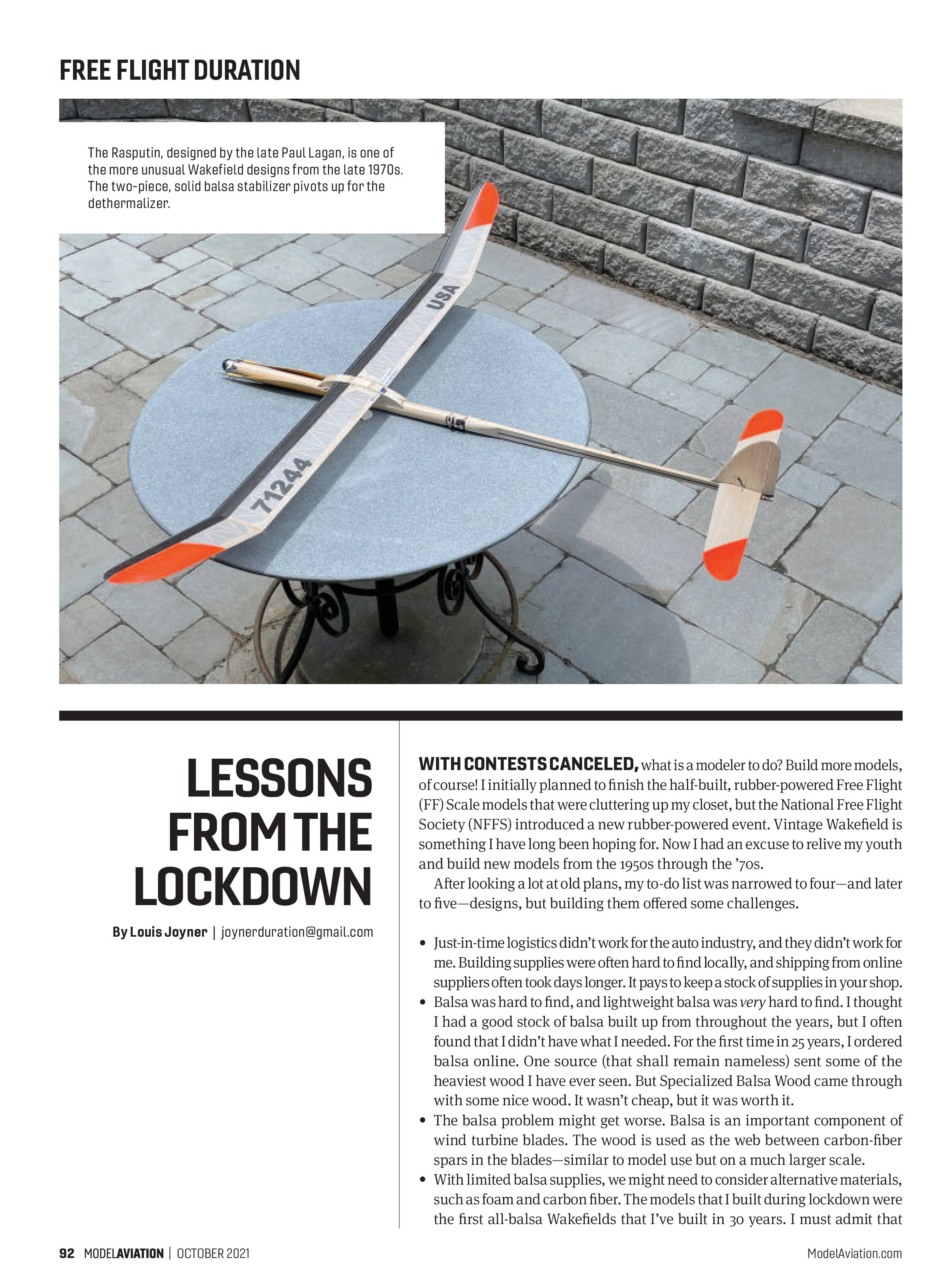
FREE FLIGHT DURATION

LESSONS FROM THE LOCKDOWN
By Louis Joyner | joynerduration@gmail.com
WITH CONTESTS CANCELED, what is a modeler to do? Build more models, of course! I initially planned to finish the half-built, rubber-powered Free Flight (FF) Scale models that were cluttering up my closet, but the National Free Flight Society (NFFS) introduced a new rubber-powered event. Vintage Wakefield is something I have long been hoping for. Now I had an excuse to relive my youth and build new models from the 1950s through the ’70s.
After looking a lot at old plans, my to-do list was narrowed to four—and later to five—designs, but building them offered some challenges.
- Just-in-time logistics didn’t work for the auto industry, and they didn’t work for me. Building supplies were often hard to find locally, and shipping from online suppliers often took days longer. It pays to keep a stock of supplies in your shop.
- Balsa was hard to find, and lightweight balsa was very hard to find. I thought I had a good stock of balsa built up from throughout the years, but I often found that I didn’t have what I needed. For the first time in 25 years, I ordered balsa online. One source (that shall remain nameless) sent some of the heaviest wood I have ever seen. But Specialized Balsa Wood came through with some nice wood. It wasn’t cheap, but it was worth it.
- The balsa problem might get worse. Balsa is an important component of wind turbine blades. The wood is used as the web between carbon-fiber spars in the blades—similar to model use but on a much larger scale.
- With limited balsa supplies, we might need to consider alternative materials, such as foam and carbon fiber. The models that I built during lockdown were the first all-balsa Wakefields that I’ve built in 30 years. I must admit that building with carbon fiber is faster and easier than with balsa. The biggest time saving is in material selection. Carbon-fiber strips and other shapes are consistent. Unlike with balsa, there is no need to spend time choosing the useable pieces.
- Be a hoarder. Throughout the years, I’ve accumulated a lot of scrap balsa, plywood, carbon fiber, and various screws and other fasteners. I even have a good stash of Esaki tissue.
- Collect and save information. Several NFFS publications from the 1979 World Championships in Taft, California, provided three-view drawings and design information about many Wakefield aircraft, as well as Towline gliders and Power models. Bill Hartill’s World Free Flight Review from 1978 was a treasure trove of three-views, photos, and information on several hundred models. (Copies of this book, as well as the NFFS publications, sometimes come up for sale on the NFFS website under “Used Books.”)
- You really don’t need full-size plans. There is enough information on a small three-view from which to build. For sheeted wings, rib locations can be drawn directly on the lower sheet. For models with an elliptical wing and stabilizer tips, I use a copier to enlarge that part of the plans to full size. This usually takes several steps. As the plans are enlarged, the outline gets wider and rather fuzzy, but it is enough to cut a template from cardstock.
- Building multiple models at the same time has its advantages. There is always something else to work on while the glue is drying. The models shared some similar parts that could be “mass produced.” I did all of the covering in one day, so the workbench only needed to be cleared once.
- To keep the pieces organized, each model had its own file folder with small-scale plans, a materials list, and model setup information. Each model had its own parts bin for ribs and other small items. Larger parts, such as tapered basswood spars, leading edges, and trailing edges, were bundled and labeled with the aircraft’s name.
- Sketch first then build. Several models had unusual design features that were not detailed on the three-views. Figuring out how the original designer did something was part of the challenge. Working details out on paper saved both time and balsa.
- I discovered that my workshop needed more temporary storage for wings, stabilizers, and other parts that were in production. There was never enough space to hold everything. I need wall-hung racks in my shop. (My finished models are stored in model boxes elsewhere in the house.)
- The two important lessons that I learned from the lockdown are that it helps to have a hobby to keep you busy, and the worldwide FF community is always ready to help with tips and advice. All you have to do is ask. I found the Builder’s Forum on the Hip Pocket Aeronautics website invaluable.

Model Train Turbulators?
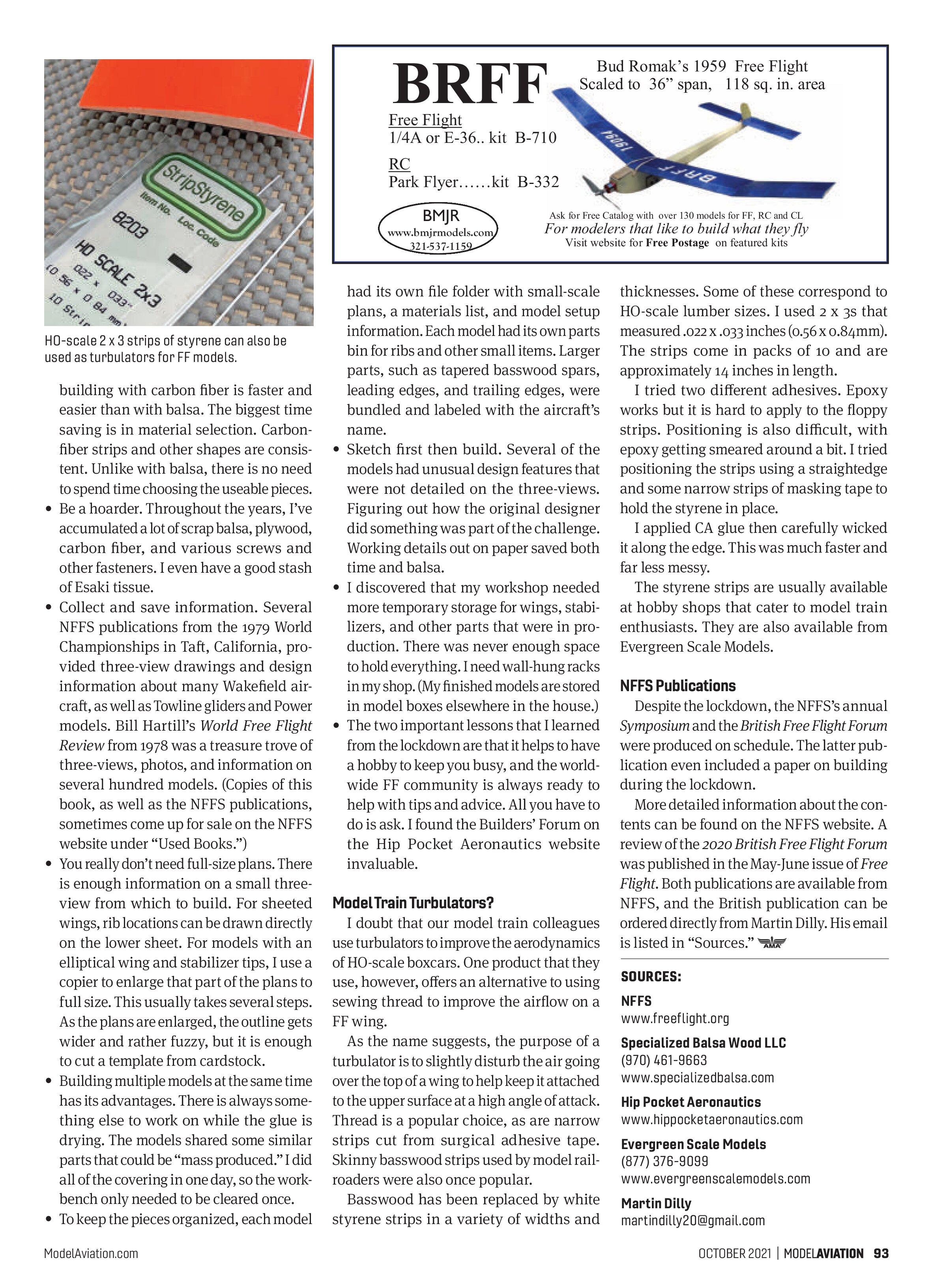
I doubt that our model train colleagues use turbulators to improve the aerodynamics of HO-scale boxcars. One product that they use, however, offers an alternative to using sewing thread to improve the airflow on a FF wing.
As the name suggests, the purpose of a turbulator is to slightly disturb the air going over the top of a wing to help keep it attached to the upper surface at a high angle of attack. Thread is a popular choice, as are narrow strips cut from surgical adhesive tape. Skinny basswood strips used by model railroaders were also once popular.
Basswood has been replaced by white styrene strips in a variety of widths and thicknesses. Some of these correspond to HO-scale lumber sizes. I used 2 x 3s that measured .022 x .033 inches (0.56 x 0.84mm). The strips come in packs of 10 and are approximately 14 inches in length.
I tried two different adhesives. Epoxy works but it is hard to apply to the floppy strips. Positioning is also difficult, with epoxy getting smeared around a bit. I tried positioning the strips using a straightedge and some narrow strips of masking tape to hold the styrene in place.
I applied CA glue then carefully wicked it along the edge. This was much faster and far less messy.
The styrene strips are usually available at hobby shops that cater to model train enthusiasts. They are also available from Evergreen Scale Models.
NFFS Publications
Despite the lockdown, the NFFS’s annual Symposium and the British Free Flight Forum were produced on schedule. The latter publication even included a paper on building during the lockdown.
More detailed information about the contents can be found on the NFFS website. A review of the 2020 British Free Flight Forum was published in the May-June issue of Free Flight. Both publications are available from NFFS, and the British publication can be ordered directly from Martin Dilly. His email is listed in “Sources.”
SOURCES:
Specialized Balsa Wood LLC
(970) 461-9663
www.specializedbalsa.com
Hip Pocket Aeronautics
www.hippocketaeronautics.com
Evergreen Scale Models
(877) 376-9099
www.evergreenscalemodels.com
Martin Dilly
martindilly20@gmail.com