FOCAL POINT
Interested in sharing your handiwork? Visit www.ModelAviation.com for submission guidelines.
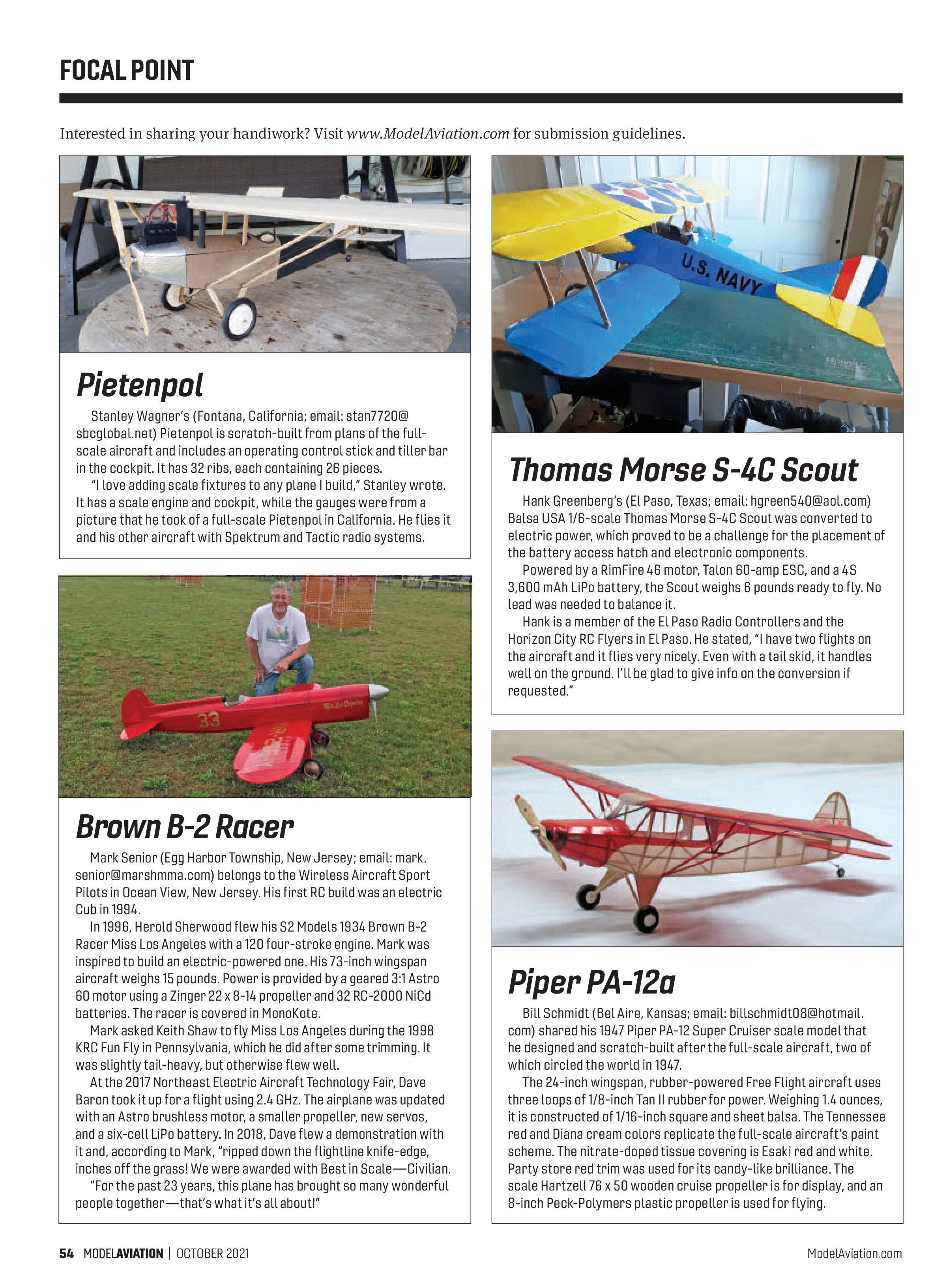
Pietenpol

Stanley Wagner’s (Fontana, California; email: stan7720@sbcglobal.net) Pietenpol is scratch-built from plans of the full-scale aircraft and includes an operating control stick and tiller bar in the cockpit. It has 32 ribs, each containing 26 pieces.
“I love adding scale fixtures to any plane I build,” Stanley wrote. It has a scale engine and cockpit, while the gauges were from a picture that he took of a full-scale Pietenpol in California. He flies it and his other aircraft with Spektrum and Tactic radio systems.
Brown B-2 Racer

Mark Senior (Egg Harbor Township, New Jersey; email: mark.senior@marshmma.com) belongs to the Wireless Aircraft Sport Pilots in Ocean View, New Jersey. His first RC build was an electric Cub in 1994.
In 1996, Herold Sherwood flew his S2 Models 1934 Brown B-2 Racer Miss Los Angeles with a 120 four-stroke engine. Mark was inspired to build an electric-powered one. His 73-inch wingspan aircraft weighs 15 pounds. Power is provided by a geared 3:1 Astro 60 motor using a Zinger 22 x 8-14 propeller and 32 RC-2000 NiCd batteries. The racer is covered in MonoKote.
Mark asked Keith Shaw to fly Miss Los Angeles during the 1998 KRC Fun Fly in Pennsylvania, which he did after some trimming. It was slightly tail-heavy, but otherwise flew well.
At the 2017 Northeast Electric Aircraft Technology Fair, Dave Baron took it up for a flight using 2.4 GHz. The airplane was updated with an Astro brushless motor, a smaller propeller, new servos, and a six-cell LiPo battery. In 2018, Dave flew a demonstration with it and, according to Mark, “ripped down the flightline knife-edge, inches off the grass! We were awarded with Best in Scale—Civilian.
“For the past 23 years, this plane has brought so many wonderful people together—that’s what it’s all about!”
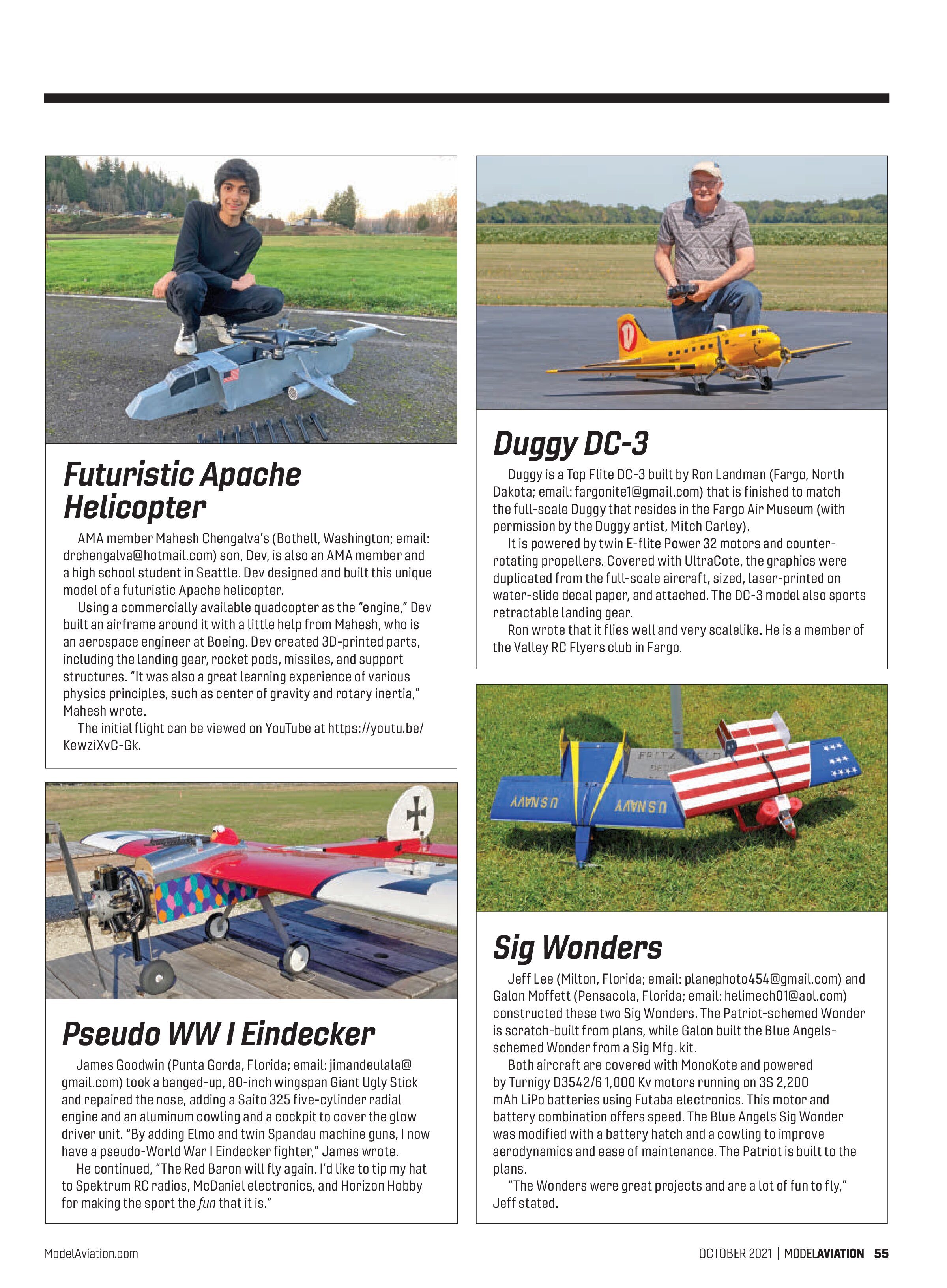
Thomas Morse S-4C Scout

Hank Greenberg’s (El Paso, Texas; email: hgreen54@aol.com) Balsa USA 1/6-scale Thomas Morse S-4C Scout was converted to electric power, which proved to be a challenge for the placement of the battery access hatch and electronic components.
Powered by a RimFire 46 motor, Talon 60-amp ESC, and a 4S 3,600 mAh LiPo battery, the Scout weighs 6 pounds ready to fly. No lead was needed to balance it.
Hank is a member of the El Paso Radio Controllers and the Horizon City RC Flyers in El Paso. He stated, “I have two flights on the aircraft and it flies very nicely. Even with a tail skid, it handles well on the ground. I’ll be glad to give info on the conversion if requested.”
Piper PA-12a

Bill Schmidt (Bel Aire, Kansas; email: billschmidt08@hotmail.com) shared his 1947 Piper PA-12 Super Cruiser scale model that he designed and scratch-built after the full-scale aircraft, two of which circled the world in 1947.
The 24-inch wingspan, rubber-powered Free Flight aircraft uses three loops of 1/8-inch Tan II rubber for power. Weighing 1.4 ounces, it is constructed of 1/16-inch square and sheet balsa. The Tennessee red and Diana cream colors replicate the full-scale aircraft’s paint scheme. The nitrate-doped tissue covering is Esaki red and white. Party store red trim was used for its candy-like brilliance. The scale Hartzell 76 x 50 wooden cruise propeller is used for display, and an 8-inch Peck-Polymer plastic propeller is used for flying.
Futuristic Apache Helicopter

AMA member Mahesh Chengalva’s (Bothell, Washington; email: drchengalva@hotmail.com) son, Dev, is also an AMA member and a high school student in Seattle. Dev designed and built this unique model of a futuristic Apache helicopter.
Using a commercially available quadcopter as the “engine,” Dev built an airframe around it with a little help from Mahesh, who is an aerospace engineer at Boeing. Dev created 3D-printed parts, including the landing gear, rocket pods, missiles, and support structures. “It was also a great learning experience of various physics principles, such as center of gravity and rotary inertia,” Mahesh wrote.
The initial flight can be viewed on YouTube at https://youtu.be/KewziXvC-Gk.
Pseudo WW I Eindecker

James Goodwin (Punta Gorda, Florida; email: jimandeulala@gmail.com) took a banged-up, 80-inch wingspan Giant Ugly Stick and repaired the nose, adding a Saito 325 five-cylinder radial engine and an aluminum cowling and a cockpit to cover the glow driver unit. “By adding Elmo and twin Spandau machine guns, I now have a pseudo-World War I Eindecker fighter,” James wrote.
He continued, “The Red Baron will fly again. I’d like to tip my hat to Spektrum RC radios, McDaniel electronics, and Horizon Hobby for making the sport the fun that it is.”
Douggy DC-3

Douggy is a Top Flite DC-3 built by Ron Landman (Fargo, North Dakota; email: fargonite1@gmail.com) that is finished to match the full-scale Douggy that resides in the Fargo Air Museum (with permission by the Douggy artist, Mitch Carley).
It is powered by twin E-flite Power 32 motors and counter-rotating propellers. Covered with UltraCote, the graphics were duplicated from the full-scale aircraft, sized, laser-printed on water-slide decal paper, and attached. The DC-3 model also sports retractable landing gear.
Ron wrote that it flies well and very scalelike. He is a member of the Valley RC Flyers club in Fargo.
Sig Wonders

Jeff Lee (Milton, Florida; email: planephoto454@gmail.com) and Galon Moffett (Pensacola, Florida; email: helimech01@aol.com) constructed these two Sig Wonders. The Patriot-schemed Wonder is scratch-built from plans, while Galon built the Blue Angels-schemed Wonder from a Sig Mfg. kit.
Both aircraft are covered with MonoKote and powered by Turnigy D3542/6 1,000 Kv motors running on 3S 2,200 mAh LiPo batteries using Futaba electronics. This motor and battery combination offers speed. The Blue Angels Sig Wonder was modified with a battery hatch and a cowling to improve aerodynamics and ease of maintenance. The Patriot is built to the plans.
“The Wonders were great projects and are a lot of fun to fly,” Jeff stated.