In the Air
AMA Thanks Its Lifetime Supporters!
The Academy of Model Aeronautics recently welcomed Life Members Dale Headings, Berryville AR; Aaron T. Delaney, Streator IL; Jennifer Alderman, Muncie IN; and Robert F Manuzak, Kailua HI.
For information about becoming a Life Member, contact AMA Headquarters at (765) 287-1256.
—AMA Membership Department
Build a Henry Struck Design and Save
AMA PLANS SERVICE houses all plans formerly sold through Model Builder magazine, Bill Northrop’s Plan Service, and the Scratch Builder’s Almanac. There are more than 18,000 plans in the collection.
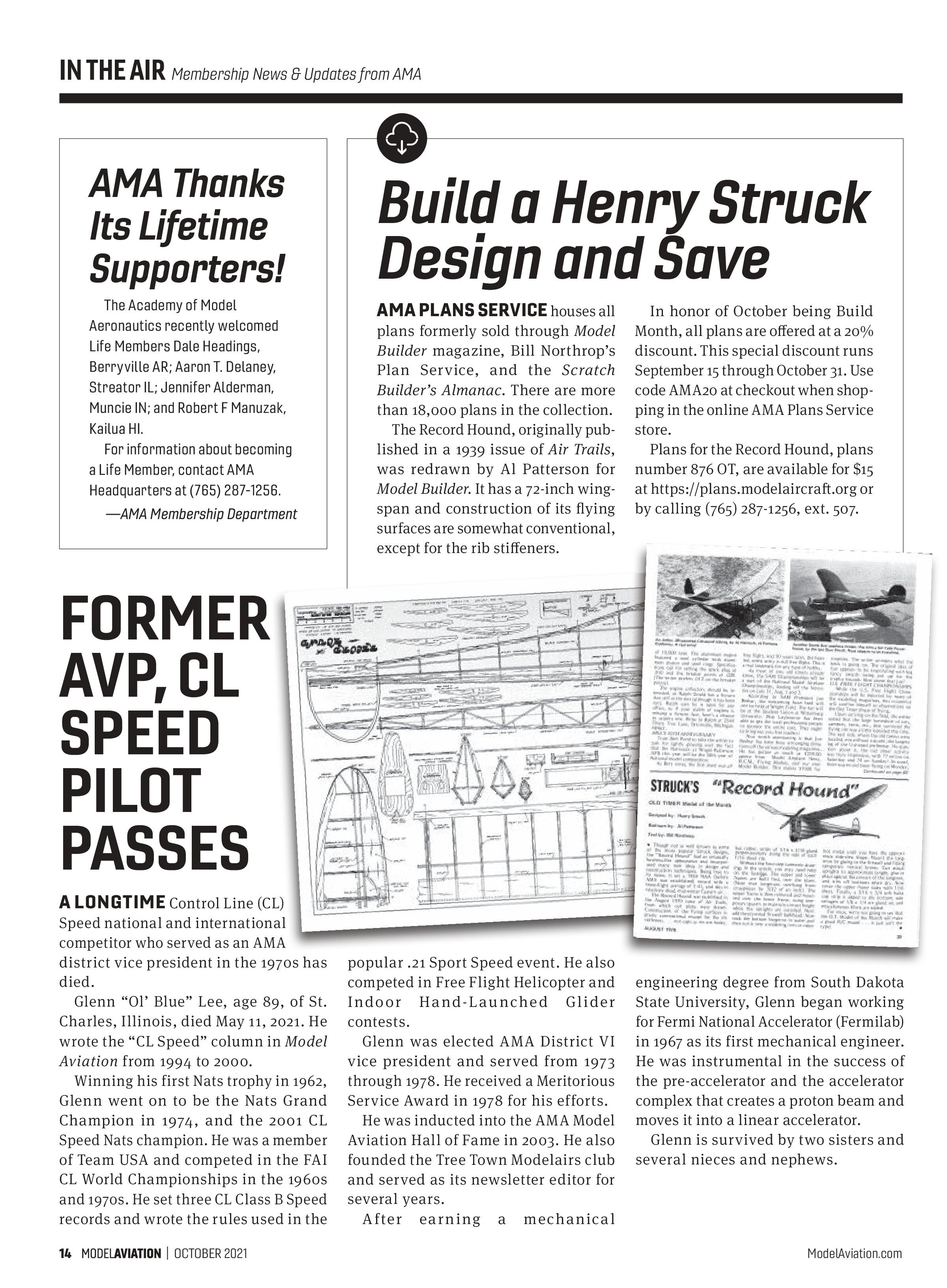
The Record Hound, originally published in a 1939 issue of Air Trails, was redrawn by Al Patterson for Model Builder. It has a 72-inch wingspan and construction of its flying surfaces are somewhat conventional, except for the rib stiffeners.
In honor of October being Build Month, all plans are offered at a 20% discount. This special discount runs September 15 through October 31. Use code AMA20 at checkout when shopping in the online AMA Plans Service store.
Plans for the Record Hound, plans number 876 OT, are available for $15 at https://plans.modelaircraft.org or by calling (765) 287-1256, ext. 507.

Former AVP, CL Speed Pilot Passes
A LONGTIME Control Line (CL) Speed national and international competitor who served as an AMA district vice president in the 1970s has died.
Glenn “O1’ Blue” Lee, age 89, of St. Charles, Illinois, died May 11, 2021. He wrote the “CL Speed” column in Model Aviation from 1994 to 2000.
Winning his first Nats trophy in 1962, Glenn went on to be the Nats Grand Champion in 1974, and the 2001 CL Speed Nats champion. He was a member of Team USA and competed in the FAI CL World Championships in the 1960s and 1970s. He set three CL Class B Speed records and wrote the rules used in the popular .21 Sport Speed event. He also competed in Free Flight Helicopter and Indoor Hand-Launched Glider contests.
Glenn was elected AMA District VI vice president and served from 1973 through 1978. He received a Meritorious Service Award in 1978 for his efforts.
He was inducted into the AMA Model Aviation Hall of Fame in 2003. He also founded the Tree Town Modelairs club and served as its newsletter editor for several years.
After earning a mechanical engineering degree from South Dakota State University, Glenn began working for Fermi National Accelerator (Fermilab) in 1967 as its first mechanical engineer. He was instrumental in the success of the pre-accelerator and the accelerator complex that creates a proton beam and moves it into a linear accelerator.
Glenn is survived by two sisters and several nieces and nephews.
New Member Benefit Offered
BEING AN AMA MEMBER comes with many benefits. The more commonly known benefits include having $2.5 million in personal liability insurance, receiving this monthly publication, and the ability to fly at thousands of AMA Chartered Club flying sites across the country. Your AMA membership comes with other perks of which you might not be aware, such as discounts on car rental, concert tickets, and more.
AMA is continually working to find even more great benefits for its members. The newest benefit, introduced in August, is TechProtect. This program provides replacement protection plans for items such as cellphones, computers, laptops, and televisions at a discounted monthly rate. AMA members can choose between two low-cost monthly plans.
To learn more about TechProtect, visit https://try.mytechprotect.com/ama/. To access other AMA member benefits, go to www.modelaircraft.org/membership/benefits/exclusive-offers and log in with your membership credentials.

Aeromodeling Author Passes
A FORMER COLUMNIST for Flying Models magazine, who also wrote several construction and event articles for Model Aviation and Park Pilot magazines, has passed away.
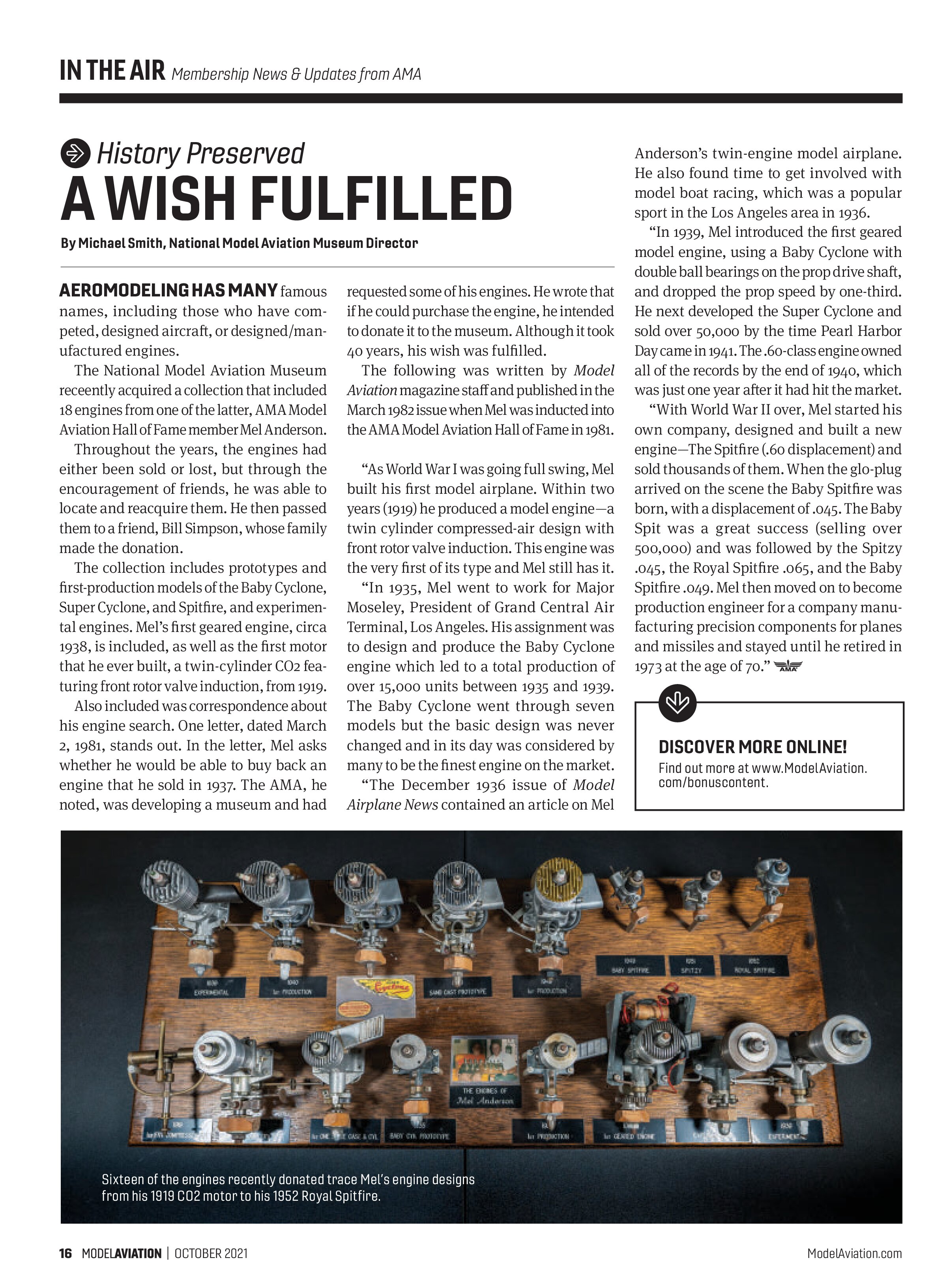
Larry Kruse, 77, died August 2, 2021, after a battle with cancer. He wrote the “Free Flight Sport” column in Flying Models from 1982 to 2013. More than 50 of his model airplane designs were published in Flying Models, Model Aviation, Model Airplane News, and Park Pilot. His most recent published designs included the RM-1 Supersonic Fighter, which appeared in the May 2020 issue of Model Aviation, and the May Bee, featured in the Winter 2020 issue of Park Pilot.
In addition to construction articles, Larry attended and covered aeromodeling events, such as Warbirds Over Texas and the AMA Nats. In his AMA History Project autobiography, he estimated that he had written more than 800 articles, which also included kit and product reviews and building tips.
He was inducted into the AMA Model Aviation Hall of Fame in 2014, the Flying Aces Club Hall of Fame in 2010, and the National Free Flight Society Hall of Fame in 2005. Throughout his life, Free Flight was his passion.
Larry began building, flying, and designing aircraft as a child. He also competed in the Nats.
Professionally, he worked as an educator, serving first as a high school teacher at Triplains High School in Winona, Kansas, and then as one of the first faculty members at Barton County Community College in Great Bend, Kansas. He later became the dean of Student Services at Seward County Community College from 1974 until 1991. During his 40-year career in education, he held leadership positions in several organizations.
Larry is survived by his wife, Cecelia; a brother, Terry Kruse; seven children; eight grandchildren; and 13 great-grandchildren.

AEROMODELING HAS MANY famous names, including those who have competed, designed aircraft, or designed/manufactured engines.
The National Model Aviation Museum recently acquired a collection that included 18 engines from one of the latter, AMA Model Aviation Hall of Fame member Mel Anderson.
Throughout the years, the engines had either been sold or lost, but through the encouragement of friends, he was able to locate and reacquire them. He then passed them to a friend, Bill Simpson, whose family made the donation.
The collection includes prototypes and first-production models of the Baby Cyclone, Super Cyclone, and Spitfire, and experimental engines. Mel’s first geared engine, circa 1938, is included, as well as the first motor that he ever built, a twin-cylinder CO2 featuring front rotor valve induction, from 1919.
Also included was correspondence about his engine search. One letter, dated March 2, 1981, stands out. In the letter, Mel asks whether he would be able to buy back an engine that he sold in 1937. The AMA, he noted, was developing a museum and had requested some of his engines. He wrote that if he could purchase the engine, he intended to donate it to the museum. Although it took 40 years, his wish was fulfilled.
The following was written by Model Aviation magazine staff and published in the March 1982 issue when Mel was inducted into the AMA Model Aviation Hall of Fame in 1981.
“As World War I was going full swing, Mel built his first model airplane. Within two years (1919) he produced a model engine—a twin cylinder compressed-air design with front rotor valve induction. This engine was the very first of its type and Mel still has it.
“In 1935, Mel went to work for Major Moseley, President of Grand Central Air Terminal, Los Angeles. His assignment was to design and produce the Baby Cyclone engine which led to a total production of over 15,000 units between 1935 and 1939. The Baby Cyclone went through seven models but the basic design was never changed and in its day was considered by many to be the finest engine on the market.
“The December 1936 issue of Model Airplane News contained an article on Mel Anderson’s twin-engine model airplane. He also found time to get involved with model boat racing, which was a popular sport in the Los Angeles area in 1936.
“In 1939, Mel introduced the first geared model engine, using a Baby Cyclone with double ball bearings on the prop drive shaft, and dropped the prop speed by one-third. He next developed the Super Cyclone and sold over 50,000 by the time Pearl Harbor Day came in 1941. The .60-class engine owned all of the records by the end of 1940, which was just one year after it had hit the market.
“With World War II over, Mel started his own company, designed and built a new engine—The Spitfire (.60 displacement) and sold thousands of them. When the glo-plug arrived on the scene the Baby Spitfire was born, with a displacement of .045. The Baby Spit was a great success (selling over 500,000) and was followed by the Spitzy .045, the Royal Spitfire .065, and the Baby Spitfire .049. Mel then moved on to become production engineer for a company manufacturing precision components for planes and missiles and stayed until he retired in 1973 at the age of 70.”