VINTAGE VIEWPOINT

JUNE 1971
By Bob Noll | bobrc@aol.com
I APPRECIATE THE EMAILS I receive from readers who tell me how they enjoy my column and that it brings back some great memories. Many of these emails are from readers who were just getting into the hobby 50 years ago, and some who had been flying longer than that, or are from dads who enjoyed the hobby with their sons.
Once again, I’ll look back 50 years ago, and my first stop will be with Flying Models (FM). Don McGovern, the editor of FM, always had some interesting comments in his “From the COCKPIT” sidebar in the front of each issue. Please let me share what Don wrote in the June 1971 issue:
“One of the great wonders of modeling is that it goes so well with the vagaries of weather and the changing seasons. When the air is calm and warm, it is a day for testing. Boiling thermals and blue skies herald the contest day, a rainy afternoon is for the workbench and the long and stormy winter gives time to build dreamships.
“As winter draws to an end, the shows begin. Toledo in the mid-west, The WRAM’s in the east, and others on the coast. Modelers trek from far and near with their new ships for the season. 8,500 souls at Toledo! It grows bigger by the year. As we go to press with this issue, we’ve just returned from the WRAM’s show in the New York area. It takes a full two days to drink them in with the eyes and mind and even then you’ve missed the details.
“And when it’s time for a cup of coffee with a friend or two, you ponder the new breed of aircraft that lie glistening upon the tables. Beautiful birds to challenge the sky. Some will fail and others will fly, records will fall and the incredible will be achieved. The state of the art is a fluid frontier which modelers force to a higher plateau with the gaining of skills and knowledge.”
As I wrote this, I felt sorry for those who entered this great hobby in later years and did not have the opportunity to enjoy and participate in the progress and the excitement that took place at that time.
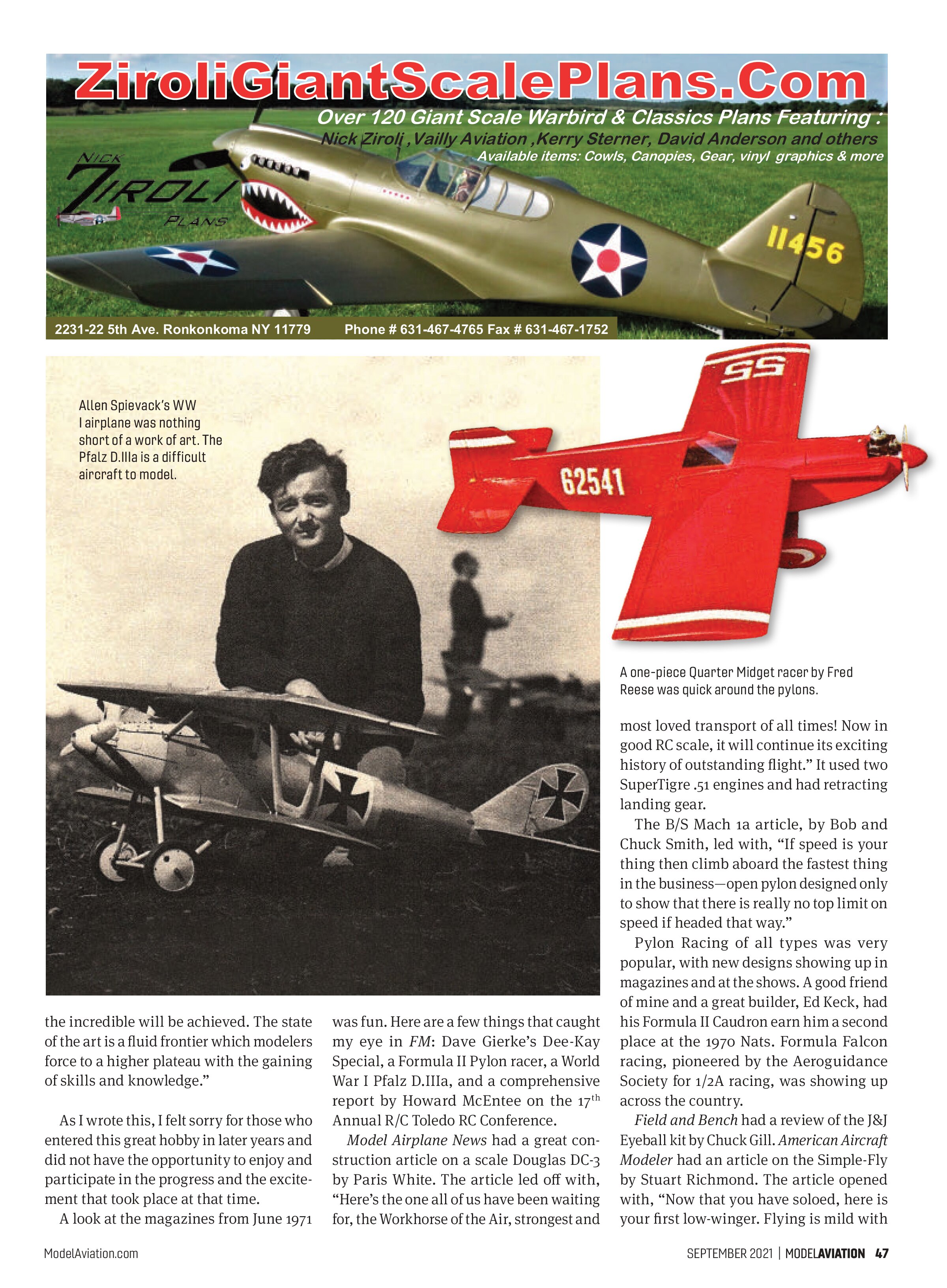
A look at the magazines from June 1971 was fun. Here are a few things that caught my eye in FM: Dave Gierke’s Dee-Kay Special, a Formula II Pylon racer, a World War I Pfalz D.IIIa, and a comprehensive report by Howard McEntee on the 17th Annual R/C Toledo RC Conference.
Model Airplane News had a great construction article on a scale Douglas DC-3 by Paris White. The article led off with, “Here’s the one all of us have been waiting for, the Workhorse of the Air, strongest and most loved transport of all times! Now in good RC scale, it will continue its exciting history of outstanding flight.” It used two SuperTigre .51 engines and had retracting landing gear.
The B/S Mach 1a article, by Bob and Chuck Smith, led with, “If speed is your thing then climb aboard the fastest thing in the business—open pylon designed only to show that there is really no top limit on speed if headed that way.”
Pylon Racing of all types was very popular, with new designs showing up in magazines and at the shows. A good friend of mine and a great builder, Ed Keck, had his Formula II Caudron earn him a second place at the 1970 Nats. Formula Falcon racing, pioneered by the Aeroguidance Society for 1/2A racing, was showing up across the country.
Field and Bench had a review of the J&J Eyeball kit by Chuck Gill. American Aircraft Modeler had an article on the Simple-Fly by Stuart Richmond. The article opened with, “Now that you have soloed, here is your first low-winger. Flying is mild with


a .29 but wild and fun with a .45.”
Radio Control Modeler’s (RCM) “Kits & Pieces” column by Dick Kidd featured the Hot Line Models Mooney Chaparral. The model was designed for .60-size engines and to be fully aerobatic while retaining the appearance of the full-scale aircraft.
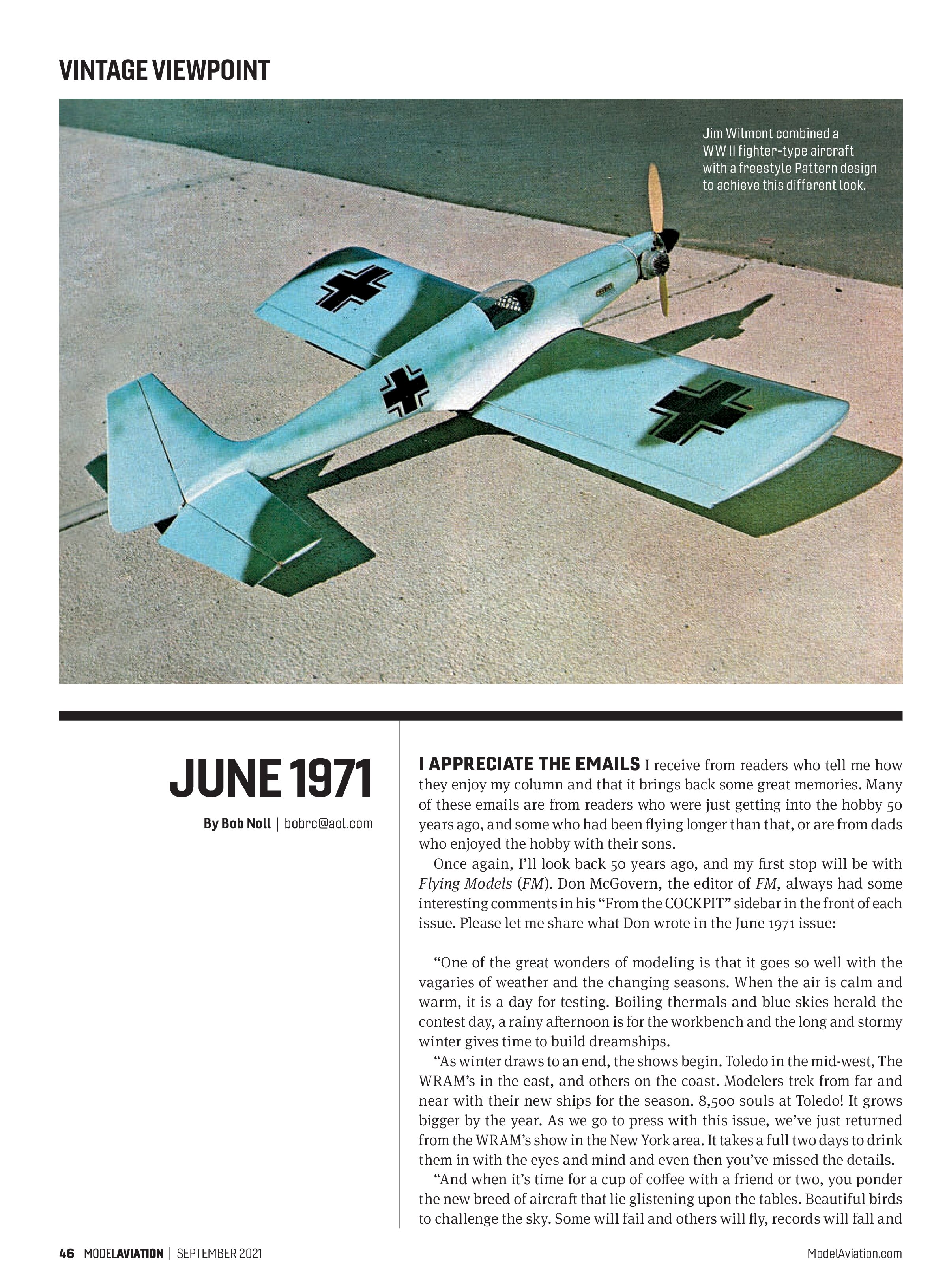
The Pegasus Mk4, by Jim Wilmot, led with, “Tired of aircraft that look like glorified baseball bats? The Pegasus combines a WW II fighter type look with conventional and freestyle pattern performance that will challenge your ability. 50 [inch] span, four pound weight, .40 to .60 engines. For the proficient only.”
Fred Reese had an article about his Cassutt Special, a nice-looking Quarter Midget racer for the RCM Quarter Midget event. The Cassutt was a one-piece, O.S. .15 engine-powered, midwing racer that was as quick around the pylons as it was to build.
Mike Dailey wrote about his Cold Duck: “Cold Duck is a sport pattern design, conceived to take full advantage of retract gear. I have tried to keep the fuselage as streamlined as possible, without sacrificing space for the radio control gear and engine.”
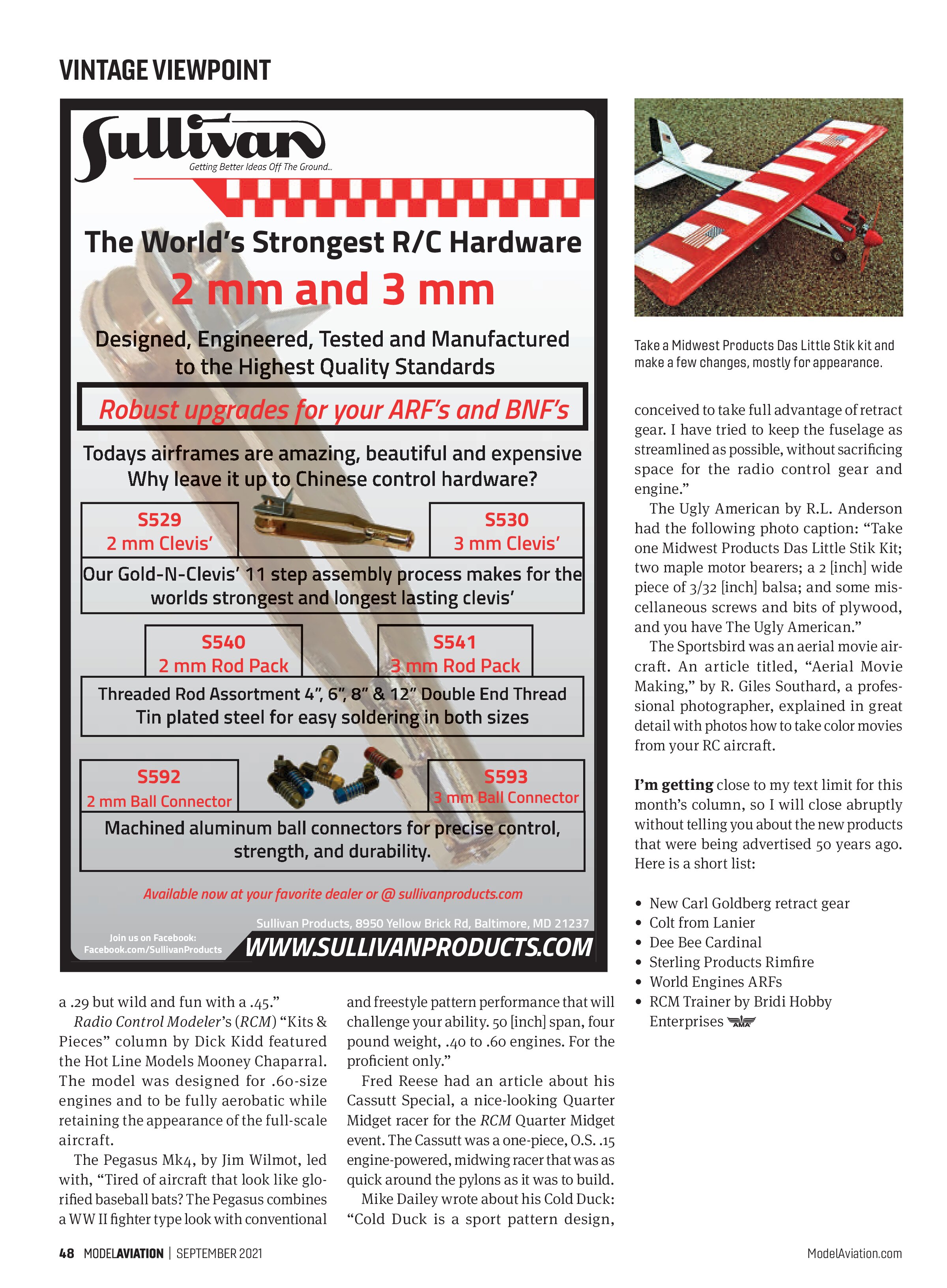
The Ugly American by R.L. Anderson had the following photo caption: “Take one Midwest Products Das Little Stik Kit; two maple motor bearers; a 2 [inch] wide piece of 3/32 [inch] balsa; and some miscellaneous screws and bits of plywood, and you have The Ugly American.”

The Sportsbird was an aerial movie aircraft. An article titled, “Aerial Movie Making,” by R. Giles Southard, a professional photographer, explained in great detail with photos how to take color movies from your RC aircraft.
I’m getting close to my text limit for this month’s column, so I will close abruptly without telling you about the new products that were being advertised 50 years ago. Here is a short list:
- New Carl Goldberg retract gear
- Colt from Lanier
- Dee Bee Cardinal
- Sterling Products Rimfire
- World Engines ARFs
- RCM Trainer by Bridi Hobby Enterprises