CEREAL BOX MODELS
TO AWARD-WINNING
AIRCRAFT
Photos provided by Ron Peterka | ron3180x@gmail.com

RON PETERKA began modeling during World War II, building cardboard warplanes that were printed on cereal boxes and used a penny glued on the nose for balance weight to “fly” across a room. Model building became a lifelong obsession.
As a preteen, he and his friends flew 1/2A Free Flight (FF) and small 1/2A Control Line models sold by Jim Walker. “We were stunned one day when Mr. Walker drove by the vacant lot where we were flying and noticed us,” he wrote. “He was kind enough to stop and gave each of us a new Firebaby model. We were thrilled.” Ron’s mother would drive them to a FF field near what is now the Los Angeles International Airport or to the Sepulveda Basin to fly.
Ron, with little electronic skills, tried to become an RC pilot, eventually building a Rudder Bug single-channel RC model. It was too heavy, carried a tube-type receiver, and used a rubber band-driven servo for rudder control. The model never flew and the radio never worked, so he went back to rubber-powered models.
His first operable radio was an Orbit three-channel proportional model. He built several aircraft well beyond his flying skills, and most flights were controlled only to the extent that they crashed somewhere other than where they would have crashed if they were not RC. It took a nice, slow RC glider to get consistent, controlled flights and he built and enjoyed several.
A wife and three children came along, then the Korean War and Vietnam. The president declined to draft fathers, and Ron missed a military career, instead earning a private pilot’s license. He eventually logged a little more than 2,000 hours.
Ron developed an interest in Scale aircraft and he and a friend collaborated on a 1/2A FF Scale model of a Bücker Bü Jungmeister that was published in Model Airplane News. It was Ron’s first time being published.
In 1991, he retired, moved to the San Diego area, and began volunteering in the San Diego Air & Space Museum’s model shop. He became the senior modeler at the museum and was awarded a 25-year pin.
In 1999, Ron accepted a product review assignment from Radio Control Modeler for a new Giant Scale Stinson gull wing aircraft kit, and the finished model was published on the magazine’s cover. That model is still airworthy after more than 500 flights and three major crashes. In 2008, it won National Champion in Team Scale at the U.S. Scale Masters Association Championships in Florida. Ron’s friend, Curtis, was the pilot for the competition flights.
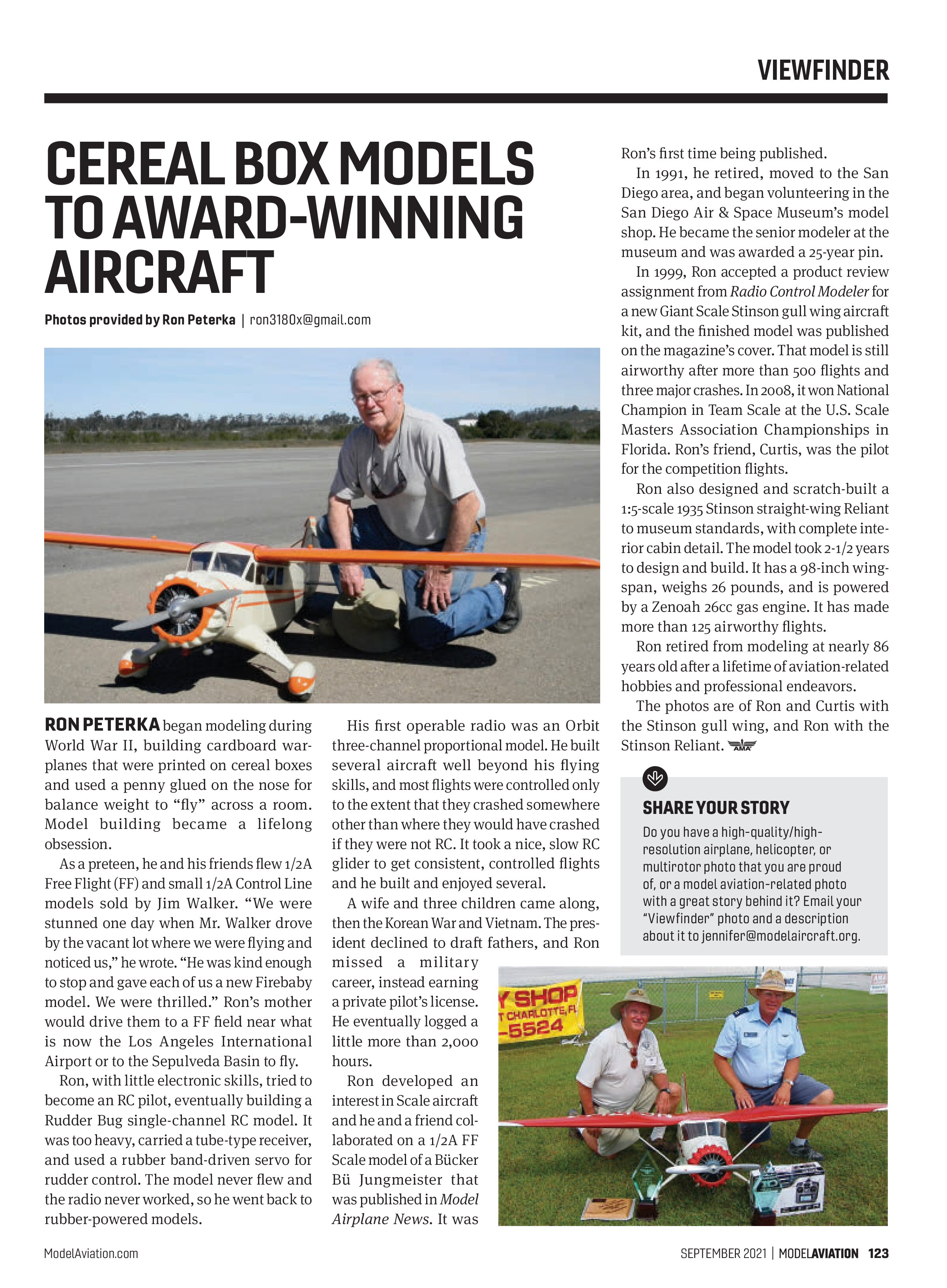
Ron also designed and scratch-built a 1:5-scale 1935 Stinson straight-wing Reliant to museum standards, with complete interior cabin detail. The model took 2-1/2 years to design and build. It has a 98-inch wingspan, weighs 26 pounds, and is powered by a Zenoah 26cc gas engine. It has made more than 125 airworthy flights.
Ron retired from modeling at nearly 86 years old after a lifetime of aviation-related hobbies and professional endeavors.
The photos are of Ron and Curtis with the Stinson gull wing, and Ron with the Stinson Reliant.