RC PYLON RACING
By Tim Lampe | tim.lampe@hotmail.com

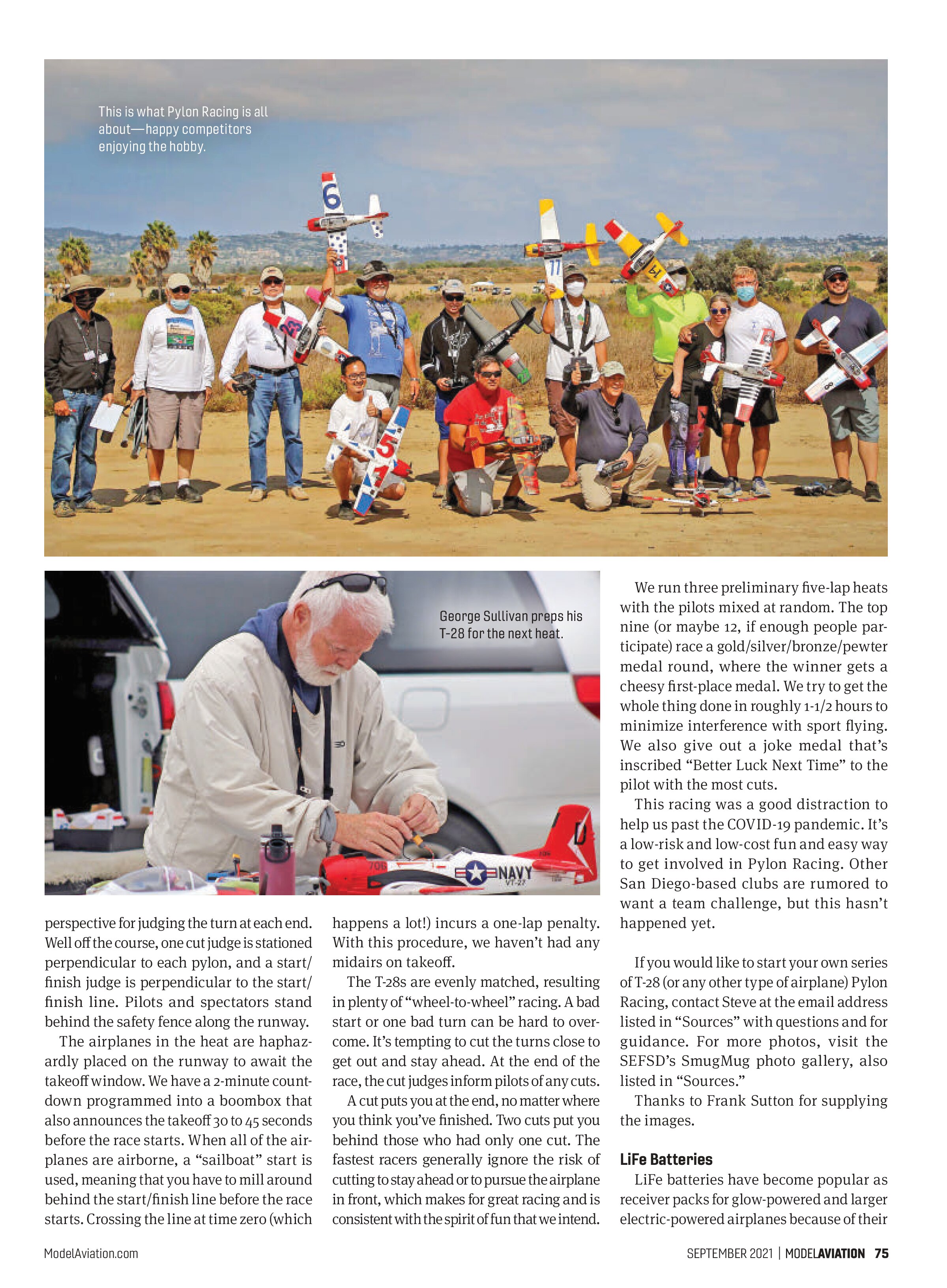
PYLON RACING ISN’T ALWAYS ABOUT lightning-fast speeds and composite airframes made of high-tech materials, but Pylon Racing is always about head-to-head competition with several airplanes simultaneously on the course. Anytime you’re racing, that’s where the excitement comes in, and this certainly applies to the monthly T-28 race series at the Silent Electric Flyers of San Diego (SEFSD) RC club in California. Competitor Steve Manganelli described it as follows:
In our most recent T-28-series race, each class was won by the only pilot not to receive a did-not-finish (DNF) score or the pilot with the fewest cuts, regardless of being two laps behind in a 10-lap race. (I topped the bronze class, even with two cuts!)
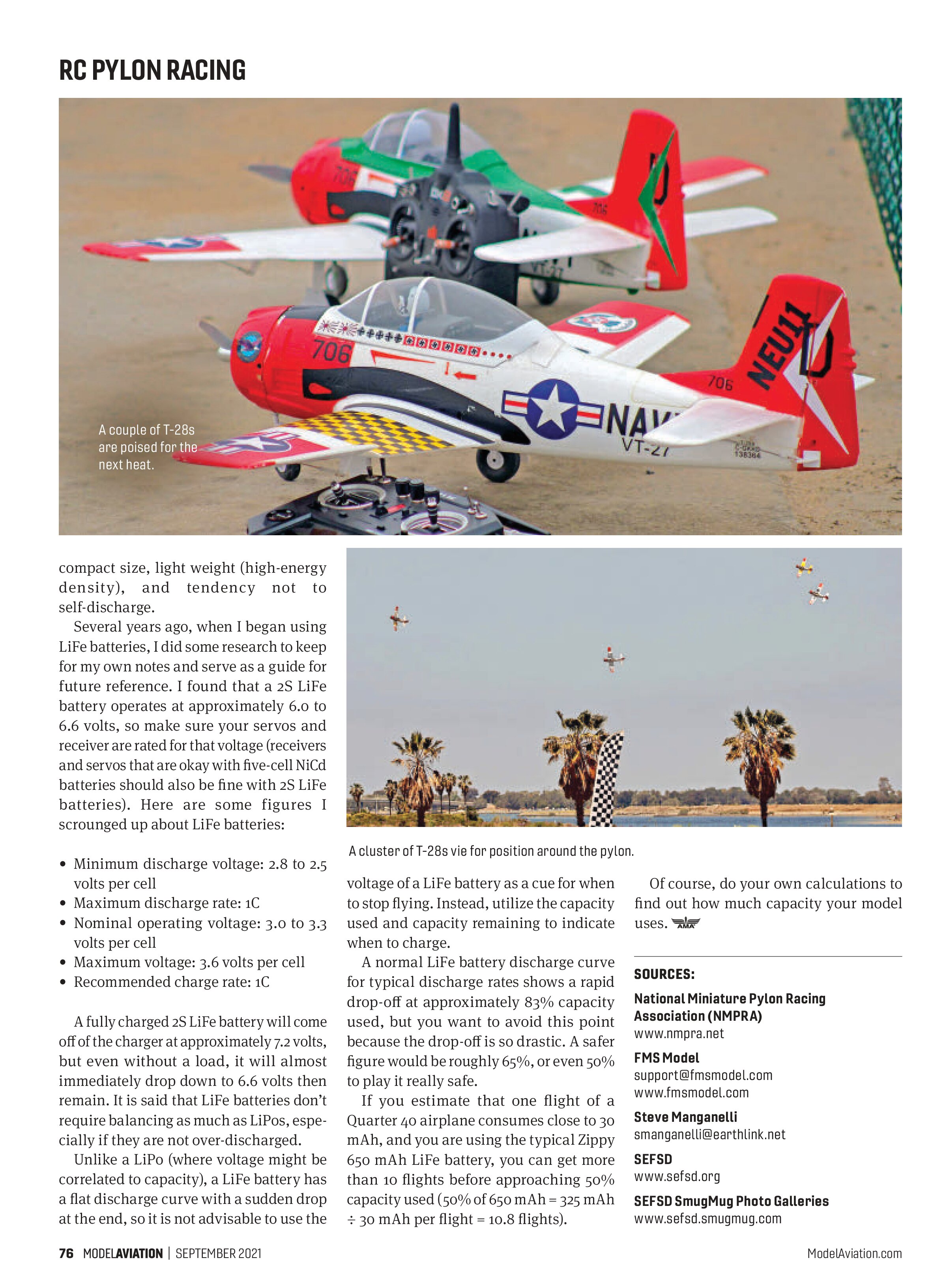
T-28 racing is an exciting and easy way to get involved in Pylon Racing with little commitment. These all-foam, 800mm (31-1/2-inch) FMS Model T-28 ARFs can be had for approximately $110. Just add your own four-channel receiver and up to a 1,300 mAh 2S or 3S LiPo battery and you’re good to go racing.
The stock power setup is 2S, but most of us run 3S batteries. The T-28 doesn’t seem to mind, and being slightly nose-heavy helps with stability. Rules also allow the stock 7 x 6 three-blade propeller to be replaced with an APC 7 x 6E propeller, which has proven to be more durable.
Pilots are assigned racing numbers and encouraged to decorate their T-28s in a manner that makes them more distinguishable. We use a roughly 300-foot two-pylon course that is marked out parallel with approximately 50 feet beyond the runway. The start/finish line is in the middle, allowing pilots an equal


perspective for judging the turn at each end. Well off the course, one cut judge is stationed perpendicular to each pylon, and a start/finish judge is perpendicular to the start/finish line. Pilots and spectators stand behind the safety fence along the runway.
The airplanes in the heat are haphazardly placed on the runway to await the takeoff window. We have a 2-minute countdown programmed into a boombox that also announces the takeoff 30 to 45 seconds before the race starts. When all of the airplanes are airborne, a “sailboat” start is used, meaning that you have to mill around behind the start/finish line before the race starts. Crossing the line at time zero (which
happens a lot!) incurs a one-lap penalty. With this procedure, we haven’t had any midairs on takeoff.
The T-28s are evenly matched, resulting in plenty of “wheel-to-wheel” racing. A bad start or one bad turn can be hard to overcome. It’s tempting to cut the turns close to get out and stay ahead. At the end of the race, the cut judges inform pilots of any cuts.
A cut puts you at the end, no matter where you think you’ve finished. Two cuts put you behind those who had only one cut. The fastest racers generally ignore the risk of cutting to stay ahead or to pursue the airplane in front, which makes for great racing and is consistent with the spirit of fun that we intend.
We run three preliminary five-lap heats with the pilots mixed at random. The top nine (or maybe 12, if enough people participate) race a gold/silver/bronze/pewter medal round, where the winner gets a cheesy first-place medal. We try to get the whole thing done in roughly 1-1/2 hours to minimize interference with sport flying. We also give out a joke medal that’s inscribed “Better Luck Next Time” to the pilot with the most cuts.
This racing was a good distraction to help us past the COVID-19 pandemic. It’s a low-risk and low-cost fun and easy way to get involved in Pylon Racing. Other San Diego-based clubs are rumored to want a team challenge, but this hasn’t happened yet.
If you would like to start your own series of T-28 (or any other type of airplane) Pylon Racing, contact Steve at the email address listed in “Sources” with questions and for guidance. For more photos, visit the SEFSD’s SmugMug photo gallery, also listed in “Sources.”
Thanks to Frank Sutton for supplying the images.
compact size, light weight (high-energy density), and tendency not to self-discharge.
Several years ago, when I began using LiFe batteries, I did some research to keep for my own notes and serve as a guide for future reference. I found that a 2S LiFe battery operates at approximately 6.0 to 6.6 volts, so make sure your servos and receiver are rated for that voltage (receivers and servos that are okay with five-cell NiCd batteries should also be fine with 2S LiFe batteries). Here are some figures I scrounged up about LiFe batteries:
- Minimum discharge voltage: 2.8 to 2.5 volts per cell
- Maximum discharging rate: 1C
- Nominal operating voltage: 3.0 to 3.3 volts per cell
- Maximum voltage: 3.6 volts per cell
- Recommended charge rate: 1C
A fully charged 2S LiFe battery will come off of the charger at approximately 7.2 volts, but even without a load, it will almost immediately drop down to 6.6 volts then remain. It is said that LiFe batteries don’t require balancing as much as LiPos, especially if they are not over-discharged.
Unlike a LiPo (where voltage might be correlated to capacity), a LiFe battery has a flat discharge curve with a sudden drop at the end, so it is not advisable to use the

voltage of a LiFe battery as a cue for when to stop flying. Instead, utilize the capacity used and capacity remaining to indicate when to charge.
A normal LiFe battery discharge curve for typical discharge rates shows a rapid drop-off at approximately 83% capacity used, but you want to avoid this point because the drop-off is so drastic. A safer figure would be roughly 65%, or even 50% to play it really safe.
If you estimate that one flight of a Quarter 40 airplane consumes close to 30 mAh, and you are using the typical Zippy 650 mAh LiFe battery, you can get more than 10 flights before approaching 50% capacity used (50% of 650 mAh = 325 mAh ÷ 30 mAh per flight = 10.8 flights).
Of course, do your own calculations to find out how much capacity your model uses.
SOURCES:
National Miniature Pylon Racing Association (NMPRA)
www.nmpra.net
FMS Model
support@fmsmodel.com
www.fmsmodel.com
Steve Manganelli
smanganelli@earthlink.net
SEFSD
www.sefsd.org
SEFSD SmugMug Photo Galleries
www.sefsd.smugmug.com