SCALE JETS
By Jim Hiller | jetmodeler@earthlink.net
SCALE MODELS CAPTURE OUR IMAGINATION and our hearts, and so it goes with scale jets. Let’s not limit ourselves with finances, but instead follow our dreams and look at some special RC model aircraft.
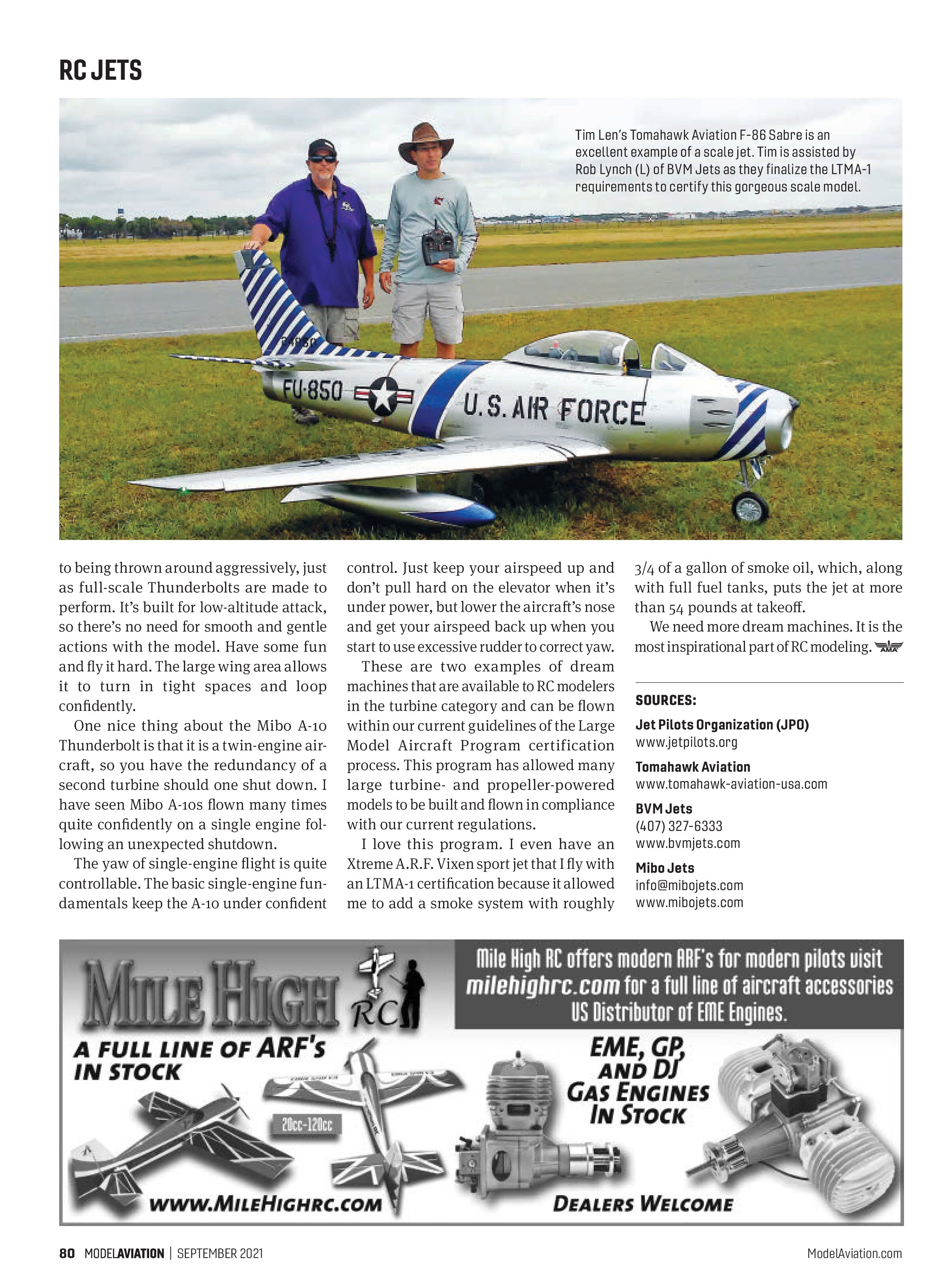
The first scale jet that caught my eye is Tim Len’s Tomahawk Aviation F-86 Sabre. It’s a gorgeous example of a large-scale jet at 122 inches in length with a 118-inch wingspan. Combine that with the F-86’s tall fin height, and its presence is huge.
This is a Large Turbine Model Aircraft (LTMA)-class airplane that typically fits into the LTMA-1 category for aircraft that weigh more than 54 pounds with fuel. Tomahawk recommends the power to be only a 200 newton-class turbine. Scale flying is this jet’s strength. Tim’s example does the F-86 proud. It was an award winner at Florida Jets 2021.
The Tomahawk Sabre started as a large-scale, lightweight fiberglass kit. It was built, systems were installed, and it was finally painted. This was a traditional build of a composite airframe. Time has moved on and the Tomahawk F-86 has matured into a full ARF airframe. It is distributed in the US by Bob Violett Models (BVM Jets).
The really cool thing with this aircraft is the available build services from BVM. The company will complete the Sabre to your desired level of completion, with options that go all the way up to the test flight if you so desire. This supreme service by skilled, top-quality builders can provide you with your ultimate dream machine.
The F-86’s flight is incredible. It’s a great-flying machine that is the right weight for its size, so it truly replicates the appearance of a full-scale F-86 in flight. Its aerobatic capabilities allow a full range of flight maneuvers to be flown smoothly with precision. It’s a quality warbird yet, as seen by other examples and pilots, it can be thrashed around like an aerobatic sport airplane. It’s unreal to see an F-86 doing a slow knife-edge pass just feet off the ground, but it does it well.
The F-86 can be landed slowly with its nose high. On the landing rollout, the nose wheel can be held off the ground to use aerodynamic drag to slow the jet down before setting the nose wheel down and applying the brakes. Many full-scale F-86s land with the nose wheel up to save wear and tear on the brakes and tires. Such landings are just beautiful; it’s more of a perfected dance sequence.
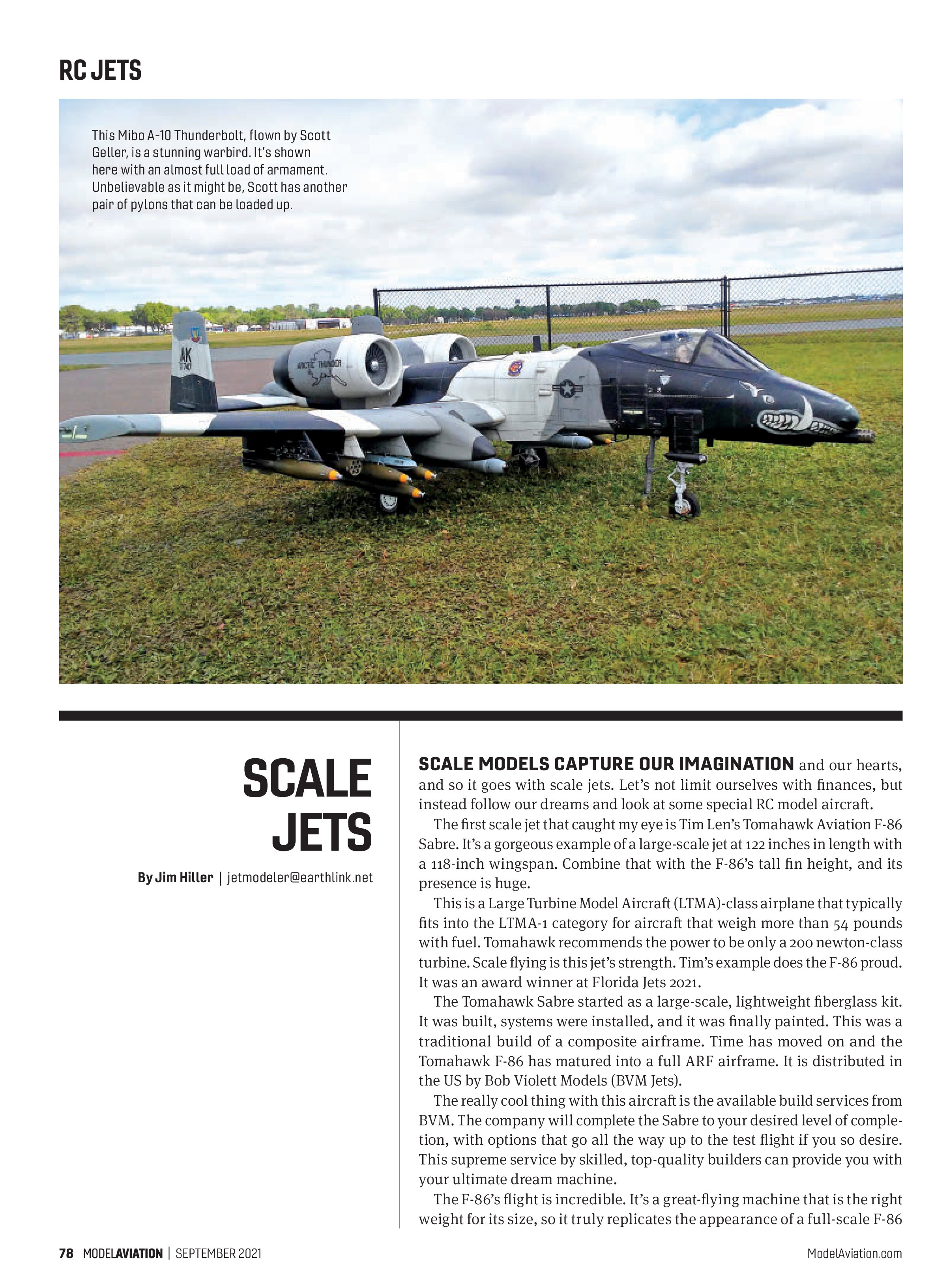
The next dream jet on this list is Scott Geller’s Mibo Jets A-10 Thunderbolt. This scale model also captured some well-earned awards at Florida Jets 2021. Scott has not simply duplicated an A-10 in detail, he flies it like a true warbird should be flown—hard and aggressive.
He has loaded up the underwing pylons with highly detailed ordnance that is fully loaded with bombs and missiles—it’s a warbird ready to launch on a mission. Complicating a scale build by loading up the pylons with detailed munitions really pulls together the true heavy-iron feeling that is portrayed by this A-10 Warthog. Very nice job, Scott.
The Mibo Jets A-10 is one of those ultimate kits for a scale aficionado. As time’s gone by, the Mibo factory has continued to develop the airframe for easier building, greater scale details, and improved durability. The company stands behind its product and has created an incredible flying machine.
The A-10 spans a hefty 118 inches, with a length of 108 inches. It’s a large airframe for sure. The typical weight of the completed jet exceeds 54 pounds when it’s loaded for takeoff, so it is typically an LTMA-1 category aircraft. Part of the responsibility of flying these dream machines is proper certification.
The A-10 accurately duplicates many items and details, although some options add to the cost of the airframe and add weight to the finished product. A couple of the attractive options include scale Fowler-type flaps and aileron decelerons.
It’s wonderful what can be done with today’s modern radios and servos when they are combined with the imagination of companies such as Mibo Jets.
Amazingly, the Warthog can be streamlined to less than 20 kg when it is built and powered consciously with minimal equipment and details. But why miss out on all of the wonderful scale finesse? Just step up into the LTMA classes that are available to us.
The A-10’s flight is realistic. It lends itself


to being thrown around aggressively, just as full-scale Thunderbolts are made to perform. It’s built for low-altitude attack, so there’s no need for smooth and gentle actions with the model. Have some fun and fly it hard. The large wing area allows it to turn in tight spaces and loop confidently.
One nice thing about the Mibo A-10 Thunderbolt is that it is a twin-engine aircraft, so you have the redundancy of a second turbine should one shut down. I have seen Mibo A-10s flown many times quite confidently on a single engine following an unexpected shutdown.
The yaw of single-engine flight is quite controllable. The basic single-engine fundamentals keep the A-10 under confident control. Just keep your airspeed up and don’t pull hard on the elevator when it’s under power, but lower the aircraft’s nose and get your airspeed back up when you start to use excessive rudder to correct yaw.
These are two examples of dream machines that are available to RC modelers in the turbine category and can be flown within our current guidelines of the Large Model Aircraft Program certification process. This program has allowed many large turbine- and propeller-powered models to be built and flown in compliance with our current regulations.
I love this program. I even have an Xtreme A.R.F. Vixen sport jet that I fly with an LTMA-1 certification because it allowed me to add a smoke system with roughly 3/4 of a gallon of smoke oil, which, along with full fuel tanks, puts the jet at more than 54 pounds at takeoff.
We need more dream machines. It is the most inspirational part of RC modeling.
SOURCES:
Jet Pilots Organization (JPO)
www.jetpilots.org
Tomahawk Aviation
www.tomahawk-aviation-usa.com
BVM Jets
(407) 327-6333
www.bvmjets.com
Mibo Jets
info@mibojets.com
www.mibojets.com