
FLYING IN AN AIR SHOW
By Joe Malinchak | joemal@echoes.net
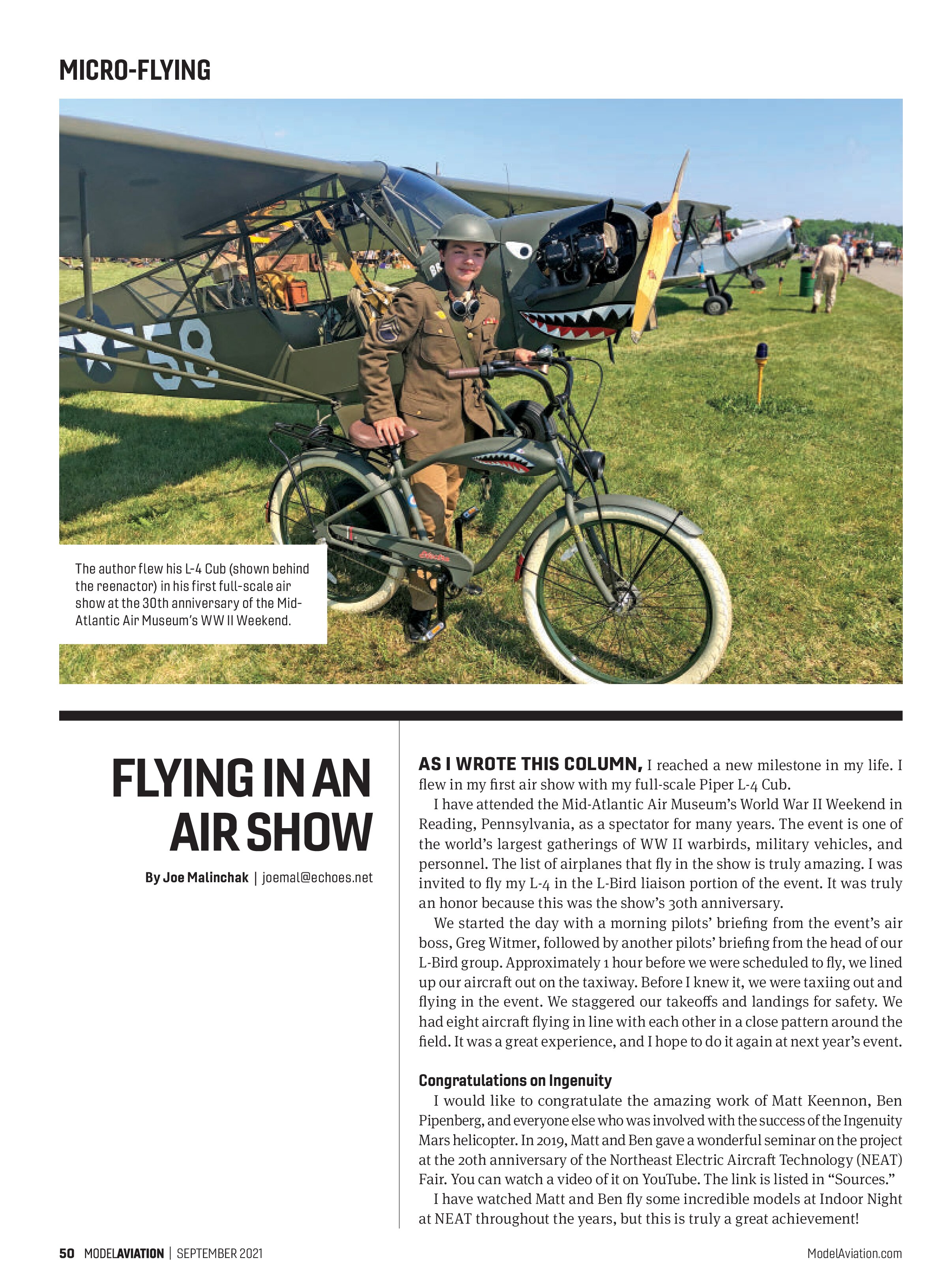
AS I WROTE THIS COLUMN, I reached a new milestone in my life. I flew in my first air show with my full-scale Piper L-4 Cub.
I have attended the Mid-Atlantic Air Museum’s World War II Weekend in Reading, Pennsylvania, as a spectator for many years. The event is one of the world’s largest gatherings of WW II warbirds, military vehicles, and personnel. The list of airplanes that fly in the show is truly amazing. I was invited to fly my L-4 in the L-Bird liaison portion of the event. It was truly an honor because this was the show’s 30th anniversary.
We started the day with a morning pilots’ briefing from the event’s air boss, Greg Witmer, followed by another pilots’ briefing from the head of our L-Bird group. Approximately 1 hour before we were scheduled to fly, we lined up our aircraft out on the taxiway. Before I knew it, we were taxiing out and flying in the event. We staggered our takeoffs and landings for safety. We had eight aircraft flying in line with each other in a close pattern around the field. It was a great experience, and I hope to do it again at next year’s event.
Congratulations on Ingenuity
I would like to congratulate the amazing work of Matt Keennon, Ben Pipenberg, and everyone else who was involved with the success of the Ingenuity Mars helicopter. In 2019, Matt and Ben gave a wonderful seminar on the project at the 20th anniversary of the Northeast Electric Aircraft Technology (NEAT) Fair. You can watch a video of it on YouTube. The link is listed in “Sources.”
I have watched Matt and Ben fly some incredible models at Indoor Night at NEAT throughout the years, but this is truly a great achievement!


Indoor Night at NEAT
Speaking of the NEAT Fair, my wife and I plan to hold Indoor Night at the NEAT event at the Downsville Central School in Downsville, New York, on September 17-18. Please see the NEAT Fair website or the Scratchbuilt Indoor and Micro Models section of RCGroups for the latest information. The event will take place from 6 to 10 p.m. on Friday, and from 5 to 10 p.m. on Saturday.
Indoor Night at NEAT is open to scratch-built models or models built from kits that weigh 2 ounces or less. Heavier models might be allowed if they can safely fly in the confines of the small gym. Micro RTF models that have been repainted or modified to show one’s creativity are also allowed to fly. AMA insurance is required, and all proceeds from the event go to the school.
286 mg Micro RC Airplane
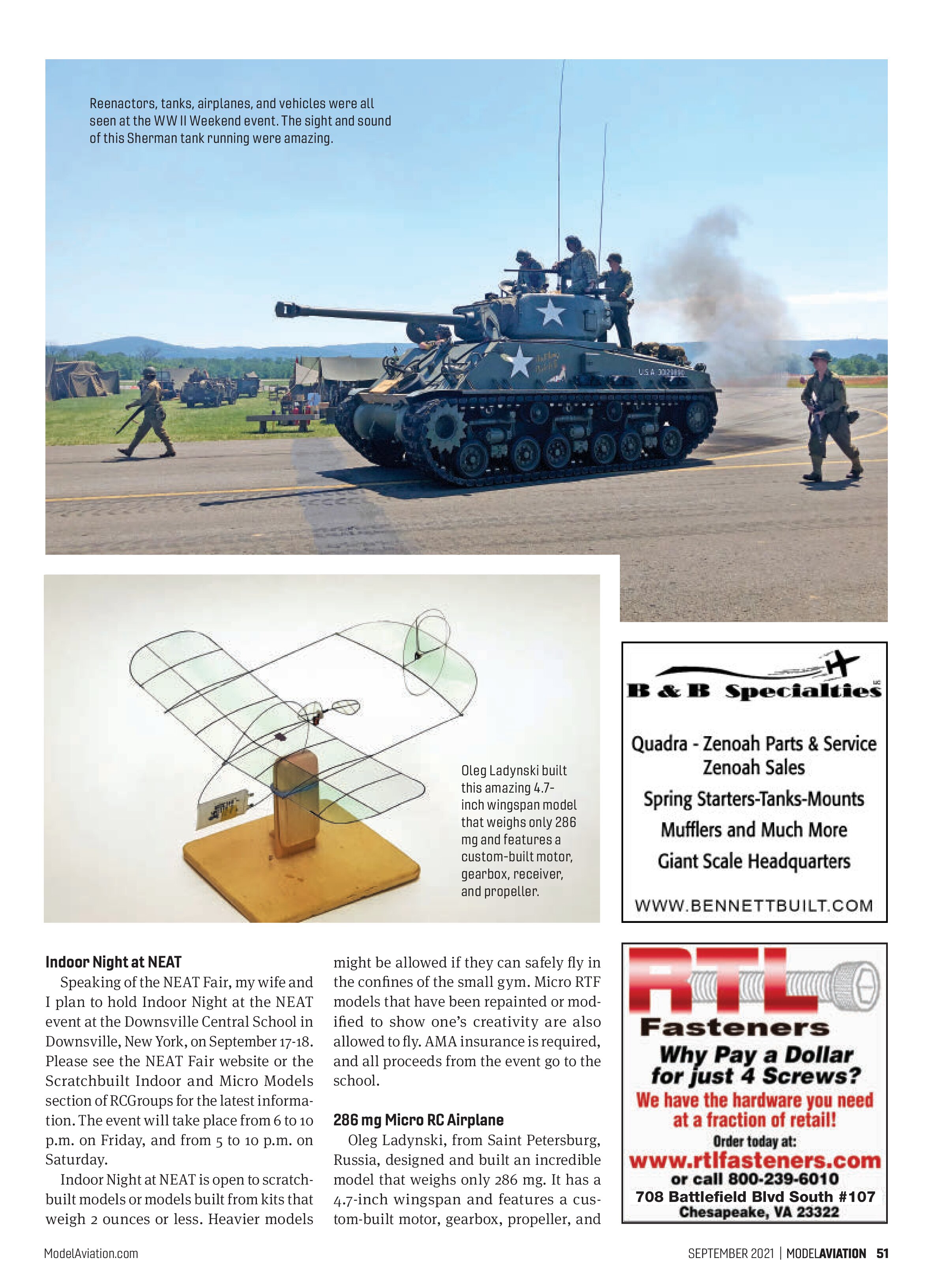
Oleg Ladynski, from Saint Petersburg, Russia, designed and built an incredible model that weighs only 286 mg. It has a 4.7-inch wingspan and features a custom-built motor, gearbox, propeller, and
receiver. The model uses a 3 mAh LiPo battery! The motor and gearbox only weigh 33 mg, and it swings a 1.4-inch propeller that puts out 300 mg of thrust.
CO2 Motors
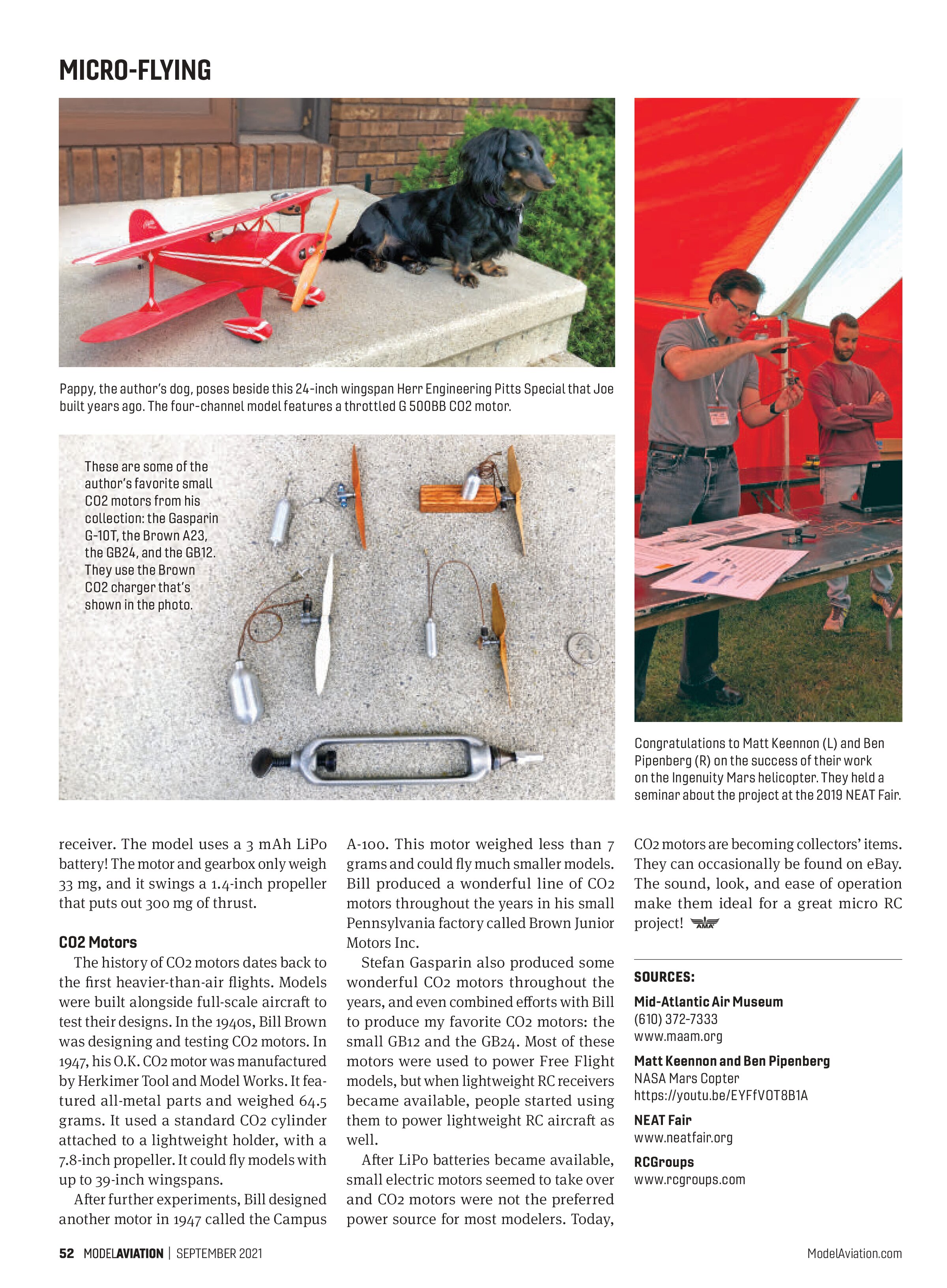
The history of CO2 motors dates back to the first heavier-than-air flights. Models were built alongside full-scale aircraft to test their designs. In the 1940s, Bill Brown was designing and testing CO2 motors. In 1947, his O.K. CO2 motor was manufactured by Herkimer Tool and Model Works. It featured all-metal parts and weighed 64.5 grams. It used a standard CO2 cylinder attached to a lightweight holder, with a 7.8-inch propeller. It could fly models with up to 39-inch wingspans.
After further experiments, Bill designed another motor in 1947 called the Campus 

A-100. This motor weighed less than 7 grams and could fly much smaller models. Bill produced a wonderful line of CO2 motors throughout the years in his small Pennsylvania factory called Brown Junior Motors Inc.
Stefan Gasparin also produced some wonderful CO2 motors throughout the years, and even combined efforts with Bill to produce my favorite CO2 motors: the small GB12 and the GB24. Most of these motors were used to power Free Flight models, but when lightweight RC receivers became available, people started using them to power lightweight RC aircraft as well.
After LiPo batteries became available, small electric motors seemed to take over and CO2 motors were not the preferred power source for most modelers. Today,
CO2 motors are becoming collectors’ items. They can occasionally be found on eBay. The sound, look, and ease of operation make them ideal for a great micro RC project!

SOURCES:
Mid-Atlantic Air Museum
(610) 372-7333
www.maam.org
Matt Keennon and Ben Pippenberg
NASA Mars Copter
https://youtu.be/EYFvOT8B1A
NEAT Fair
www.neatfair.org
RCGroups
www.rcgroups.com