INDOOR FREE FLIGHT
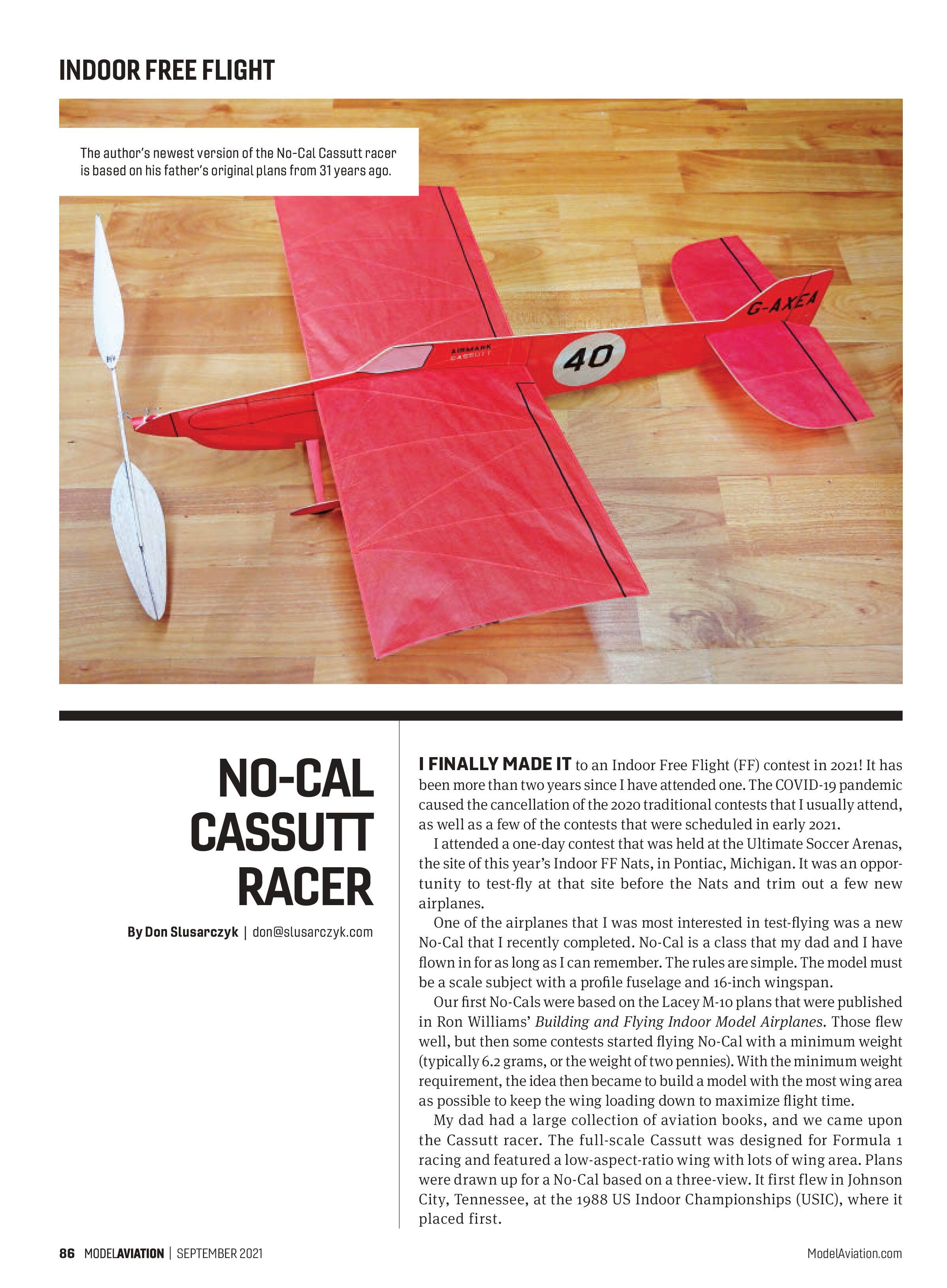
The author’s newest version of the No-Cal Cassutt racer is based on his father’s original plans from 31 years ago.

NO-CAL
CASSUTT
RACER
By Don Sluzarczyk | don@slusarczyk.com
I FINALLY MADE IT to an Indoor Free Flight (FF) contest in 2021! It has been more than two years since I have attended one. The COVID-19 pandemic caused the cancellation of the 2020 traditional contests that I usually attend, as well as a few of the contests that were scheduled in early 2021.
I attended a one-day contest that was held at the Ultimate Soccer Arenas, the site of this year’s Indoor FF Nats, in Pontiac, Michigan. It was an opportunity to test-fly at that site before the Nats and trim out a few new airplanes.
One of the airplanes that I was most interested in test-flying was a new No-Cal that I recently completed. No-Cal is a class that my dad and I have flown in for as long as I can remember. The rules are simple. The model must be a scale subject with a profile fuselage and 16-inch wingspan.
Our first No-Cals were based on the Lacey M-10 plans that were published in Ron Williams’ Building and Flying Indoor Model Airplanes. Those flew well, but then some contests started flying No-Cal with a minimum weight (typically 6.2 grams, or the weight of two pennies). With the minimum weight requirement, the idea then became to build a model with the most wing area as possible to keep the wing loading down to maximize flight time.
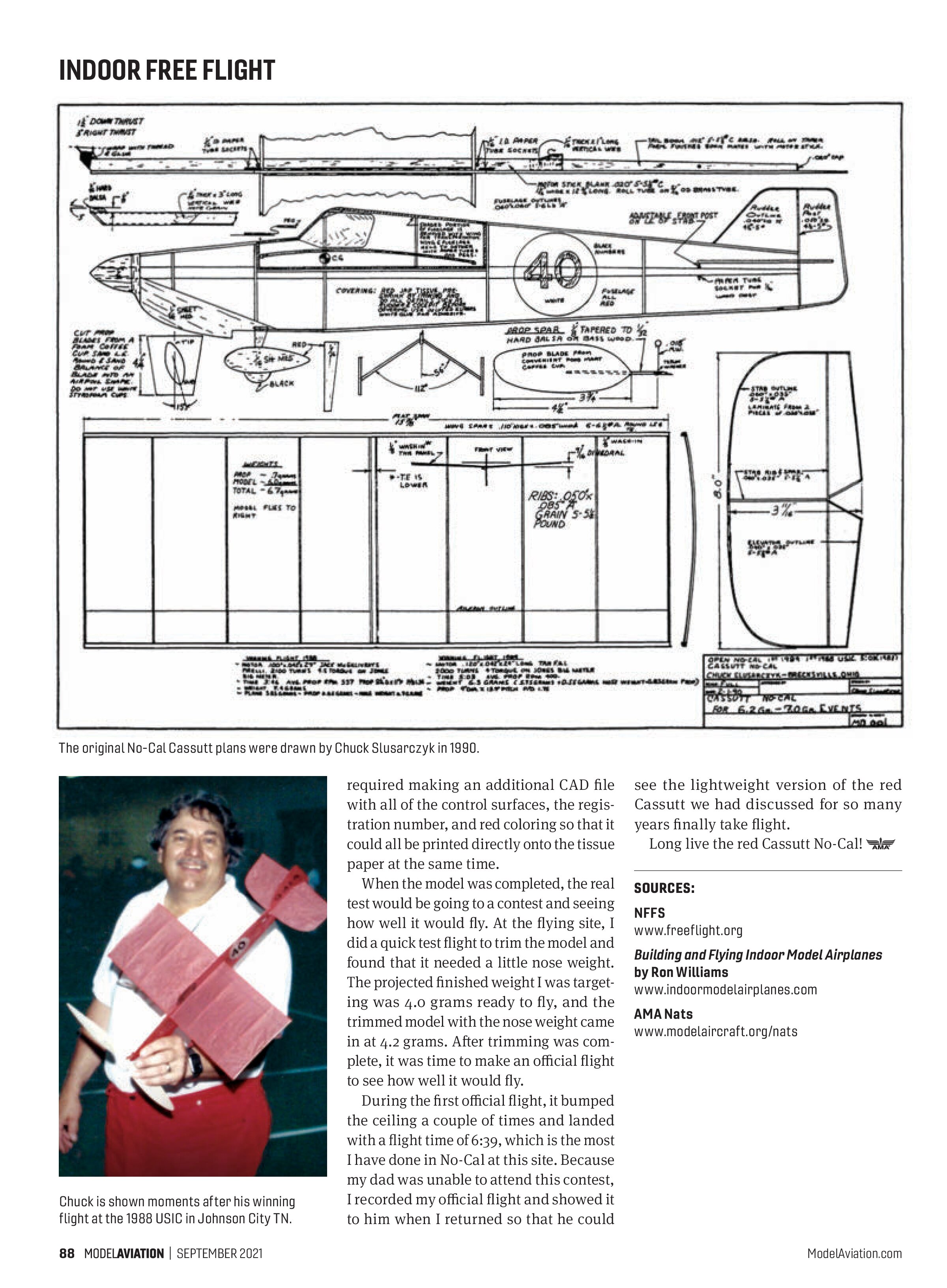
My dad had a large collection of aviation books, and we came upon the Cassutt racer. The full-scale Cassutt was designed for Formula 1 racing and featured a low-aspect-ratio wing with lots of wing area. Plans were drawn up for a No-Cal based on a three-view. It first flew in Johnson City, Tennessee, at the 1988 US Indoor Championships (USIC), where it placed first.
Several iterations were built to refine the model’s design, but they were always in a red color scheme (my dad’s favorite color). For several years, the red Cassutt was the model to beat at the USIC and plans for the model appeared in Winning Indoor Designs, which was published by the National Free Flight Society (NFFS) in 1990.
The Cassutt design eventually came in second behind a new racer called the Hosler Fury, which has an even lower aspect-ratio wing, resulting in a little more wing area than the Cassutt. The full-scale Hosler also had retractable landing gear (the Cassutt does not), so the model does not have added drag from a set of fixed gear to overcome. To remain competitive in the event, we had to switch to the Hosler because it had roughly a 20-second flight advantage in a high-ceiling area, but we always had a soft spot for the red Cassutt racers.
I am giving this history as a backstory to why I decided to build a Cassutt again after so many years. It has family history for me because Dad and I flew it. I also wanted to see a red Cassutt fly at an Indoor contest again. We always flew the Cassutt in the 6.2-gram-minimum class and flew a different subject when there was no weight limit.
We always wondered if a Cassutt could be built light enough and strong enough to compete in the no-minimum-weight class. We talked about it a lot but never got around to doing it. This year, I decided to give it a try. After doing some calculations of the component weights and tissue weight, a lightweight version looked quite feasible.
I took my dad’s original Cassutt plans and traced them in AutoCAD to get the correct contours of the fuselage, fin, and stabilizer. I then created a new balsa structure layout for the components for the lightened version.
Construction began after the new plans were created and printed. Careful wood selection was used throughout to keep on track with the target component weights that I had calculated.
One major weight savings measure was to replace the red Esaki tissue with lighter-weight Gampi tissue. Gampi is an uncolored tissue, but it takes printer ink well, so I decided to print the red onto it.


The model’s structure was completely redesigned for the lightweight version.
The color scheme for the model was laid out in CAD then printed directly onto Gampi tissue paper.


required making an additional CAD file with all of the control surfaces, the registration number, and red coloring so that it could all be printed directly onto the tissue paper at the same time.
When the model was completed, the real test would be going to a contest and seeing how well it would fly. At the flying site, I did a quick test flight to trim the model and found that it needed a little nose weight. The projected finished weight I was targeting was 4.0 grams ready to fly, and the trimmed model with the nose weight came in at 4.2 grams. After trimming was complete, it was time to make an official flight to see how well it would fly.
During the first official flight, it bumped the ceiling a couple of times and landed with a flight time of 6:39, which is the most I have done in No-Cal at this site. Because my dad was unable to attend this contest, I recorded my official flight and showed it to him when I returned so that he could see the lightweight version of the red Cassutt we had discussed for so many years finally take flight.
Long live the red Cassutt No-Cal!
SOURCES:
Building and Flying Indoor Model Airplanes
by Ron Williams
www.indoormodelairplanes.com
AMA Nats
www.modelaircraft.org/nats