CONTROL LINE COMBAT
FOCUS ON FAST
By Mark Rudner | mark.s.rudner@gmail.com

COMBAT. FAST COMBAT. FAST. Big Block Fast. AMA 328. The event goes by many names, but whatever you call it, there is no mistaking the central role that Fast Combat has played in the Control Line (CL) Combat community for many years.
Fast Combat is the granddaddy of all of the Combat events. That noted, there is nothing geriatric about Fast Combat. It is the most amped-up, nitro-and adrenaline-fueled Combat event in existence.
In contrast to the nimble 0.15 cu. in. engine-powered models that are used in international FAI F2D Combat, AMA Fast Combat models are powered by roaring, wide-open 0.36 cu. in. engines at speeds that easily exceed 120 mph.
There is something unique to the experience of flying a Fast Combat model. Between the throaty growl of the engine, the incredible speed, and the intense pull of the lines, the direct connection between human and machine transports the Fast Combat pilot into a heart-pumping state of heightened awareness. This is the state in which our body’s fight-or-flight response is activated. For Fast Combat pilots, it’s all fight-in-flight.
The difference between Fast Combat and F2D Combat is not just in the equipment. The difference in scoring for these two events crucially changes the strategies and tactics used and the characters of the matches themselves.
In F2D Combat, a pilot is awarded 100 points for every cut of his or her opponents’ crepe paper streamers. The same goes for Fast Combat; however, a pilot can score an instant win with a “kill”—a clean cut of the opponent’s string that secures the paper streamer to the airplane. The possibility of the
kill means that the match can end essentially at any moment, and even a pilot who is down by five cuts can turn the tables and win with a single flick of the wrist.
For this reason, there is little to be gained by building up a big lead, and the predominant strategy in Fast Combat is all-out aggression. This makes for high-paced, action-packed matches that tend to last only a fraction of the maximum 5-minute match duration.

For years, Fast Combat was the dominant CL Combat event in the country. On top of the Nats and many regional contests, such as the Michigan State CL Championships, in the 1980s, 1990s, and early 2000s, a circuit of high-profile contests with a nationwide draw developed across the country: Top Gun in Tucson; the LA Money Nats/Riverside Combat Challenge in Southern California; the Houston Combat Classic; the Duke Fox Memorial in Chicago; and, of course, the one contest to rule them all, the Bladder Grabber near Seattle.
Built up by Bob Carver to be the biggest, baddest Combat contest in the world, for many, the crown of becoming the Bladder Grabber champion became the most prestigious title one could win throughout the course of the season. For a time, it was even more prestigious than becoming the Nats champion.
It would be an interesting sociological study to analyze exactly how and why it happened, but in the latter half of the “aughts,” a significant shift occurred. Fast Combat’s status as the undisputed premier CL Combat event in the country faded, while interest and participation in F2D Combat rose sharply.
The fact that the two events use completely different equipment is not particularly conducive to parallel participation. For this reason, an official F2D Fast event has gained popularity throughout the country, in which F2D-legal equipment is used but matches are scored according to Fast Combat rules. Although this brings some satisfaction to those who like the “kill” rule, the earth-shaking roar of two Nelson 0.36 Combat engines in flight cannot be mimicked.
Despite this shift, Big Block Fast (distinguished from F2D Fast) is still alive and kicking. Aside from the annual Nats issue of Model Aviation, we haven’t had much coverage of Fast Combat throughout the past few years, so I wanted to recognize some of the big winners of this period.
Although most of the contests on the Fast Combat circuit have faded into memory (replaced by a circuit of top-notch F2D contests across the country), the Nats, the Michigan State CL Championships, and the Bladder Grabber have continued to keep the flame alive.
Evolving with the times, the Bladder Grabber has shifted from the traditional triple-elimination format to a multi-round format with semifinal and final rounds to give all competitors more circle time and more fun in the process. Jeff Dawson pulled off an impressive three-peat in the early 2010s at the Bladder Grabber, only to be followed by an unprecedented four-peat Bladder Grabber and that year’s Nats championship run by Ron Colombo.
In 2018, George Cleveland won the Nats, followed by Mike Evans in 2019, who pulled off the Nats/Bladder Grabber double crown. The 2020 Nats champion was Pete Plunkett, who has come back in force after a long time out of the spotlight.
At the time of this writing, the 2021 Nats hasn’t happened, but a new national Fast Combat champion will be crowned. Although it’s a little too late to serve as an advertisement, I also wanted to highlight that the Detroit Combat Team has generously sponsored Nelson .36 engines for the first- and second-place winners at this year’s Nats, Michigan CL State Championships, and the Bladder Grabber.
Fast Combat Equipment
It was once the norm for all pilots to build their own airplanes. Now it is also possible to buy ready-to-fly Fast Combat models online through Yuvenko & Co. Aeromodel Production and Yuvenko-F2D.com (see the contact information in “Sources”).
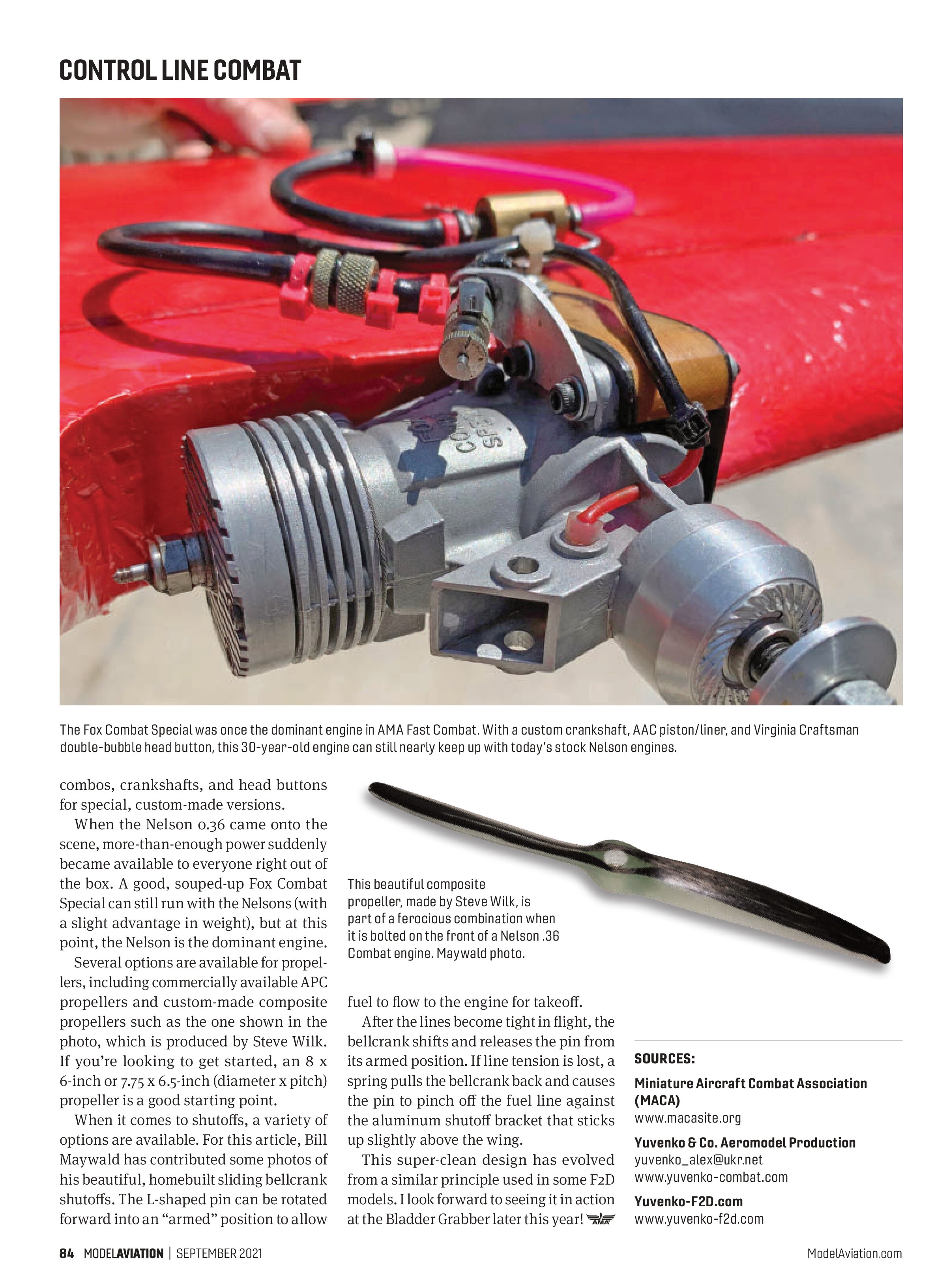
For many years, the Fox Combat Special was the engine of choice for nearly everyone in the field. Many pilots had their own special tricks for hopping-up their engines, including swapping out piston/liner
combos, crankshafts, and head buttons for special, custom-made versions.
When the Nelson 0.36 came onto the scene, more-than-enough power suddenly became available to everyone right out of the box. A good, souped-up Fox Combat Special can still run with the Nelsons (with a slight advantage in weight), but at this point, the Nelson is the dominant engine.
Several options are available for propellers, including commercially available APC propellers and custom-made composite propellers such as the one shown in the photo, which is produced by Steve Wilk. If you’re looking to get started, an 8 x 6-inch or 7.75 x 6.5-inch (diameter x pitch) propeller is a good starting point.

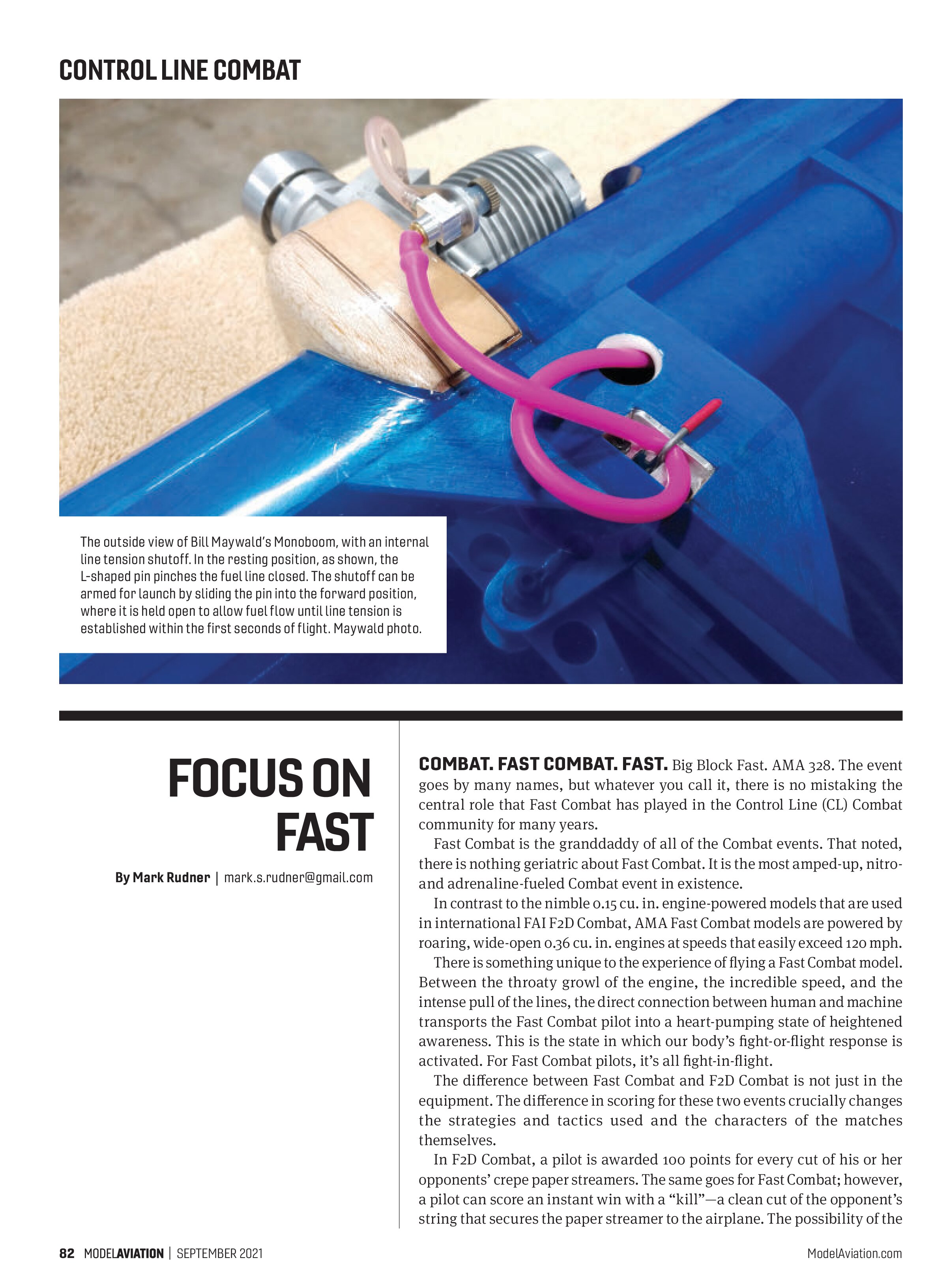
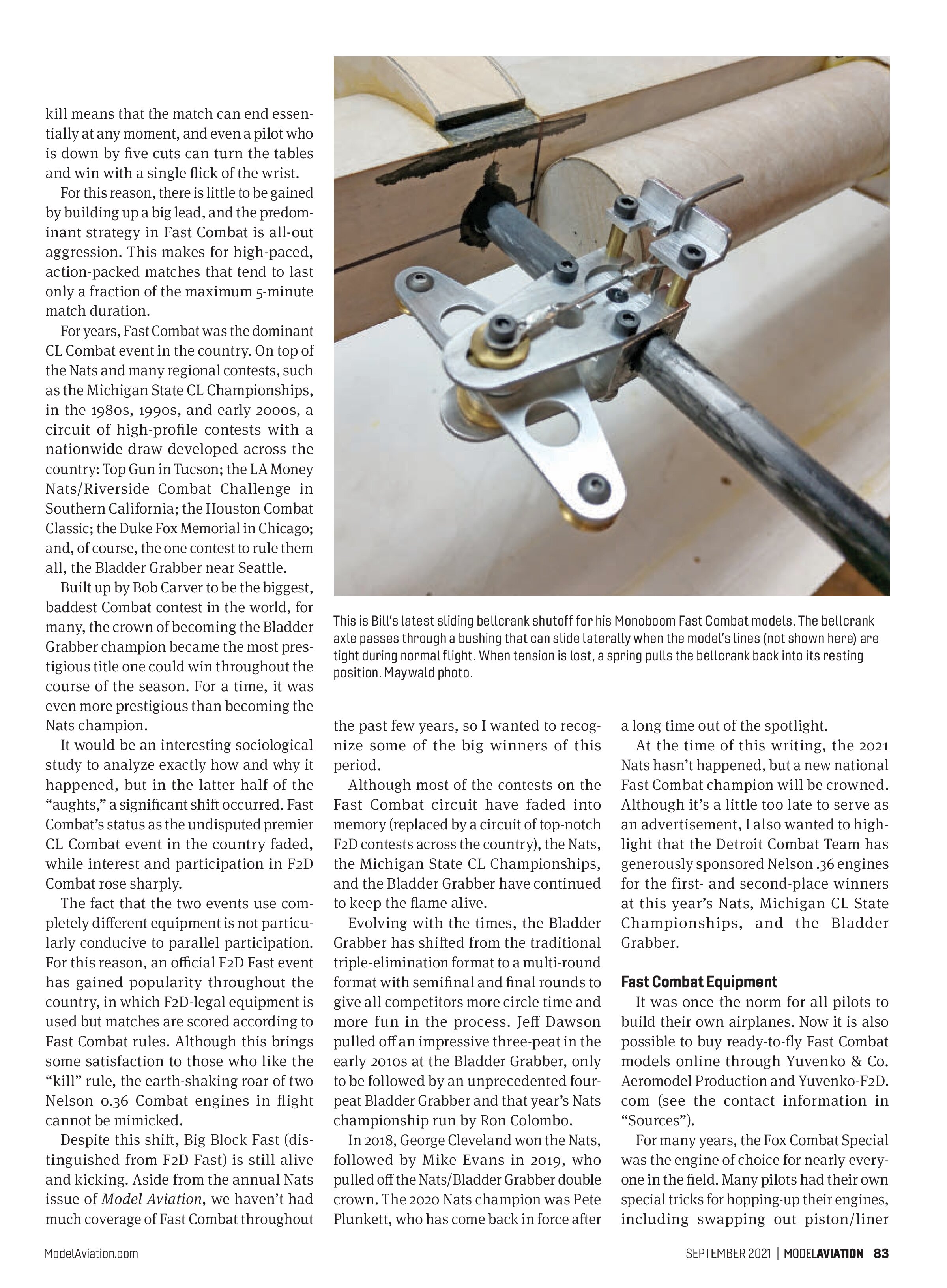
When it comes to shutoffs, a variety of options are available. For this article, Bill Maywald has contributed some photos of his beautiful, homebuilt sliding bellcrank shutoffs. The L-shaped pin can be rotated forward into an “armed” position to allow fuel to flow to the engine for takeoff.
After the lines become tight in flight, the bellcrank shifts and releases the pin from its armed position. If line tension is lost, a spring pulls the bellcrank back and causes the pin to pinch off the fuel line against the aluminum shutoff bracket that sticks up slightly above the wing.
This super-clean design has evolved from a similar principle used in some F2D models. I look forward to seeing it in action at the Bladder Grabber later this year!
SOURCES:
Miniature Aircraft Combat Association (MACA)
www.macasite.org
Yuvenko & Co. Aeromodel Production
yuvenko_alex@ukr.net
www.yuvenko-combat.com
Yuvenko-F2D.com
www.yuvenko-f2d.com