ULTIMATION
SANDER
By Thayer Syme | thayer@flying-models.com

AT LONG LAST, we are finally getting back to some sense of normalcy again, and I hope you have all enjoyed a fruitful summer flying season. Most of us have another month or two before the weather starts to close back in again. With any luck, the wind will be calm, and the sun plentiful.
The Ultimation Sander
Picking up where I left off in my July column, I’ve had another two months to wring out the Ultimation Sander a bit more, and I continue to be impressed. Al Collins did a great job with this sander and has posted a few videos on his website detailing its construction, operation, and optional accessories. I recommend them to anyone who might have even the slightest interest in this tool.
I’ve also found Al’s Repeater accessory to be a great help when matching fuselage uprights and crossmembers. With a little practice, I’ve found it takes only slightly longer to prep a piece of stock than with an X-Acto knife, and with much greater precision. Thanks, Al! It has been a joy to add your disk sander to my arsenal.
Building a Classic
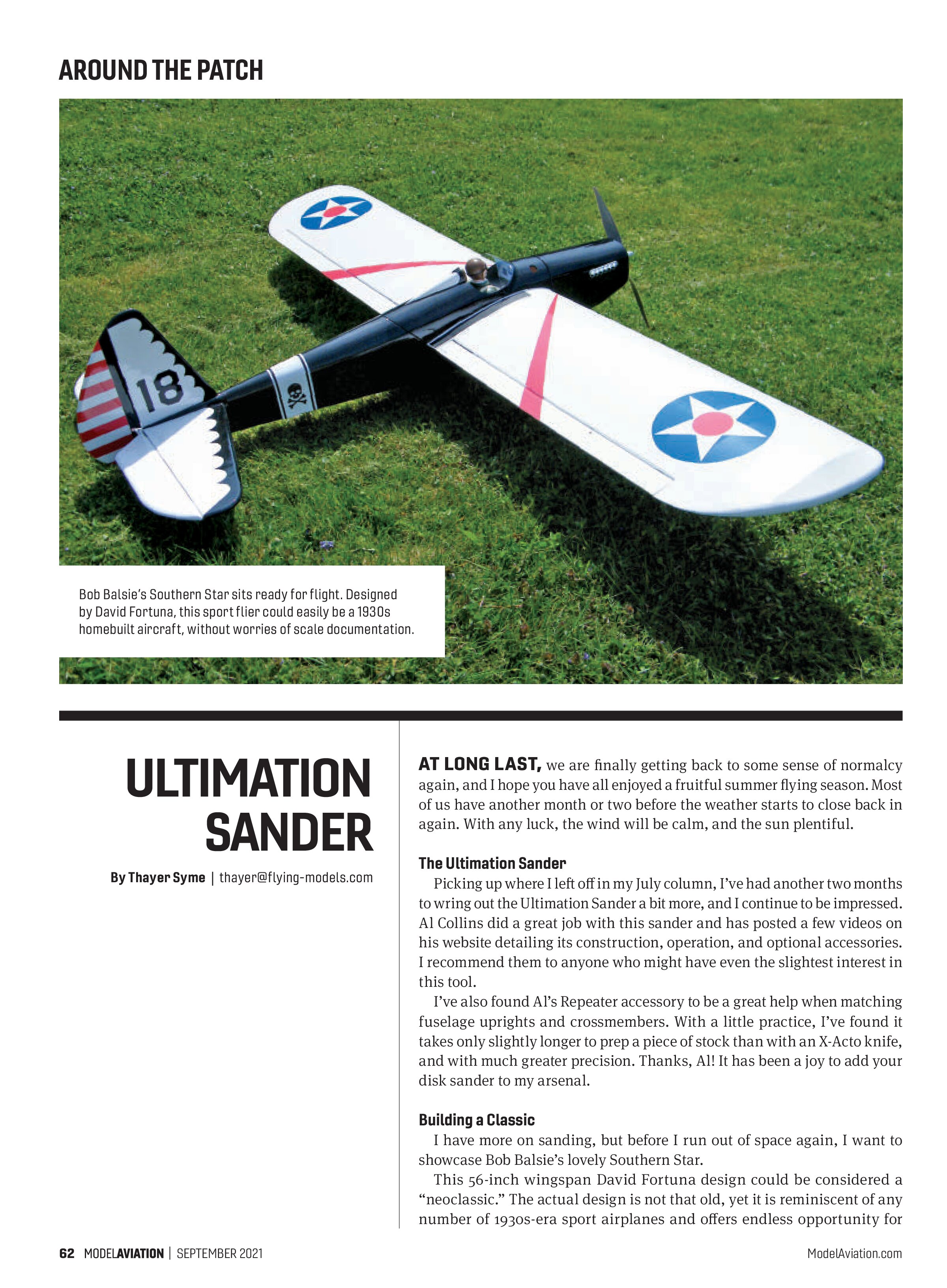
I have more on sanding, but before I run out of space again, I want to showcase Bob Balsie’s lovely Southern Star.
This 56-inch wingspan David Fortuna design could be considered a “neoclassic.” The actual design is not that old, yet it is reminiscent of any number of 1930s-era sport airplanes and offers endless opportunity for customizing it to suit your own vision. It was published in Flying Models in the late 1990s and is sized for .20 to .40 glow-powered engines.
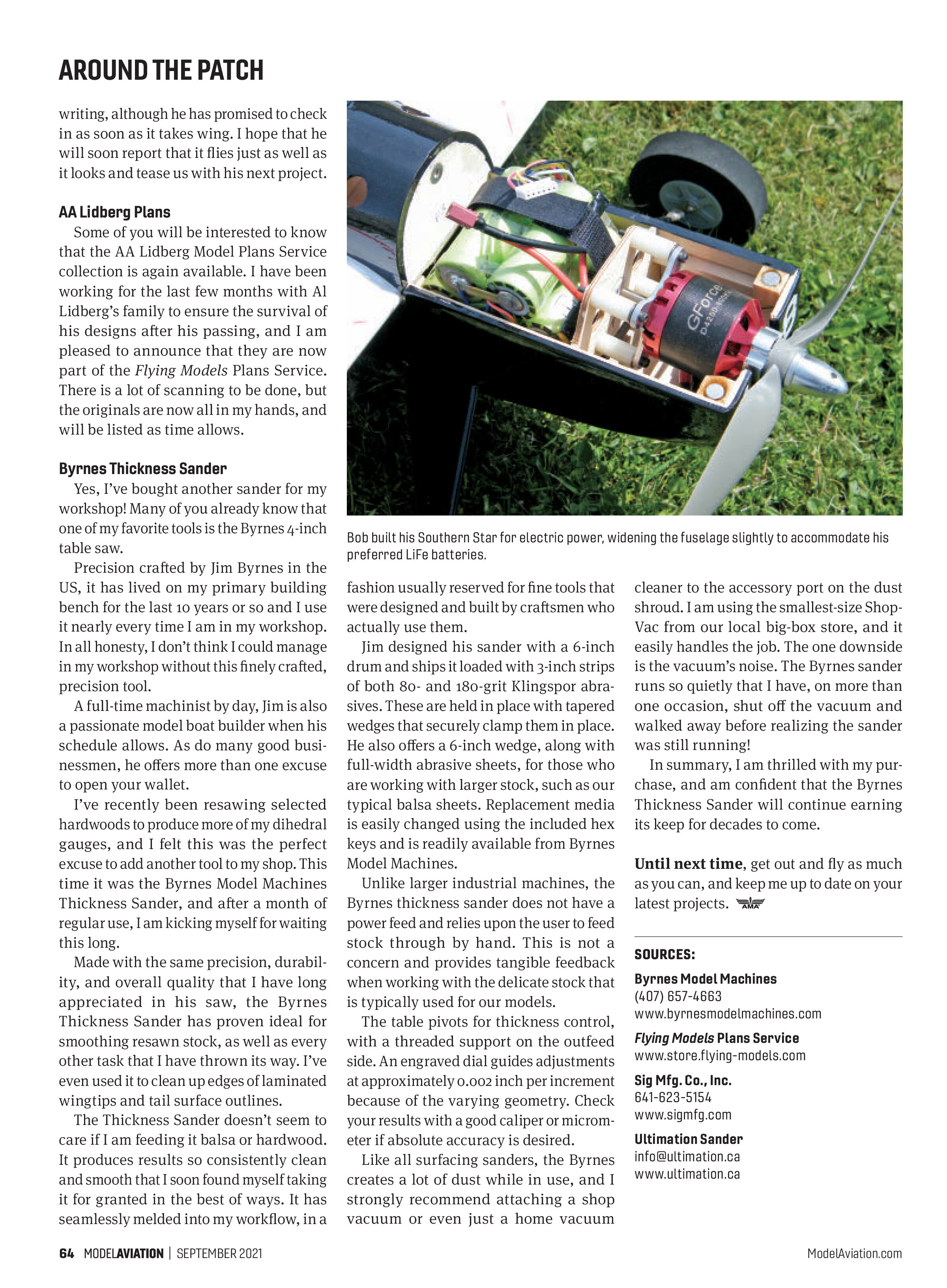
Bob bought a copy of the plans a couple of years ago and decided to build his version for electric power. He called Sig Mfg. for some balsa and started soon after it arrived. As do many builders, Bob treated the plans as a guide rather than an absolute. He needed to slightly widen the fuselage to accommodate his intended LiFe battery packs and made some substitutions for wood sizes based on experience and what he had on hand.
David originally drew the Southern Star with 4.5° of dihedral on each side, ensuring good control for both three- and four-channel configurations. Bob decided to include the optional ailerons and reduced the dihedral to a mere 1° per side. The nearly flat wing should provide more neutral control, yet it still prevents that sagging-wing look that is common on models with zero dihedral.

Bob’s Southern Star weighed 4 pounds when it was finished, including his 14.5-ounce battery. He cautiously used heavier wood than what was recommended in a few places behind the wing, and found the model needed just another ounce of ballast at the tail to balance at the designed center of gravity. It is rare to get much closer than that to perfect trim right off the bench!
Unfortunately, some distractions had delayed Bob’s first flight at the time of this
writing, although he has promised to check in as soon as it takes wing. I hope that he will soon report that it flies just as well as it looks and tease us with his next project.
AA Lidberg Plans
Some of you will be interested to know that the AA Lidberg Model Plans Service collection is again available. I have been working for the last few months with Al Lidberg’s family to ensure the survival of his designs after his passing, and I am pleased to announce that they are now part of the Flying Models Plans Service. There is a lot of scanning to be done, but the originals are now all in my hands, and will be listed as time allows.
Byrnes Thickness Sander
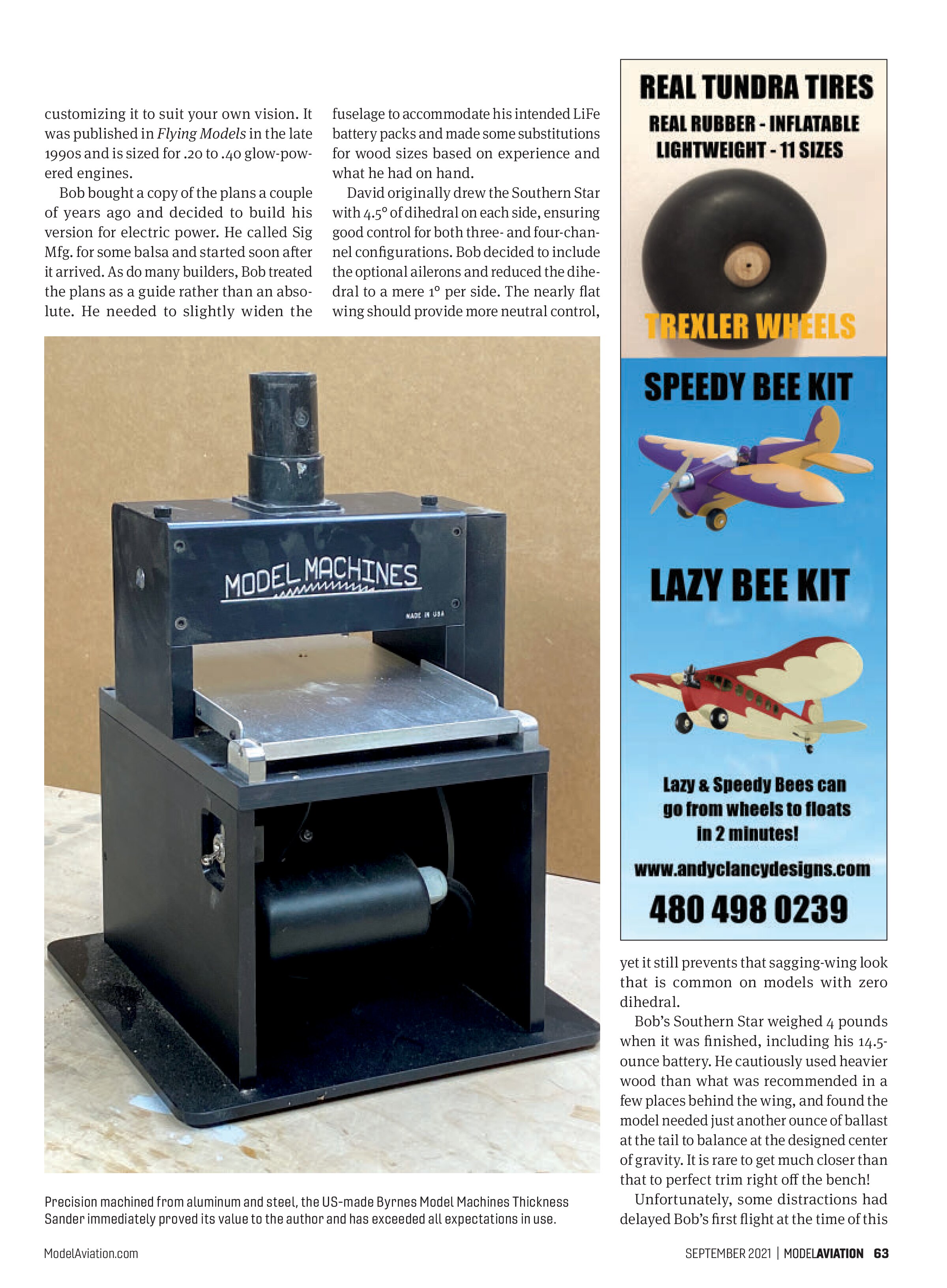
Yes, I’ve bought another sander for my workshop! Many of you already know that one of my favorite tools is the Byrnes 4-inch table saw.
Precision crafted by Jim Byrnes in the US, it has lived on my primary building bench for the last 10 years or so and I use it nearly every time I am in my workshop. In all honesty, I don’t think I could manage in my workshop without this finely crafted, precision tool.
A full-time machinist by day, Jim is also a passionate model boat builder when his schedule allows. As do many good businessmen, he offers more than one excuse to open your wallet.
I’ve recently been resawing selected hardwoods to produce more of my dihedral gauges, and I felt this was the perfect excuse to add another tool to my shop. This time it was the Byrnes Model Machines Thickness Sander, and after a month of regular use, I am kicking myself for waiting this long.
Made with the same precision, durability, and overall quality that I have long appreciated in his saw, the Byrnes Thickness Sander has proven ideal for smoothing resawn stock, as well as every other task that I have thrown its way. I’ve even used it to clean up edges of laminated wingtips and tail surface outlines.
The Thickness Sander doesn’t seem to care if I am feeding it balsa or hardwood. It produces results so consistently clean and smooth that I soon found myself taking it for granted in the best of ways. It has seamlessly melded into my workflow, in a fashion usually reserved for fine tools that were designed and built by craftsmen who actually use them.
Jim designed his sander with a 6-inch drum and ships it loaded with 3-inch strips of both 80- and 180-grit Klingspor abrasives. These are held in place with tapered wedges that securely clamp them in place. He also offers a 6-inch wedge, along with full-width abrasive sheets, for those who are working with larger stock, such as our typical balsa sheets. Replacement media is easily changed using the included hex keys and is readily available from Byrnes Model Machines.
Unlike larger industrial machines, the Byrnes thickness sander does not have a power feed and relies upon the user to feed stock through by hand. This is not a concern and provides tangible feedback when working with the delicate stock that is typically used for our models.
The table pivots for thickness control, with a threaded support on the outfeed side. An engraved dial guides adjustments at approximately 0.002 inch per increment because of the varying geometry. Check your results with a good caliper or micrometer if absolute accuracy is desired.
Like all surfacing sanders, the Byrnes creates a lot of dust while in use, and I strongly recommend attaching a shop vacuum or even just a home vacuum cleaner to the accessory port on the dust shroud. I am using the smallest-size Shop-Vac from our local big-box store, and it easily handles the job. The one downside is the vacuum’s noise. The Byrnes sander runs so quietly that I have, on more than one occasion, shut off the vacuum and walked away before realizing the sander was still running!
In summary, I am thrilled with my purchase, and am confident that the Byrnes Thickness Sander will continue earning its keep for decades to come.
Until next time, get out and fly as much as you can, and keep me up to date on your latest projects.
SOURCES:
Byrnes Model Machines
(407) 657-4663
www.byrnesmodelmachines.com
Flying Models Plans Service
www.store.flying-models.com
Sig Mfg. Co., Inc.
641-623-5154
www.sig mfg.com
Ultimation Sander
info@ultimation.ca
www.ultimation.ca