SMALL-FIELD FLYING
COVERING UNDER-CAMBERED WINGS
By Pat Tritle | patscustommodels@gmail.com
WITH FLYING SEASON in full swing, there’s probably less building and more flying in the works. At the time of this writing, however, we’re in the full throes of spring wind, so flying is scarce. For that reason, the last of my winter builds are nearly complete.
In the meantime, I’ve received a lot of mail from readers concerning covering. A case in point, Wayne Forke dropped me a line asking about techniques for covering undercambered wings. We don’t see a lot of undercambered wings these days, but they’re still out there, so I’ll touch on a technique I’ve used successfully throughout the years to cover them.
Undercambered wings are no different than flat-bottom wings because the covering still must be attached at the bottom. I’ve found that the easiest way to cover all wings is to do the bottom first.
With the covering attached to the perimeter, attach it to the bottom of each individual rib, starting at the center of the center rib, then tack it in place. Working from the center forward and back, tack the covering to the full chord. From there, tack the covering to each rib, working back and forth on either side of the first one, until all of the ribs are tacked.
Take note along the way that you’re not building a twist into the wing as you progress. From there, again starting from the center, shrink each bay, alternating sides until all of the bays are shrunk. The only thing to watch is that you don’t inadvertently break the seal and release the covering from the rib while shrinking the individual bays.
The technique is the same for doped finishes as well, but after the covering is attached to each rib, I like to run a small bead of either thinned Titebond,

Elmer’s, or Super ’Phatic wood glue along the edges of each rib then water-size or heat-shrink it. The reason for the wood glue is that when the dope is applied to seal the covering, it softens the dope that attaches the covering to the rib and frequently releases it. With the covering pulled tight, it’s hard to reattach it.
The ailerons are set up using a scale torque rod arrangement that is actuated by a servo in each wing. Provisions for adjustment were built into the servo mounts to make it easier to set up the proper throws.
On the Subject of Covering
Gary Brown checked in with his 50-inch wingspan Nieuport 16 that was built from enlarged and backdated Peter Rake Nieuport 17 plans. The model was covered with Polyspan and dope. The covering was sealed with six coats of Randolph non-tautening nitrate dope, with the natural linen look duplicated by adding art store alcohol-based inks to the dope. He also tried water-based inks, but they proved to be unsuccessful.
Another unique feature of Gary’s Nieuport is the aileron linkage that closely resembles the full-scale airplane. The ailerons are actuated by torque rods that are controlled by bellcranks in the top wing and by a single servo for each aileron. The full-scale Nieuport 16 works the same way, except the aileron cranks are articulated by a pushrod from the control stick in the fuselage. Gary also made allowances for throw adjustment by repositioning the servo or by relocating the slip fitting on the servo output arm. In all, the system is a clever arrangement.
A Cobra 2826-12 outrunner motor swinging an APC 13 x 4.7 propeller powers the upscaled Nieuport, and the all-up weight, excluding the battery, tips the scales at 44

ounces. The first flights proved that the model is a great flier with a gentle stall and slow landing speed. That’s not a big surprise because all of Peter Rake’s designs are great fliers, and smaller models only get better as they get bigger.
On the Subject of Biplanes
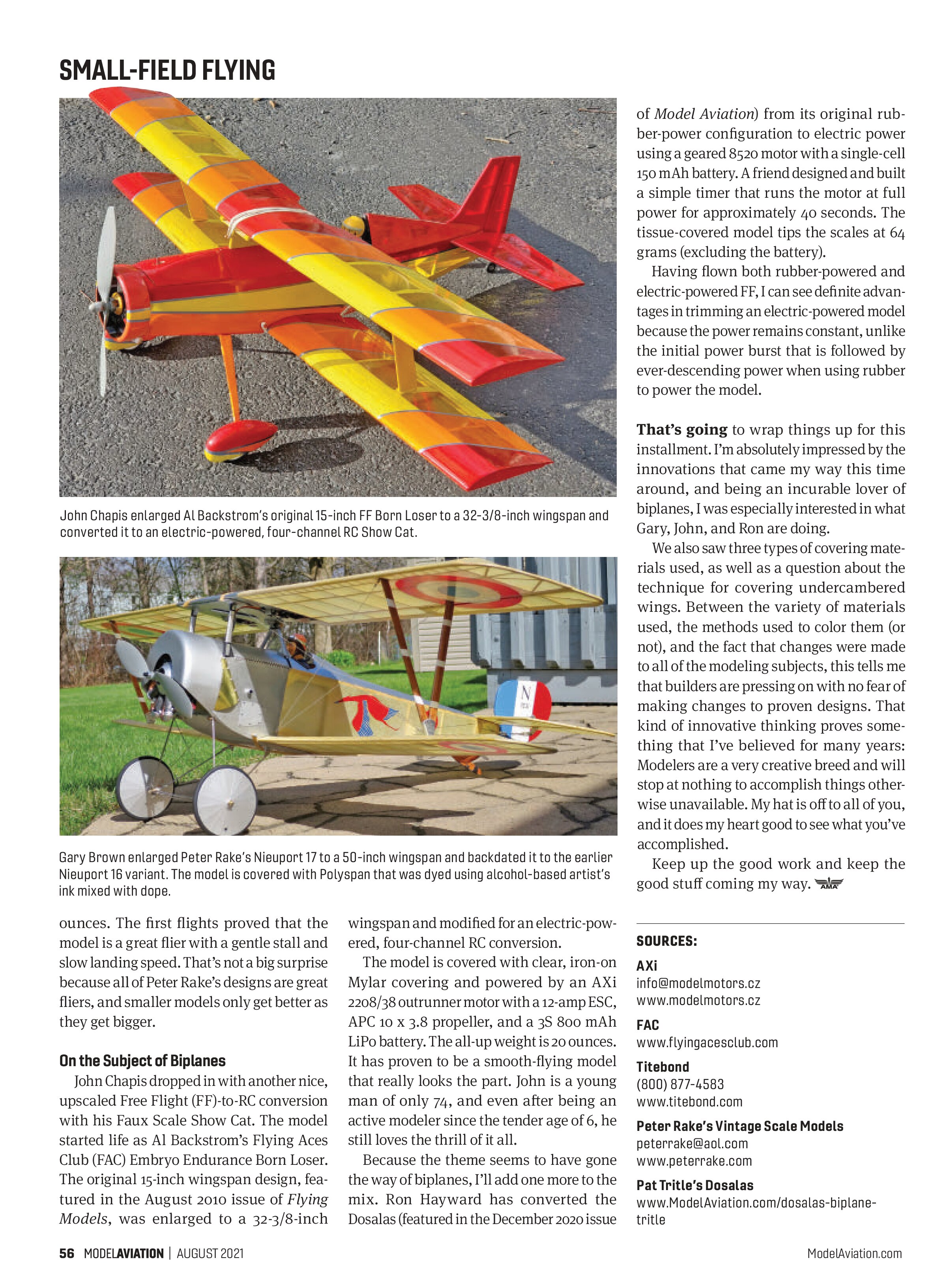
John Chapis dropped in with another nice, upscaled Free Flight (FF)-to-RC conversion with his Faux Scale Show Cat. The model started life as Al Backstrom’s Flying Aces Club (FAC) Embryo Endurance Born Loser. The original 15-inch wingspan design, featured in the August 2010 issue of Flying Models, was enlarged to a 32-3/8-inch
wingspan and modified for an electric-powered, four-channel RC conversion. The model is covered with clear, iron-on Mylar covering and powered by an AXi 2208/38 outrunner motor with a 12-amp ESC, APC 10 x 3.8 propeller, and a 3S 800 mAh LiPo battery. The all-up weight is 20 ounces. It has proven to be a smooth-flying model that really looks the part. John is a young man of only 74, and even after being an active modeler since the tender age of 6, he still loves the thrill of it all.
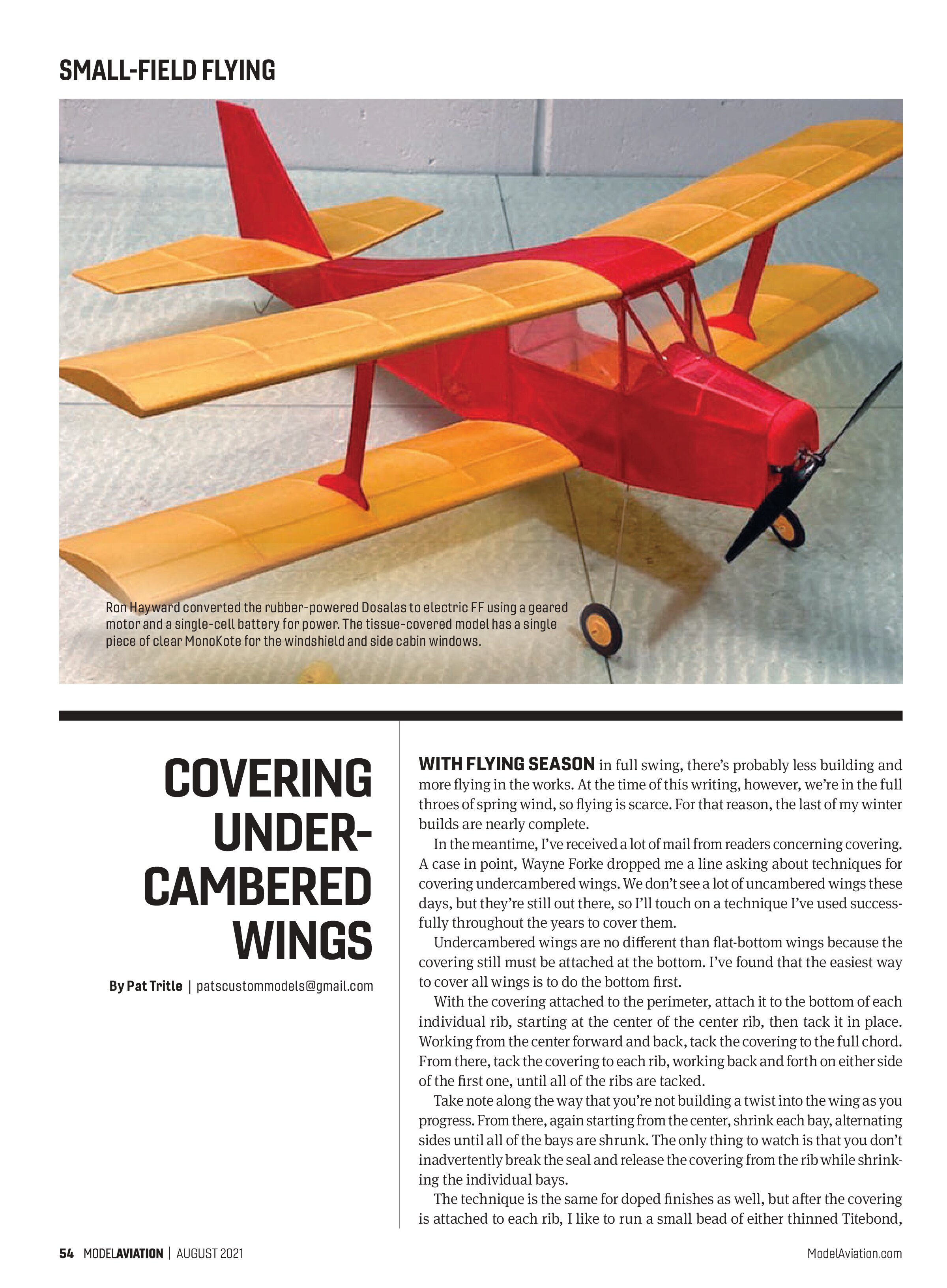
Because the theme seems to have gone the way of biplanes, I’ll add one more to the mix. Ron Hayward has converted the Dosalas (featured in the December 2020 issue of Model Aviation) from its original rubber-power configuration to electric power using a geared 8520 motor with a single-cell 150 mAh battery. A friend designed and built a simple timer that runs the motor at full power for approximately 40 seconds. The tissue-covered model tips the scales at 64 grams (excluding the battery).
Having flown both rubber-powered and electric-powered FF, I can see definite advantages in trimming an electric-powered model because the power remains constant, unlike the initial power burst that is followed by ever-descending power when using rubber to power the model.
That’s going to wrap things up for this installment. I’m absolutely impressed by the innovations that came my way this time around, and being an incurable lover of biplanes, I was especially interested in what Gary, John, and Ron are doing.
We also saw three types of covering materials used, as well as a question about the technique for covering undercambered wings. Between the variety of materials used, the methods used to color them (or not), and the fact that changes were made to all of the modeling subjects, this tells me that builders are pressing on with no fear of making changes to proven designs. That kind of innovative thinking proves something that I’ve believed for many years: Modelers are a very creative breed and will stop at nothing to accomplish things otherwise unavailable. My hat is off to all of you, and it does my heart good to see what you’ve accomplished.
Keep up the good work and keep the good stuff coming my way.
SOURCES:
AXi
info@modelmotors.cz
www.modelmotors.cz
Titebond
(800) 877-4583
www.titebond.com
Peter Rake’s Vintage Scale Models
peternrake@aol.com
www.peterake.com
Pat Tritle’s Dosalas
www.ModelAviation.com/dosalas-biplane-tritle