Remote Aerial Photography Platforms
One veteran pilot’s perspective
By Jon Barnes
Photos by the author
barnesjonr@gmail.com
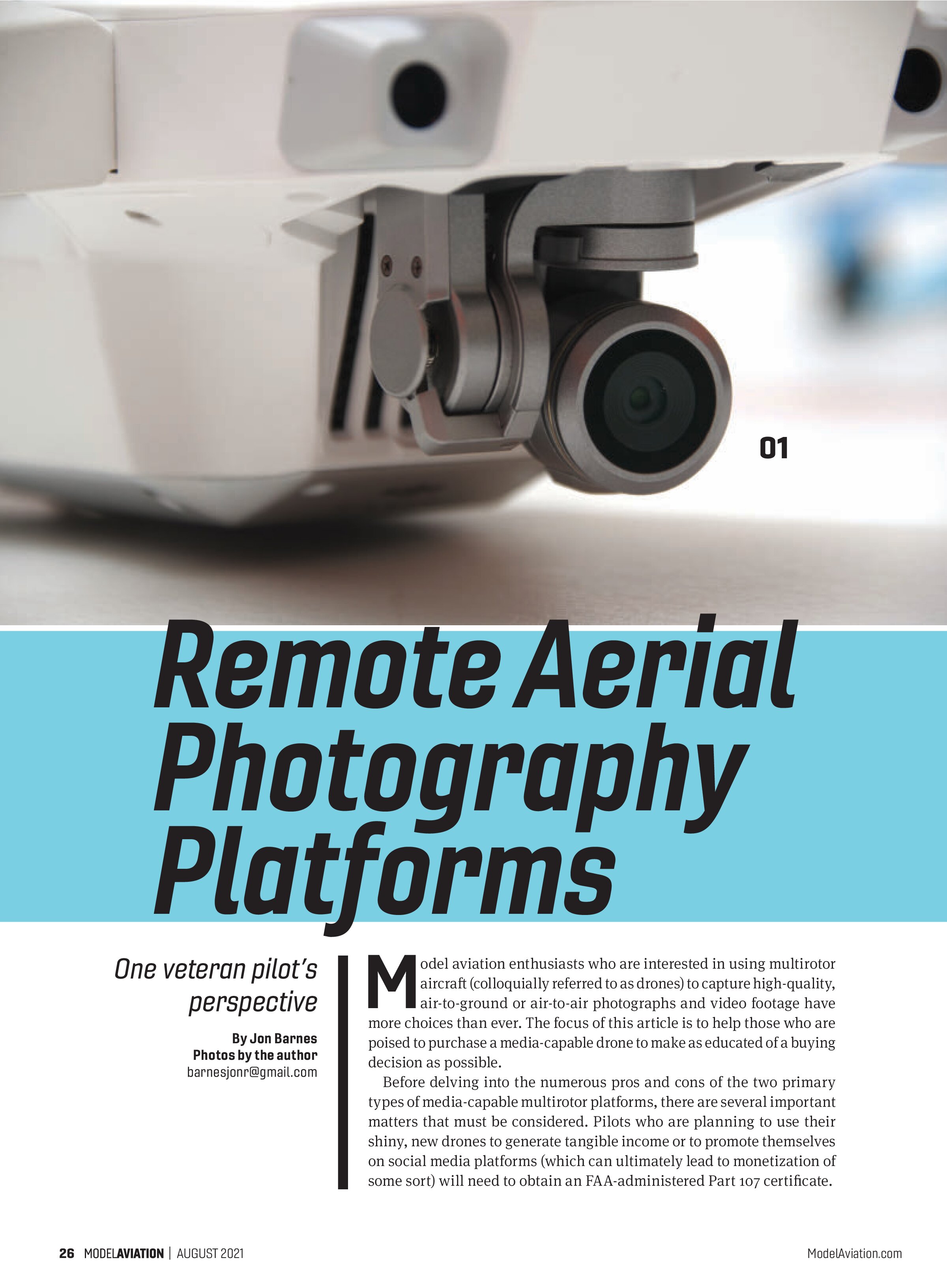
Model aviation enthusiasts who are interested in using multirotor aircraft (colloquially referred to as drones) to capture high-quality, air-to-ground or air-to-air photographs and video footage have more choices than ever. The focus of this article is to help those who are poised to purchase a media-capable drone to make as educated of a buying decision as possible.
Before delving into the numerous pros and cons of the two primary types of media-capable multirotor platforms, there are several important matters that must be considered. Pilots who are planning to use their shiny, new drones to generate tangible income or to promote themselves on social media platforms (which can ultimately lead to monetization of some sort) will need to obtain an FAA-administered Part 107 certificate.
Pilots who plan to use their drones for nothing more than their own hobby-related enjoyment need not acquire the Part 107 license, although they will still need to properly educate themselves to be sure that they always fly responsibly. Pilots will still likely need to register their aircraft with the FAA, although the ultimate determining factor for this depends on the net takeoff weight of each aircraft.
Additionally, pilots who are interested in keeping themselves 100% aboveboard and legal should plan to get at least a Technician-class Amateur Radio License. This entry-level license gives pilots full privileges in the 2.4 and 5.8 GHz bands, with an allowed maximum transmitted power output of 1 watt.
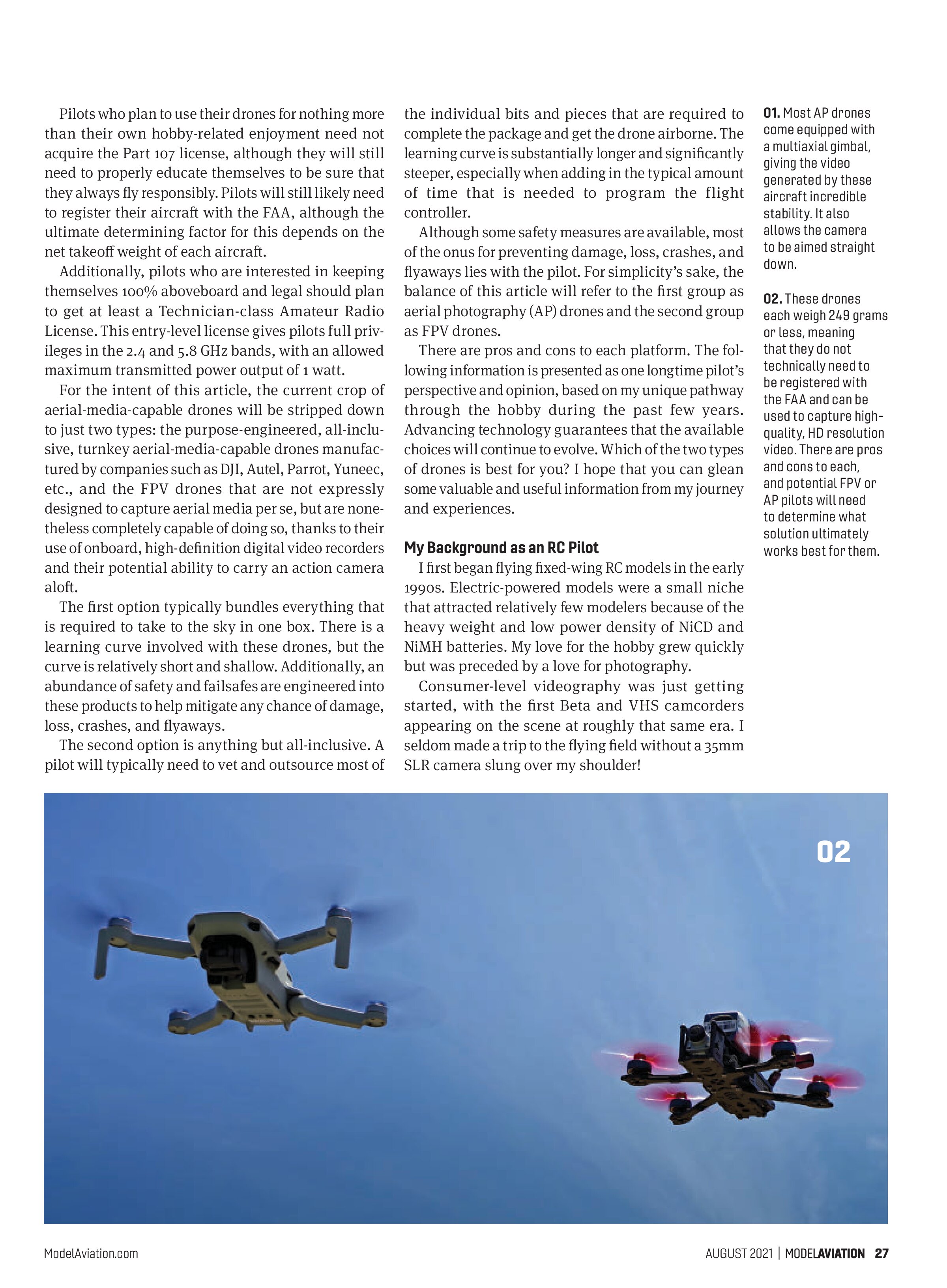
For the intent of this article, the current crop of aerial-media-capable drones will be stripped down to just two types: the purpose-engineered, all-inclusive, turnkey aerial-media-capable drones manufactured by companies such as DJI, Autel, Parrot, Yuneec, etc., and the FPV drones that are not expressly designed to capture aerial media per se, but are nonetheless completely capable of doing so, thanks to their use of onboard, high-definition digital video recorders and their potential ability to carry an action camera aloft.
The first option typically bundles everything that is required to take to the sky in one box. There is a learning curve involved with these drones, but the curve is relatively short and shallow. Additionally, an abundance of safety and failsafes are engineered into these products to help mitigate any chance of damage, loss, crashes, and flyaways.
The second option is anything but all-inclusive. A pilot will typically need to vet and outsource most of the individual bits and pieces that are required to complete the package and get the drone airborne. The learning curve is substantially longer and significantly steeper, especially when adding in the typical amount of time that is needed to program the flight controller.
Although some safety measures are available, most of the onus for preventing damage, loss, crashes, and flyaways lies with the pilot. For simplicity’s sake, the balance of this article will refer to the first group as aerial photography (AP) drones and the second group as FPV drones.
There are pros and cons to each platform. The following information is presented as one longtime pilot’s perspective and opinion, based on my unique pathway through the hobby during the past few years. Advancing technology guarantees that the available choices will continue to evolve. Which of the two types of drones is best for you? I hope that you can glean some valuable and useful information from my journey and experiences.
My Background as an RC Pilot
I first began flying fixed-wing RC models in the early 1990s. Electric-powered models were a small niche that attracted relatively few modelers because of the heavy weight and low power density of NiCd and NiMH batteries. My love for the hobby grew quickly but was preceded by a love for photography.
Consumer-level videography was just getting started, with the first Beta and VHS camcorders appearing on the scene at roughly that same era. I seldom made a trip to the flying field without a 35mm SLR camera slung over my shoulder!


Fast forward to the present, and electric-powered models are absolutely the rage thanks to brushless technology and lithium-chemistry batteries. For several decades, I enjoyed exploring nearly every emerging and evolutionary genre of the hobby.
Although the appearance of multirotor aircraft eventually lured me into tentatively dipping a toe into the world of FPV-equipped models, my need to wear glasses made a workable goggle solution elusive. Using a tripod LCD screen was unsatisfying because of unavoidable glare and a general lack of immersion. I slowly lost interest and drifted out of multirotors and FPV at a time when HobbyKing and DJI Naza provided some of the mainstream flight controllers.
Enter the Phantom!
I was drawn back to the genre with the appearance of the DJI Phantom series of AP drones. In time, I purchased a DJI Phantom 3, and was instantly smitten with its aerial imaging capabilities. Its amazing ability to virtually eliminate all in-flight jitter using a gimbal-mounted, onboard, HD-capable camera, which could also shoot 12-megapixel still photos, had me agog and amped beyond belief! The icing on the cake came when DJI released its first generation of goggles, the design of which accommodated pilots who needed to wear corrective lenses.
My love affair with DJI AP drones continued to blossom, and I eventually bought a first-generation Inspire One, a Spark, a Mavic Pro, and a Mavic Mini. These products all satisfied my itch to shoot high-quality aerial media. The Mavic Mini, weighing in at roughly 250 grams, stood out because it did not even need to be registered with the FAA! The engineering behind these products is top notch! DJI made it possible for literally anyone to buy and fly, with a confidence-inspiring abundance of safeguards and failsafes built in.

It was only natural that I would want to use my variety of AP drones to try to shoot media of other RC aircraft in air-to-air style. Although my DJI drones shot high-quality, stabilized cinematic footage, chasing other aircraft around the sky was not their forte. Even the fastest of my fleet, the Inspire One, maxed out with a top speed of roughly 50 mph.
My favorite in the fleet would eventually prove to be the Mavic Pro. A typical flight duration of 20 minutes, coupled with compatibility with the DJI goggles with no need for any connecting cables whatsoever (thanks to DJI’s proprietary wireless OcuSync technology), made the Mavic Pro my go-to AP platform.
Years of use resulted in developing nearly complete confidence in the dependability of my DJI drones. From the Smart LiPo battery packs to the automatic return-to-home feature and everything in between, these products are as close to foolproof as any product that is routinely asked to defy gravity could ever be.
As a pilot with roots deeply embedded in the full-on flying of fixed-wing models, however, the day finally came when I reluctantly confessed to myself that these AP rigs were little more than aerial tripods!
That statement is at the same time both complimentary and indicting. Take off, fly to the spot in the sky where you plan to shoot your media, and capture media. The machine was all but guaranteed to still be on station exactly where you left it. Although that alone is impressive, for a pilot accustomed to flying his or her aircraft, it was also uninspiring! Something special was missing from my AP drone exploits.
Whoop It Up!
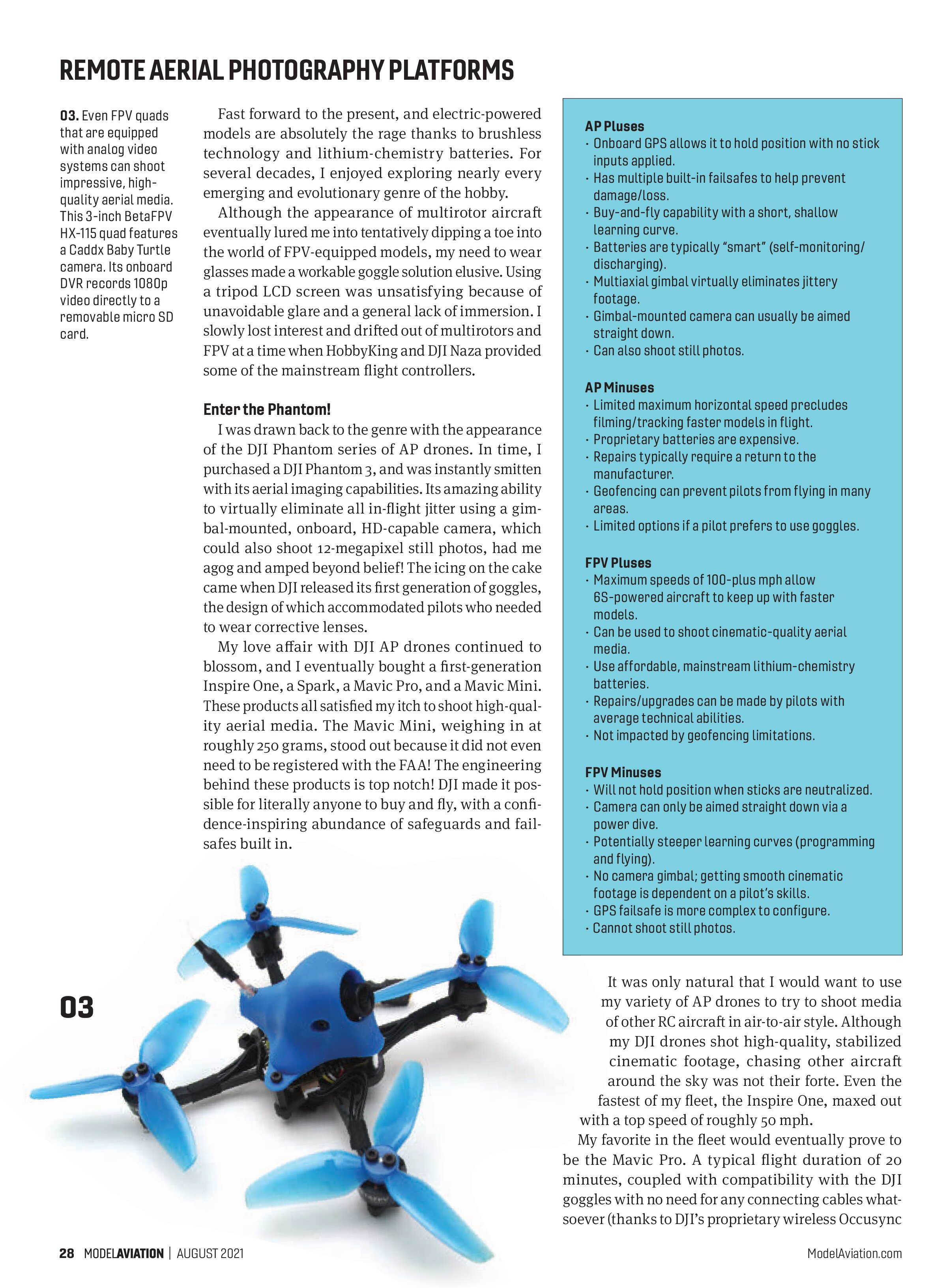
While I was busy flying my AP drones, the Cinewhoop craze burst onto the FPV scene with a vengeance. I willed myself to not be drawn into the frenzy. It was not until Cinewhoops were well established, and even perhaps passé, that I sat up and took notice. I tentatively dipped a toe into the Whoop waters with the purchase of a used BetaFPV 85X HD. It was the advertised ability to record onboard 1080p video footage that really piqued my curiosity.
Getting my first Whoop configured and connected to my radio took some doing. Although I found the somewhat steep learning curve of using Betaflight to configure/program the drone slightly challenging, I enjoyed the sense of accomplishment that washed over me when the little 85X first took to the sky. I was beyond impressed with the jitter-free HD video that the Caddx Turtle camera/DVR produced! And all of this from an FPV drone weighing less than 100 grams!
A relatively inexpensive pair of Fat Shark Scout goggles, which are designed to allow the user to wear glasses if needed, completed the package. While finding out which analog FPV goggles were compatible for those wearing corrective lenses, my searches kept turning up DJI’s Digital FPV technology and goggles. The word on the street was that they were also designed to accommodate a user needing to wear corrective lenses. The digital bug was planted, although I kept telling myself that I did not need to go there!
My newfound interest in media-capable FPV drones resulted in me spending way too much time lurking in the various online RC forums’ classifieds sections. When a nearby pilot listed a complete package that included a slightly used pair of DJI digital goggles, a DJI controller, a 5-inch Nazgul FPV drone equipped with the Caddx Vista, and a variety of accessories, I bought the entire kit and kaboodle and summarily roared past the point of no return!
Most analog FPV pilots likely remember the first time they donned a pair of digital goggles. My digital “there is no going back” moment was this: I sat there quietly, stunned and in utter disbelief and amazement, as I watched a tiny, winged insect crawl up a singular blade of grass just in front of my drone. It was almost as though I was peering through a microscope—so clear and detailed was the image in front of my eyes!
After it was in the air, it was beyond incredible! I could easily spot and track any other model aircraft in the air at the same time and attempt to cozy up to them to capture them on video. And the quality of the video (720p) recorded by the DVR built into the goggles is surprisingly good.
My plunge into the rabbit hole after going digital has seen me purchase several additional FPV drones. The integral DVR of the DJI Air Unit, which is capable of recording in 1080p, ratchets the quality of the digital FPV system up another notch. Pilots who are interested


AP Pluses
- Onboard GPS allows it to hold position with no stick inputs applied.
- Has multiple built-in failsafes to help prevent damage/loss.
- Buy-and-fly capability with a short, shallow learning curve.
- Batteries are typically “smart” (self-monitoring/discharging).
- Multiaxial gimbal virtually eliminates jittery footage.
- Gimbal-mounted camera can usually be aimed straight down.
- Can also shoot still photos.
AP Minuses
- Limited maximum horizontal speed precludes filming/tracking faster models in flight.
- Proprietary batteries are expensive.
- Repairs typically require a return to the manufacturer.
- Geofencing can prevent pilots from flying in many areas.
- Limited options if a pilot prefers to use goggles.
FPV Pluses
- Maximum speeds of 100-plus mph allow 6S-powered aircraft to keep up with faster models.
- Can be used to shoot cinematic-quality aerial media.
- Use affordable, mainstream lithium-chemistry batteries.
- Repairs/upgrades can be made by pilots with average technical abilities.
- Not impacted by geofencing limitations.
FPV Minuses
- Will not hold position when sticks are neutralized.
- Camera can only be aimed straight down via a power dive.
- Potentially steeper learning curves (programming and flying).
- No camera gimbal; getting smooth cinematic footage is dependent on a pilot’s skills.
- GPS failsafe is more complex to configure.
- Cannot shoot still photos.
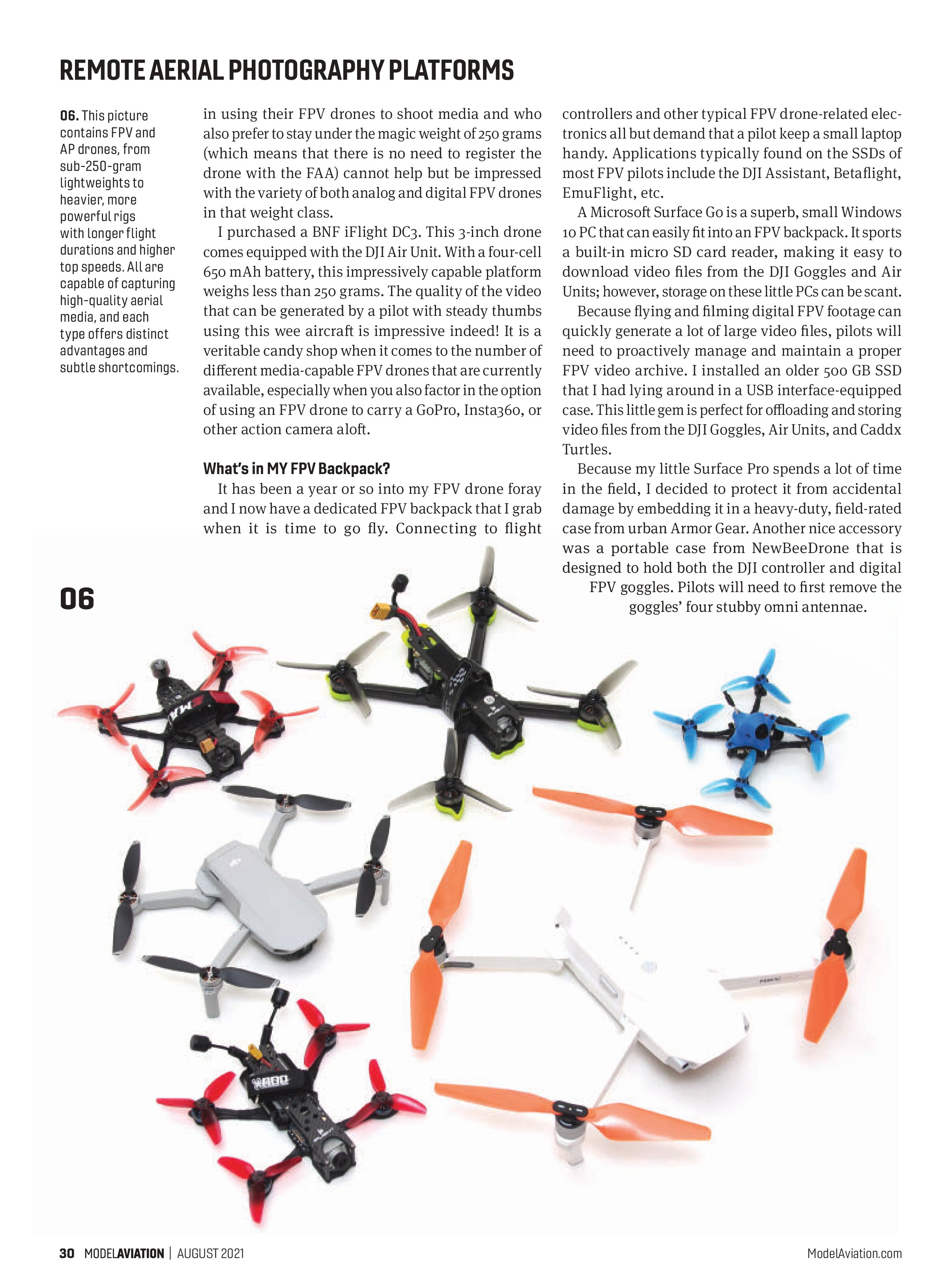
in using their FPV drones to shoot media and who also prefer to stay under the magic weight of 250 grams (which means that there is no need to register the drone with the FAA) cannot help but be impressed with the variety of both analog and digital FPV drones in that weight class.
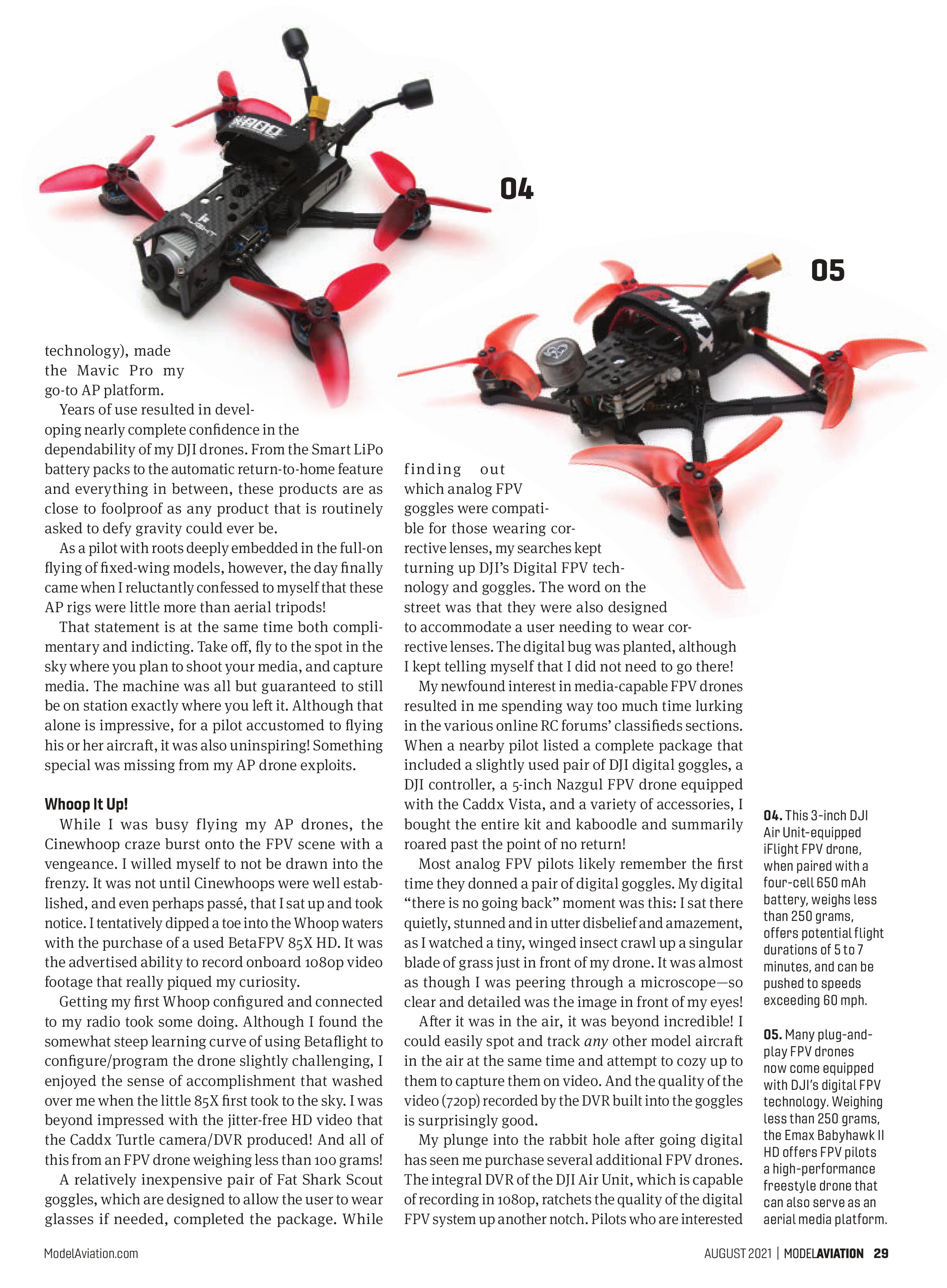
I purchased a BNF iFlight DC3. This 3-inch drone comes equipped with the DJI Air Unit. With a four-cell 650 mAh battery, this impressively capable platform weighs less than 250 grams. The quality of the video that can be generated by a pilot with steady thumbs using this wee aircraft is impressive indeed! It is a veritable candy shop when it comes to the number of different media-capable FPV drones that are currently available, especially when you also factor in the option of using an FPV drone to carry a GoPro, Insta360, or other action camera aloft.
What’s in MY FPV Backpack?
It has been a year or so into my FPV drone foray and I now have a dedicated FPV backpack that I grab when it is time to go fly. Connecting to flight

controllers and other typical FPV drone-related electronics all but demand that a pilot keep a small laptop handy. Applications typically found on the SSDs of most FPV pilots include the DJI Assistant, Betaflight, EmuFlight, etc.
A Microsoft Surface Go is a superb, small Windows 10 PC that can easily fit into an FPV backpack. It sports a built-in micro SD card reader, making it easy to download video files from the DJI Goggles and Air Units; however, storage on these little PCs can be scant.
Because flying and filming digital FPV footage can quickly generate a lot of large video files, pilots will need to proactively manage and maintain a proper FPV video archive. I installed an older 500 GB SSD that I had lying around in a USB interface-equipped case. This little gem is perfect for offloading and storing video files from the DJI Goggles, Air Units, and Caddx Turtles.
Because my little Surface Pro spends a lot of time in the field, I decided to protect it from accidental damage by embedding it in a heavy-duty, field-rated case from urban Armor Gear. Another nice accessory was a portable case from NewBeeDrone that is designed to hold both the DJI controller and digital FPV goggles. Pilots will need to first remove the goggles’ four stubby omni antennae.


Conclusion
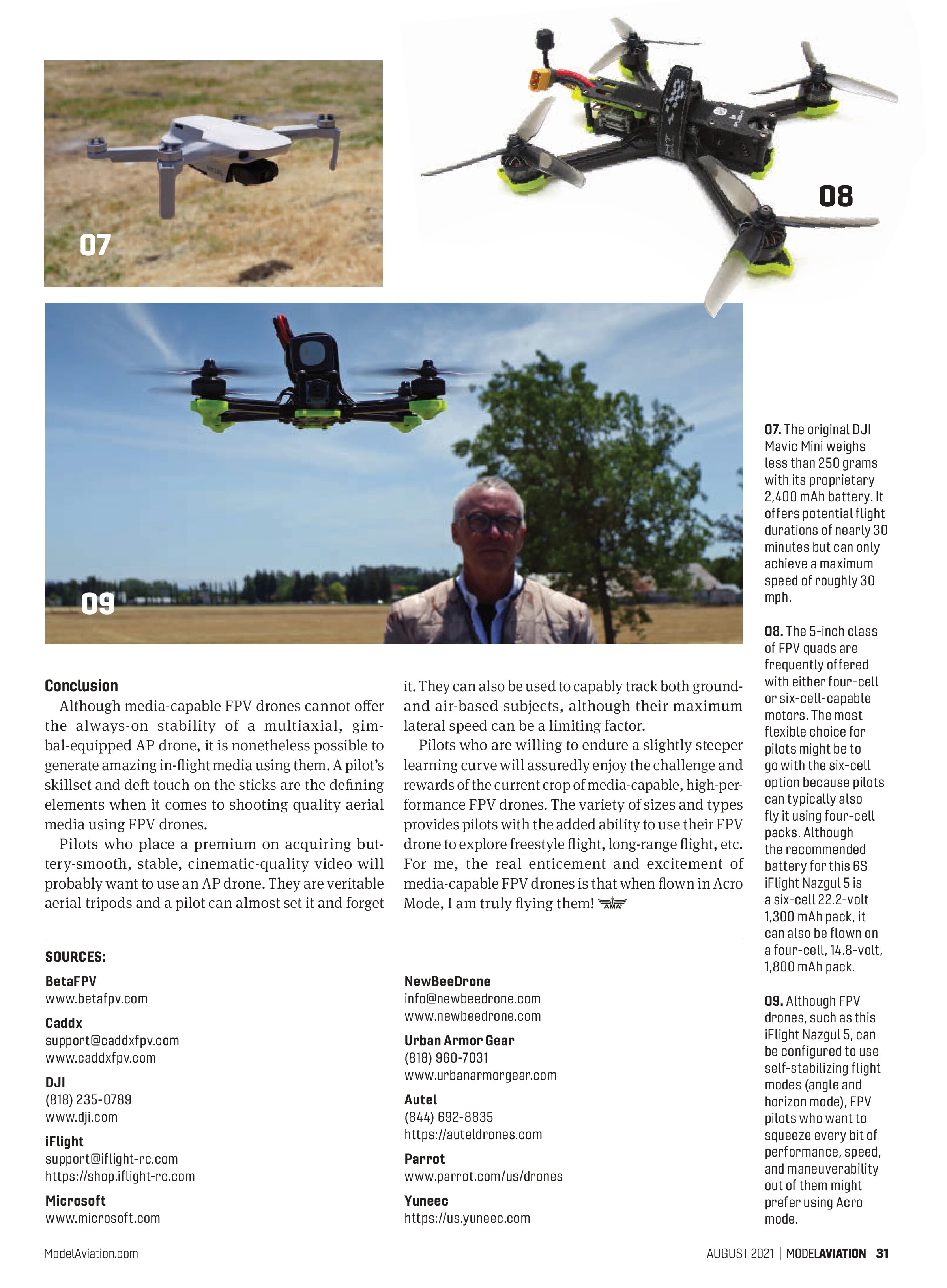
Although media-capable FPV drones cannot offer the always-on stability of a multiaxial, gimbal-equipped AP drone, it is nonetheless possible to generate amazing in-flight media using them. A pilot’s skillset and deft touch on the sticks are the defining elements when it comes to shooting quality aerial media using FPV drones.
Pilots who place a premium on acquiring buttery-smooth, stable, cinematic-quality video will probably want to use an AP drone. They are veritable aerial tripods and a pilot can almost set it and forget it. They can also be used to capably track both ground- and air-based subjects, although their maximum lateral speed can be a limiting factor.
Pilots who are willing to endure a slightly steeper learning curve will assuredly enjoy the challenge and rewards of the current crop of media-capable, high-performance FPV drones. The variety of sizes and types provides pilots with the added ability to use their FPV drone to explore freestyle flight, long-range flight, etc. For me, the real enticement and excitement of media-capable FPV drones is that when flown in Acro Mode, I am truly flying them!
SOURCES:
BetaFPV
www.betafpv.com
Caddx
support@caddxfpv.com
www.caddx f pv.com
DJI
(818) 235-0789
www.dji.com
iFlight
support@iflight-rc.com
https://shop.iflight-rc.com
Microsoft
www.microsoft.com
NewBeeDrone
info@newbeedrone.com
www.newbeedrone.com
Urban Armor Gear
(818) 960-7031
www.urbanarmorgear.com
Autel
(844) 692-8835
https://auteldrones.com
Parrot
www.parrot.com/us/drones
Yuneec
https://us.yuneec.com