RC HELICOPTERS

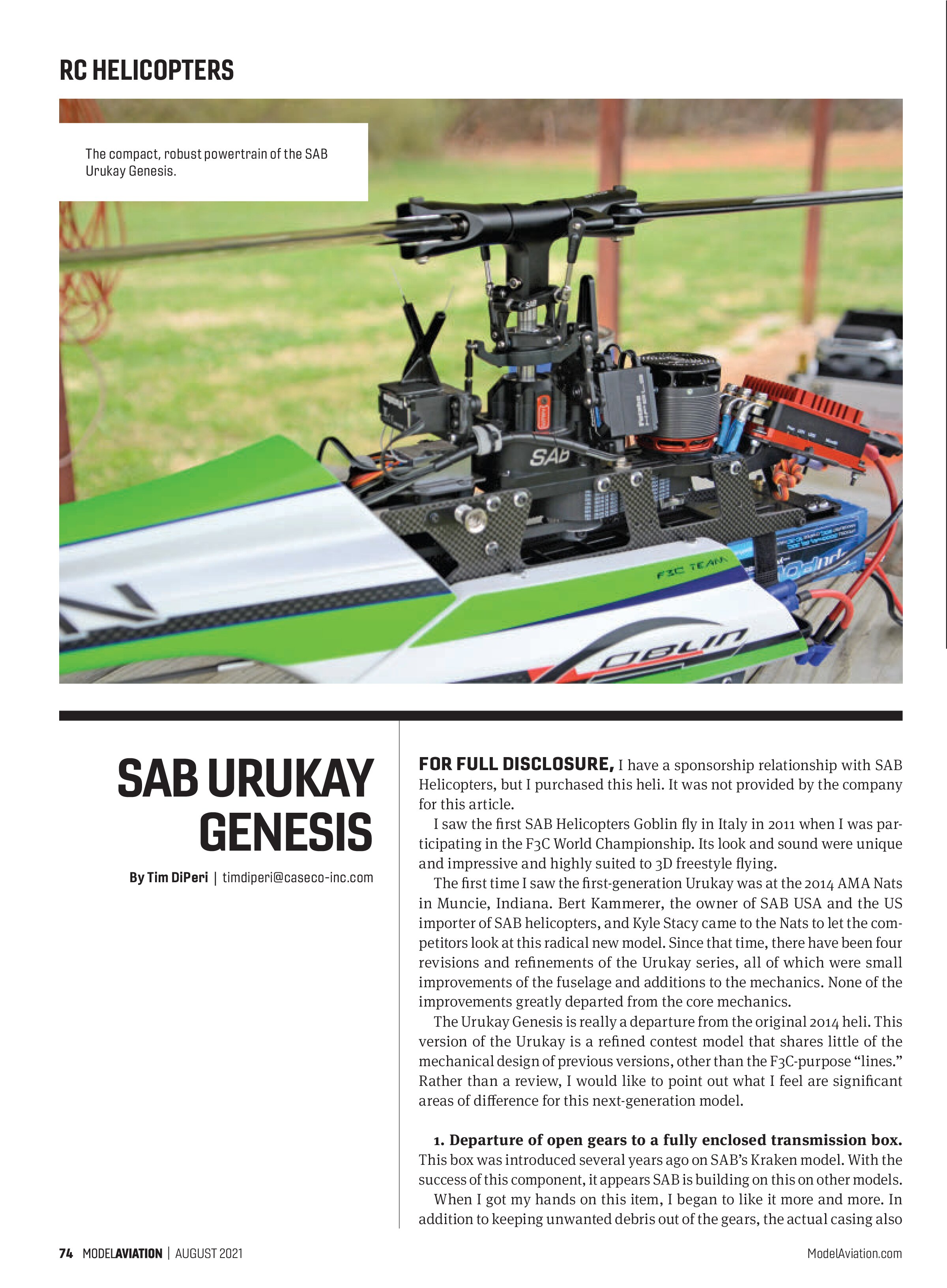
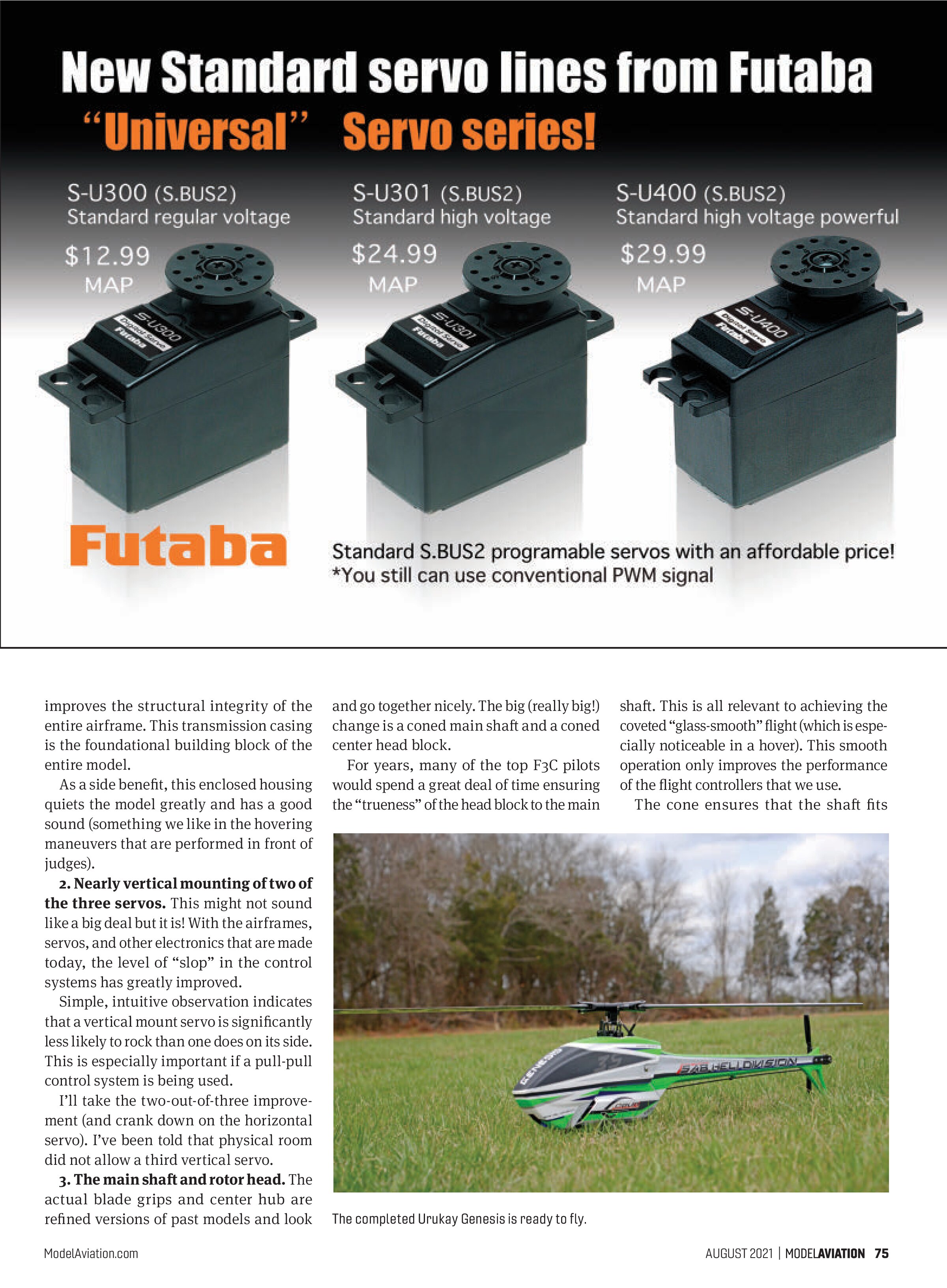
The compact, robust powertrain of the SAB Urukay Genesis.
SAB URUKAY GENESIS
By Tim DiPeri | timd iperi@caseco-inc.com
FOR FULL DISCLOSURE, I have a sponsorship relationship with SAB Helicopters, but I purchased this heli. It was not provided by the company for this article.
I saw the first SAB Helicopters Goblin fly in Italy in 2011 when I was participating in the F3C World Championship. Its look and sound were unique and impressive and highly suited to 3D freestyle flying.
The first time I saw the first-generation Urukay was at the 2014 AMA Nats in Muncie, Indiana. Bert Kammerer, the owner of SAB USA and the US importer of SAB helicopters, and Kyle Stacy came to the Nats to let the competitors look at this radical new model. Since that time, there have been four revisions and refinements of the Urukay series, all of which were small improvements of the fuselage and additions to the mechanics. None of the improvements greatly departed from the core mechanics.
The Urukay Genesis is really a departure from the original 2014 heli. This version of the Urukay is a refined contest model that shares little of the mechanical design of previous versions, other than the F3C-purpose “lines.” Rather than a review, I would like to point out what I feel are significant areas of difference for this next-generation model.
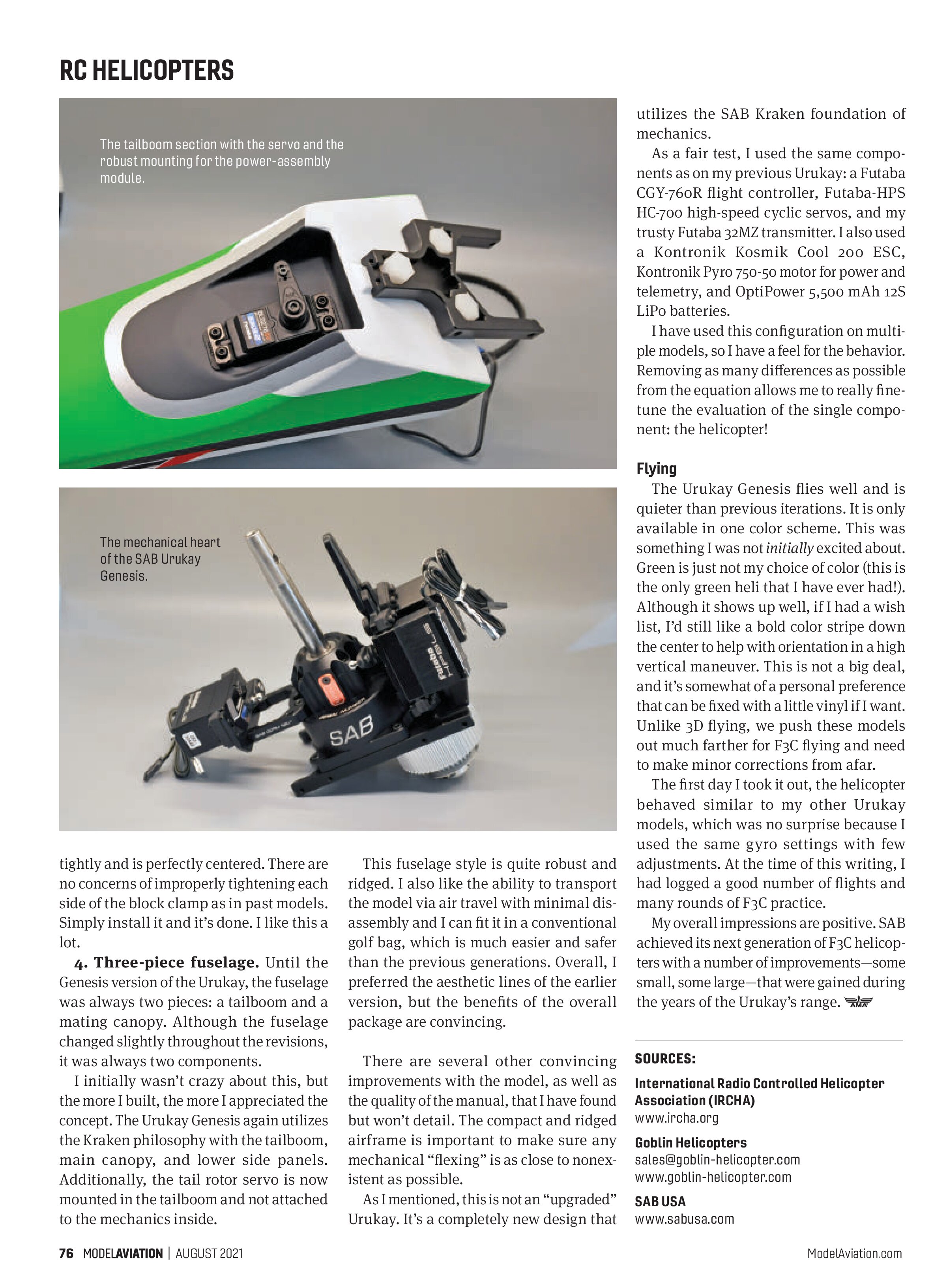
1. Departure of open gears to a fully enclosed transmission box. This box was introduced several years ago on SAB’s Kraken model. With the success of this component, it appears SAB is building on this on other models.
When I got my hands on this item, I began to like it more and more. In addition to keeping unwanted debris out of the gears, the actual casing also improves the structural integrity of the entire airframe. This transmission casing is the foundational building block of the entire model.
As a side benefit, this enclosed housing quiets the model greatly and has a good sound (something we like in the hovering maneuvers that are performed in front of judges).
2. Nearly vertical mounting of two of the three servos. This might not sound like a big deal but it is! With the airframes, servos, and other electronics that are made today, the level of “slop” in the control systems has greatly improved.
Simple, intuitive observation indicates that a vertical mount servo is significantly less likely to rock than one does on its side. This is especially important if a pull-pull control system is being used.
I’ll take the two-out-of-three improvement (and crank down on the horizontal servo). I’ve been told that physical room did not allow a third vertical servo.
3. The main shaft and rotor head. The actual blade grips and center hub are refined versions of past models and look and go together nicely. The big (really big!) change is a coned main shaft and a coned center head block.
For years, many of the top F3C pilots would spend a great deal of time ensuring the “trueness” of the head block to the main

shaft. This is all relevant to achieving the coveted “glass-smooth” flight (which is especially noticeable in a hover). This smooth operation only improves the performance of the flight controllers that we use.
The cone ensures that the shaft fits
tightly and is perfectly centered. There are no concerns of improperly tightening each side of the block clamp as in past models. Simply install it and it’s done. I like this a lot.
4. Three-piece fuselage.
Until the Genesis version of the Urukay, the fuselage was always two pieces: a tailboom and a mating canopy. Although the fuselage changed slightly throughout the revisions, it was always two components.
I initially wasn’t crazy about this, but the more I built, the more I appreciated the concept. The Urukay Genesis again utilizes the Kraken philosophy with the tailboom, main canopy, and lower side panels. Additionally, the tail rotor servo is now mounted in the tailboom and not attached to the mechanics inside.
This fuselage style is quite robust and ridged. I also like the ability to transport the model via air travel with minimal disassembly and I can fit it in a conventional golf bag, which is much easier and safer than the previous generations. Overall, I preferred the aesthetic lines of the earlier version, but the benefits of the overall package are convincing.
There are several other convincing improvements with the model, as well as the quality of the manual, that I have found but won’t detail. The compact and ridged airframe is important to make sure any mechanical “flexing” is as close to nonexistent as possible.
As I mentioned, this is not an “upgraded” Urukay. It’s a completely new design that utilizes the SAB Kraken foundation of mechanics.
As a fair test, I used the same components as on my previous Urukay: a Futaba CGY-760R flight controller, Futaba-HPS HC-700 high-speed cyclic servos, and my trusty Futaba 32MZ transmitter. I also used a Kontronik Kosmik Cool 200 ESC, Kontronik Pyro 750-50 motor for power and telemetry, and OptiPower 5,500 mAh 12S LiPo batteries.
I have used this configuration on multiple models, so I have a feel for the behavior. Removing as many differences as possible from the equation allows me to really fine-tune the evaluation of the single component: the helicopter!
Flying
The Urukay Genesis flies well and is quieter than previous iterations. It is only available in one color scheme. This was something I was not initially excited about. Green is just not my choice of color (this is the only green heli that I have ever had!). Although it shows up well, if I had a wish list, I’d still like a bold color stripe down the center to help with orientation in a high vertical maneuver. This is not a big deal, and it’s somewhat of a personal preference that can be fixed with a little vinyl if I want. Unlike 3D flying, we push these models out much farther for F3C flying and need to make minor corrections from afar.
The first day I took it out, the helicopter behaved similar to my other Urukay models, which was no surprise because I used the same gyro settings with few adjustments. At the time of this writing, I had logged a good number of flights and many rounds of F3C practice.
My overall impressions are positive. SAB achieved its next generation of F3C helicopters with a number of improvements—some small, some large—that were gained during the years of the Urukay’s range.


SOURCES:
International Radio Controlled Helicopter Association (IRCHA)
www.ircha.org
Goblin Helicopters
sales@goblin-helicopter.com
www.goblin-helicopter.com
SAB USA
www.sabusa.com