LET’S GET FLYING AGAIN!
By Bob Angel | samrcflier@verizon.net

THAT TITLE OR SOMETHING SIMILAR could possibly show up in one or more other columns, but it’s still appropriate. With mass vaccinations and a bit of pushback over government control of our lives, let’s hope that by the time this issue is published, life will be at least halfway back to normal.
Looking at the “AMA Sanctioned Event Calendar” for May and June 2021 (as I write this in early May), I see a healthy schedule of events and few cancellations. That’s a good sign, but until we all get flying once more, following is some recommended research for the many modelers who find the history of modeling and the Old-Timer (OT) movement more than a passing interest.
SAM Hall of Fame
The Society of Antique Modelers (SAM) has its own Hall of Fame, as do many SIGs. I’ve been perusing these lately and find that it’s especially interesting to read a more complete story about fellow modelers whom you know and occasionally mix with. It forms a nice basis for conversation when you learn that a fellow modeler also plays the guitar, writes science fiction, restores antique cars, is an astronaut, etc.
All Hall of Fame biographies reside on the SAM website. In 1989, the first 10 inductees included many well-known names of those who were born between 1894 and 1920, and most of whom lived long enough to see the birth of SAM.
SAM Website
The latest SAM Speaks (SAM’s official bimonthly journal) has an item about the website, to which I’ll add a little more without undue repetition. It’s one of the “cleanest” websites that I’ve seen on the internet. It’s open to all, without requiring registration or adding another darn password to your growing collection. There are no ads to divert your attention, encroach on your time, and generally annoy you. One click on the address takes you directly to the site’s homepage.
You’ll see a column of 24 sections listed down the left side of the homepage. Choose and click on a subject and you’re there. There are five separate how-to sections on engines, rubber power, electric power (yes, electric power is allowed), covering, and general building.
Under “Approved Lists” are entries of hundreds of old models, from gliders, rubber- and engine-powered models, and even engines themselves that are eligible for competition. You can find models by their name or the designer’s name, and there are many three-views of the aircraft.
You can find hundreds of action and event photos in the photo gallery, and a contest results section shows who has been competing with what results. Most of the results listings also show models and their flight times, and some list the engines that were used. The later postings include videos, which are still in their infancy and are sometimes a little slower to access.
The extensive newsletter section is a goldmine of general information from worldwide SAM chapters from years past to present. The complete SAM rule book is there, along with listings of vendors and services. You’d have to fill a shelf with modeling books in order to match the information available on this site for free.
I’ll mention one final item about the SAM Hall of Fame. Most of the biographies are complete, but a few lack details such as birth dates or, if appropriate, dates of the modeler’s passing. A few still lack photos. Surely someone can come up with a good facial photo of modelers such as Bill Northrop or Addie Naccarato. Hall of Fame members themselves shouldn’t be shy about adding to or correcting their biographies because many were originally written as autobiographical. Just contact the skilled Australian webmaster, Trevor Boundy, at his email address that is listed on the website under “Email Contacts.”
I’ll end this subject here. You’re on your own to explore this easy-to-navigate website.
Which Way?
A question arose recently in the Model Engine Collectors Association (MECA) bulletin regarding the direction of flight of Control Line (CL) aircraft. Most CL airplanes today are flown in the counterclockwise direction as viewed from above. But in the beginning days of CL, the preferred direction was

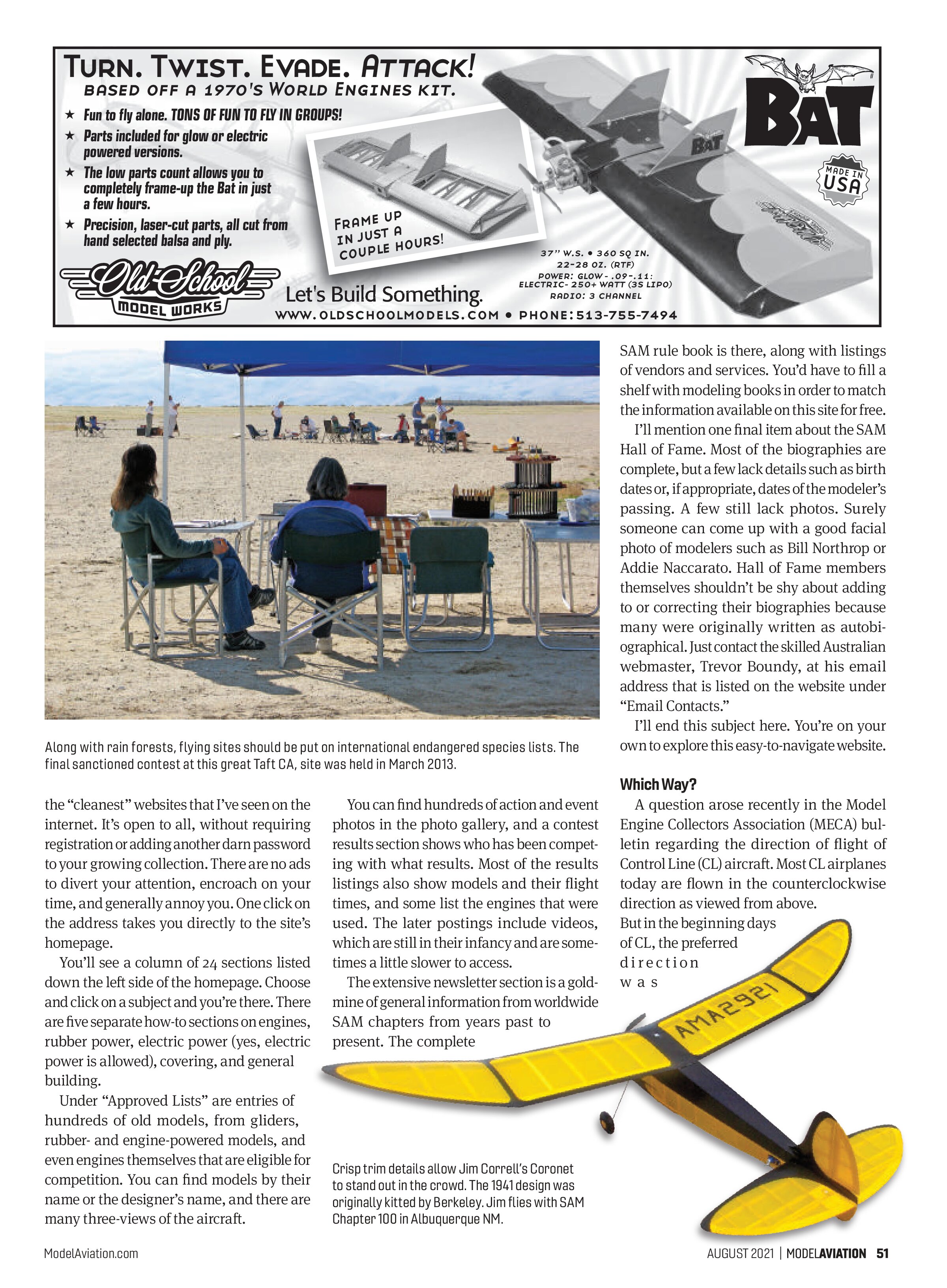
Along with rain forests, flying sites should be put on international endangered species lists. The final sanctioned contest at this great Taft CA, site was held in March 2013.

clockwise. Inverted flight had hardly been envisioned then, so clockwise made good sense at the time.
With the engine and propeller rotation predominantly counterclockwise as viewed from the front of the engine, by flying clockwise, propeller torque helped offset the weight of the control lines, especially during takeoff. Less weight was also needed in the outboard wingtip to help the model fly level.
The changeover started around the 1940s, along with inverted flight. Flying inverted was fairly “iffy” at first, so it was probably felt that the propeller torque was needed more when inverted than upright. Because most flying is done upright, it seems more natural and safer (at least for right-handers) to rotate in the direction of more open visibility.
Tonky
In the November 1972 edition of Model Builder magazine, Dale Kirn published plans for a 1/2A CL Profile Proto Speed aircraft called Tonky. AMA had created the event for Junior modelers only.
Dale explained how torque affected smaller airplanes more than larger ones. Rather than recommending clockwise flight as the solution, he recommended using a left-handed crankshaft, which was available for the Cox Tee Dee .049 front rotary engine. A left-handed propeller was also required, with the combination providing torque in the proper direction to ensure more successful takeoffs.
Correction
Al Lidberg was pictured launching a model in my April column, but there was a small typo in his name. I missed noting that in proofing and apologize to the family and his son, Chris, who is also a modeler and ably took over managing the annual Southwest Regionals event after his father passed away.
Al had managed the Southwest Regionals for years, after he and Bob Angus rescued the event from collapse in approximately 1990. Al is also a SAM Hall of Fame member.
The Southwest Regionals has been a long-time go-to event in Arizona and is held early each year. I recall first going many years ago when, along with Free Flight (FF) events, it still featured CL flying on the tarmac at the Buckeye, Arizona, airport. That year was an exciting one for my CL club in Santa Maria, California.
Approximately eight of us flew over in a twin Beechcraft aircraft, which was contracted to haul the mail in and out of Santa Maria. One club member also happened to be the mail airplane pilot, and we just had to buy gas. We took backpacking tents and sleeping bags and literally slept under the wing at the flying site.
Because of “progress” at the Buckeye airport, the event was later moved to a larger, open area in Eloy, Arizona. Today, the events flown include AMA, FAI, and SAM FF events, and there is also room for SAM OT RC, with good separation between the launch areas.
The event transpired last year as scheduled, except, because of the pandemic that affected seniors more, the Speed 400 OT RC portion was relegated to a Postal Contest.
SOURCES:
MECA
www.modelenginecollectors.org
DigitecBooks
cardinal.eng@grics.net
www.digitekbooks.com