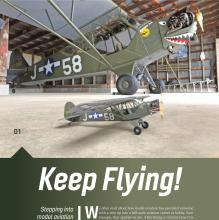

Keep Flying!
Stepping into model aviation from full-scale aviation
By Pierre J. Moeser
Photos by the author and as noted
pjmoeser@gmail.com
We often read about how model aviation has provided someone with a step up into a full-scale aviation career or hobby. Sure enough, that applies to me. After flying a Control Line Cox Thimble-Drome U.S. Navy Helldiver a long time ago as a kid, I developed a yearning to fly full-scale aircraft.
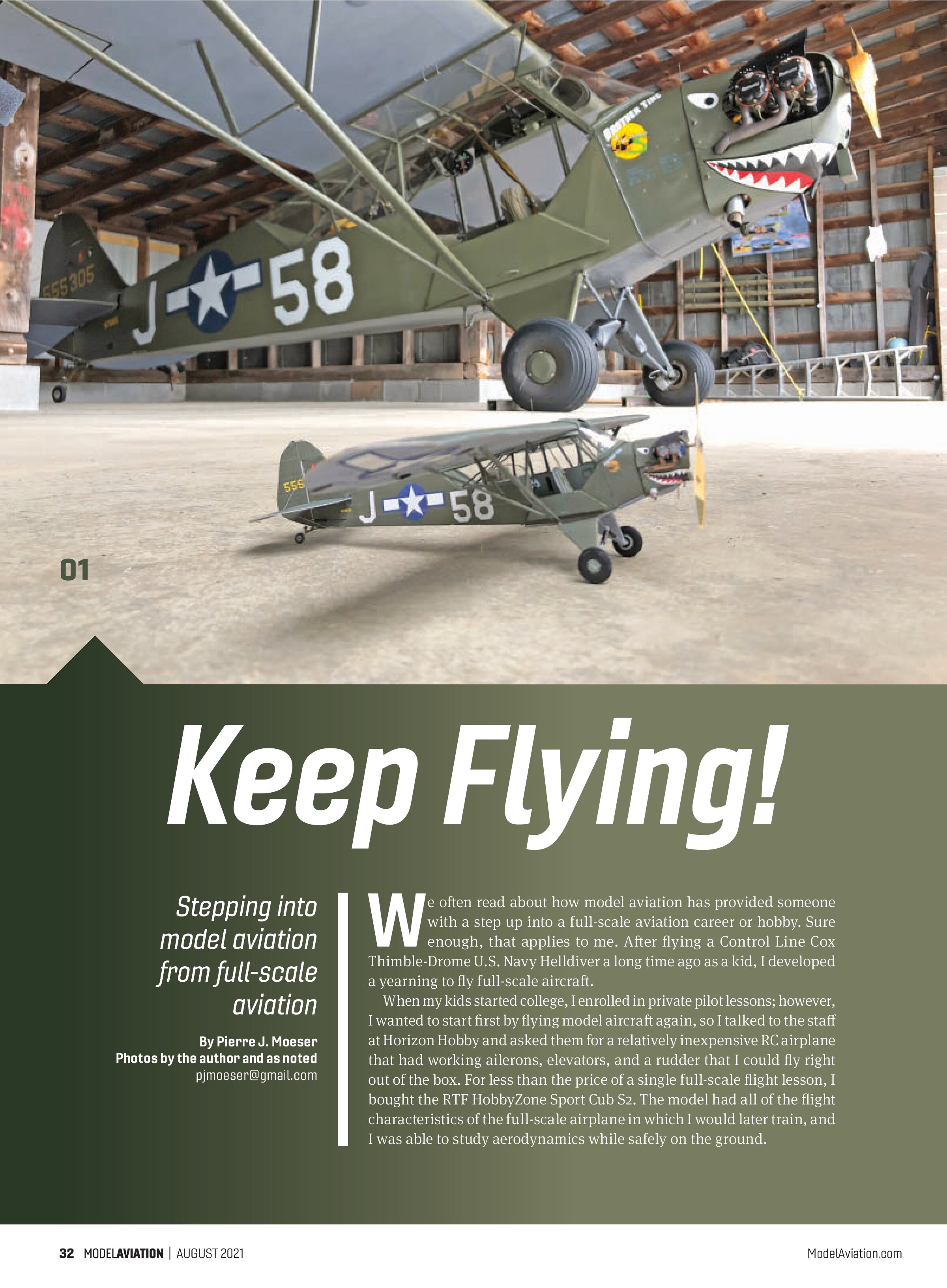
When my kids started college, I enrolled in private pilot lessons; however, I wanted to start first by flying model aircraft again, so I talked to the staff at Horizon Hobby and asked them for a relatively inexpensive RC airplane that had working ailerons, elevators, and a rudder that I could fly right out of the box. For less than the price of a single full-scale flight lesson, I bought the RTF HobbyZone Sport Cub S2. The model had all of the flight characteristics of the full-scale airplane in which I would later train, and I was able to study aerodynamics while safely on the ground.
How about the reverse scenario? Can model aviation help pilots who are no longer able to fly full-scale aircraft (temporarily or permanently) to continue to enjoy aviation? The answer is “absolutely yes!”
To start, let’s look at the term, “sidestep.” In hospitals, patients whose conditions are improving are moved from the Intensive Care Unit to a step-down unit for lower-acuity care. In moving from full-scale to model aviation, the term sidestep is more appropriate than “step-down” because the difficulty of flying models, in some cases, can meet or exceed the difficulty of full-scale flight.
In model aviation, there is no pilot aboard the aircraft to make the small adjustments needed for a successful flight. Necessary adjustments need to be completed during the model’s preflight or adjustments can be made via remote control when flying RC.
Many characteristics of model aviation create an easy sidestep transition from flying full-scale aircraft. The two model aviation aspects that offer the greatest satisfaction to full-scale pilots are the flight controls and FPV.
For those who are uninitiated into the world of model aviation, the basic flight controls for an RC airplane are identical to those of a full-scale aircraft. This is because the laws of aerodynamics don’t change, regardless of the size of the aircraft. You still “pitch for airspeed and power for altitude.”
Coordinated flight trumps a sideslip in both a model and a full-scale airplane. Drag, thrust, lift, and weight all apply equally to a micro model weighing slightly more than 0.7 ounces and a commercial Airbus A321 with a takeoff weight of 183,000 pounds.
One of the most enjoyable aspects of flying full-scale aircraft is the amazing view. Thanks to modern, lightweight cameras, we can attain those first-person views in RC airplanes and rotorcraft.
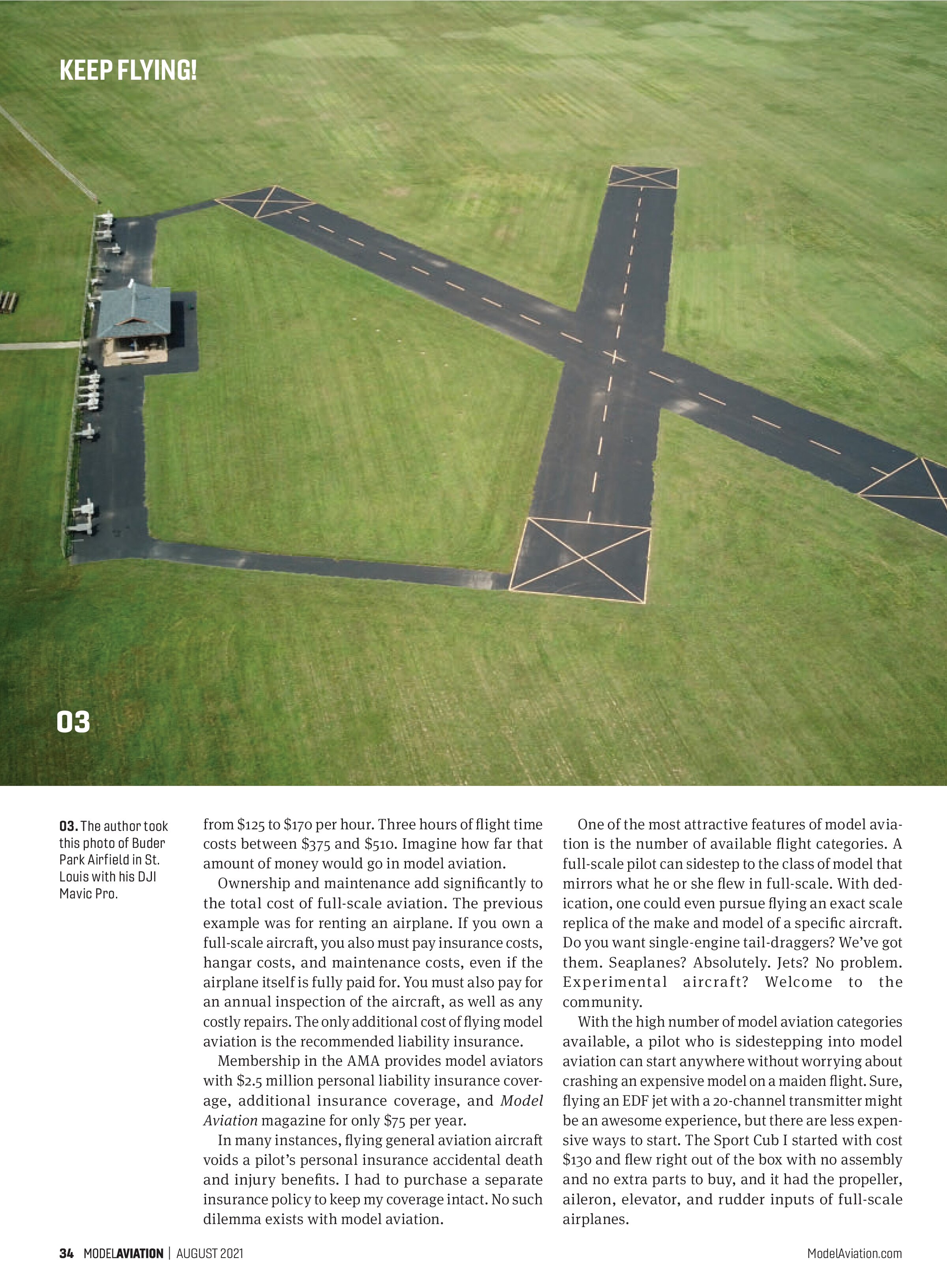
I have included a photo of Buder Park Airfield in St. Louis, taken with my DJI Mavic Pro quadcopter. I can film smooth cinematography, or I can select a fixed-wing mode that makes the view from my drone look like I am back flying an airplane instead of a quadcopter.
Model aviation is a hobby that is easy to enter at multiple points and at virtually any price point. When compared with full-scale aviation, model aviation allows a pilot to jump many of the usual barriers that are encountered in full-scale flight.
Many full-scale aviation pilots lose their medical certification because of illness or age-related decline. Model aviation has no age limit and offers a broad range of flight possibilities for multiple levels of physical ability.
There is a huge cost difference between model and full-scale aviation. Renting a modest, four-passenger, single-engine Cessna 172 in the St. Louis area ranges


from $125 to $170 per hour. Three hours of flight time costs between $375 and $510. Imagine how far that amount of money would go in model aviation.
Ownership and maintenance add significantly to the total cost of full-scale aviation. The previous example was for renting an airplane. If you own a full-scale aircraft, you also must pay insurance costs, hangar costs, and maintenance costs, even if the airplane itself is fully paid for. You must also pay for an annual inspection of the aircraft, as well as any costly repairs. The only additional cost of flying model aviation is the recommended liability insurance.
Membership in the AMA provides model aviators with $2.5 million personal liability insurance coverage, additional insurance coverage, and Model Aviation magazine for only $75 per year.
In many instances, flying general aviation aircraft voids a pilot’s personal insurance accidental death and injury benefits. I had to purchase a separate insurance policy to keep my coverage intact. No such dilemma exists with model aviation.
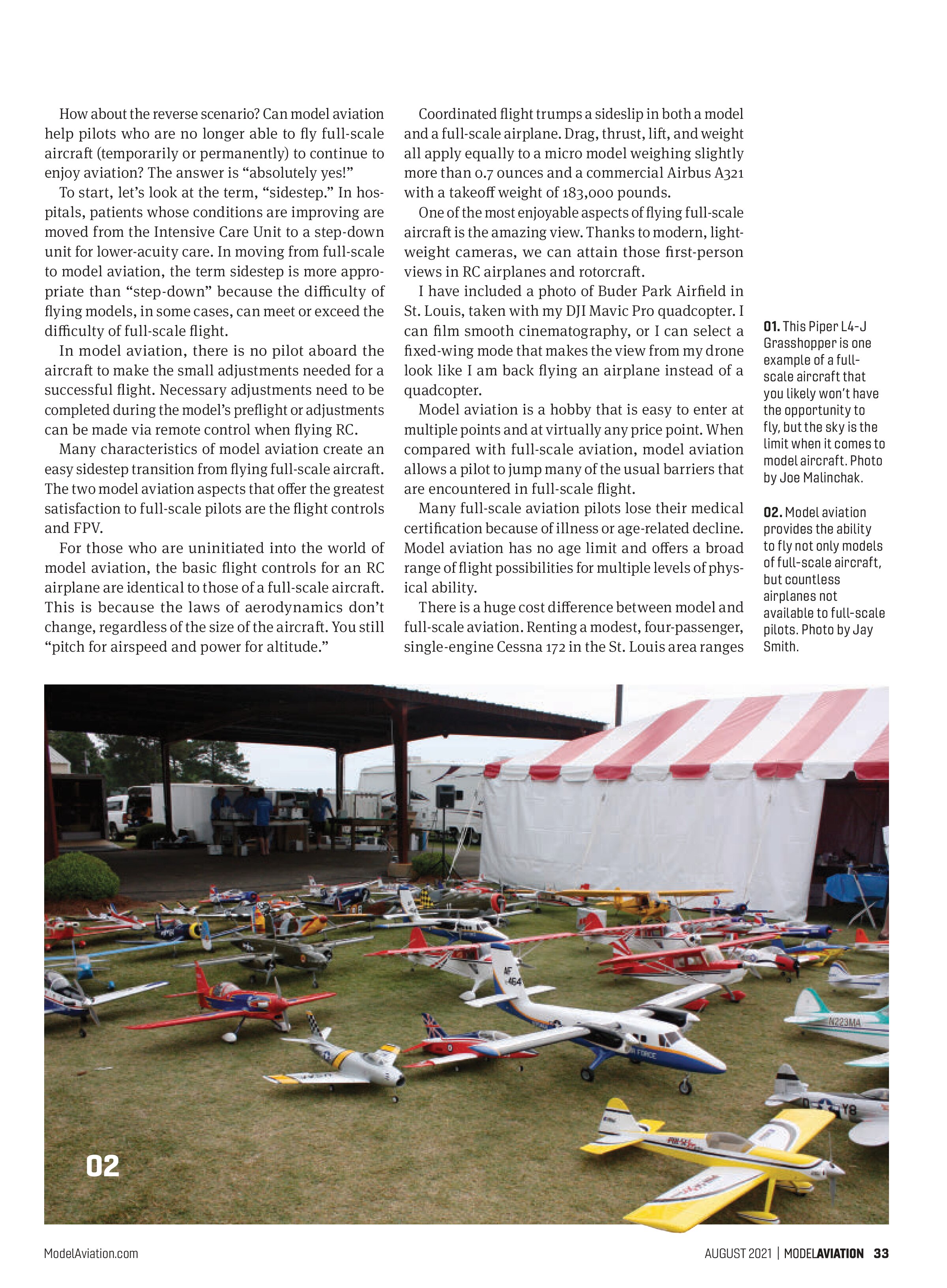
One of the most attractive features of model aviation is the number of available flight categories. A full-scale pilot can sidestep to the class of model that mirrors what he or she flew in full-scale. With dedication, one could even pursue flying an exact scale replica of the make and model of a specific aircraft. Do you want single-engine tail-draggers? We’ve got them. Seaplanes? Absolutely. Jets? No problem. Experimental aircraft? Welcome to the community.
With the high number of model aviation categories available, a pilot who is sidestepping into model aviation can start anywhere without worrying about crashing an expensive model on a maiden flight. Sure, flying an EDF jet with a 20-channel transmitter might be an awesome experience, but there are less expensive ways to start. The Sport Cub I started with cost $130 and flew right out of the box with no assembly and no extra parts to buy, and it had the propeller, aileron, elevator, and rudder inputs of full-scale airplanes.

If a pilot is still nervous about where to start and how much to spend, he or she should invest in RC flight simulator software, such as RealFlight. With a simulator, multiple fixed-wing and rotorcraft models can be flown (and crashed) before any additional money is spent.
Let’s say that a full-scale pilot sidesteps into model aviation and has always wanted to fly something rare and delicate, such as the Blériot XI. In full-scale aviation, there are only two flying examples in the world of this 100-plus-year-old historic airplane that was the first to fly over the English Channel in 1909. Those two Blériot XI relics are rarely flown and are not available for public use. In the model aviation hobby, it is possible to purchase plans or completed models of the Blériot XI. I found 20 models and plans available on the internet in less than 5 minutes.
A model aviation pilot can easily switch classes without the expensive training required of a full-scale pilot. I was surprised to learn that RC modeling even includes lighter-than-air aircraft, such as balloons and dirigibles. Again, with the current availability of RC flight simulators, many new classes and model of RC aircraft can be tried without the agony and cost of rebuilding crashed models.
Finally, one class of full-scale aviators deserves special consideration. Only 20% of student pilots finish their training and obtain pilot’s licenses. Part of the reason for the 80% dropout rate is the cost. A student pilot learning to fly a high-wing, tricycle-gear, full-scale Cessna 152 will take an average of 60 to 75 flight hours of lessons and spend an average of $10,000 to obtain a private pilot’s license.
A model aviation novice can learn to fly a high-wing, tricycle-gear Mini Apprentice in an afternoon at a cost of $250 with no license required. To this point, a full-scale student pilot sidestepping into flying model aircraft will realize a tremendous cost saving.
Big or small, simple or complex, there is a model aircraft out there for every taste and of every design. To help you learn about this fascinating hobby, there are plenty of passionate members in the model aviation community. The AMA has every resource that a pilot needs to get into model aviation. AMA represents every great special interest group in model aviation. The gateway website into this fascinating hobby is www.modelaircraft.org.
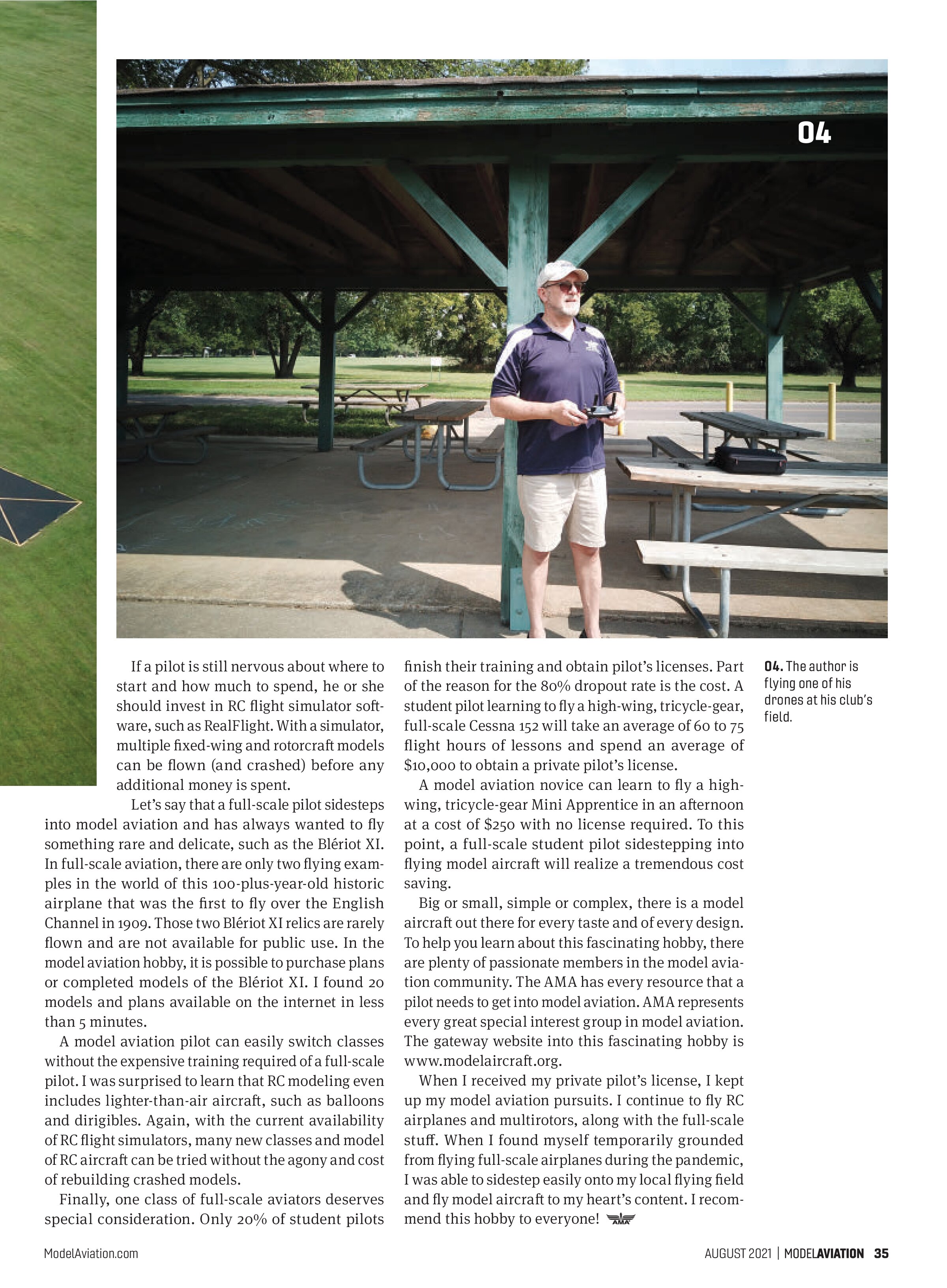
When I received my private pilot’s license, I kept up my model aviation pursuits. I continue to fly RC airplanes and multirotors, along with the full-scale stuff. When I found myself temporarily grounded from flying full-scale airplanes during the pandemic, I was able to sidestep easily onto my local flying field and fly model aircraft to my heart’s content. I recommend this hobby to everyone!