FOCAL POINT
Interested in sharing your handiwork? Visit www.ModelAviation.com for submission guidelines.

Foam Board-Constructed Jet
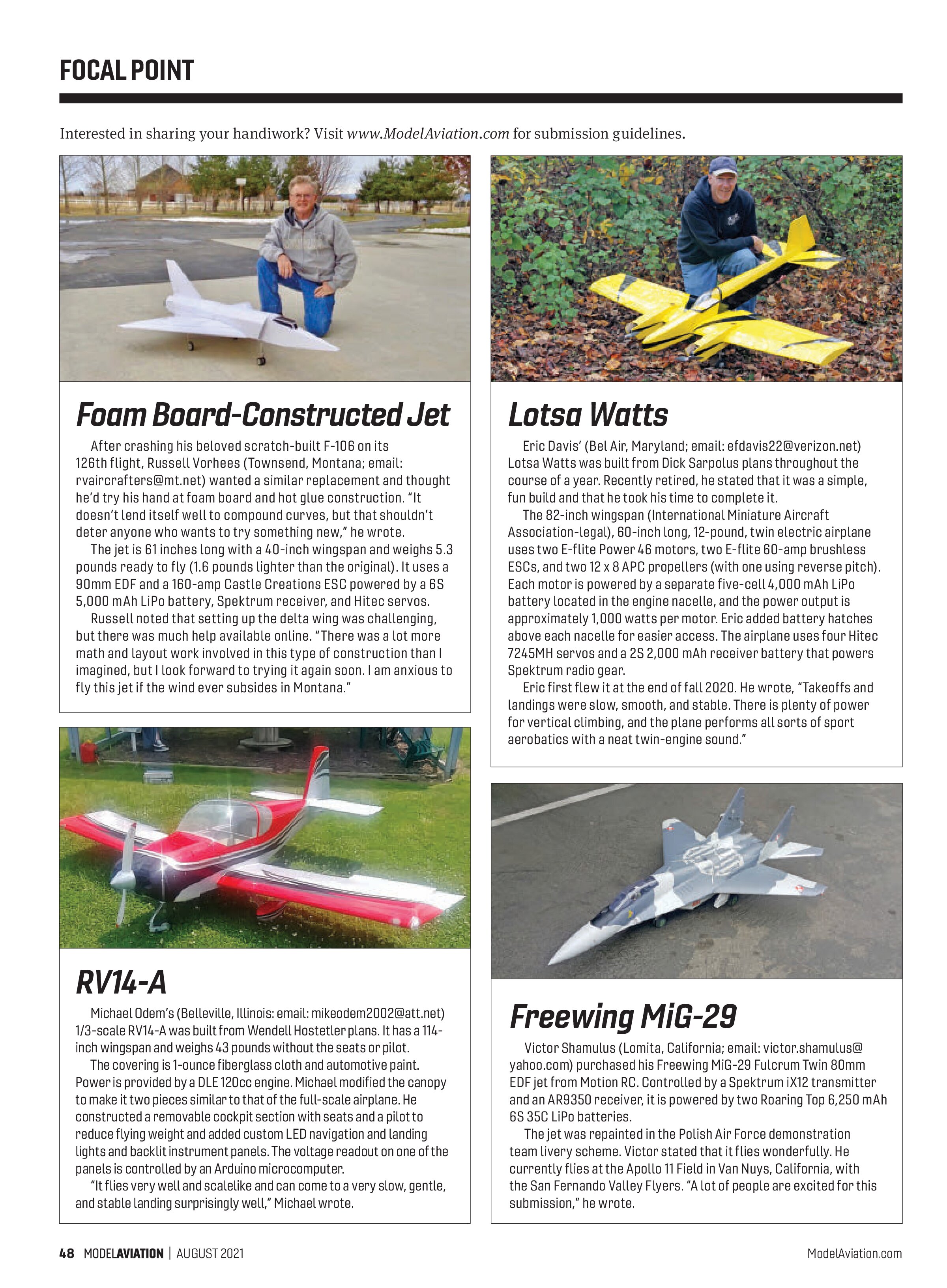
After crashing his beloved scratch-built F-106b on its 126th flight, Russell Vorhees (Townsend, Montana; email: rvaicrafters@mt.net) wanted a similar replacement and thought he’d try his hand at foam board and hot glue construction. “It doesn’t lend itself well to compound curves, but that shouldn’t deter anyone who wants to try something new,” he wrote.
The jet is 61 inches long with a 40-inch wingspan and weighs 5.3 pounds ready to fly (1.6 pounds lighter than the original). It uses a 90mm EDF and a 160-amp Castle Creations ESC powered by a 6S 5,000 mAh LiPo battery, Spektrum receiver, and Hitec servos.
Russell noted that setting up the delta wing was challenging, but there was much help available online. “There was a lot more math and layout work involved in this type of construction than I imagined, but I look forward to trying it again soon. I am anxious to fly this jet if the wind ever subsides in Montana.”

RV1/4-A
Michael Odem’s (Belleville, Illinois; email: mikeodem2002@att.net) 1/3-scale RV14-A was built from Wendell Hostetler plans. It has a 114-inch wingspan and weighs 43 pounds without the seats or pilot.
The covering is 1-ounce fiberglass cloth and automotive paint. Power is provided by a DLE 120cc engine. Michael modified the canopy to make it two pieces similar to that of the full-scale airplane. He constructed a removable cockpit section with seats and a pilot to reduce flying weight and added custom LED navigation and landing lights and backlit instrument panels. The voltage readout on one of the panels is controlled by an Arduino microcomputer.
“It flies very well and scalelike and can come to a very slow, gentle, and stable landing surprisingly well,” Michael wrote.

Sig Smith Miniplane
Ken Hollman (Hurricane, Utah; email: hollmank@sbcglobal.net) shared a model that he recently completed, describing it as “the first build I have completed in about 40 years.” The Sig Manufacturing Smith Miniplane kit was originally sold in California in 1984 and was given to Ken by his brother as a project while he underwent treatment for a rare blood disease.
Originally designed for glow power, Ken modified the Miniplane for electric power. It’s outfitted with a 1,650-watt motor, 100-amp ESC, a 13 x 8 propeller, and controlled by a Spektrum transmitter and receiver.
Ken stated that he will maiden the Smith Miniplane with his brother when the weather warms up. “I enjoyed the work and really like the outcome.” He flies at the Remote Possibilities RC Club in St. George, Utah.

Olympic II Glider
Dave Siegler’s (New Berlin, Wisconsin; email: dwsiegler@gmail.com) Olympic II glider was a recent rebuild, with all of the covering removed and some construction problems repaired.
The airplane had flown on a winch and was very tail-heavy, so the nose block was cut off and a SuperTigre 10-size electric outrunner motor was installed. A new canopy hatch was fabricated and the area under the canopy was modified to fit the battery. The servos were moved back beneath the wing to make space for a 3,000 mAh three-cell LiPo battery pack and a 28-amp ESC. Hitec metal-gear servos were also used.
The glider’s covering is a mixture of MonoKote and UltraCote scraps and the wing is covered with Nuecoover.

Avios C-130 to DC-130
Robert Husar (Granada Hills, California; email: robert.husar@eas.enersys.com) is a member of the Coachella Valley Radio Control Club in Thermal, California. He modified the Avios C-130 into the DC-130 drone carrier of the 432nd Tactical Drone Group of Tactical Air Command at Davis-Monthan Air Force Base. The 432nd graphics are by Callie Graphics.
Four 3D-printed Firebee target drones are mounted under the wing balsa pylons. “In real-life operations, some of the target drones were modified for reconnaissance missions and redesignated as AQM-34 [drones],” he wrote.
The stock Avios C-130 from HobbyKing was previously featured in Model Aviation and has a wingspan of 63 inches. Test flights were performed with two outboard drones with no adverse effects; however, Robert stated that with adding the two inboard drones, additional power was needed to maintain normal flight, despite placing them lower than the outboard drones.

1936 Dallaire Sportster
Charles Morganti (Tyler, Texas; email: chacon@suddenlink.net) submitted his 1936 Dallaire Sportster. He wrote, “In 1936, the Dallaire was designed to be a Free Flight model; today, nearly all are gas-powered RC airplanes.”
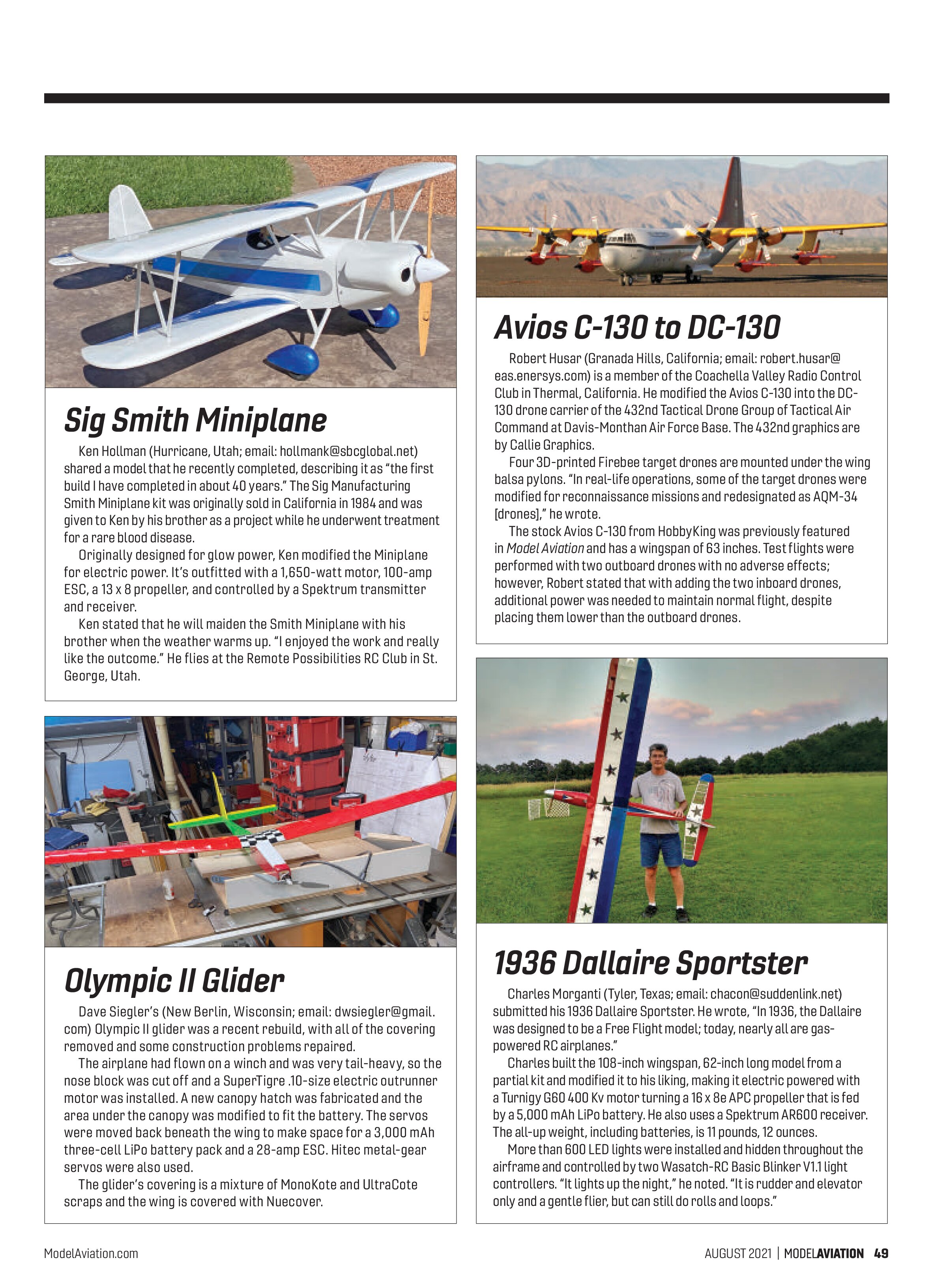
Charles built the 108-inch wingspan, 62-inch long model from a partial kit and modified it to his liking, making it electric powered with a Turnigy G60 400 Kv motor turning a 16 x 8e APC propeller that is fed by a 5,000 mAh LiPo battery. He also uses a Spektrum AR600 receiver. The all-up weight, including batteries, is 11 pounds, 12 ounces.
More than 600 LED lights were installed and hidden throughout the airframe and controlled by two Wasatch-RC Basic Blinker V1.1 light controllers. “It lights up the night,” he noted. “It is rudder and elevator only and a gentle flier, but can still do rolls and loops.”