The Deal with Drones

Would You Trust an Open-Source Control Link?
By Joshua Bardwell | joshuabardwell@fpvknowitall.com
AS LONG AS RC HAS existed, pilots have searched for the most reliable control link possible. The 72 MHz analog links offered excellent range but would go into failsafe if another pilot powered up on the same frequency. (My apologies to those who still fly 72 MHz and might be insulted that I used the past tense.) The 2.4 GHz spread spectrum systems, first developed by Horizon Hobby, have a shorter range than 72 MHz but have great resistance to interference.
In the last few years, long-range systems using LoRa technology in the 900 MHz and 2.4 GHz bands—most notably the TBS Crossfire—have gained popularity for their excellent range and low latency. These systems are all developed by professional engineers, working for a company selling you a product. That company will lose business if its control link goes into failsafe too easily, which provides a sort of accountability.
So why is ExpressLRS, an open-source, noncommercial technology, attracting so much interest? And what can ExpressLRS do that a commercial control link can’t or won’t?
Open-source means that the program code for the project is published publicly and is available for anyone to modify and contribute to. Open-source projects are often distributed and worked on for free. That’s the case with ExpressLRS. The developers are RC flight enthusiasts with a background in programming, who set out to design the longest-range and lowest-latency control link possible.
Similar to TBS Crossfire and ImmersionRC Ghost (both of which I wrote about in a previous column), ExpressLRS uses the LoRa technology developed by SemTech. This means you can get tens of kilometers of range, even on relatively low-powered transmitters and without specialized antennas. That’s true of all LoRa control links, so what makes ExpressLRS special? The ExpressLRS developers have made their data packets as small as possible, so you get longer range and/or faster packet update rates compared with Crossfire and Ghost, all else being equal.
When comparing modern, long-range control links, some people argue that range tests are pointless. If the typical pilot flies at a distance of 1 to 2 km, what difference does it make if one control link goes 60 km and another goes 80 km? Neither will go into failsafe for that pilot!
The counterargument is that longer range also equals longer penetration, and drone pilots are more likely to fly behind obstacles. (Note: The FAA and AMA safety guidelines require pilots to always maintain visual line of sight [VLOS] with their aircraft.) Additionally, when a control link is configured for the lowest possible latency, range often decreases significantly, so a link that can go 50 km at an update rate of 50 Hz might only go 10 km at an update rate of 250 Hz. These are all reasons why long-range is still relevant, even for pilots who only fly at typical distances of a few km or less.

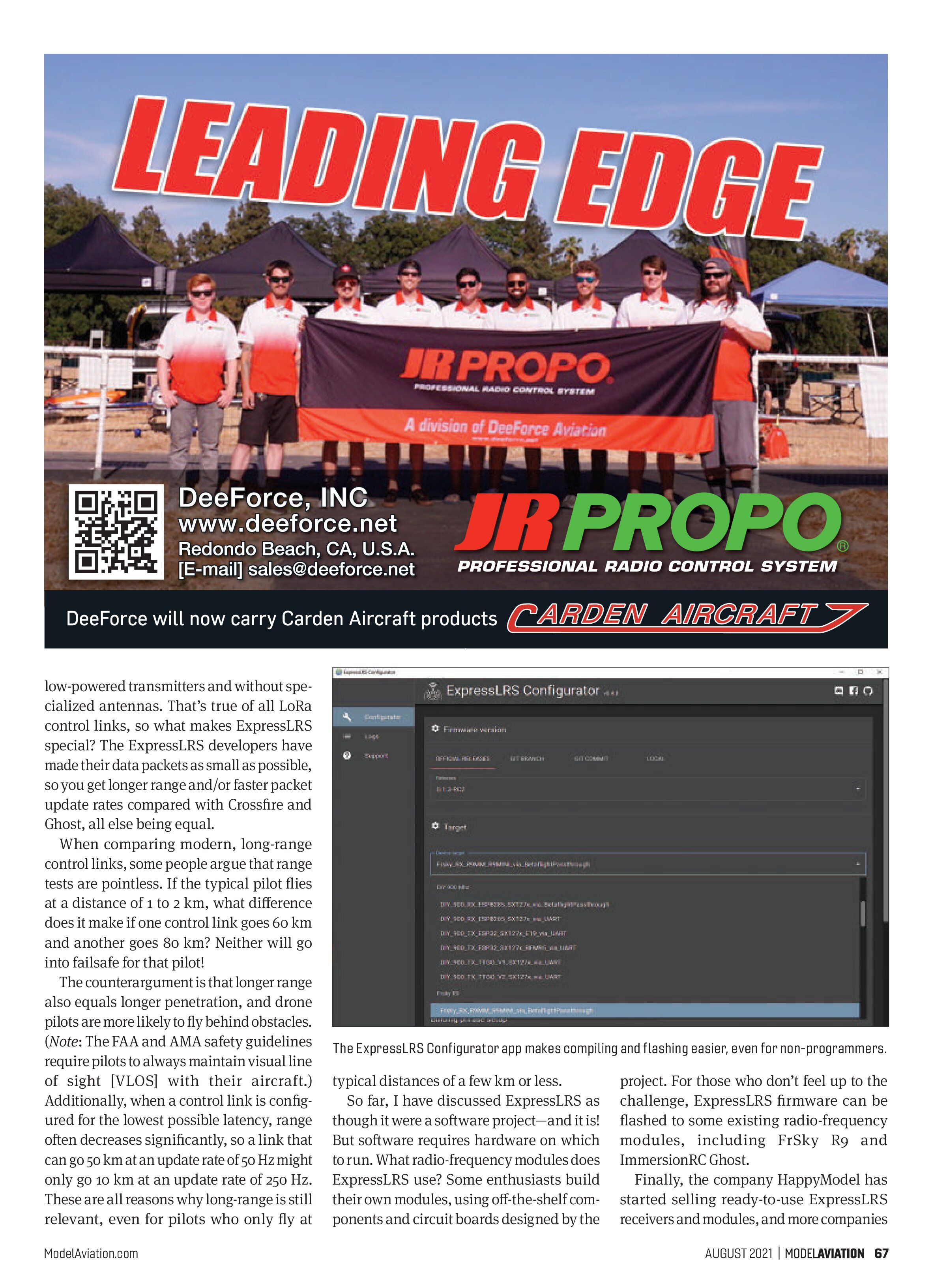
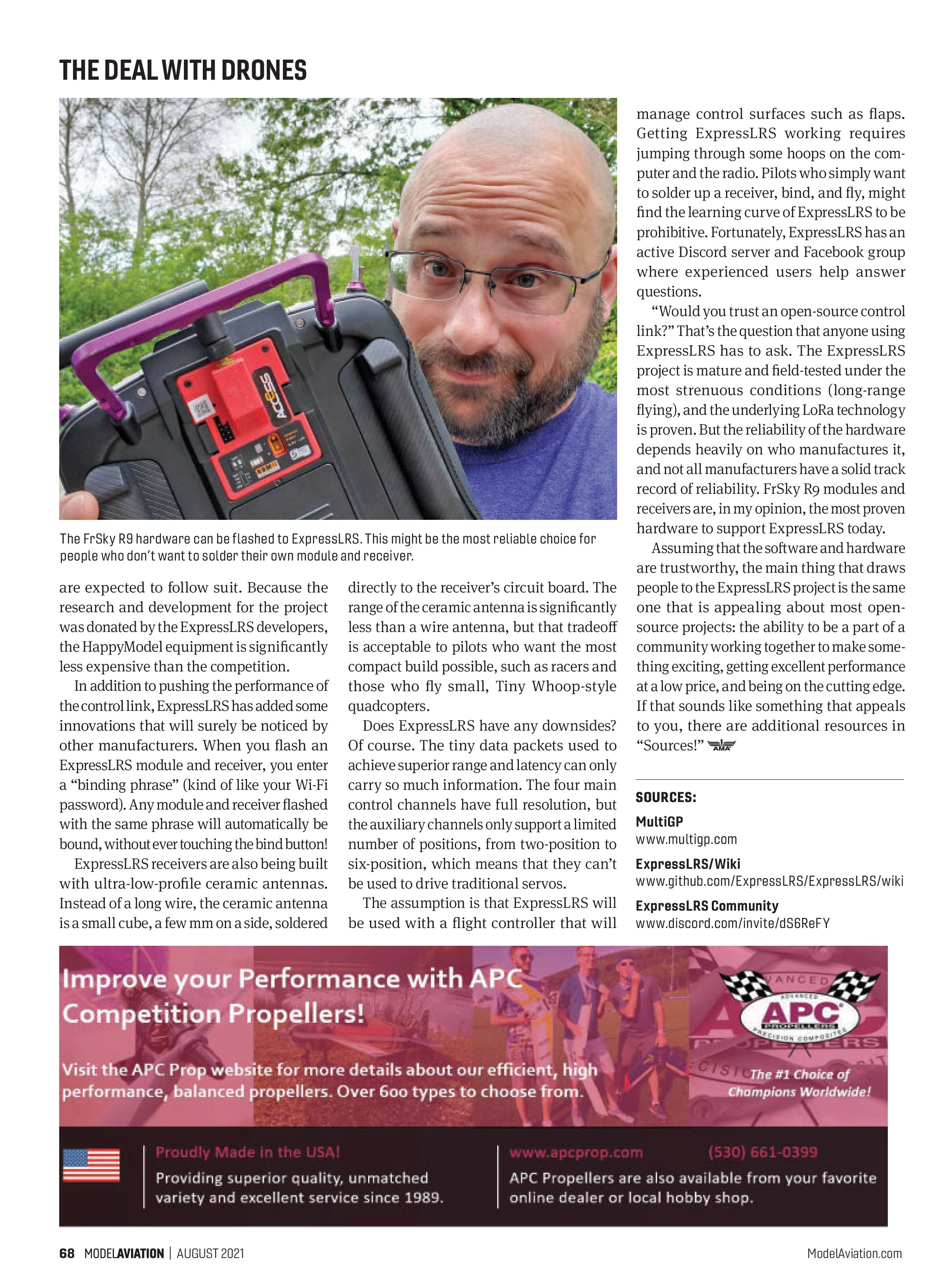
So far, I have discussed ExpressLRS as though it were a software project—and it is! But software requires hardware on which to run. What radio-frequency modules does ExpressLRS use? Some enthusiasts build their own modules, using off-the-shelf components and circuit boards designed by the project. For those who don’t feel up to the challenge, ExpressLRS firmware can be flashed to some existing radio-frequency modules, including FrSky R9 and ImmersionRC Ghost.
Finally, the company HappyModel has started selling ready-to-use ExpressLRS receivers and modules, and more companies

are expected to follow suit. Because the research and development for the project was donated by the ExpressLRS developers, the HappyModel equipment is significantly less expensive than the competition.
In addition to pushing the performance of the control link, ExpressLRS has added some innovations that will surely be noticed by other manufacturers. When you flash an ExpressLRS module and receiver, you enter a “binding phrase” (kind of like your Wi-Fi password). Any module and receiver flashed with the same phrase will automatically be bound, without ever touching the bind button!
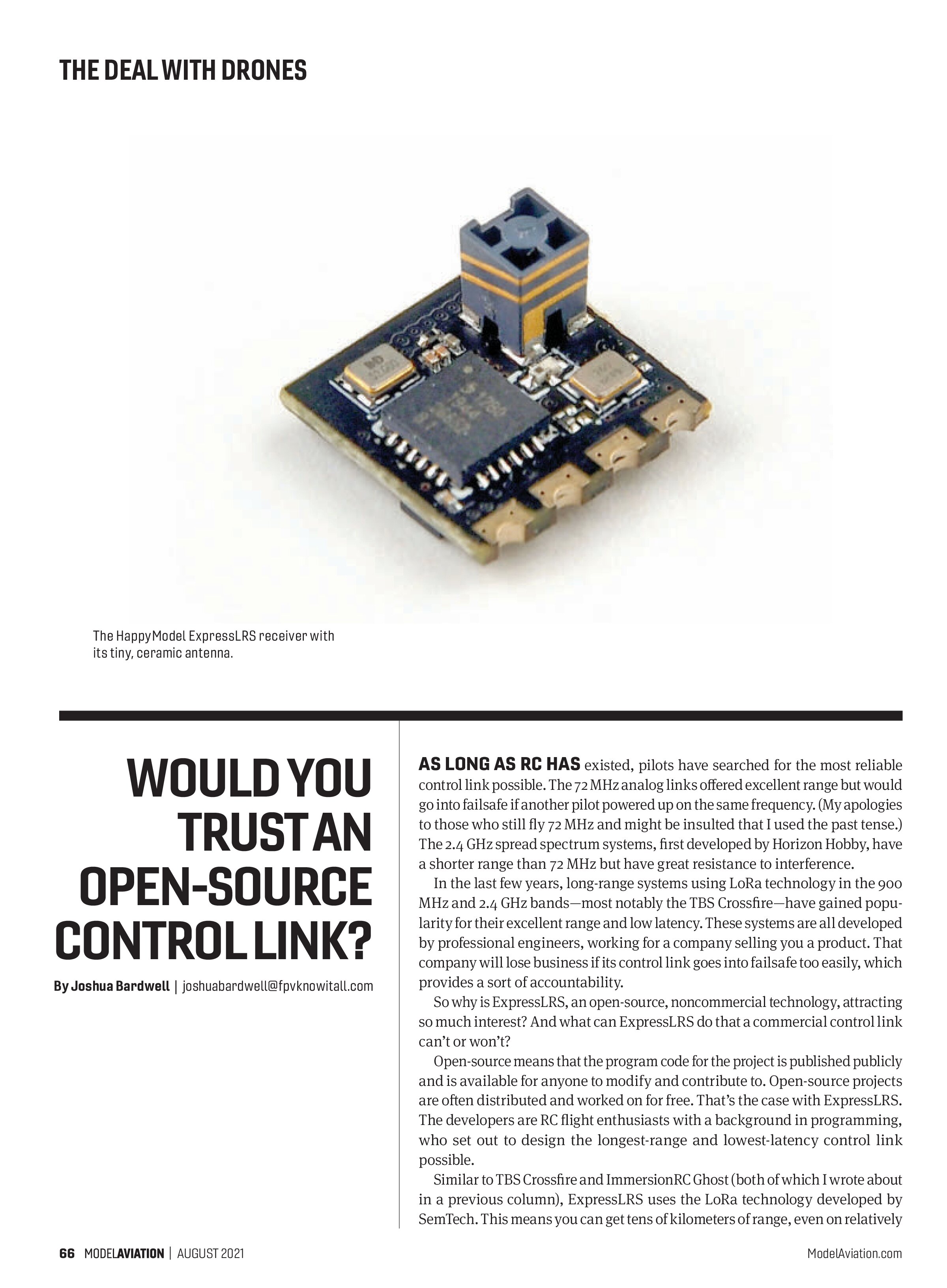
ExpressLRS receivers are also being built with ultra-low-profile ceramic antennas. Instead of a long wire, the ceramic antenna is a small cube, a few mm on a side, soldered directly to the receiver’s circuit board. The range of the ceramic antenna is significantly less than a wire antenna, but that tradeoff is acceptable to pilots who want the most compact build possible, such as racers and those who fly small, Tiny Whoop-style quadcopters.
Does ExpressLRS have any downsides? Of course. The tiny data packets used to achieve superior range and latency can only carry so much information. The four main control channels have full resolution, but the auxiliary channels only support a limited number of positions, from two-position to six-position, which means that they can’t be used to drive traditional servos.
The assumption is that ExpressLRS will be used with a flight controller that will manage control surfaces such as flaps. Getting ExpressLRS working requires jumping through some hoops on the computer and the radio. Pilots who simply want to solder up a receiver, bind, and fly, might find the learning curve of ExpressLRS to be prohibitive. Fortunately, ExpressLRS has an active Discord server and Facebook group where experienced users help answer questions.
“Would you trust an open-source control link?” That’s the question that anyone using ExpressLRS has to ask. The ExpressLRS project is mature and field-tested under the most strenuous conditions (long-range flying), and the underlying LoRa technology is proven. But the reliability of the hardware depends heavily on who manufactures it, and not all manufacturers have a solid track record of reliability. FrSky R9 modules and receivers are, in my opinion, the most proven hardware to support ExpressLRS today.
Assuming that the software and hardware are trustworthy, the main thing that draws people to the ExpressLRS project is the same one that is appealing about most open-source projects: the ability to be a part of a community working together to make something exciting, getting excellent performance at a low price, and being on the cutting edge. If that sounds like something that appeals to you, there are additional resources in “Sources!”
SOURCES:
MultiGP
www.multigp.com
ExpressLRS/Wiki
www.github.com/ExpressLRS/ExpressLRS/wiki
ExpressLRS Community
www.discord.com/invite/dS6ReFY