FIFTY YEARS AGO: APRIL 1971
By Bob Noll | bobrc@aol.com
YOU GUESSED IT! It’s time to see what was going on in RC model aviation 50 years ago. Thanks to my magazine library, I was again able to pull out four April 1971 magazines: Radio Control Modeler (RCM), Model Airplane News (MAN), American Aircraft Modeler (AAM), and Flying Models (FM). These popular US model magazines provided me with a lot of fun and memory recalls as I paged through them.
Before I check out the magazine articles, let me tell you about a clever gadget that a friend sent me. I thought I had seen most of the gadgets that came along at least 50 years ago, but this one was new to me.
I received it from Ron Ogren, a fellow Vintage Radio Control Society (VRCS) member. The SPINIT is a spring-driven glow-engine starter. It comes with two sizes of nosecone adapters and must be “wound up” to energize the internal drive spring. To operate it, simply center the SPINIT so that the two arms engage the propeller and release the internal spring by pressing a release lever.
Magazine Articles
MAN carried a Lanier Industries ad that advertised the company’s “New Custom Control Extruder,” which was able to produce its own AIR-O-SHEET for quality wing covering. Lanier also advertised its “New Hard Wing Covering” and a new process to permanently bond this covering to molded wings.
Brent Rausch published a Scale Henschel Hs 129B. This twin-engine German airplane was a specially developed anti-tank aircraft during World War II. It was a blend between a Nick Ziroli Plans and a Dave Platt type of airplane and powered by Enya .35 engines.

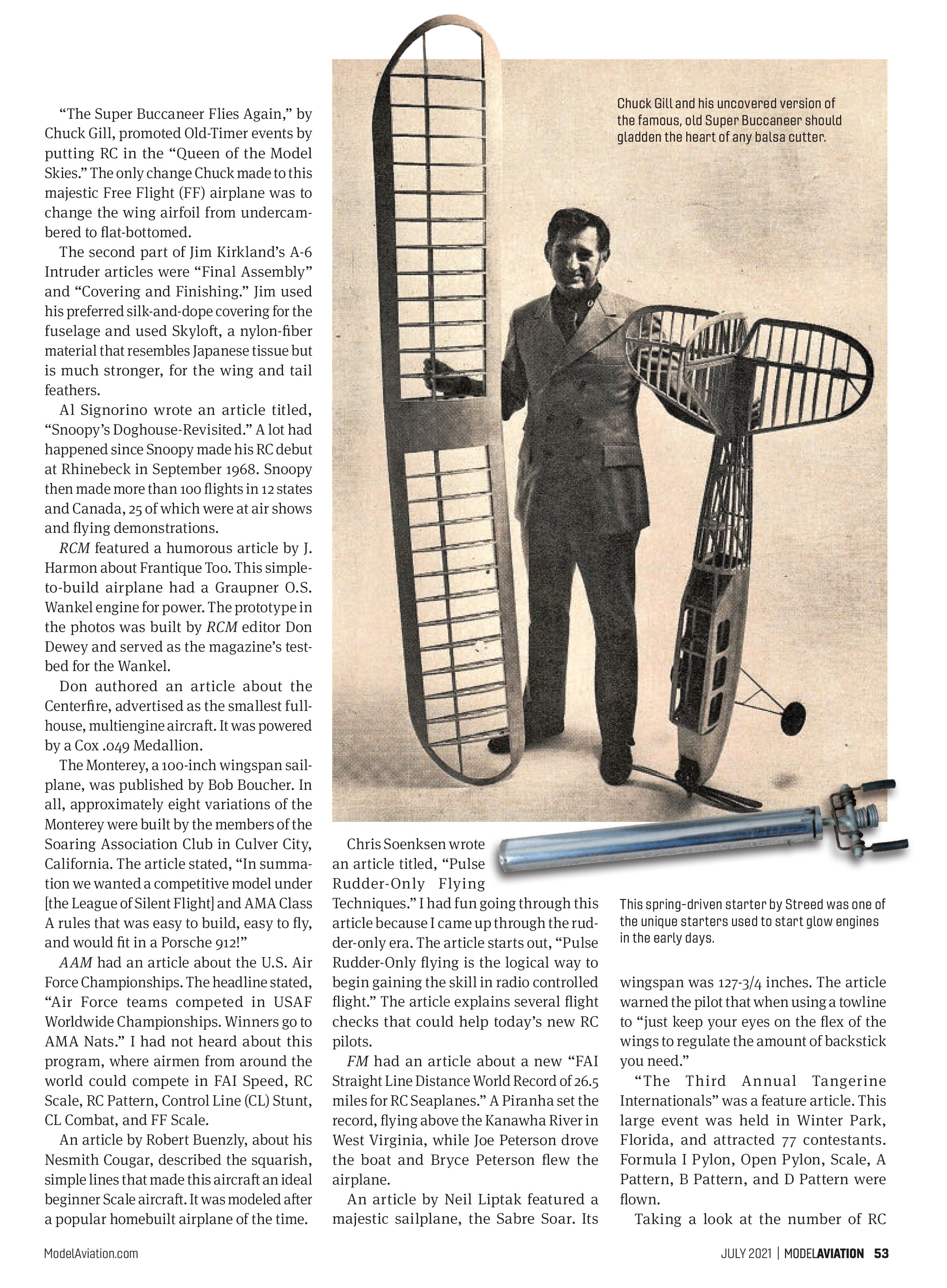
“The Super Buccaneer Flies Again,” by Chuck Gill, promoted Old-Timer events by putting RC in the “Queen of the Model Skies.” The only change Chuck made to this majestic Free Flight (FF) airplane was to change the wing airfoil from undercambered to flat-bottomed.
The second part of Jim Kirkland’s A-6 Intruder articles were “Final Assembly” and “Covering and Finishing.” Jim used his preferred silk-and-dope covering for the fuselage and used Skyloft, a nylon-fiber material that resembles Japanese tissue but is much stronger, for the wing and tail feathers.
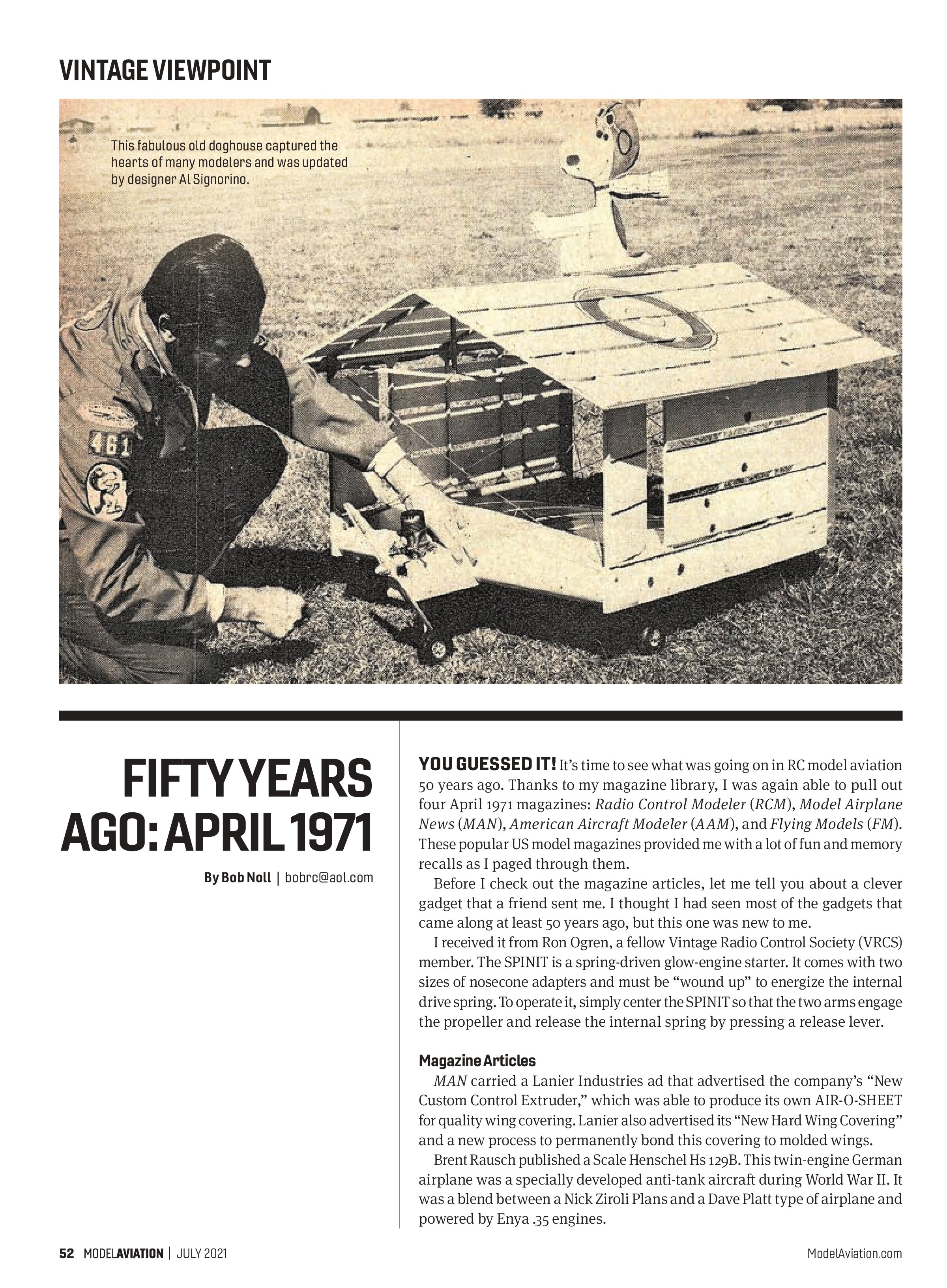
Al Signorino wrote an article titled, “Snoopy’s Doghouse-Revisited.” A lot had happened since Snoopy made his RC debut at Rhinebeck in September 1968. Snoopy then made more than 100 flights in 12 states and Canada, 25 of which were at air shows and flying demonstrations.
RCM featured a humorous article by J. Harmon about Frantique Too. This simple-to-build airplane had a Graupner O.S. Wankel engine for power. The prototype in the photos was built by RCM editor Don Dewey and served as the magazine’s test-bed for the Wankel.
Don authored an article about the Centerfire, advertised as the smallest full-house, multiengine aircraft. It was powered by a Cox .049 Medallion.
The Monterey, a 100-inch wingspan sailplane, was published by Bob Boucher. In all, approximately eight variations of the Monterey were built by the members of the Soaring Association Club in Culver City, California. The article stated, “In summation we wanted a competitive model under [the League of Silent Flight] and AMA Class A rules that was easy to build, easy to fly, and would fit in a Porsche 912!”
AAM had an article about the U.S. Air Force Championships. The headline stated, “Air Force teams competed in USAF Worldwide Championships. Winners go to AMA Nats.” I had not heard about this program, where airmen from around the world could compete in FAI Speed, RC Scale, RC Pattern, Control Line (CL) Stunt, CL Combat, and FF Scale.
An article by Robert Buenzly, about his Nesmith Cougar, described the squarish, simple lines that made this aircraft an ideal beginner Scale aircraft. It was modeled after a popular homebuilt airplane of the time.

Chris Soenksen wrote an article titled, “Pulse Rudder-Only Flying Techniques.” I had fun going through this article because I came up through the rudder-only era. The article starts out, “Pulse Rudder-Only flying is the logical way to begin gaining the skill in radio controlled flight.” The article explains several flight checks that could help today’s new RC pilots.
FM had an article about a new “FAI Straight Line Distance World Record of 26.5 miles for RC Seaplanes.” A Piranha set the record, flying above the Kanawha River in West Virginia, while Joe Peterson drove the boat and Bryce Peterson flew the airplane.
An article by Neil Liptak featured a majestic sailplane, the Sabre Soar. Its wingspan was 127-3/4 inches. The article warned the pilot that when using a towline to “just keep your eyes on the flex of the wings to regulate the amount of backstick you need.”

“The Third Annual Tangerine Internationals” was a feature article. This large event was held in Winter Park, Florida, and attracted 77 contestants. Formula I Pylon, Open Pylon, Scale, A Pattern, B Pattern, and D Pattern were flown.
Taking a look at the number of RC

systems that were advertised in 1971, you would probably lose count. The best I could come up with was 25. This included simple single-channel radios up to and including the top radios of the day, such as Kraft, World Engines, Pro Line, Orbit, Bonner, EK Logictrol, Futaba, Citizenship, and Heath.
New Products in April 1971
Some of the new products in the magazines included the Vortex Models Formula I Little Mike, the Quarter Midget Ballerina, J&J Eyeball, a sneak preview of the Ross Parallel Twin, the VK Cherokee Babe, and the VK Fokker Triplane DR I.
Super Coverite arrived as the newest covering material to replace plain Coverite.
In closing, I would like to wish everyone good health and a good flying season. I got my second COVID-19 virus shot on St. Patrick’s Day. The snow is all gone in Endicott, New York, and more people are getting out. A report from the Aero Guidance Society (AGS) field chairman is that the AGS model airport is ready for action.
I went to the British Car Club meeting in my 1971 MGB at the beginning of April and the attendance was as large as I have ever seen.
Don’t forget to visit a VRCS event near you.
SOURCES:
VRCS
www.vintagercsociety.org