REPURPOSING A SIG KADET SR.
Photos by Chris Heard | email: cph163@yahoo.com
ONE OF CHRIS HEARD’S (Etowah, Tennessee) favorite airplanes is a Sig Kadet Sr. that he built in the early 1990s. It has used numerous engines, from a .46 engine to a .91 four-stroke glow engine. Chris added ailerons some years ago and it became his “guest” airplane because it was so slow, stable, and easy to see.
Because of its light wing loading, it became the obvious platform for his early exploration of FPV. “As the inevitable happened with the early FPV equipment, I lost signal and my spotter wasn’t sure where she last saw it, but she knew it was that way,” he wrote.
Having a two-seat, full-scale experimental airplane on his farm, they searched for the model, flying in that direction. “We

As the owner of a machine-building company, Chris had tools and lightweight materials available, so he decided to machine parts for a new section of the airplane from the leading edge (LE) forward. “Because I had been using props considerably larger than the props on the Sig-suggested .46 engine, I was having trouble with prop strikes on my grass field,” he noted. “It seemed to me that two EDF units mounted to each side would eliminate the clearance problem. I had hoped to mount the EDFs under the wing halves to look really cool, but that location would have required considerable ballast to achieve an acceptable center of gravity (CG), and I wanted to keep the plane light.”
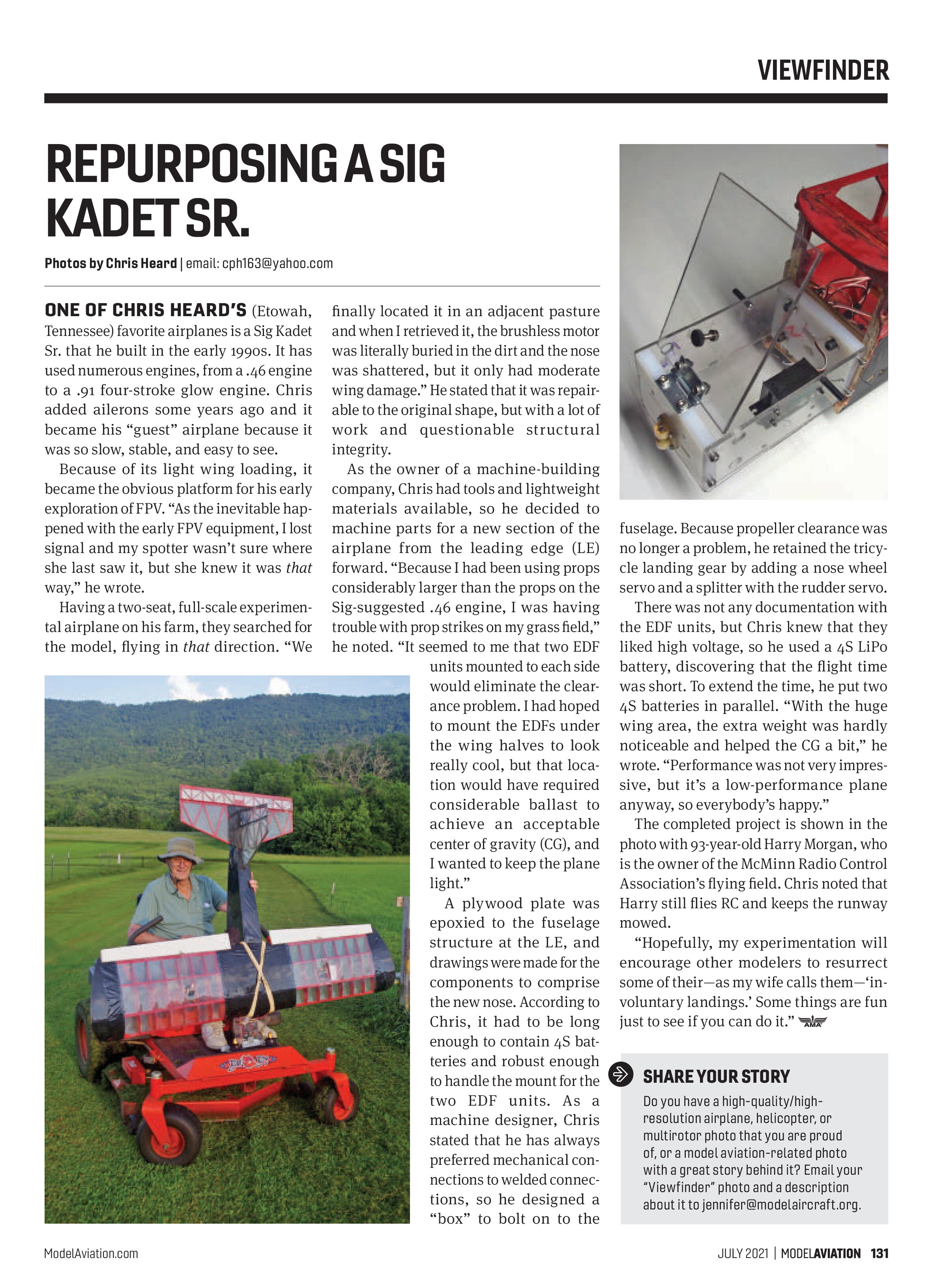
A plywood plate was epoxied to the fuselage structure at the LE, and drawings were made for the components to comprise the new nose. According to Chris, it had to be long enough to contain 4S batteries and robust enough to handle the mount for the two EDF units. As a machine designer, Chris stated that he has always preferred mechanical connections to welded connections, so he designed a “box” to bolt on to the

finally located it in an adjacent pasture and when I retrieved it, the brushless motor was literally buried in the dirt and the nose was shattered, but it only had moderate wing damage.” He stated that it was repairable to the original shape, but with a lot of work and questionable structural integrity.
fuselage. Because propeller clearance was no longer a problem, he retained the tricycle landing gear by adding a nose wheel servo and a splitter with the rudder servo.
There was not any documentation with the EDF units, but Chris knew that they liked high voltage, so he used a 4S LiPo battery, discovering that the flight time was short. To extend the time, he put two 4S batteries in parallel. “With the huge wing area, the extra weight was hardly noticeable and helped the CG a bit,” he wrote. “Performance was not very impressive, but it’s a low-performance plane anyway, so everybody’s happy.”
The completed project is shown in the photo with 93-year-old Harry Morgan, who is the owner of the McMinn Radio Control Association’s flying field. Chris noted that Harry still flies RC and keeps the runway mowed.
“Hopefully, my experimentation will encourage other modelers to resurrect some of their—as my wife calls them—‘involuntary landings.’ Some things are fun just to see if you can do it.”
SHARE YOUR STORY
Do you have a high-quality/high-resolution airplane, helicopter, or multirotor photo that you are proud of, or a model aviation-related photo with a great story behind it? Email your “Viewfinder” photo and a description about it to jennifer@modelaircraft.org.