SAFETY COMES FIRST

RC AND ATC
DON’T MIX
By Dave Gee | safetycolumn@cs.com
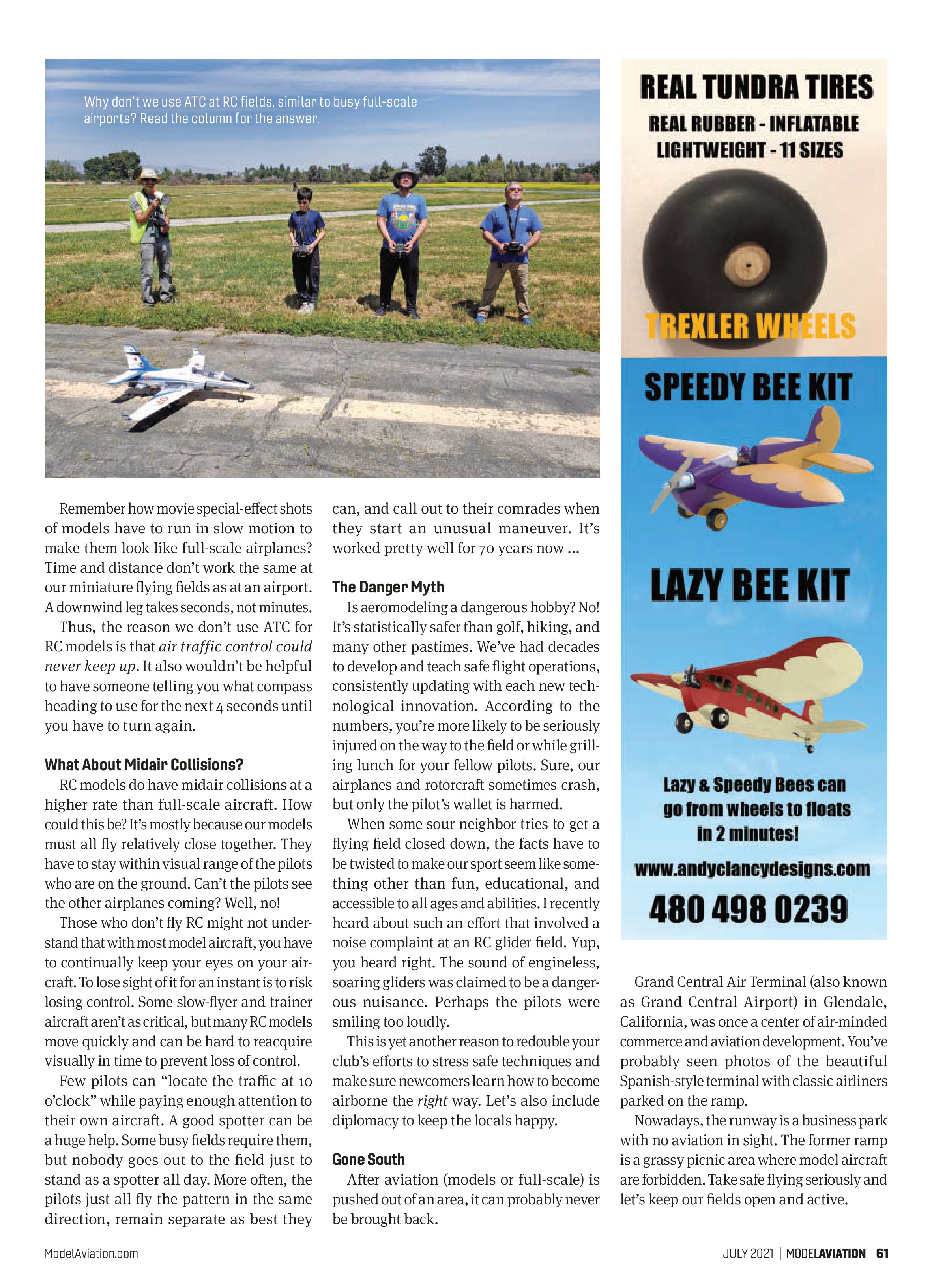
A READER ASKED ME why busy RC fields don’t have formal air traffic control (ATC) systems, similar to a full-scale airport. This is a legitimate question for someone who is unfamiliar with RC models. The real answer is simple and a bit surprising, but first, here are a few comments I received through consulting with various experienced RC pilots. They all think they are sky comedians.
- Because no pilot likes being told what to do (this is from an RC pilot who also owns his own full-scale light airplane).
- Expense. It would somehow end up costing a lot of money, like everything in aviation.
- Who would take the job? Nobody wants to spend his or her day at the field yelling instructions. Plus, that person would be responsible for mishaps, so no mistakes would be allowed.
- How would everyone communicate? Colored flares and signal lights wouldn’t work. Do we all wear headsets, use bullhorns, or just shout back and forth?
- It’s really not needed. Even at the busiest fun-fly events, “traffic control” usually means signing up for a window of flight time. Limiting the number of airplanes in the air works better than trying to guide them around individually.
Those are all legitimate points, but the real answer has to do with the “scale effect” of models versus manned aircraft. Things happen much faster with models, especially things such as flight emergencies.

Remember how movie special-effect shots of models have to run in slow motion to make them look like full-scale airplanes? Time and distance don’t work the same at our miniature flying fields as at an airport. A downwind leg takes seconds, not minutes.
Thus, the reason we don’t use ATC for RC models is that air traffic control could never keep up. It also wouldn’t be helpful to have someone telling you what compass heading to use for the next 4 seconds until you have to turn again.
What About Midair Collisions?
RC models do have midair collisions at a higher rate than full-scale aircraft. How could this be? It’s mostly because our models must all fly relatively close together. They have to stay within visual range of the pilots who are on the ground. Can’t the pilots see the other airplanes coming? Well, no!
Those who don’t fly RC might not understand that with most model aircraft, you have to continually keep your eyes on your aircraft. To lose sight of it for an instant is to risk losing control. Some slow-flyer and trainer aircraft aren’t as critical, but many RC models move quickly and can be hard to reacquire visually in time to prevent loss of control.
Few pilots can “locate the traffic at 10 o’clock” while paying enough attention to their own aircraft. A good spotter can be a huge help. Some busy fields require them, but nobody goes out to the field just to stand as a spotter all day. More often, the pilots just all fly the pattern in the same direction, remain separate as best they can, and call out to their comrades when they start an unusual maneuver. It’s worked pretty well for 70 years now …
The Danger Myth
Is aeromodeling a dangerous hobby? No! It’s statistically safer than golf, hiking, and many other pastimes. We’ve had decades to develop and teach safe flight operations, consistently updating with each new technological innovation. According to the numbers, you’re more likely to be seriously injured on the way to the field or while grilling lunch for your fellow pilots. Sure, our airplanes and rotorcraft sometimes crash, but only the pilot’s wallet is harmed.
When some sour neighbor tries to get a flying field closed down, the facts have to be twisted to make our sport seem like something other than fun, educational, and accessible to all ages and abilities. I recently heard about such an effort that involved a noise complaint at an RC glider field. Yup, you heard right. The sound of engineless, soaring gliders was claimed to be a dangerous nuisance. Perhaps the pilots were smiling too loudly.
This is yet another reason to redouble your club’s efforts to stress safe techniques and make sure newcomers learn how to become airborne the right way. Let’s also include diplomacy to keep the locals happy.
Gone South
After aviation (models or full-scale) is pushed out of an area, it can probably never be brought back.
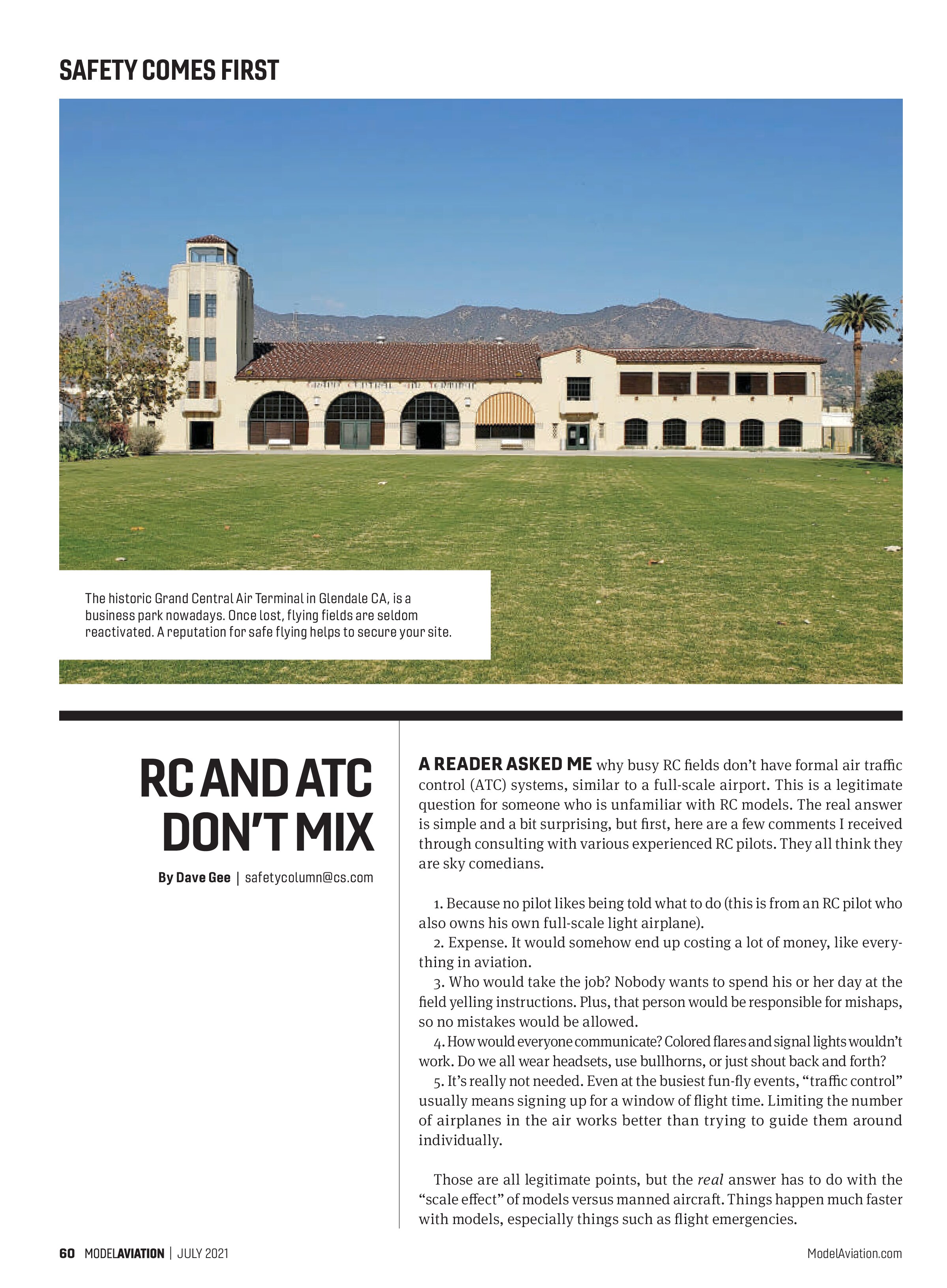
Grand Central Air Terminal (also known as Grand Central Airport) in Glendale, California, was once a center of air-minded commerce and aviation development. You’ve probably seen photos of the beautiful Spanish-style terminal with classic airliners parked on the ramp.
Nowadays, the runway is a business park with no aviation in sight. The former ramp is a grassy picnic area where model aircraft are forbidden. Take safe flying seriously and let’s keep our fields open and active.

Mystery Airplane: A Toughie?
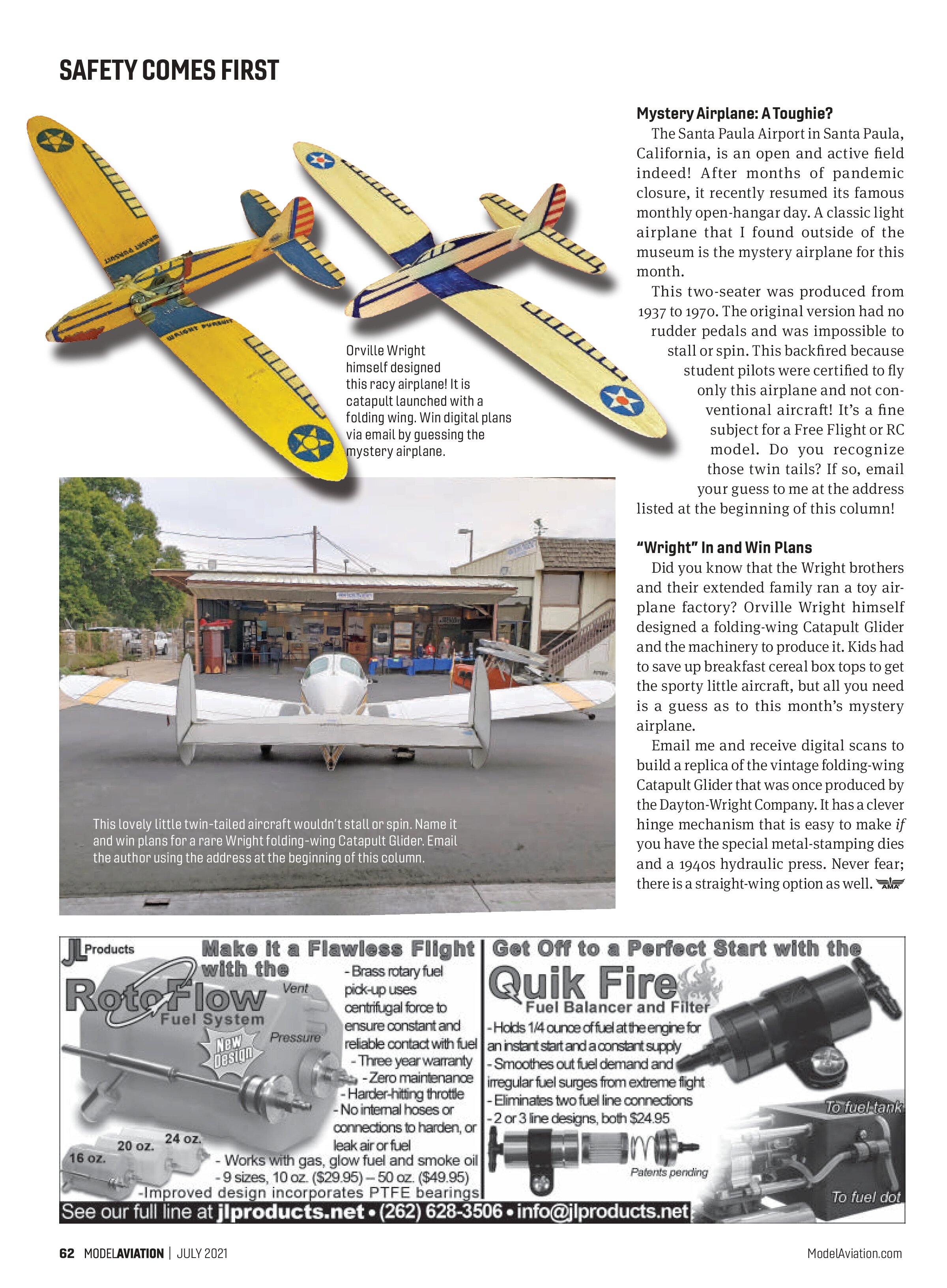
The Santa Paula Airport in Santa Paula, California, is an open and active field indeed! After months of pandemic closure, it recently resumed its famous monthly open-hangar day. A classic light airplane that I found outside of the museum is the mystery airplane for this month.
This two-seater was produced from 1937 to 1970. The original version had no rudder pedals and was impossible to stall or spin. This backfired because student pilots were certified to fly only this airplane and not conventional aircraft! It’s a fine subject for a Free Flight or RC model. Do you recognize those twin tails? If so, email your guess to me at the address listed at the beginning of this column!

“Wright” In and Win Plans
Did you know that the Wright brothers and their extended family ran a toy airplane factory? Orville Wright himself designed a folding-wing Catapult Glider and the machinery to produce it. Kids had to save up breakfast cereal box tops to get the sporty little aircraft, but all you need is a guess as to this month’s mystery airplane.
Email me and receive digital scans to build a replica of the vintage folding-wing Catapult Glider that was once produced by the Dayton-Wright Company. It has a clever hinge mechanism that is easy to make if you have the special metal-stamping dies and a 1940s hydraulic press. Never fear; there is a straight-wing option as well.