COVID-19 DELAYS THE F3J WORLD CHAMPIONSHIP
By Gordon Buckland | gordon@gatorf3b.com

THE COVID-19 SITUATION and new infections in Slovakia have forced the organizers to again postpone the FAI F3J World Championship for Model Gliders from August 2021 to an undetermined date in 2022. The US F3J team has been preparing for this championship for more than two years, with new models being purchased, built, and prepared. Much research has been conducted by the team for optimum flight configurations and launching techniques.
Fundraising has continued at a rather slow pace because of COVID-19 and the lack of events, but the team’s main fundraising effort is the raffle. Few tickets have been sold so far. The US team plans to hold the major raffle drawing after the World Championship, but a drawing for one of the major prizes will be announced in August 2021. Buy tickets now to be entered in both drawings.
The US team has some amazing sponsors, led by Soaring USA, MKS Servos, and Kennedy Composites. There is a fantastic array of prizes available to win, such as two F3J models, two F5J models, an F3K model, a Peter Goldsmith Designs model, and no less than seven radio systems, including a Spektrum iX20. Please go to the website, listed in “Sources,” and buy tickets for this huge raffle to help the team make it to Slovakia.
Joe Wurts’ New F3K Design
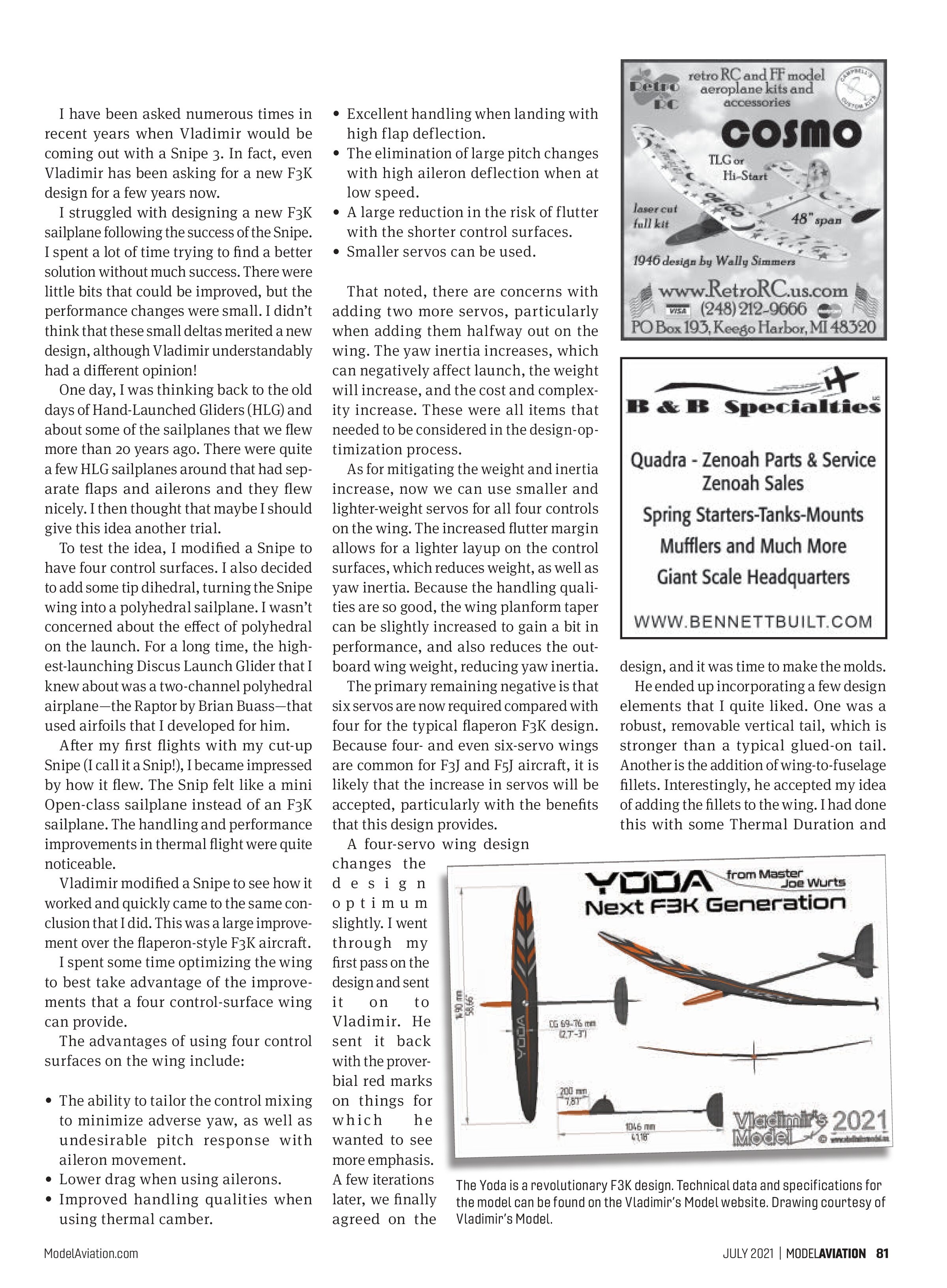
A significant breakthrough has occurred in the development of F3K models, with the new Vladimir’s Model Yoda. Joe Wurts, the designer of the Yoda, was kind enough to provide the following insight into its development.
I have been asked numerous times in recent years when Vladimir would be coming out with a Snipe 3. In fact, even Vladimir has been asking for a new F3K design for a few years now.
I struggled with designing a new F3K sailplane following the success of the Snipe. I spent a lot of time trying to find a better solution without much success. There were little bits that could be improved, but the performance changes were small. I didn’t think that these small deltas merited a new design, although Vladimir understandably had a different opinion!
One day, I was thinking back to the old days of Hand-Launched Gliders (HLG) and about some of the sailplanes that we flew more than 20 years ago. There were quite a few HLG sailplanes around that had separate flaps and ailerons and they flew nicely. I then thought that maybe I should give this idea another trial.
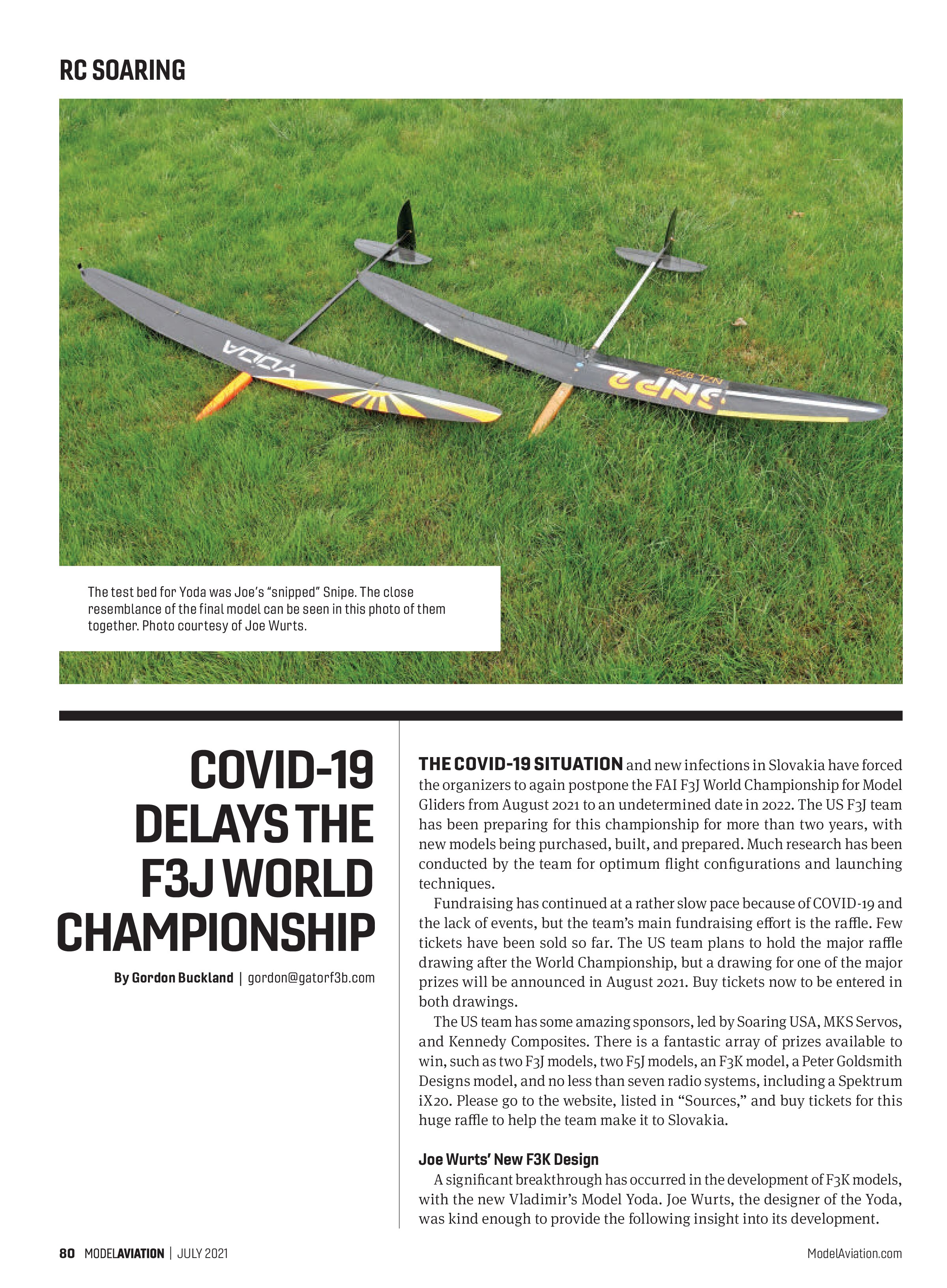
To test the idea, I modified a Snipe to have four control surfaces. I also decided to add some tip dihedral, turning the Snipe wing into a polyhedral sailplane. I wasn’t concerned about the effect of polyhedral on the launch. For a long time, the highest-launching Discus Launch Glider that I knew about was a two-channel polyhedral airplane—the Raptor by Brian Buass—that used airfoils that I developed for him.
After my first flights with my cut-up Snipe (I call it a Snip!), I became impressed by how it flew. The Snip felt like a mini Open-class sailplane instead of an F3K sailplane. The handling and performance improvements in thermal flight were quite noticeable.
Vladimir modified a Snipe to see how it worked and quickly came to the same conclusion that I did. This was a large improvement over the flaperon-style F3K aircraft.
I spent some time optimizing the wing to best take advantage of the improvements that a four control-surface wing can provide.
The advantages of using four control surfaces on the wing include:
- The ability to tailor the control mixing to minimize adverse yaw, as well as undesirable pitch response with aileron movement.
- Lower drag when using ailerons.
- Improved handling qualities when using thermal camber.
- Excellent handling when landing with high flap deflection.
- The elimination of large pitch changes with high aileron deflection when at low speed.
- A large reduction in the risk of flutter with the shorter control surfaces.
- Smaller servos can be used.
That noted, there are concerns with adding two more servos, particularly when adding them halfway out on the wing. The yaw inertia increases, which can negatively affect launch, the weight will increase, and the cost and complexity increase. These were all items that needed to be considered in the design-optimization process.
As for mitigating the weight and inertia increase, now we can use smaller and lighter-weight servos for all four controls on the wing. The increased flutter margin allows for a lighter layup on the control surfaces, which reduces weight, as well as yaw inertia. Because the handling qualities are so good, the wing planform taper can be slightly increased to gain a bit in performance, and also reduces the outboard wing weight, reducing yaw inertia.
The primary remaining negative is that six servos are now required compared with four for the typical flaperon F3K design. Because four- and even six-servo wings are common for F3J and F5J aircraft, it is likely that the increase in servos will be accepted, particularly with the benefits that this design provides.
A four-servo wing design changes the design optimum slightly. I went through my first pass on the design and sent it on to Vladimir. He sent it back with the proverbial red marks on things for which he wanted to see more emphasis. A few iterations later, we finally agreed on the design, and it was time to make the molds.
He ended up incorporating a few design elements that I quite liked. One was a robust, removable vertical tail, which is stronger than a typical glued-on tail. Another is the addition of wing-to-fuselage fillets. Interestingly, he accepted my idea of adding the fillets to the wing. I had done this with some Thermal Duration and


Vladimir made several prototype aircraft and distributed them to a few test pilots around the world. I was quite keen to get mine, but I had to live vicariously via the flight-test reports from the pilots in Ukraine, Austria, Germany, and Poland, while my sailplane slowly made its way to New Zealand. The reports aligned well with what I expected; it flew well indeed.
I finally received mine and flew it the same day that I opened the box. It had a few unexpected characteristics. The amount of speed range had increased. I was also pleasantly surprised at its capability for low-altitude thermal flying while carrying high ballast. As compared with the Snipe, the new sailplane needs approximately 20% less ballast for the same conditions. The primary gain was more subjective because the handling qualities were so much better than the typical flaperon-equipped aircraft.
This handling quality improvement is a change that should greatly benefit a typical pilot. With this “new” approach (stolen from designs flown a couple of decades ago), a new name was needed. This definitely wasn’t a Snipe 3, but it instead merited an entirely new name. We settled on Yoda F3K.
Much thanks to Joe for contributing his insight into the development of his “retro,” revolutionary HLG design. It looks to be a real winner.
Go downwind and soar.
SOURCES:
League of Silent Flight (LSF)
www.silentflight.org
Team USA F3J
www.teamusaf3j.com
Kennedy Composites
(972) 602-3144
www.kennedycomposites.com
Vladimir’s Model
vladimir@airplane-model.com
www.f3j.in.ua