RC PYLON RACING
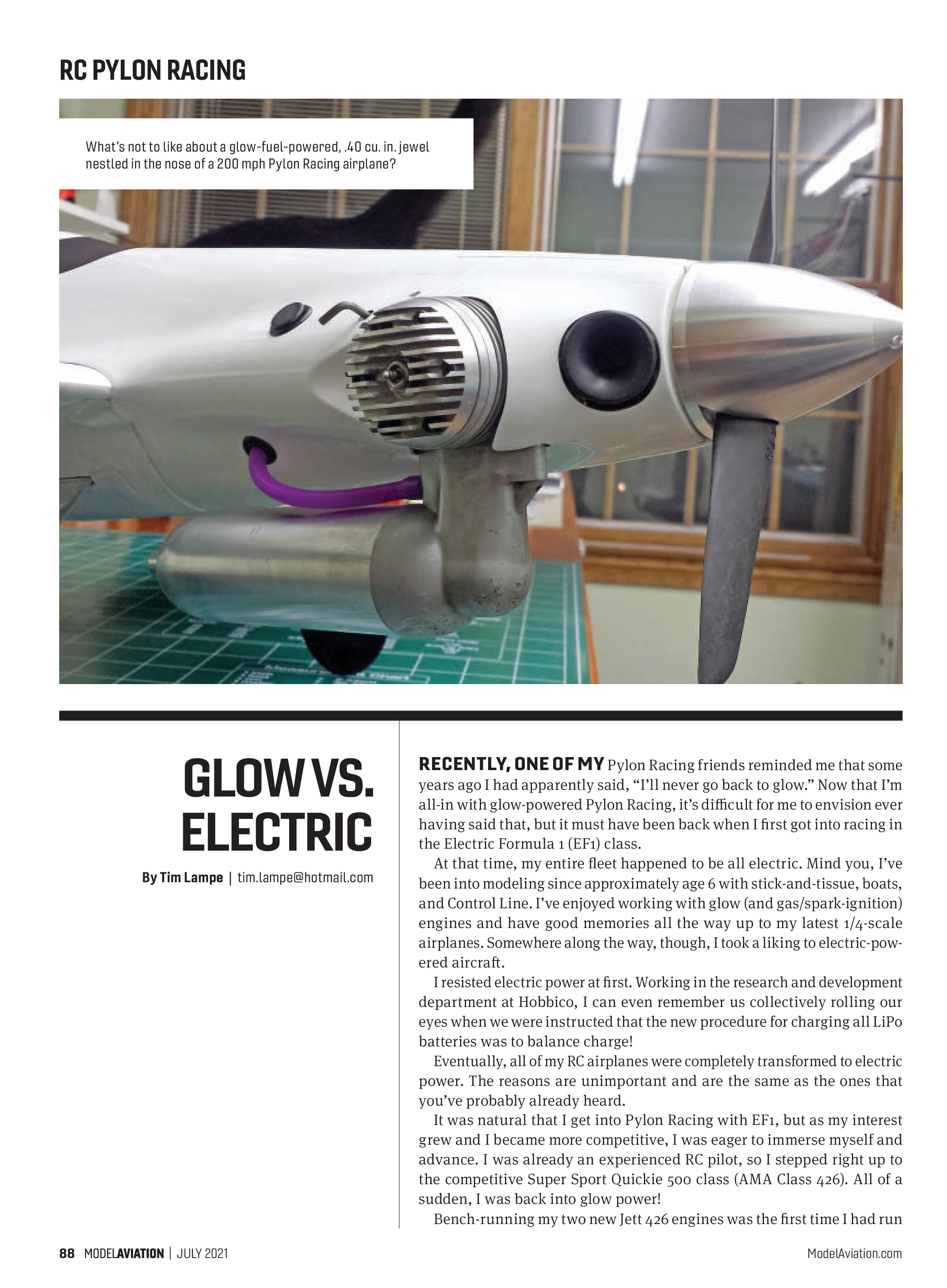
What’s not to like about a glow-fuel-powered, .40 cu. in. jewel nestled in the nose of a 200 mph Pylon Racing airplane?
GLOW VS.
ELECTRIC
By Tim Lampe | tim.lampe@hotmail.com
RECENTLY, ONE OF MY Pylon Racing friends reminded me that some years ago I had apparently said, “I’ll never go back to glow.” Now that I’m all-in with glow-powered Pylon Racing, it’s difficult for me to envision ever having said that, but it must have been back when I first got into racing in the Electric Formula 1 (EF1) class.
At that time, my entire fleet happened to be all electric. Mind you, I’ve been into modeling since approximately age 6 with stick-and-tissue, boats, and Control Line. I’ve enjoyed working with glow (and gas/spark-ignition) engines and have good memories all the way up to my latest 1/4-scale airplanes. Somewhere along the way, though, I took a liking to electric-powered aircraft.
I resisted electric power at first. Working in the research and development department at Hobbico, I can even remember us collectively rolling our eyes when we were instructed that the new procedure for charging all LiPo batteries was to balance charge!
Eventually, all of my RC airplanes were completely transformed to electric power. The reasons are unimportant and are the same as the ones that you’ve probably already heard.
It was natural that I get into Pylon Racing with EF1, but as my interest grew and I became more competitive, I was eager to immerse myself and advance. I was already an experienced RC pilot, so I stepped right up to the competitive Super Sport Quickie 500 class (AMA Class 426). All of a sudden, I was back into glow power!
Bench-running my two new Jett 426 engines was the first time I had run

my own glow-power engine in probably 10 years! It was exhilarating and even slightly nostalgic. I was working with needle valves, fuel tubing, glow plugs, nitromethane, and rags again!
The purpose of this month’s column isn’t to convince anybody of anything. It’s simply to reveal the attractions and a few of the intricacies of glow-powered engines to those who might never have experienced them (or to those who might have forgotten as I had).
With electric-powered models, a few of the most important variables we concern ourselves with are motor Kv, voltage (cell count), current draw (greatly determined by the Kv and propeller), battery capacity, and the discharge C-rating. After these have been determined through your own testing or the manufacturer’s recommendations, they generally remain the same, so we always fly X airplane (and motor) with Y propeller and Z battery.
Although this might also hold true for a couple of the entry-level, glow-engine-powered Pylon classes (where the propeller and engine/motor are specified in the rules), in the advanced classes such as AMA 426 and AMA 422 Quarter 40 (Q-40), multiple propeller choices and certain changes to the engine setup are permitted, making these classes more challenging—or opening up another can of worms, depending upon how you look at it. When you add the effects that weather can have on engine performance, namely density altitude (barometric pressure, humidity, and temperature), it takes time to figure out what works best and what will allow you to be competitive.
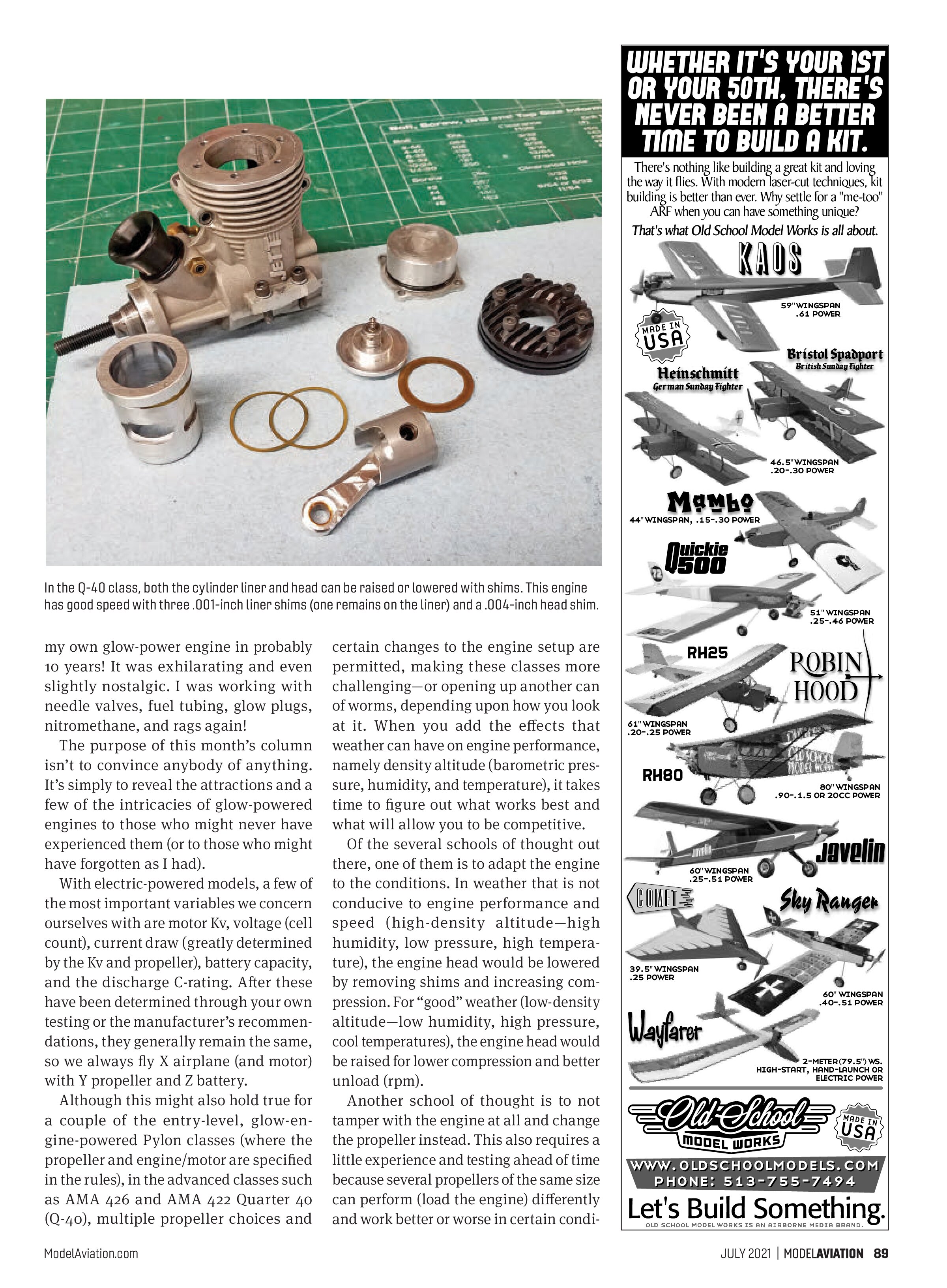
Of the several schools of thought out there, one of them is to adapt the engine to the conditions. In weather that is not conducive to engine performance and speed (high-density altitude—high humidity, low pressure, high temperature), the engine head would be lowered by removing shims and increasing compression. For “good” weather (low-density altitude—low humidity, high pressure, cool temperatures), the engine head would be raised for lower compression and better unload (rpm).
Another school of thought is to not tamper with the engine at all and change the propeller instead. This also requires a little experience and testing ahead of time because several propellers of the same size can perform (load the engine differently and work better or worse in certain condi-


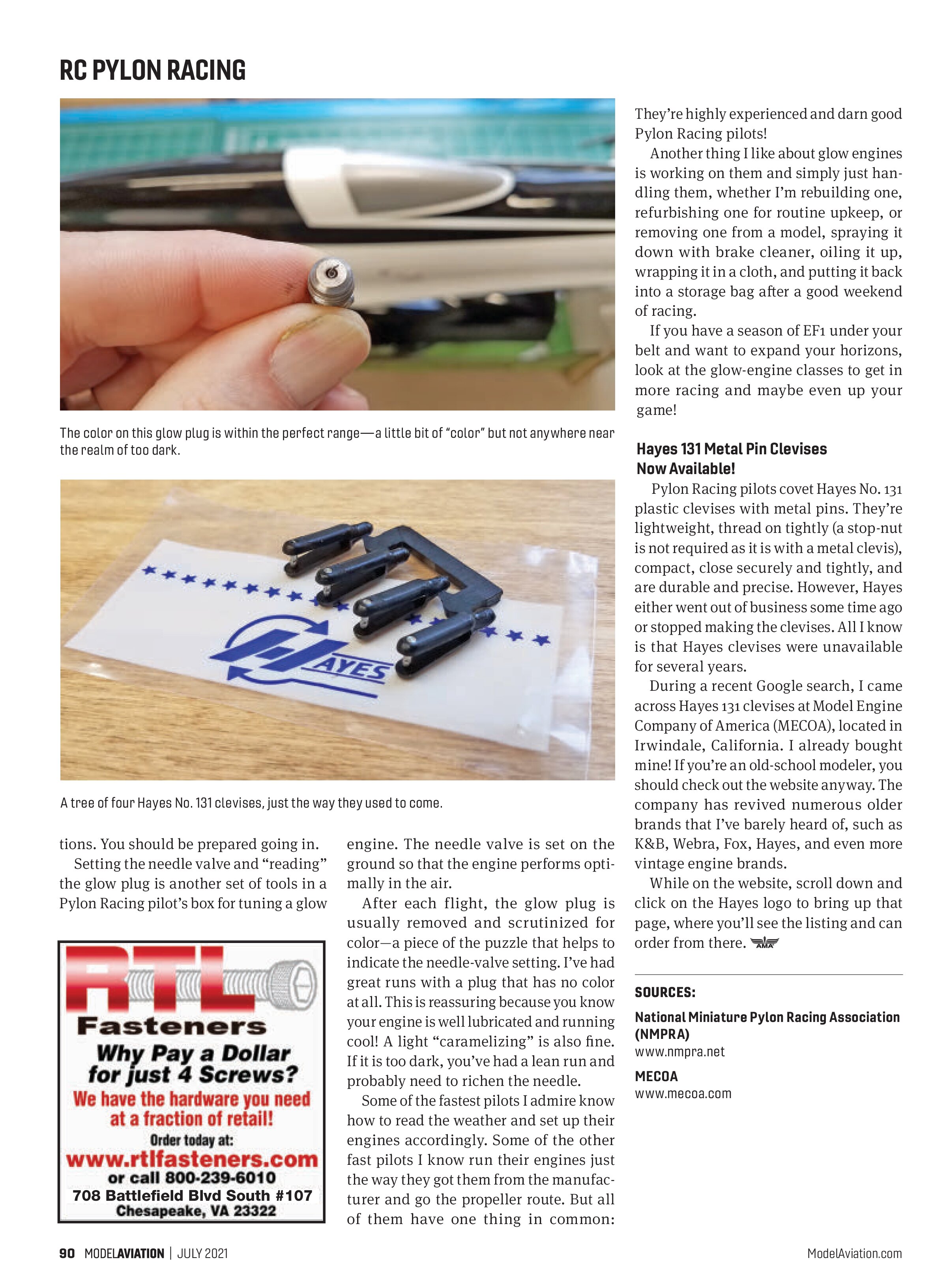
The color on this glow plug is within the perfect range—a little bit of “color” but not anywhere near the realm of too dark.

A tree of four Hayes No. 131 clevises, just the way they used to come.
tions. You should be prepared going in.
Setting the needle valve and “reading” the glow plug is another set of tools in a Pylon Racing pilot’s box for tuning a glow engine. The needle valve is set on the ground so that the engine performs optimally in the air.
After each flight, the glow plug is usually removed and scrutinized for color—a piece of the puzzle that helps to indicate the needle-valve setting. I’ve had great runs with a plug that has no color at all. This is reassuring because you know your engine is well lubricated and running cool! A light “caramelizing” is also fine. If it is too dark, you’ve had a lean run and probably need to richen the needle.
Some of the fastest pilots I admire know how to read the weather and set up their engines accordingly. Some of the other fast pilots I know run their engines just the way they got them from the manufacturer and go the propeller route. But all of them have one thing in common: They’re highly experienced and darn good Pylon Racing pilots!
Another thing I like about glow engines is working on them and simply just handling them, whether I’m rebuilding one, refurbishing one for routine upkeep, or removing one from a model, spraying it down with brake cleaner, oiling it up, wrapping it in a cloth, and putting it back into a storage bag after a good weekend of racing.
If you have a season of EF1 under your belt and want to expand your horizons, look at the glow-engine classes to get in more racing and maybe even up your game!
Hayes 131 Metal Pin Clevises Now Available!
Pylon Racing pilots covet Hayes No. 131 plastic clevises with metal pins. They’re lightweight, thread on tightly (a stop-nut is not required as it is with a metal clevis), compact, close securely and tightly, and are durable and precise. However, Hayes either went out of business some time ago or stopped making the clevises. All I know is that Hayes clevises were unavailable for several years.
During a recent Google search, I came across Hayes 131 clevises at Model Engine Company of America (MECOA), located in Irwindale, California. I already bought mine! If you’re an old-school modeler, you should check out the website anyway. The company has revived numerous older brands that I’ve barely heard of, such as K&B, Webra, Fox, Hayes, and even more vintage engine brands.
While on the website, scroll down and click on the Hayes logo to bring up that page, where you’ll see the listing and can order from there.
SOURCES:
National Miniature Pylon Racing Association (NMPRA)
www.nmpra.net
MECOA
www.mecoa.com