MICRO-FLYING
MOLDED CARBON-FIBER MICRO-FLYERS
By Joe Malinchak | joemal@echoes.net
ONE GREAT THING about our hobby is that we are always learning new modeling techniques and ideas. I’ve wanted to learn how to mold carbon-fiber rod for many years, so I decided it was time to try out some new building techniques. My friend, Gordon Johnson, has been perfecting the process of molding carbon-fiber rod and has graciously guided me through it.
My first step was to decide what to build. I was thinking that a molded carbon-fiber version of one of my Classroom Fighter designs would be perfect and decided on a Classroom Corsair. My Classroom Corsair is a great-flying model and would be a challenge to build with its bent wing. Gordon decided to join in on the fun and build a Cartoon Scale molded carbon-fiber P-51. That led to some long, late-night discussions and sharing ideas about how the models should be built!
Molded Carbon-Fiber Classroom Corsair
Because my 9-inch wingspan, 1/48-scale Classroom Fighter Corsair was originally designed to be built out of foam, I had to redraw it to be built from curved carbon fiber. I had to decide which parts could be made out of the curved carbon fiber and what areas could be constructed with plain carbon-fiber rod.
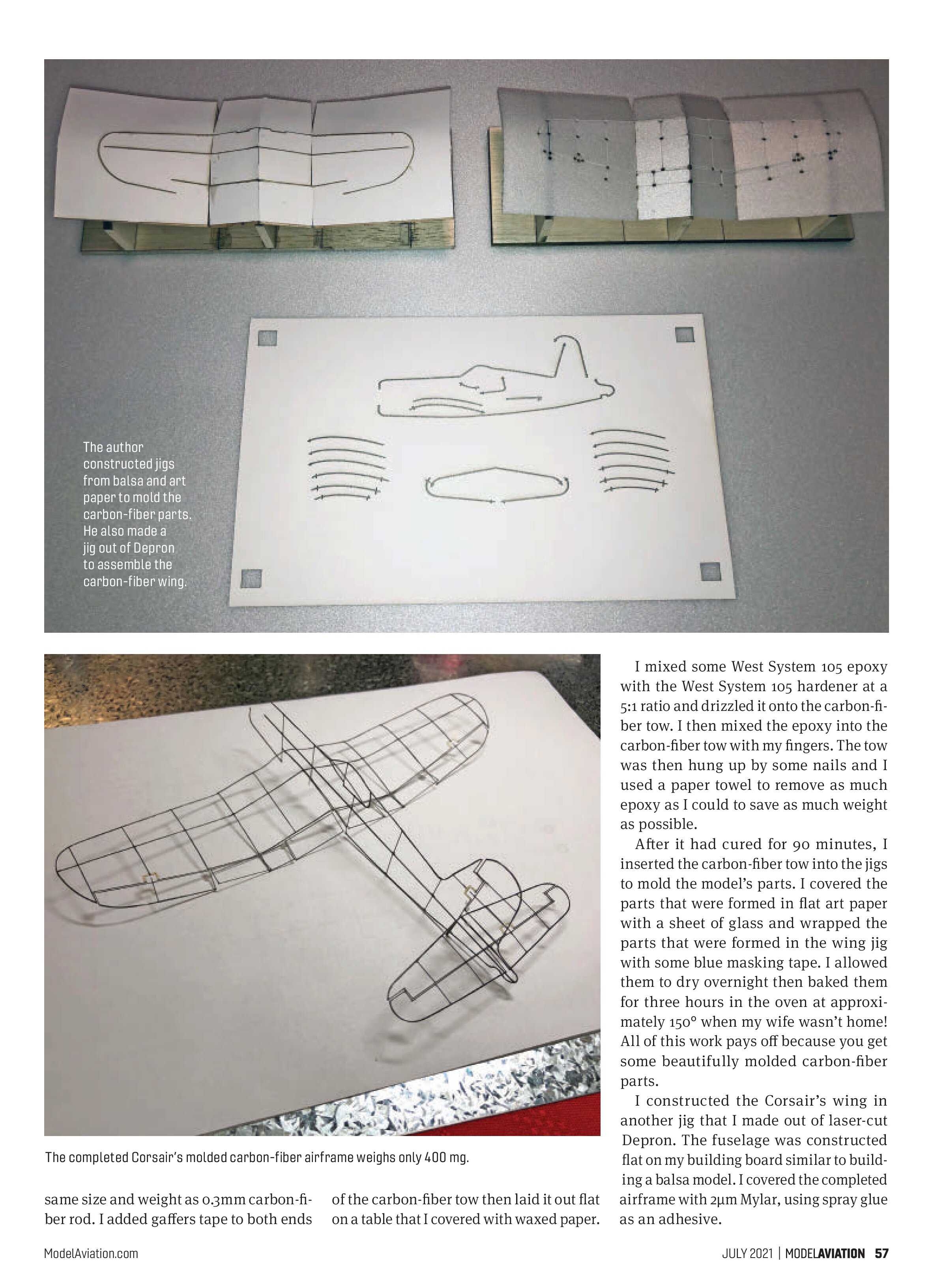
The outlines of the elevator, rudder, fuselage, wing, and ribs were all made out of molded, curved carbon fiber. I first had to make jigs to hold the carbon-fiber tow in place. This was slightly challenging.
For the Corsair’s wing, I constructed a jig out of balsa and laser-cut art paper. I used 1.5K carbon-fiber tow for this airplane, which is about the


I mixed some West System 105 epoxy with the West System 105 hardener at a 5:1 ratio and drizzled it onto the carbon-fiber tow. I then mixed the epoxy into the carbon-fiber tow with my fingers. The tow was then hung up by some nails and I used a paper towel to remove as much epoxy as I could to save as much weight as possible.
After it had cured for 90 minutes, I inserted the carbon-fiber tow into the jigs to mold the model’s parts. I covered the parts that were formed in flat art paper with a sheet of glass and wrapped the parts that were formed in the wing jig with some blue masking tape. I allowed them to dry overnight then baked them for three hours in the oven at approximately 150° when my wife wasn’t home!
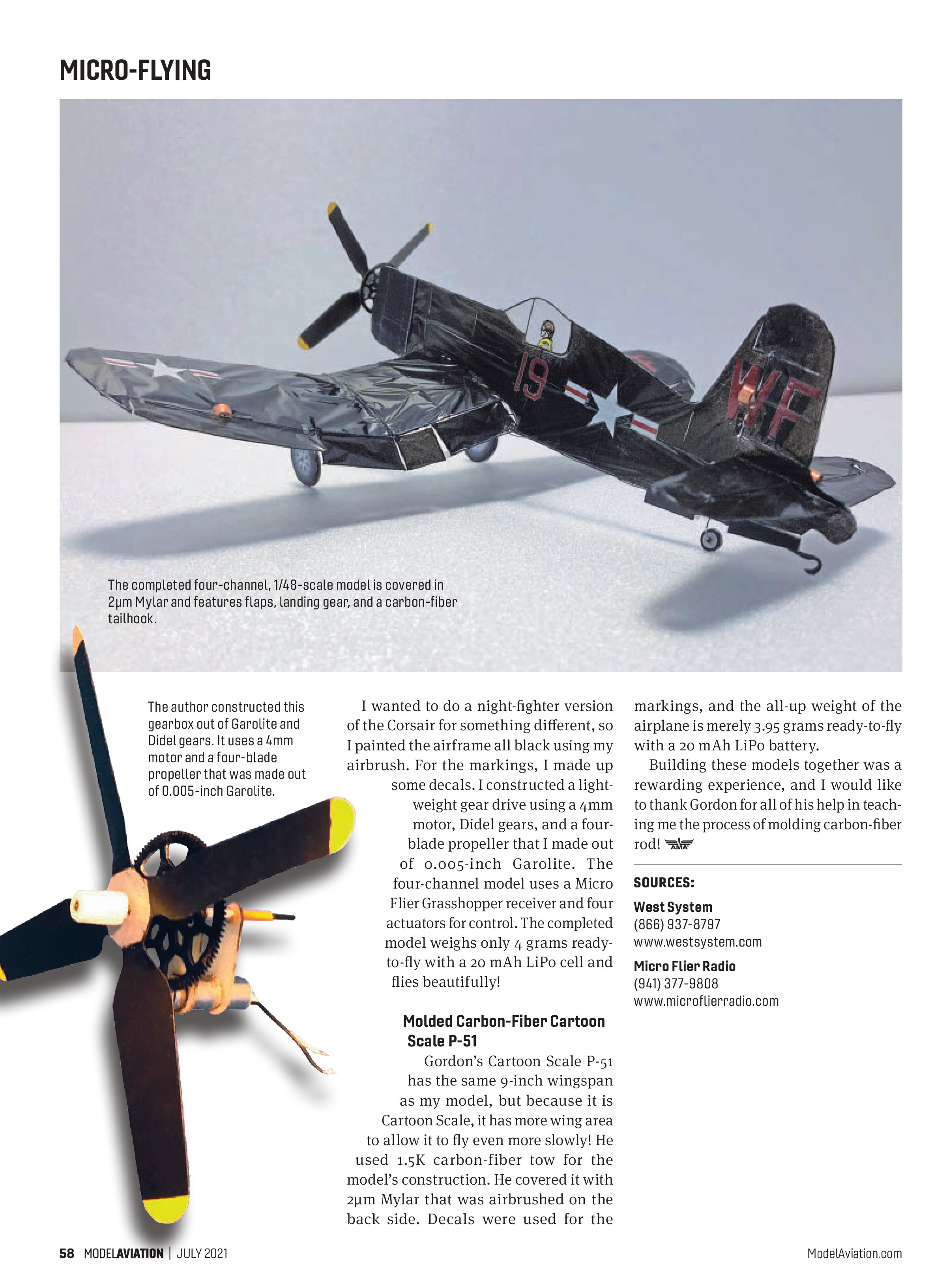
All of this work pays off because you get some beautifully molded carbon-fiber parts.
I constructed the Corsair’s wing in another jig that I made out of laser-cut Depron. The fuselage was constructed flat on my building board similar to building a balsa model. I covered the completed airframe with 2μm Mylar, using spray glue as an adhesive.


I wanted to do a night-fighter version of the Corsair for something different, so I painted the airframe all black using my airbrush. For the markings, I made up some decals. I constructed a lightweight gear drive using a 4mm motor, Didel gears, and a four-blade propeller that I made out of 0.005-inch Garolite. The four-channel model uses a Micro Flier Grasshopper receiver and four actuators for control. The completed model weighs only 4 grams ready-to-fly with a 20 mAh LiPo cell and flies beautifully!
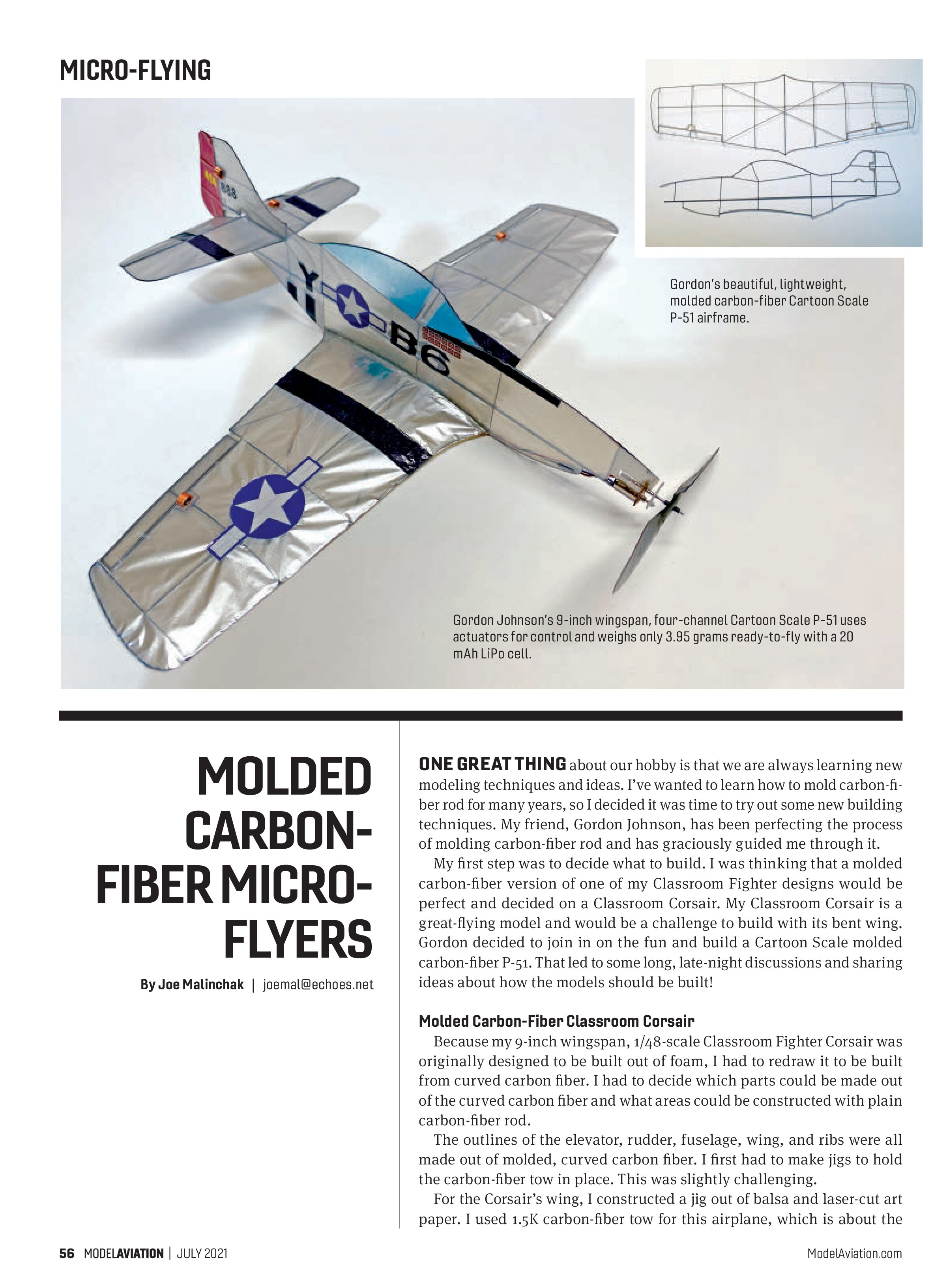
Decals were used for the markings, and the all-up weight of the airplane is merely 3.95 grams ready-to-fly with a 20 mAh LiPo battery.
Building these models together was a rewarding experience, and I would like to thank Gordon for all of his help in teaching me the process of molding carbon-fiber rod!
Molded Carbon-Fiber Cartoon Scale P-51
Gordon’s Cartoon Scale P-51 has the same 9-inch wingspan as my model, but because it is Cartoon Scale, it has more wing area to allow it to fly even more slowly! He used 1.5K carbon-fiber tow for the model’s construction. He covered it with 2μm Mylar that was airbrushed on the back side.
SOURCES:
West System
(866) 937-8797
www.westsystem.com
Micro Flier Radio
(941) 377-9808
www.microflieradio.com