FOCAL POINT
Interested in sharing your handiwork? Visit www.ModelAviation.com for submission guidelines.
Freewing BAe Hawk

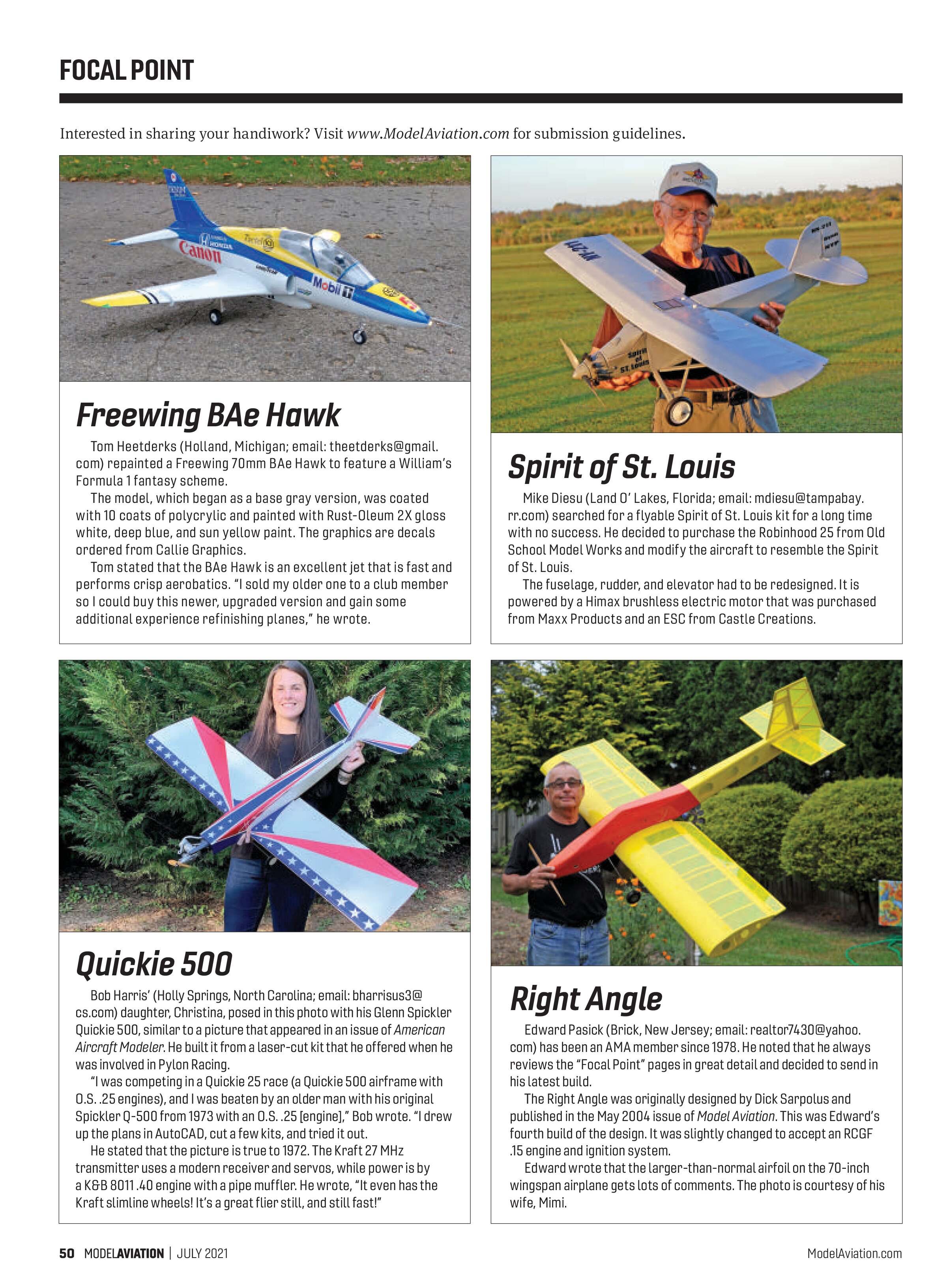
Tom Heetderks (Holland, Michigan; email: theetderks@gmail.com) repainted a Freewing 70mm BAe Hawk to feature a William’s Formula 1 fantasy scheme.
The model, which began as a base gray version, was coated with 10 coats of polycrylic and painted with Rust-Oleum 2X gloss white, deep blue, and sun yellow paint. The graphics are decals ordered from Callie Graphics.
Tom stated that the BAe Hawk is an excellent jet that is fast and performs crisp aerobatics. “I sold my older one to a club member so I could buy this newer, upgraded version and gain some additional experience refinishing planes,” he wrote.
Spirit of St. Louis

Mike Diesu (Land O’ Lakes, Florida; email: mdiesu@tampabay.rr.com) searched for a flyable Spirit of St. Louis kit for a long time with no success. He decided to purchase the Robinhood 25 from Old School Model Works and modify the aircraft to resemble the Spirit of St. Louis.
The fuselage, rudder, and elevator had to be redesigned. It is powered by a Himax brushless electric motor that was purchased from Maxx Products and an ESC from Castle Creations.
Quickie 500

Bob Harris’ (Holly Springs, North Carolina; email: bharrissus@aol? cs.com) daughter, Christina, posed in this photo with his Glenn Spickler Quickie 500, similar to a picture that appeared in an issue of American Aircraft Modeler. He built it from a laser-cut kit that he offered when he was involved in Pylon Racing.
“I was competing in a Quickie 25 race (a Quickie 500 airframe with O.S. .25 engines), and I was beaten by an older man with his original Spickler Q-500 from 1973 with an O.S. .25 [engine],” Bob wrote. “I drew up the plans in AutoCAD, cut a few kits, and tried it out.
He stated that the picture is true to 1972. The Kraft 27 MHz transmitter uses a modern receiver and servos, while power is by a K&B 8011 .40 engine with a pipe muffler. He wrote, “It even has the Kraft slimline wheels! It’s a great flier still, and still fast!”
Right Angle

Edward Pasick (Brick, New Jersey; email: realtor/430@yahoo.com) has been an AMA member since 1978. He noted that he always reviews the “Focal Point” pages in great detail and decided to send in his latest build.
The Right Angle was originally designed by Dick Sarpolus and published in the May 2004 issue of Model Aviation. This was Edward’s fourth build of the design. It was slightly changed to accept an RCGF .15 engine and ignition system.
Edward wrote that the larger-than-normal airfoil on the 70-inch wingspan airplane gets lots of comments. The photo is courtesy of his wife, Mimi.
Top Flite Fw 190 D-9

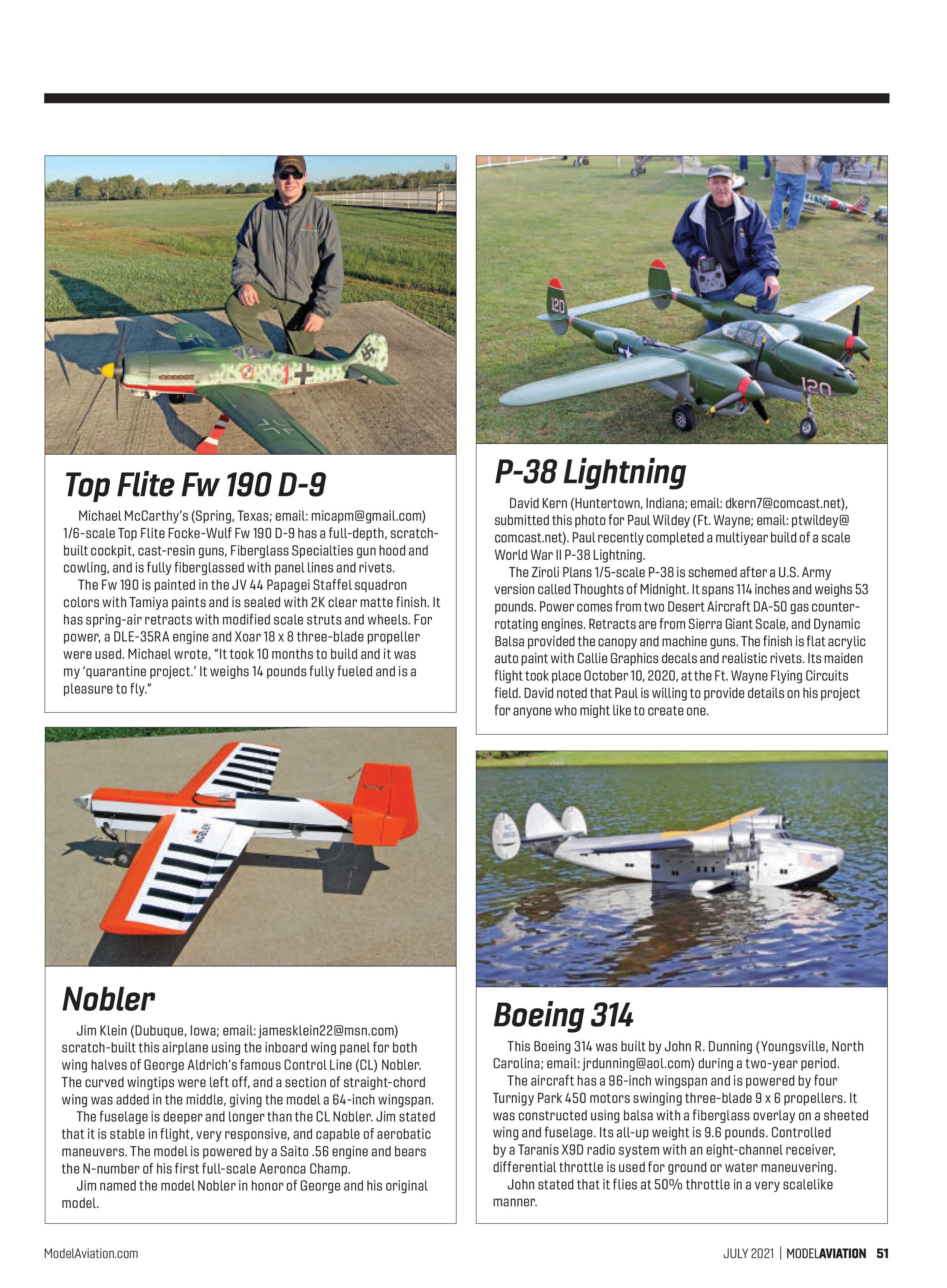
Michael McCarthy’s (Spring, Texas; email: micapm@gmail.com) 1/6-scale Top Flite Focke-Wulf Fw 190 D-9 has a full-depth, scratch-built cockpit, cast-resin guns, Fiberglass Specialties gun hood and cowling, and is fully fiberglassed with panel lines and rivets.
The Fw 190 is painted in the JV 44 Papagei Staffel squadron colors with Tamiya paints and is sealed with 2K clear matte finish. It has spring-air retracts with modified scale struts and wheels. For power, a DLE-35RA engine and Xoar 18 x 8 three-blade propeller were used. Michael wrote, “It took 10 months to build and it was my ‘quarantine project.’ It weighs 14 pounds fully fueled and is a pleasure to fly.”
P-38 Lightning

David Kern (Huntertown, Indiana; email: dkern17@comcast.net), submitted this photo for Paul Wildley (Ft. Wayne; email: ptwildley@comcast.net). Paul recently completed a multiyear build of a scale World War II P-38 Lightning.
The Ziroli Plans 1/5-scale P-38 is schemed after a U.S. Army version called Thoughts of Midnight. It spans 114 inches and weighs 53 pounds. Power comes from two Desert Aircraft DA-50 gas counter-rotating engines. Retracts are from Sierra Giant Scale, and Dynamic Balsa provided the canopy and machine guns. The finish is flat acrylic auto paint with Callie Graphics decals and realistic rivets. Its maiden flight took place October 10, 2020, at the Ft. Wayne Flying Circuits field. David noted that Paul is willing to provide details on his project for anyone who might like to create one.
Nobler

Jim Klein (Dubuque, Iowa; email: jamesklein22@msn.com) scratch-built this airplane using the inboard wing panel for both wing halves of George Aldrich’s famous Control Line (CL) Nobler. The curved wingtips were left off, and a section of straight-chord wing was added in the middle, giving the model a 64-inch wingspan.
The fuselage is deeper and longer than the CL Nobler. Jim stated that it is stable in flight, very responsive, and capable of aerobatic maneuvers. The model is powered by a Saito .56 engine and bears the N-number of his first full-scale Aeronca Champ.
Jim named the model Nobler in honor of George and his original model.
Boeing 314

This Boeing 314 was built by John R. Dunning (Youngsville, North Carolina; email: jrdunning@aol.com) during a two-year period.
The aircraft has a 96-inch wingspan and is powered by four Turnigy Park 450 motors swinging three-blade 9 x 6 propellers. It was constructed using balsa with a fiberglass overlay on a sheeted wing and fuselage. Its all-up weight is 9.6 pounds. Controlled by a Taranis X9D radio system with an eight-channel receiver, differential throttle is used for ground or water maneuvering.
John stated that it flies at 50% throttle in a very scalelike manner.