ADVANCED FLIGHT TECHNOLOGIES

FORWARD, BACKWARD, SIDE-TO-SIDE: HOW DO YOU FLY?
By Patrick Sherman
lucidity@roswellflighttestcrew.com
HOW DO YOU FLY? Fixed-wing, rotorcraft, vertical takeoff and landing (VTOL), or maybe just by flapping the aircraft’s wings? If you’re a commercial sUAS operator, these differences can have a profound effect on the types of missions you are able to perform safely and successfully. For recreational pilots, there are operational considerations as well. What type of infrastructure do you require to go flying and what skills do you need to safely operate your aircraft?
Fixed-Wing Aircraft
The first heavier-than-air flying machine was the fixed-wing Wright Flyer, which took to the sky in 1903 in Kitty Hawk, North Carolina. In fact, the Wright brothers experimented with kites and gliders—the sUAS and model airplanes of their day—leading up to their first successful flight with a human being onboard.
Today, fixed-wing aircraft are the undisputed leaders in crewed aviation, with more than a billion people flying on commercial jetliners annually—and that’s just in the US. There is a good reason for that. Fixed-wing platforms are more efficient than any other type. They can fly farther and faster, carry a heavier payload, and consume less energy than other aircraft with comparable capabilities.
These immense advantages come with a few key drawbacks, however. First and foremost is the need for a ground-based infrastructure to launch and recover the aircraft. This most often takes the form of an established runway at an airport or other dedicated facility.
Some small military UAS, such as the Insitu ScanEagle, employ a pneumatically operated launcher and skyhook recovery technique. The system snags the aircraft using an arresting wire that is suspended vertically from a 50-foot boom, which engages a hook located at the tip of each wing. To deploy the aircraft, the boom folds down to become a launch rail. You can find videos of this process on YouTube. It’s hard to imagine that a 50-pound aircraft bouncing around like a child’s toy is a standard operating procedure, but it’s a well-proven technique at this point.
While offering much greater flexibility than an established runway, the ScanEagle launch and recovery system still has to be moved on a flatbed truck, making it the exception that proves the rule: For a fixed-wing aircraft, flying through the air means having assets on the ground.
There are additional limitations to a fixed-wing aircraft. It must maintain a minimum airspeed in order to keep flying, so loitering over a specific location will require the aircraft to fly in circles, which might limit its perspective on a ground-based target at different points in its orbit.
Rotorcraft
This category includes conventional, tandem, and coaxial helicopter designs, as well as the multirotors that have exploded in popularity as small, civilian UAS throughout the past decade. Rotorcraft are nearly the opposite of fixed-wing aircraft. They are less efficient, carry less payload, and fly slower when compared with fixed-wing aircraft. However, they are infinitely more maneuverable. They can hover, fly backward and side-to-side, and make direct vertical ascents and descents.
As a result, rotorcraft can be operated independently of prepared launch and recovery sites and are able to touch down on any bare patch of ground that is large enough to accommodate their rotors. This provides an amazing degree of flexibility, which is why crewed helicopters are the platform of choice for many military operations, search and rescue teams, wildland firefighting, and transport to and from specific destinations, such as rooftop helipads.
The first modern helicopter ever to take flight was the Focke-Wulf Fw 61, which was built in 1936 in prewar Germany. However, the first helicopter to be produced at scale was the R-4, which was developed in the US in 1942 by Russian immigrant Igor Sikorsky.
I don’t have any statistics to back this up, but I’d be willing to bet $100 that rotorcraft—and multirotors in particular—account for most civil sUAS in operation today. In addition to their professional applications, hundreds of thousands have been sold to recreational pilots who are interested in aerial photography, drone racing, and the simple enjoyment of flight.
Although conventional single-rotor helicopters and multirotors are both capable of performing similar maneuvers, there are important differences between them. Among these is the helicopter’s reliance on a complex set of mechanical linkages to control aircraft roll, pitch, and lift by manipulating the main rotor blades. This delicate system relies on routine maintenance to function safely and dependably.
A typical quadcopter multirotor, on the


other hand, has only four moving parts that are responsible for maneuvering and maintaining it in the air—robust and reliable electric motors that require little in the way of maintenance. The tradeoff is that, in the event of an engine failure, a helicopter can autorotate (the equivalent of gliding in a fixed-wing platform) to a safe landing, while a multirotor is simply doomed to fall.
VTOL
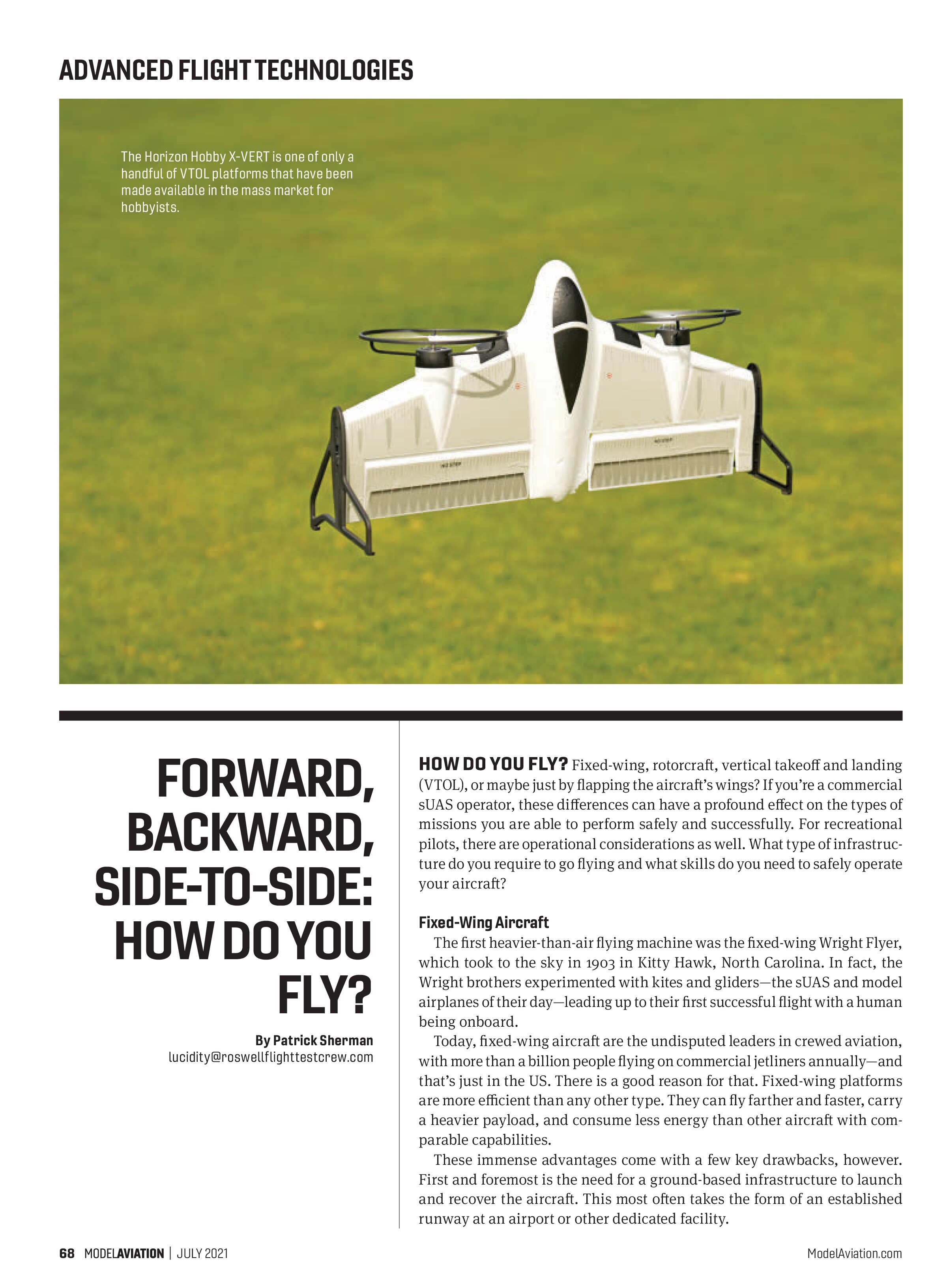
VTOL aircraft seek to combine the advantages of both fixed-wing airplanes and rotorcraft. They are able to launch and recover vertically on a small patch of open ground, similar to a helicopter, but also travel long distances at a greater speed, much like an airplane. However, as a compromise between the two types, they never achieve a level of performance equal to a dedicated platform of either type.
In crewed aviation, VTOL platforms grew up alongside helicopters, albeit with more limited success. After World War II, a pair of practical aircraft were developed by Lockheed and Convair. Both were flown successfully, but the projects were subsequently canceled.
NASA has continued to conduct research

on VTOL aircraft, and two have been successfully deployed by the military: the McDonnell Douglas AV-8B Harrier Jump Jet and the Bell Boeing V-22 Osprey. Both are used primarily by the U.S. Marine Corps to support expeditionary combat operations.
Similar to their crewed counterparts, only a few VTOL UAS have been developed, although their numbers appear to be growing as the industry matures. A significant challenge with any VTOL is the transition from vertical to horizontal flight and back, but the sophisticated sensors and flight control algorithms that have made multirotor UAS operations so common and reliable benefit this problem as well.
Orni-What?
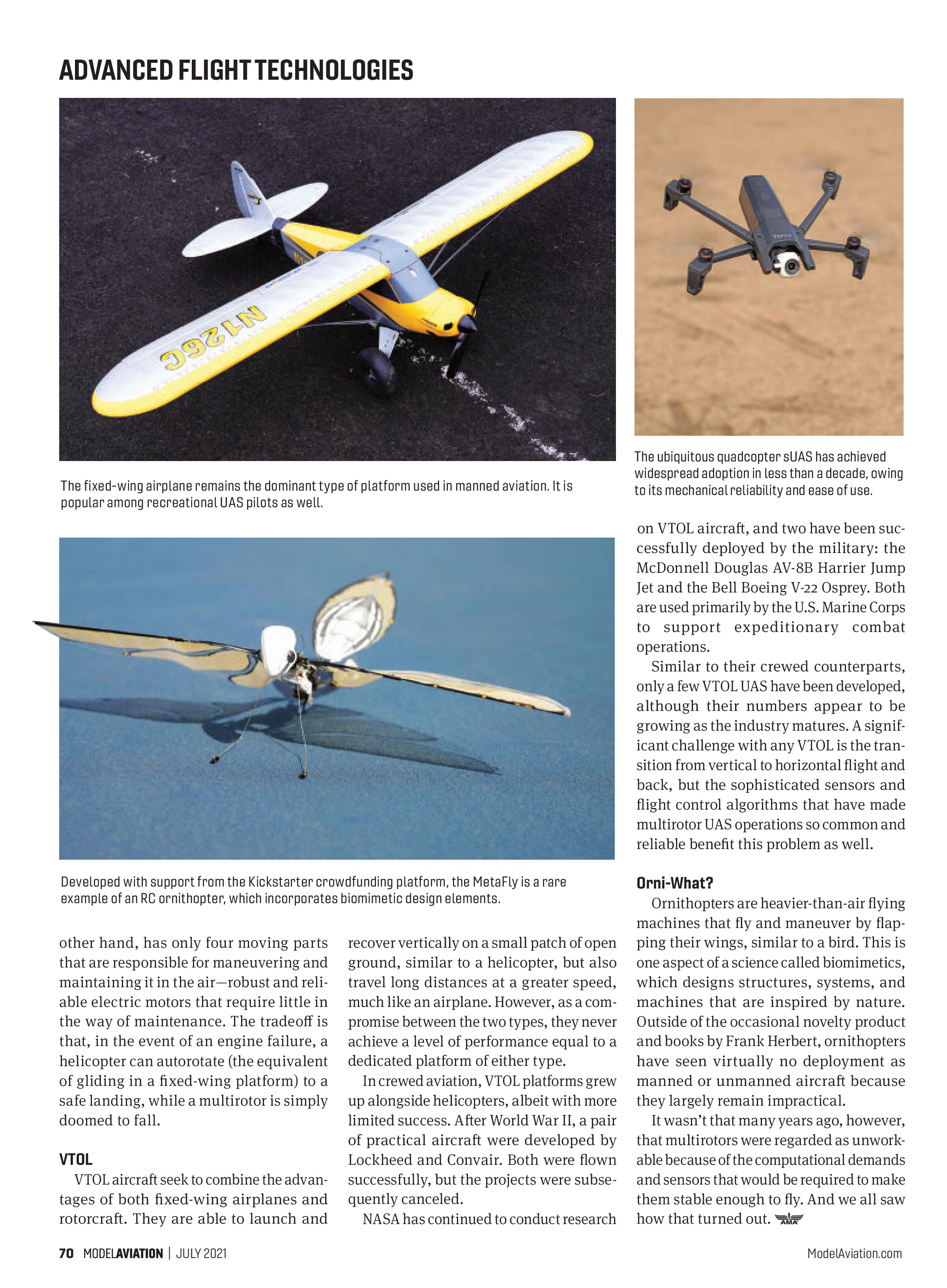
Ornithopters are heavier-than-air flying machines that fly and maneuver by flapping their wings, similar to a bird. This is one aspect of a science called biomimetics, which designs structures, systems, and machines that are inspired by nature. Outside of the occasional novelty product and books by Frank Herbert, ornithopters have seen virtually no deployment as manned or unmanned aircraft because they largely remain impractical.
It wasn’t that many years ago, however, that multirotors were regarded as unworkable because of the computational demands and sensors that would be required to make them stable enough to fly. And we all saw how that turned out.