Vintage Radio Control Society
A very special SIG
By Bob Noll
Photos by the author
bobrc@aol.com

Some of you might not know about the AMA program that recognizes groups within the organization that share similar interests. AMA calls them Special Interest Groups (SIGs). Among them is the Vintage Radio Control Society, or VRCS.
VRCS is an organization dedicated to the preservation of RC history. Its primary objective is to fly the old RC designs—those airplanes that were designed for radio control.
The VRCS was born in 1989, initially as an idea by Bill Winter, resulting from discussions with Hal “Pappy” deBolt about how the history of RC could be recorded and preserved. Further discussions involved Joe Beshar, John Worth, and Art Schroeder. With Joe’s prodding, Art accepted the editorship responsibility for producing the society’s newsletter, and John agreed to serve as the initial president, whereupon Joe signed on as secretary-treasurer.
The society needed some bylaws, and the objective of the VRCS was clearly stated as, “The VRCS is intended to preserve and promote the memory of Radio Control aeromodeling activity as it was prior to the establishment of VRCS in 1989.” I remember John telling me that he wanted to demonstrate that those early designs would excel with the use of more modern radio systems.
By the end of 1989, the first VRCS reunion was scheduled for Labor Day weekend in September 1990, at the airport in Selinsgrove, Pennsylvania, a site for earlier RC events. Following a successful inaugural VRCS event that year, the annual reunion continued regularly on Labor Day weekends at the

Selinsgrove airport until 1996, when the location was changed to the Lums Pond State Park near Newark, Delaware. The early reunions were hosted by the AMA officers, but the move to Delaware changed that and the new host was the Delaware RC Club.
In 1999, the reunion moved to Sayre, Pennsylvania, and was hosted by the Aeroguidance Society. When the airport in Sayre was lost, the reunion moved to the Aeroguidance Society’s home field in Endicott, New York, where it remains today.
A VRCS Hall of Fame was established in 1973, and the original members were those who had received the Howard McEntee Award that was presented at the annual Westchester Radio Aero Modelers (WRAM) trade show. In 2002, VRCS formed its own VRCS Hall of Fame committee.
VRCS was originally composed of four regions, each having an executive council that had the responsibility of representing their region when organizational decisions had to be made. As VRCS activity increased, two more regions were added. The six regions are Northwest, North Central, Northeast, Southwest, South Central, and Southeast.
VRCS is a “builder’s SIG” because the airplanes flown at VRCS events across the country are built from complete kits or short kits. Some original kits can still be found; however, several manufacturers can provide freshly made complete kits or short kits. Short kits contain laser-cut parts such as formers and ribs, leaving the balsa sheeting and strips to be purchased elsewhere by the builder.
Member satisfaction comes from building and flying “designs with character.” Building your own airplane allows for a variety of color choices and paint schemes. Although there might be several models of the same design at VRCS events, it is rare that the paint

schemes are alike. Each builder can express his or her own personality when choosing a paint scheme for the vintage model. This is not the case with the present trend to purchase foam, look-alike aircraft.
Here is a little information about VRCS that is found on its official website (listed in “Sources”):
The VRCS is an organization dedicated to the preservation of our radio control history—the achievements of those electronic and airframe design pioneers who made RC one of the best hobbies/sports in the world today. We do this through our bimonthly newsletter, The Vintage Flier, and annual reunions and fly-ins.
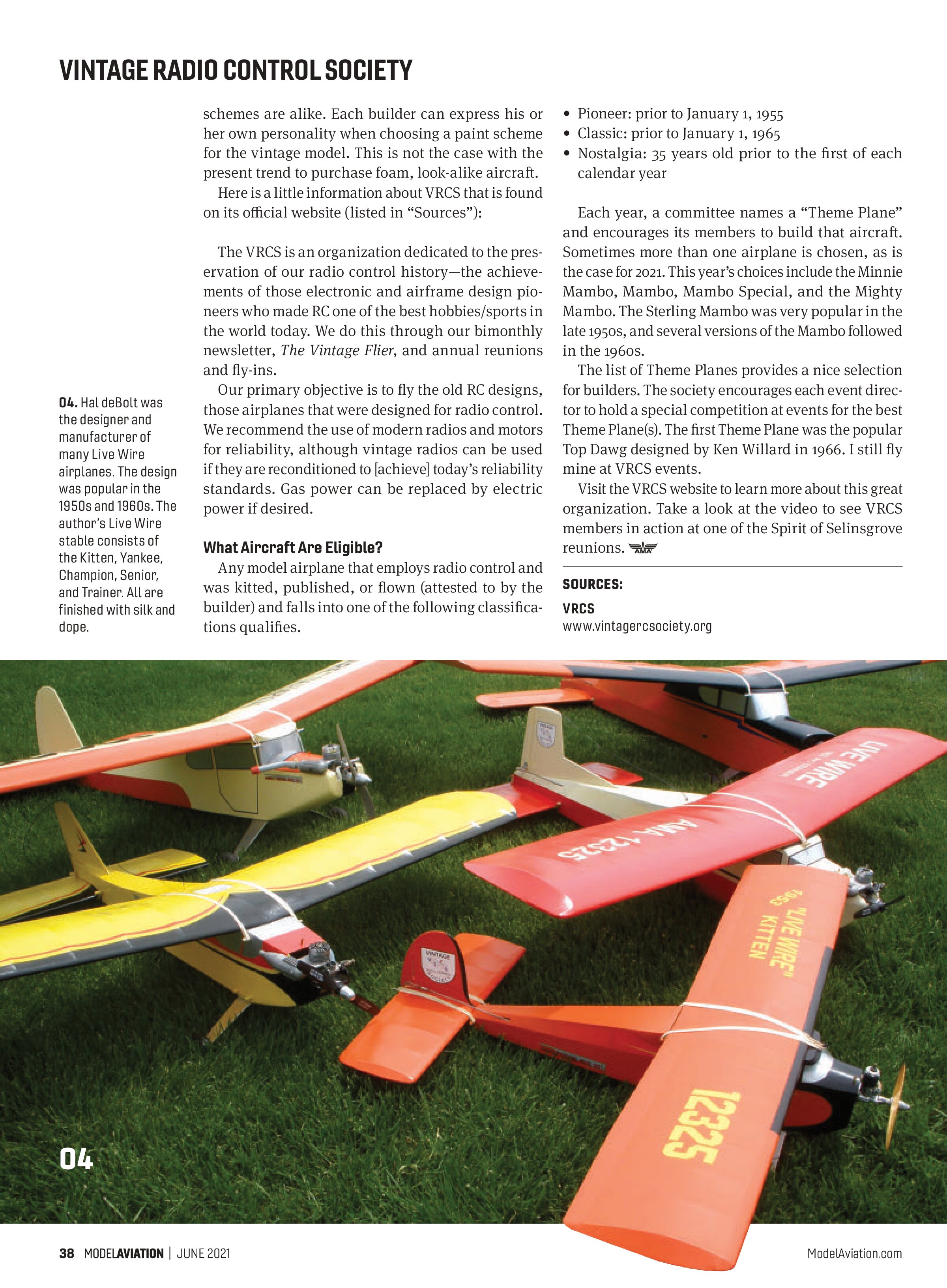
Our primary objective is to fly the old RC designs, those airplanes that were designed for radio control. We recommend the use of modern radios and motors for reliability, although vintage radios can be used if they are reconditioned to [achieve] today’s reliability standards. Gas power can be replaced by electric power if desired.
What Aircraft Are Eligible?
Any model airplane that employs radio control and was kitted, published, or flown (attested to by the builder) and falls into one of the following classifications qualifies.
- Pioneer: prior to January 1, 1955
- Classic: prior to January 1, 1965
- Nostalgia: 35 years old prior to the first of each calendar year
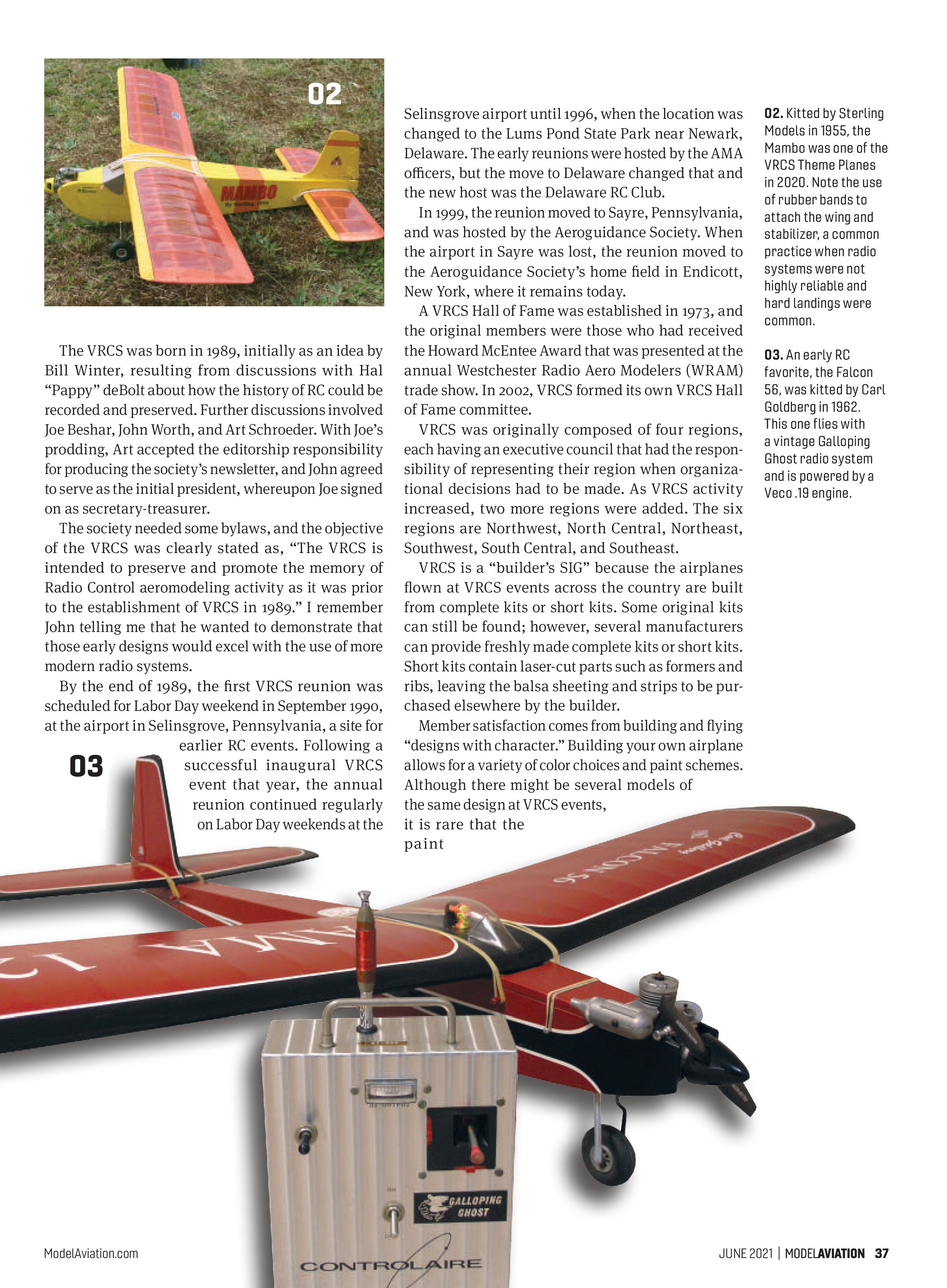
Each year, a committee names a “Theme Plane” and encourages its members to build that aircraft. Sometimes more than one airplane is chosen, as is the case for 2021. This year’s choices include the Minnie Mambo, Mambo, Mambo Special, and the Mighty Mambo. The Sterling Mambo was very popular in the late 1950s, and several versions of the Mambo followed in the 1960s.
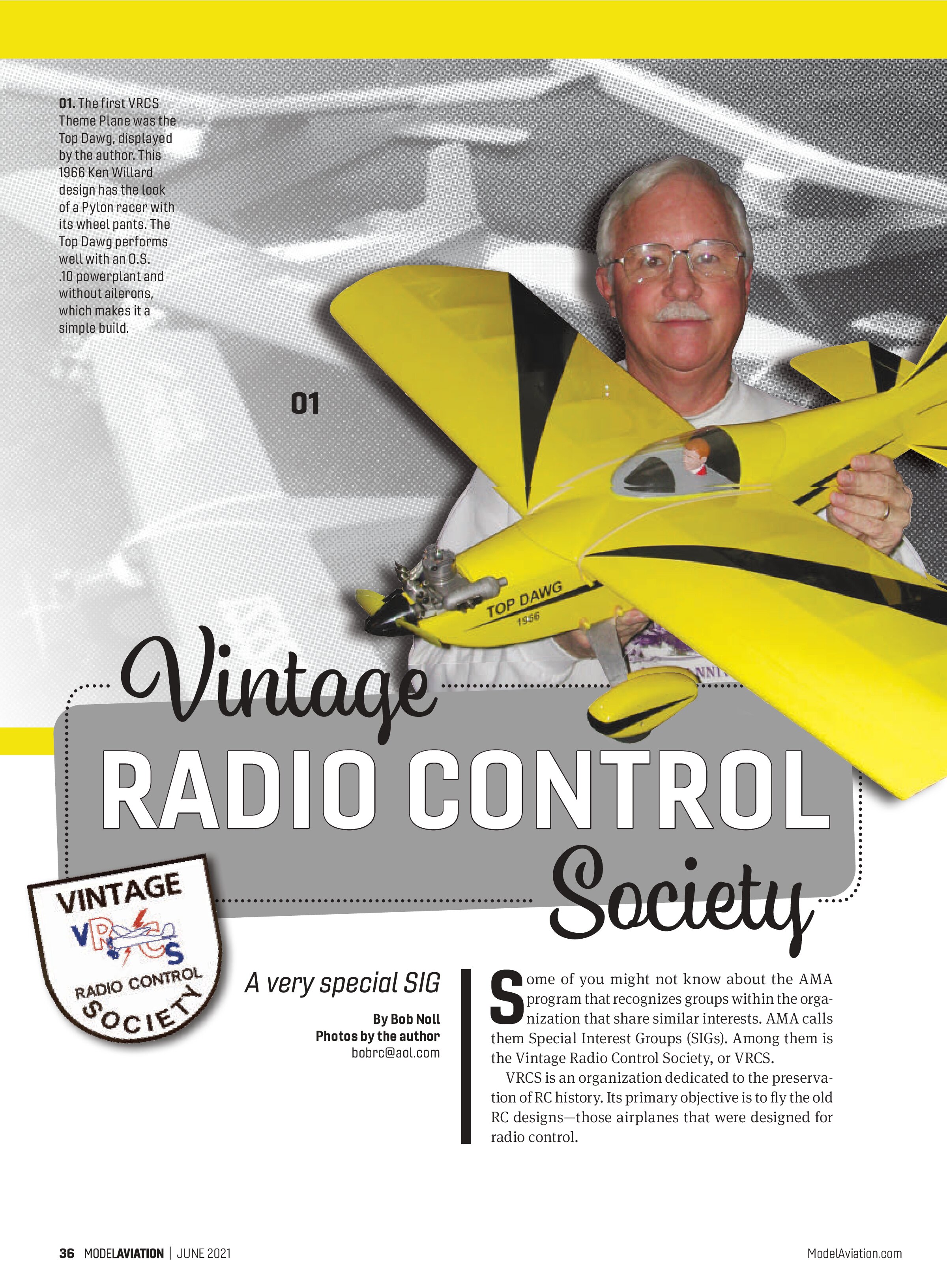
The list of Theme Planes provides a nice selection for builders. The society encourages each event director to hold a special competition at events for the best Theme Plane(s). The first Theme Plane was the popular Top Dawg designed by Ken Willard in 1966. I still fly mine at VRCS events.
Visit the VRCS website to learn more about this great organization. Take a look at the video to see VRCS members in action at one of the Spirit of Selinsgrove reunions.
SOURCES: