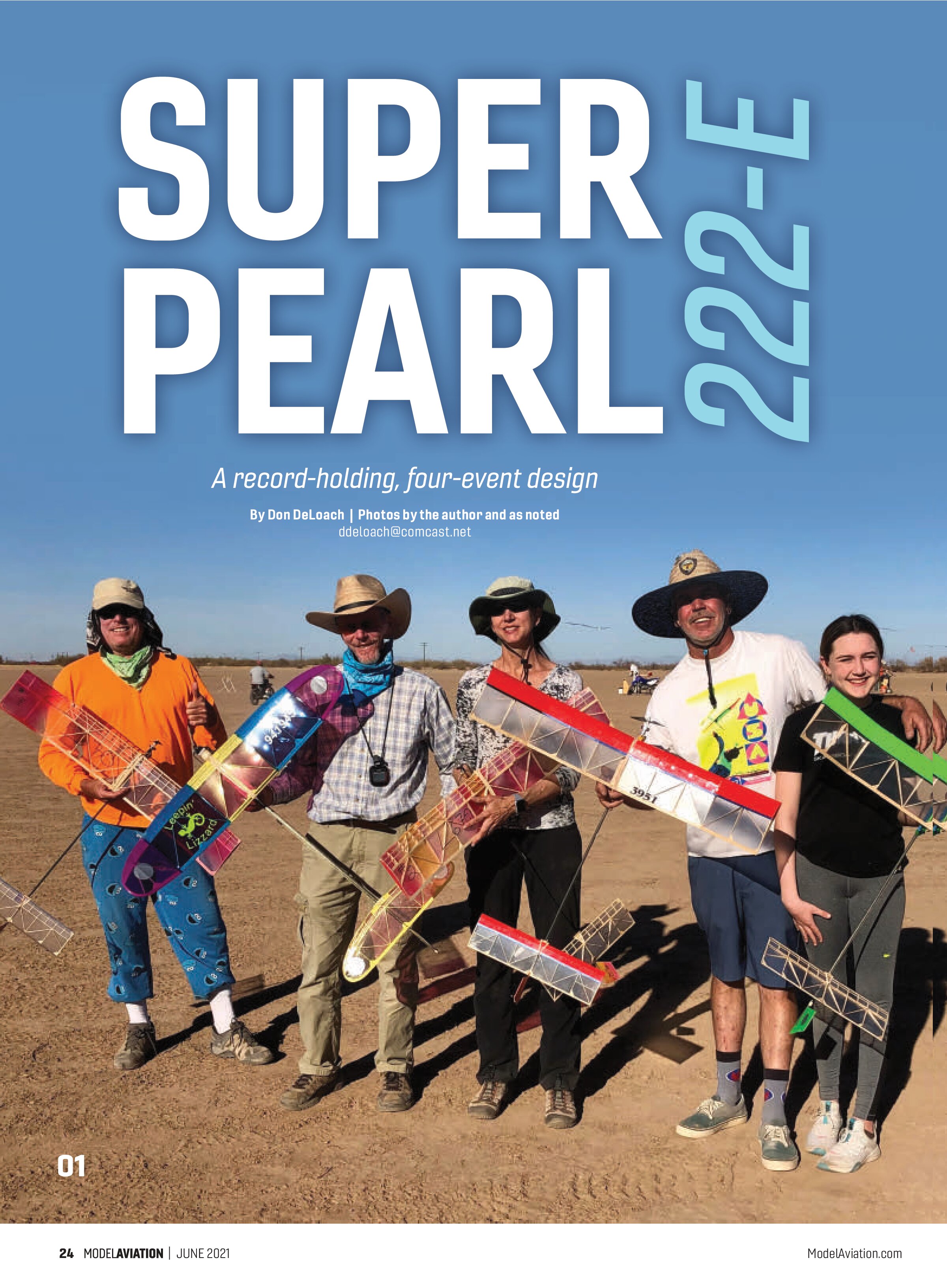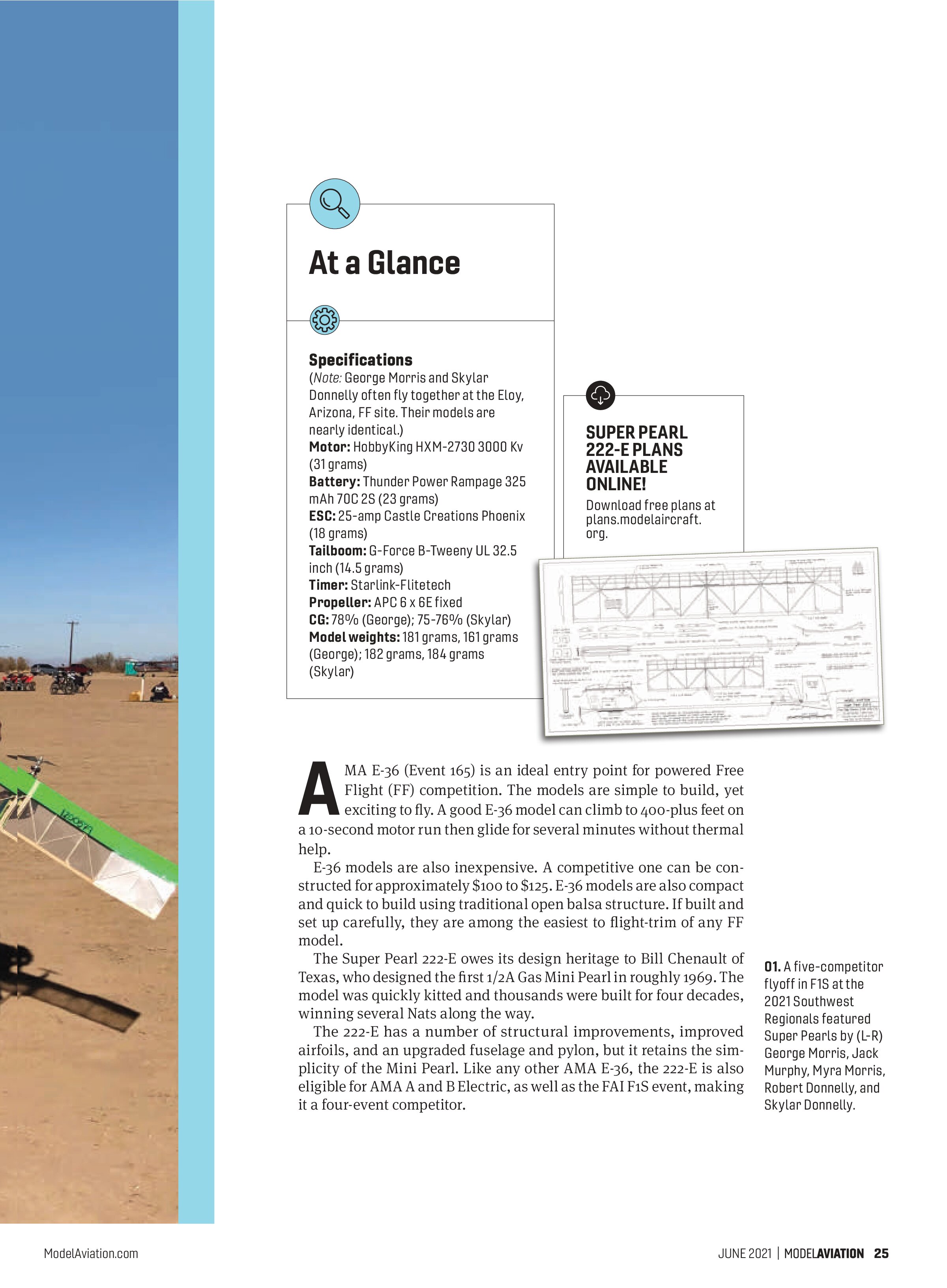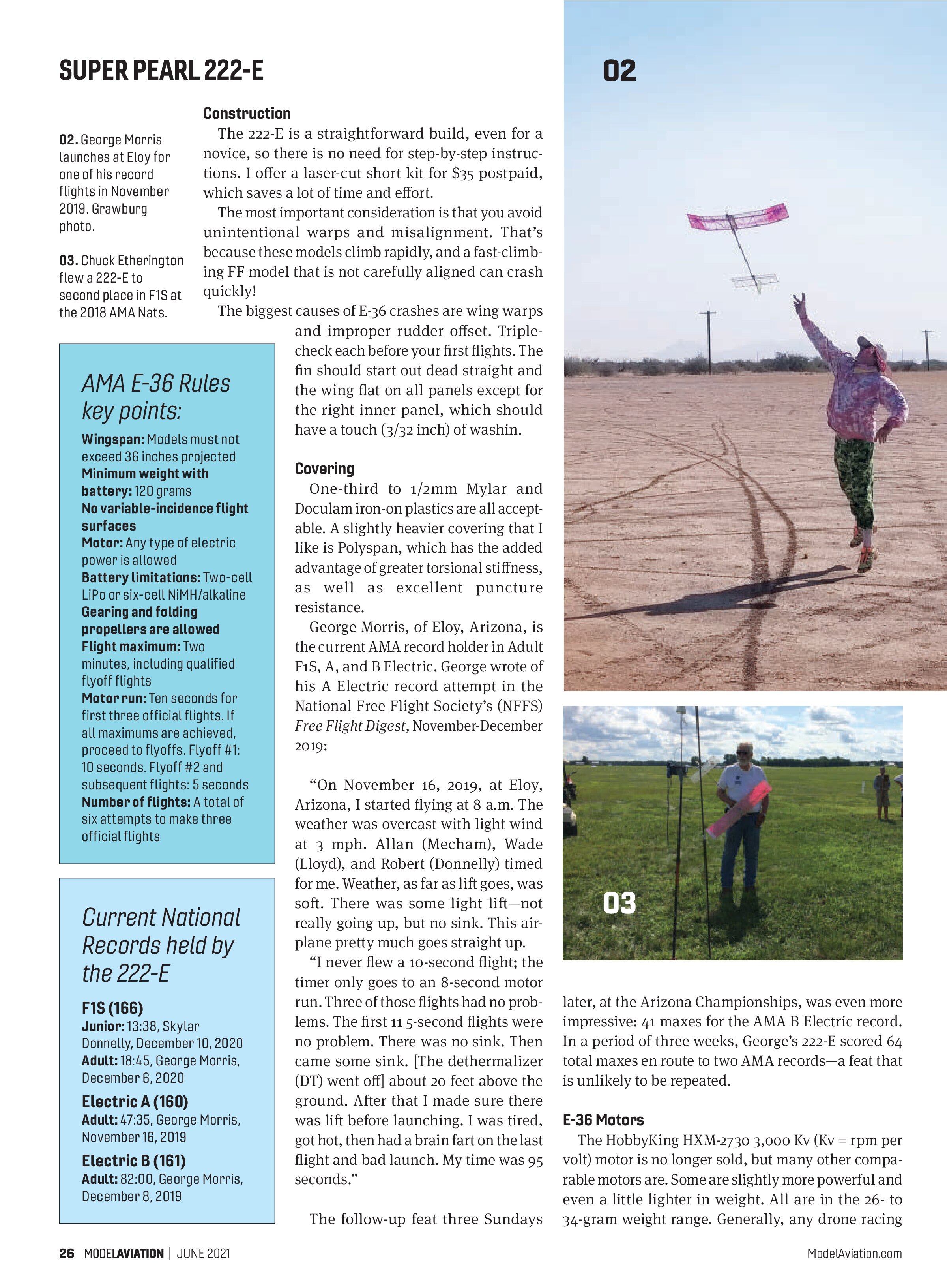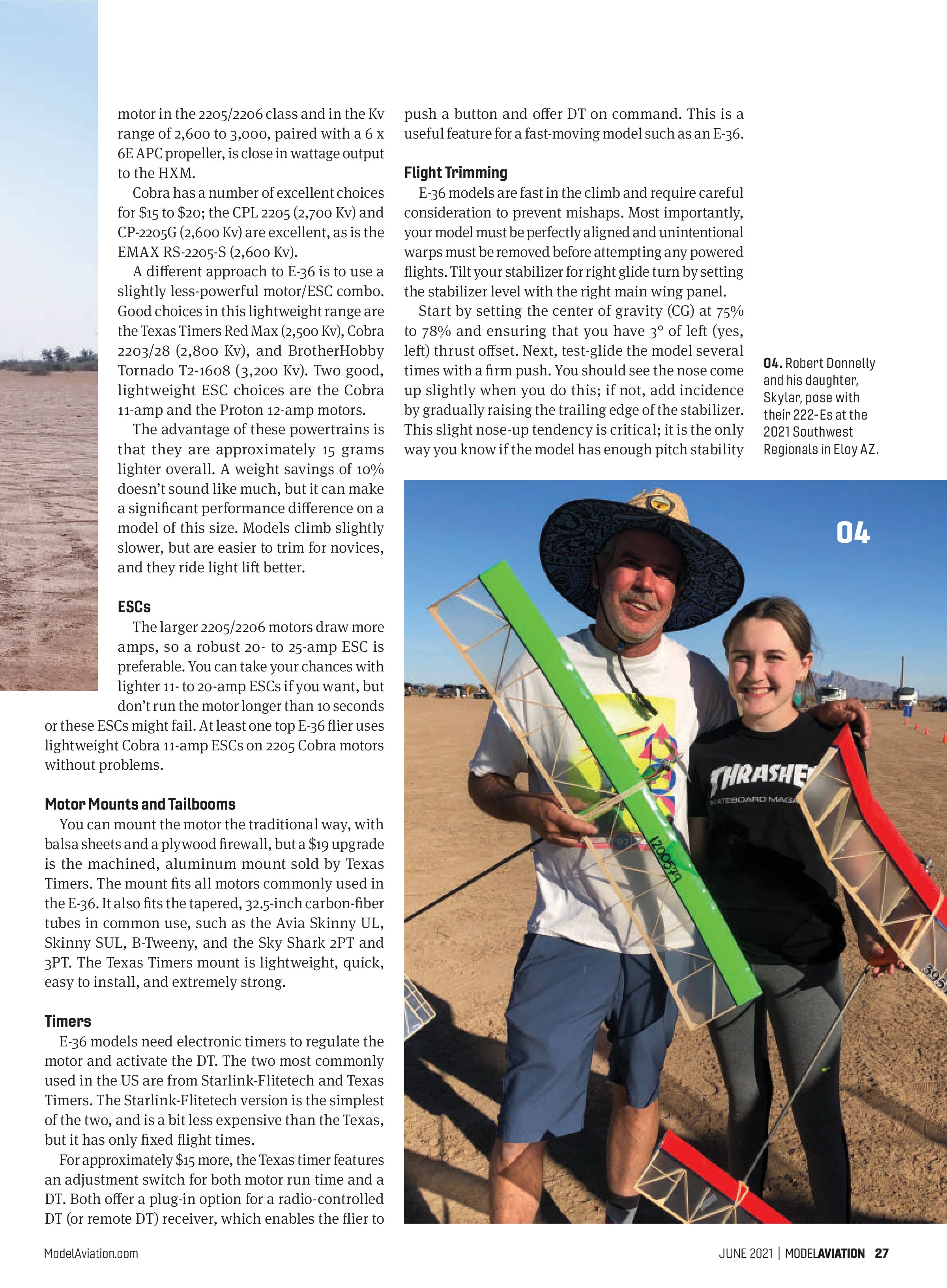
SUPER PEARL 222-E
A record-holding, four-event design
By Don DeLoach | Photos by the author and as noted
ddeloach@comcast.net

At a Glance
Specifications
(Note: George Morris and Skylar Donnelly often fly together at the Eloy, Arizona, FF site. Their models are nearly identical.)
Motor: HobbyKing HXM-2730 3000 Kv (31 grams)
Battery: Thunder Power Rampage 325 mAh 70C 2S (23 grams)
ESC: 25-amp Castle Creations Phoenix (18 grams)
Tailboom: G-Force B-Tweeny UL 32.5 inch (14.5 grams)
Timer: Starlink-Flitetech
Propeller: APC 6 x 6E fixed
CG: 78% (George); 75-76% (Skylar)
Model weights: 181 grams, 161 grams (George); 182 grams, 184 grams (Skylar)
SUPER PEARL 222-E PLANS AVAILABLE ONLINE!
Download free plans at plans.modelaircraft.org.

AMA E-36 (Event 165) is an ideal entry point for powered Free Flight (FF) competition. The models are simple to build, yet exciting to fly. A good E-36 model can climb to 400-plus feet on a 10-second motor run then glide for several minutes without thermal help.
E-36 models are also inexpensive. A competitive one can be constructed for approximately $100 to $125. E-36 models are also compact and quick to build using traditional open balsa structure. If built and set up carefully, they are among the easiest to flight-trim of any FF model.
The Super Pearl 222-E owes its design heritage to Bill Chenault of Texas, who designed the first 1/2A Gas Mini Pearl in roughly 1969. The model was quickly kitted and thousands were built for four decades, winning several Nats along the way.
The 222-E has a number of structural improvements, improved airfoils, and an upgraded fuselage and pylon, but it retains the simplicity of the Mini Pearl. Like any other AMA E-36, the 222-E is also eligible for AMA A and B Electric, as well as the FAI F15 event, making it a four-event competitor.
Construction
The 222-E is a straightforward build, even for a novice, so there is no need for step-by-step instructions. I offer a laser-cut short kit for $35 postpaid, which saves a lot of time and effort.
The most important consideration is that you avoid unintentional warps and misalignment. That’s because these models climb rapidly, and a fast-climbing FF model that is not carefully aligned can crash quickly!
The biggest causes of E-36 crashes are wing warps and improper rudder offset. Triple-check each before your first flights. The fin should start out dead straight and the wing flat on all panels except for the right inner panel, which should have a touch (3/32 inch) of washin.


AMA E-36 Rules key points:
Wingspan: Models must not exceed 36 inches projected
Minimum weight with battery: 120 grams
No variable-incidence flight surfaces
Motor: Any type of electric power is allowed
Battery limitations: Two-cell LiPo or six-cell NiMH/alkaline
Gearing and folding propellers are allowed
Flight maximum: Two minutes, including qualified flyoff flights
Motor run: Ten seconds for first three official flights. If all maximums are achieved, proceed to flyoffs. Flyoff #1: 10 seconds. Flyoff #2 and subsequent flights: 5 seconds
Number of flights: A total of six attempts to make three official flights
Current National Records held by the 222-E
F15 (16b)
Junior: 13:38, Skylar Donnelly, December 10, 2020
Adult: 18:45, George Morris, December 6, 2020
Electric A (160)
Adult: 47:35, George Morris, November 16, 2019
Electric B (161)
Adult: 82:00, George Morris, December 8, 2019
George Morris, of Eloy, Arizona, is the current AMA record holder in Adult F1S, A, and B Electric. George wrote of his A Electric record attempt in the National Free Flight Society’s (NFFS) Free Flight Digest, November-December 2019:
“On November 16, 2019, at Eloy, Arizona, I started flying at 8 a.m. The weather was overcast with light wind at 3 mph. Allan (Mecham), Wade (Lloyd), and Robert (Donnelly) timed for me. Weather, as far as lift goes, was soft. There was some light lift—not really going up, but no sink. This airplane pretty much goes straight up.”
“I never flew a 10-second flight; the timer only goes to an 8-second motor run. Three of those flights had no problems. The first 11.5-second flights were no problem. There was no sink. Then came some sink. [The dethermalizer (DT) went off about 20 feet above the ground. After that I made sure there was lift before launching. I was tired, got hot, then had a brain fart on the last flight and bad launch. My time was 95 seconds.”
The follow-up feat three Sundays later, at the Arizona Championships, was even more impressive: 41 maxes for the AMA B Electric record. In a period of three weeks, George’s 222-E scored 64 total maxes en route to two AMA records—a feat that is unlikely to be repeated.
E-36 Motors
The HobbyKing HXM-2730 3,000 Kv (Kv = rpm per volt) motor is no longer sold, but many other comparable motors are. Some are slightly more powerful and even a little lighter in weight. All are in the 26- to 34-gram weight range. Generally, any drone racing motor in the 2205/2206 class and in the Kv range of 2,600 to 3,000, paired with a 6 x 6E APC propeller, is close in wattage output to the HXM.
Cobra has a number of excellent choices for $15 to $20; the CPL 2205 (2,700 Kv) and CP-2205G (2,600 Kv) are excellent, as is the EMAX RS-2205-S (2,600 Kv).
A different approach to E-36 is to use a slightly less-powerful motor/ESC combo. Good choices in this lightweight range are the Texas Timers Red Max (2,500 Kv), Cobra 2203/28 (2,800 Kv), and BrotherHobby Tornado T2-1608 (3,200 Kv). Two good, lightweight ESC choices are the Cobra 11-amp and the Proton 12-amp motors.
The advantage of these powertrains is that they are approximately 15 grams lighter overall. A weight savings of 10% doesn’t sound like much, but it can make a significant performance difference on a model of this size. Models climb slightly slower, but are easier to trim for novices, and they ride light lift better.
ESCs
The larger 2205/2206 motors draw more amps, so a robust 20- to 25-amp ESC is preferable. You can take your chances with lighter 11- to 20-amp ESCs if you want, but don’t run the motor longer than 10 seconds or these ESCs might fail. At least one top E-36 flier uses lightweight Cobra 11-amp ESCs on 2205 Cobra motors without problems.
Motor Mounts and Tailbooms
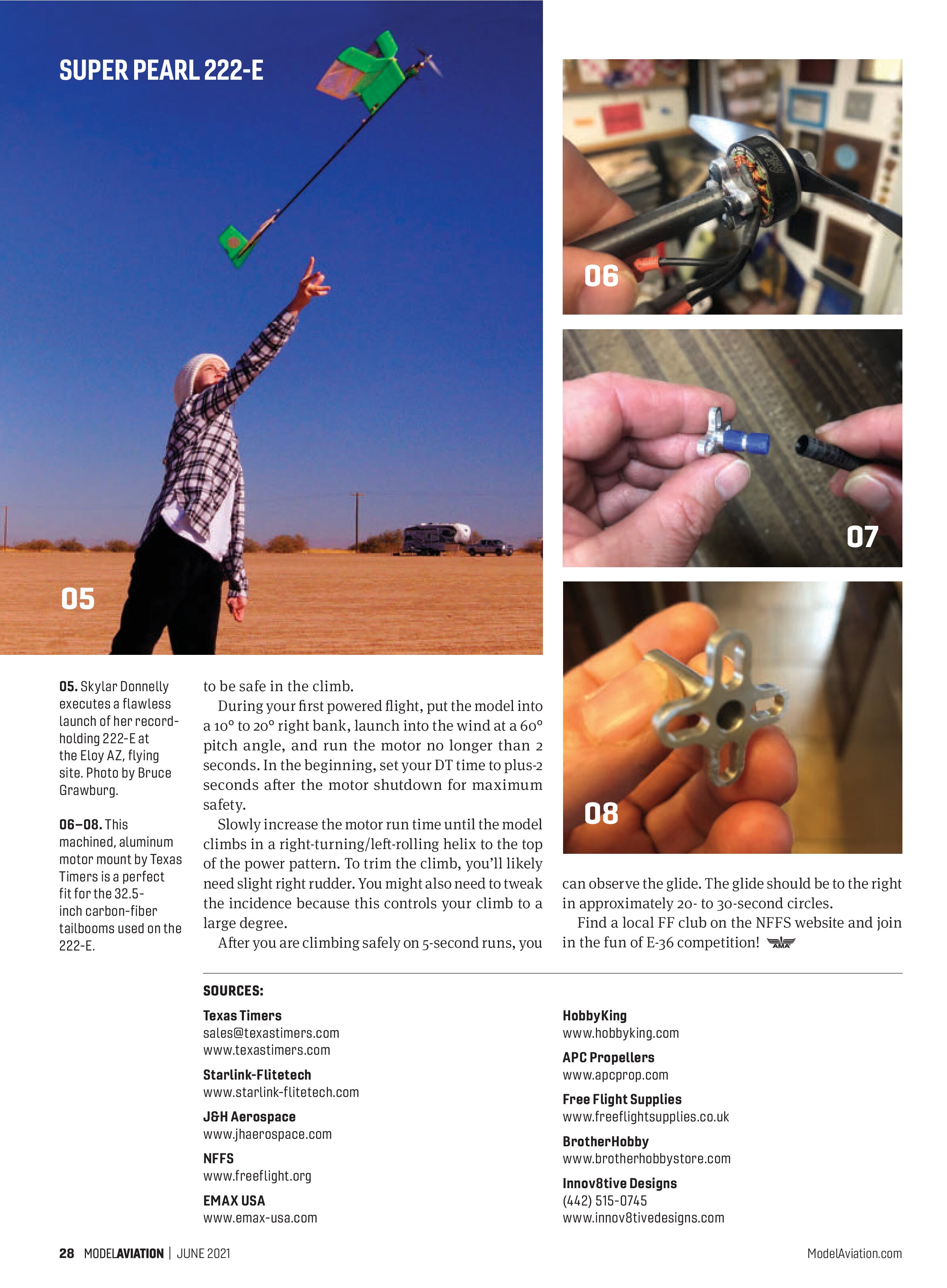
You can mount the motor the traditional way, with balsa sheets and a plywood firewall, but a $19 upgrade is the machined, aluminum mount sold by Texas Timers. The mount fits all motors commonly used in the E-36. It also fits the tapered, 32.5-inch carbon fiber tubes in common use, such as the Avia Skinny UL, Skinny SUL, B-Tweeny, and the Sky Shark 2PT and 3PT. The Texas Timers mount is lightweight, quick, easy to install, and extremely strong.
Timers
E-36 models need electronic timers to regulate the motor and activate the DT. The two most commonly used in the US are from Starlink-Flitetech and Texas Timers. The Starlink-Flitetech version is the simplest of the two, and is a bit less expensive than the Texas, but it has only fixed flight times.
For approximately $15 more, the Texas timer features an adjustment switch for both motor run time and a DT. Both offer a plug-in option for a radio-controlled DT (or remote DT) receiver, which enables the flier to push a button and offer DT on command. This is a useful feature for a fast-moving model such as an E-36.
Flight Trimming
E-36 models are fast in the climb and require careful consideration to prevent mishaps. Most importantly, your model must be perfectly aligned and unintentional warps must be removed before attempting any powered flights. Tilt your stabilizer for right glide turn by setting the stabilizer level with the right main wing panel.
Start by setting the center of gravity (CG) at 75% to 78% and ensuring that you have 3° of left (yes, left) thrust offset. Next, test-glide the model several times with a firm push. You should see the nose come up slightly when you do this; if not, add incidence by gradually raising the trailing edge of the stabilizer. This slight nose-up tendency is critical; it is the only way you know if the model has enough pitch stability.


to be safe in the climb.
During your first powered flight, put the model into a 10° to 20° right bank, launch into the wind at a 60° pitch angle, and run the motor no longer than 2 seconds. In the beginning, set your DT time to plus-2 seconds after the motor shutdown for maximum safety.
Slowly increase the motor run time until the model climbs in a right-turning/left-rolling helix to the top of the power pattern. To trim the climb, you’ll likely need slight right rudder. You might also need to tweak the incidence because this controls your climb to a large degree.
After you are climbing safely on 5-second runs, you can observe the glide. The glide should be to the right in approximately 20° to 30°-second circles.
Find a local FF club on the NFFS website and join in the fun of E-36 competition!
SOURCES:
Texas Timers
sales@texastimers.com
www.texastimers.com
Starlink-Flitetech
www.starlink-flitetech.com
J&H Aerospace
www.jhaerospace.com
EMAX USA
www.emax-usa.com
HobbyKing
www.hobbyking.com
APC Propellers
www.apcprop.com
Free Flight Supplies
www.freeflightsupplies.co.uk
BrotherHobby
www.brotherhobbystore.com
Innov8tive Designs
(442) 515-0745
www.innov8tivedesigns.com