SMALL-FIELD FLYING

ASUKA TISSUE
By Pat Tritle | patscustommodels@gmail.com
AS YOU READ THIS, I suspect that you are in short sleeves, sitting in air conditioning, and soaking up the nice, cool air. As I write this, however, we’re in the throes of the longest, windiest, coldest, and wettest stretch of winter weather we’ve seen in years.
All things considered, outside stuff is out of the question—for now. There is good news. Being shut in has provided me time to try a couple of things I just haven’t otherwise had time for.
Before I get into that, I first need to wipe the egg off of my face. In my February column, I gave credit to George Ash for the Baby Fleetster, when in fact, Glenn Dunlap built the model. As always, credit must go where credit is due, and my apologies for the mix-up.
Wind-It-Up Enterprises
While I was snowed in, I took the opportunity to build a new Free Flight (FF) model, not only because it needed doing but because a new Japanese tissue is available. Esaki tissue is getting hard to come by, and although domestic tissue works fine in most applications, I still prefer Japanese tissue to domestic for smaller models.
I received a note from Chuck Imbergamo of Wind-it-up Enterprises, a company that now offers Flying Bird Asuka tissue. Chuck was kind enough to send a sample sheet of white, which I used to cover the wing and stabilizer on my new model.
In a word, this stuff works great. The tissue has a “slick” side like the old Esaki, but it’s not as stiff, which makes it easier to work with and it can be applied damp. It also seals nicely with only one coat of nitrate dope.


If that’s not enough, Wind-it-up is actually Peck-Polymers, and Chuck carries a full line of propellers, shafts, bearings, and flying and building supplies, as well as kits and both Japanese and domestic tissue. Your best bet is to check the website, listed in “Sources,” to see what’s there.
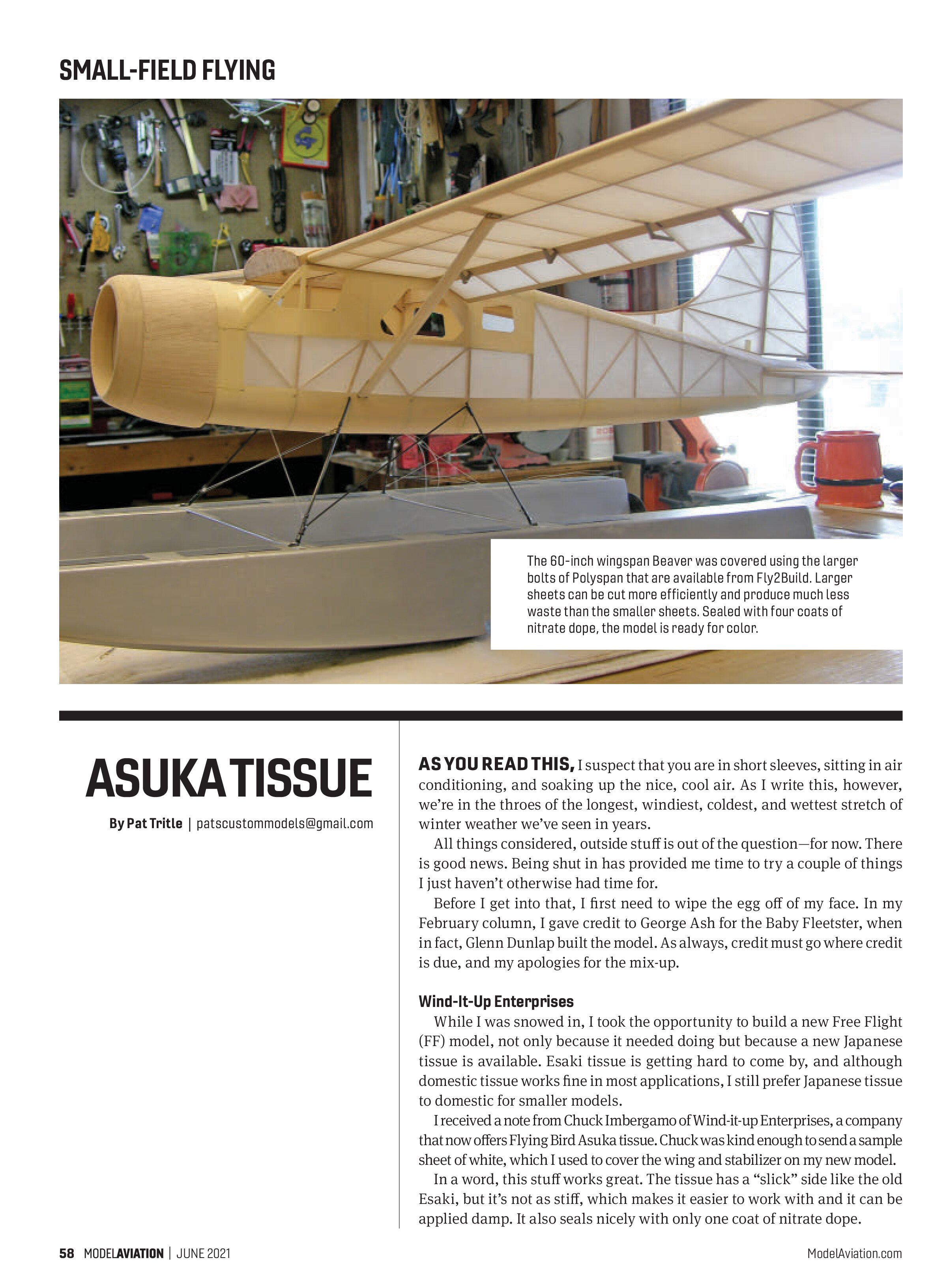
hardly enough waste to mention.
On another note, I got a roll of Polyspan Lite from FAI Model Supply, but I no longer see that covering listed on the company’s website. If anyone knows of a source for it, please let me know and I’ll be happy to share the information.
Larger Bolts of Polyspan
While I’m on the subject of covering materials, anyone who covers larger models knows that larger bolts of covering material can be used more efficiently. Using Polyspan from the 20-inch x 2-meter rolls works great for smaller models, but for larger ones, there’s just too much waste. The good news is that I found Polyspan in 38-inch x 10- or 20-foot-long bolts at Fly2Build. I covered a 60-inch wingspan Beaver using a large bolt, and there was
Readers Write In
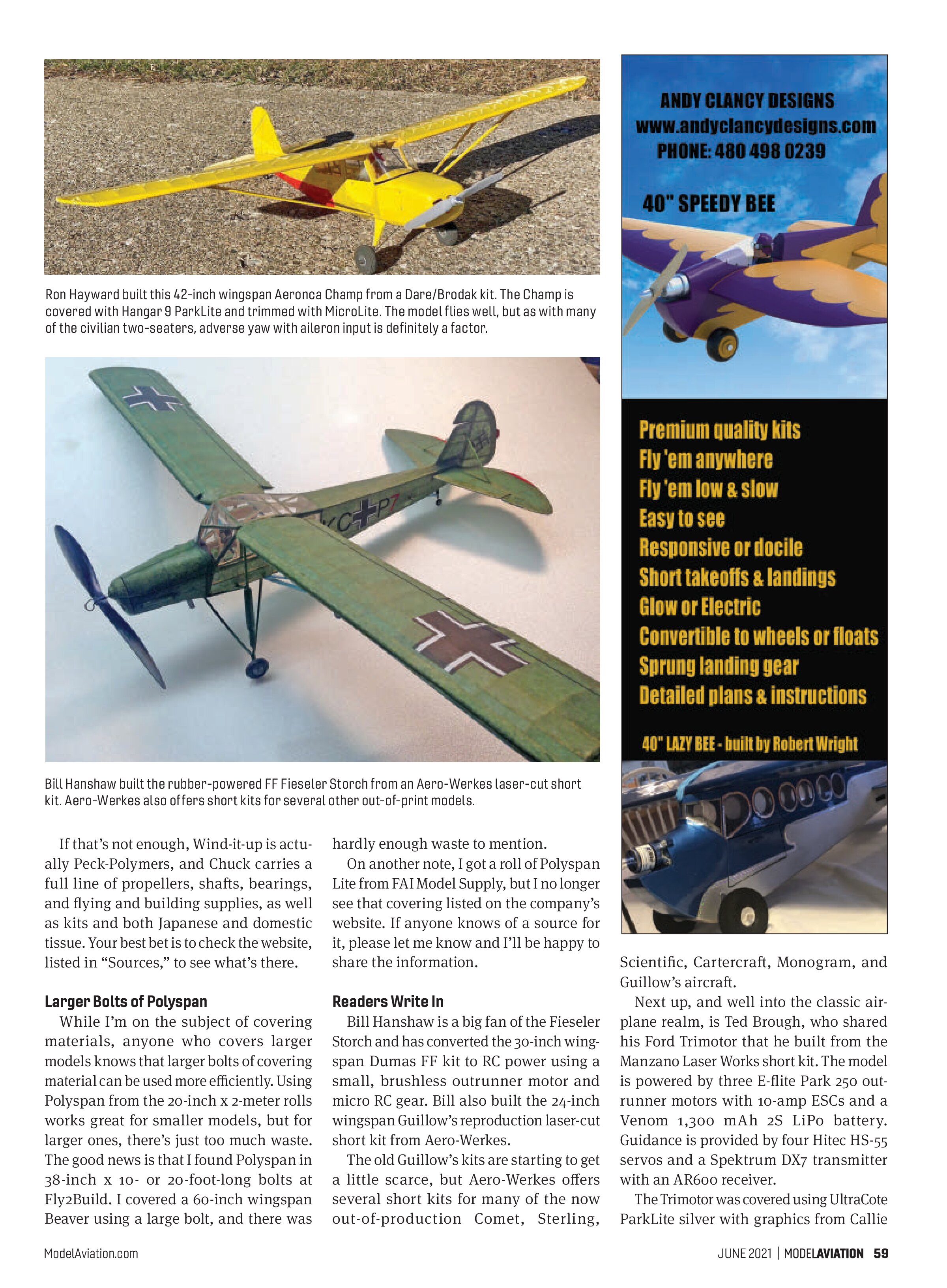
Bill Hanshaw is a big fan of the Fieseler Storch and has converted the 30-inch wingspan Dumas FF kit to RC power using a small, brushless outrunner motor and micro RC gear. Bill also built the 24-inch wingspan Guilllow’s reproduction laser-cut short kit from Aero-Werkes.
The old Guillow’s kits are starting to get a little scarce, but Aero-Werkes offers several short kits for many of the now out-of-production Comet, Sterling, Scientific, Cartercraft, Monogram, and Guillow’s aircraft.
Next up, and well into the classic airplane realm, is Ted Brough, who shared his Ford Trimotor that he built from the Manzano Laser Works short kit. The model is powered by three E-flite Park 250 outrunner motors with 10-amp ESCs and a Venom 1,300 mAh 2S LiPo battery. Guidance is provided by four Hitec HS-55 servos and a Spektrum DX7 transmitter with an AR600 receiver.
The Trimotor was covered using UltraCote ParkLite silver with graphics from Callie
Graphics. It has five flights on it now and, as described by Ted, “the last three flights were beautiful, with a lot of thumbs-up comments from the other modelers.” In keeping with scalelike flight, the model required full aileron throw plus a bit of rudder to get good roll response. This is not a surprise. After all, it is the old Tin Goose.


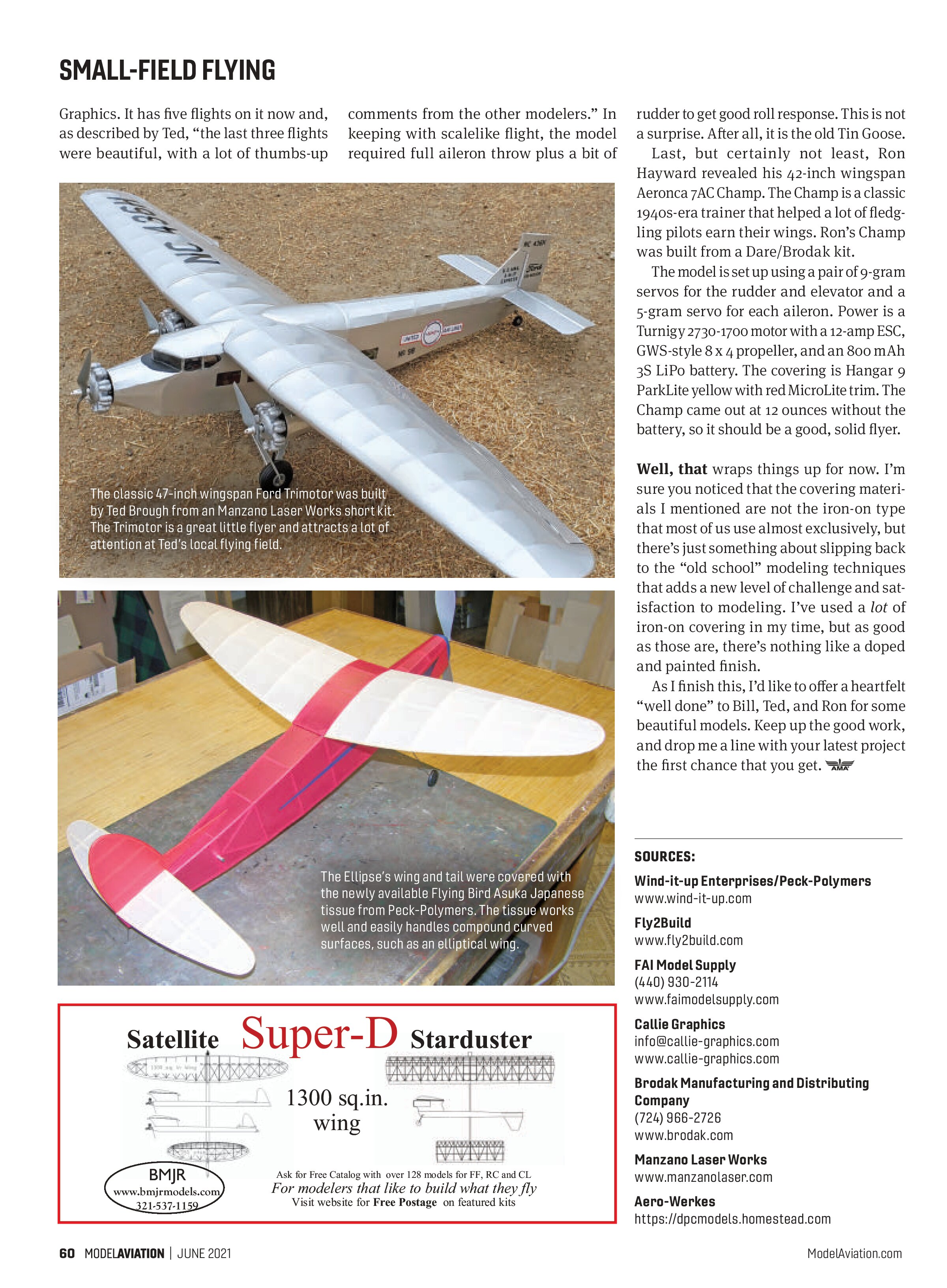
Last, but certainly not least, Ron Hayward revealed his 42-inch wingspan Aeronca 7AC Champ. The Champ is a classic 1940s-era trainer that helped a lot of fledgling pilots earn their wings. Ron’s Champ was built from a Dare/Brodak kit.
The model is set up using a pair of 9-gram servos for the rudder and elevator and a 5-gram servo for each aileron. Power is a Turnigy 2730-1700 motor with a 12-amp ESC, GWS-style 8 x 4 propeller, and an 800 mAh 3S LiPo battery. The covering is Hangar 9 ParkLite yellow with red MicroLite trim. The Champ came out at 12 ounces without the battery, so it should be a good, solid flyer.
Well, that wraps things up for now. I’m sure you noticed that the covering materials I mentioned are not the iron-on type that most of us use almost exclusively, but there’s just something about slipping back to the “old school” modeling techniques that adds a new level of challenge and satisfaction to modeling. I’ve used a lot of iron-on covering in my time, but as good as those are, there’s nothing like a doped and painted finish.
As I finish this, I’d like to offer a heartfelt “well done” to Bill, Ted, and Ron for some beautiful models. Keep up the good work, and drop me a line with your latest project the first chance that you get.
SOURCES:
Wind-it-up Enterprises/Peck-Polymers
www.wind-it-up.com
Fly2Build
www.fly2build.com
FAI Model Supply
(440) 930-2114
www.faimodelsupply.com
Callie Graphics
info@callie-graphics.com
www.callie-graphics.com
Brodak Manufacturing and Distributing Company
(724) 966-2726
www.brodak.com
Manzano Laser Works
www.manzanolaser.com
Aero-Werkes
https://dpcmodels.homestead.com