RC SCALE AEROBATICS
By John Glezellis | jglezellis@gmail.com

IN MY LAST few columns, I have discussed numerous aircraft preparation and maintenance techniques to ensure that your aerobatic aircraft is ready for the next International Miniature Aerobatic Club (IMAC) competition. A properly built, programmed, and maintained airplane will enable a pilot to focus on perfecting each individual figure of a routine, one of which is the Hammerhead.
Otherwise known as a stall turn, the Hammerhead appears within all current classes and increases significantly in difficulty. For example, while the base figure is shown in the 2021 Basic category, roll and snap roll elements are incorporated in higher classes that result in a higher total K-Factor (or difficulty factor) for the entire maneuver.
This month, I will look at two variations of the Hammerhead, discuss a few flying and judging elements, and examine some different techniques you might wish to utilize to decrease your workload. Without further delay, let’s get started!
Maneuver Overview
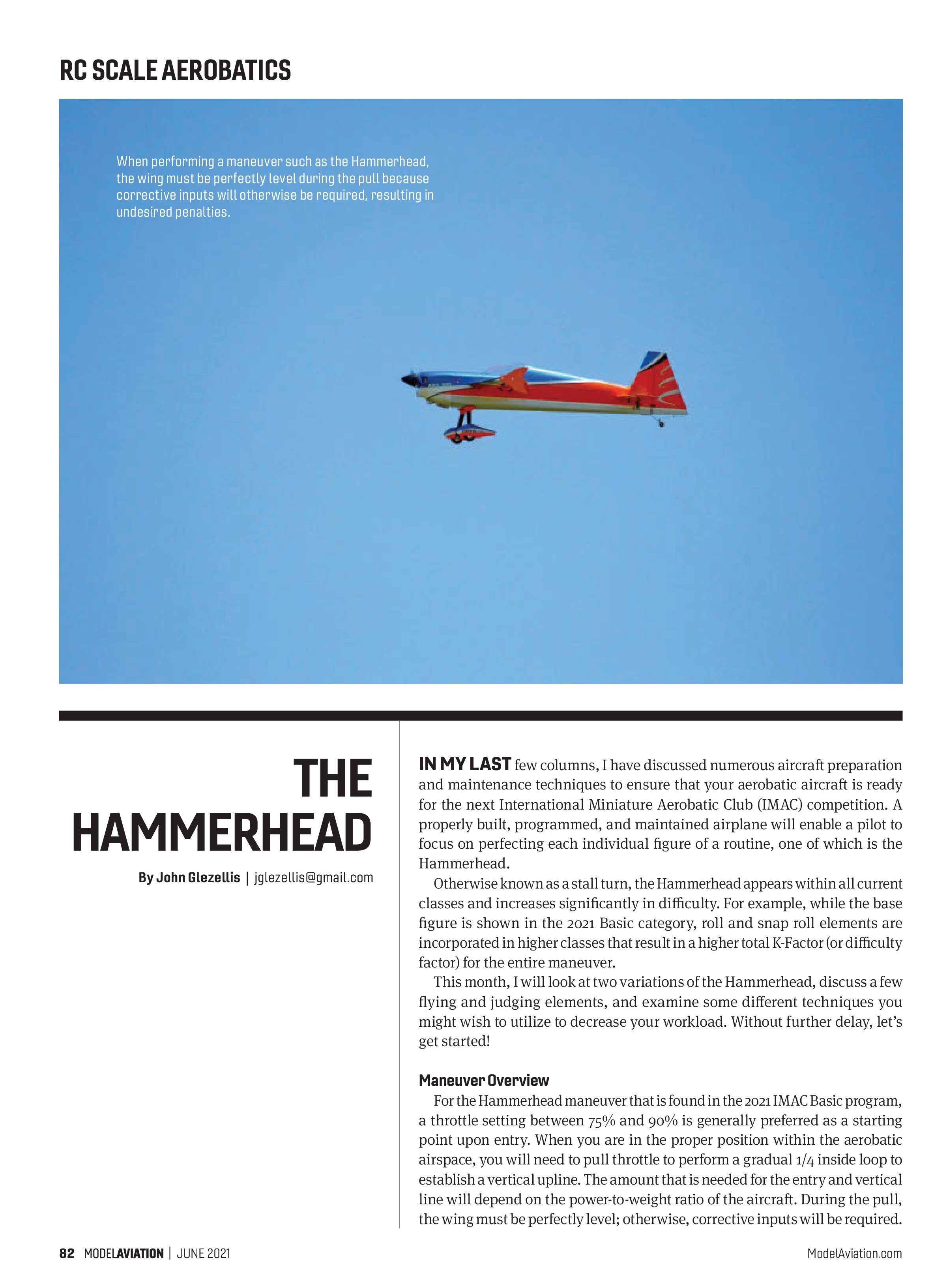
For the Hammerhead maneuver that is found in the 2021 IMAC Basic program, a throttle setting between 75% and 90% is generally preferred as a starting point upon entry. When you are in the proper position within the aerobatic airspace, you will need to pull throttle to perform a gradual 1/4 inside loop to establish a vertical upline. The amount that is needed for the entry and vertical line will depend on the power-to-weight ratio of the aircraft. During the pull, the wing must be perfectly level; otherwise, corrective inputs will be required.
When the model is tracking perfectly vertical and a desired line segment is shown, decrease power. As the airplane nears a complete stop, add rudder to pivot the aircraft 180°, preferably into the wind. No pendulum movement because of improper rudder release should be observed after the pivot—this will result in a downgrade of 1/2 point per 5° of movement. Allow the model to track on the downline and execute another 1/4 inside loop to horizontal, upright level flight to exit at the same altitude as the entry.
Skipping to the Unlimited class on the opposite side of the spectrum, you begin inverted, push to establish a vertical upline, and perform a negative snap roll with a 1/2 roll in the opposite direction. Throttle management and higher throttle settings might be required before the snap roll to maintain energy throughout and to result in a clean 1/2 roll. You must also be comfortable rolling and performing snap rolls in the opposite direction.
Following the 180° pivot, you will then perform three points of a two-point roll, otherwise known as three half rolls, and push to exit inverted. Quite an increase in complexity exists with this variant, but you can become successful by breaking down each element of the figure.
Aircraft Setup Fundamentals
Newcomers often attempt to use excessive control-surface deflection amounts for precision flight, which can result in erratic and inconsistent visible behavior from the aircraft. I prefer the use of flight modes, where all rates are found on a single switch for simplicity. Using my Spektrum iX12 radio, I use Switch G because it is where, as a “thumb flier,” I keep my index finger.
For my aerobatic models, I prefer the use of a three-position switch. Position 2 is for precision flight and Hammerheads so that I have little aileron and elevator travel, with a fair amount of rudder for the Hammerhead pivot and rudder that is required for rolling circles. Position 1 (the middle position) is for snap rolls and spins, and Position 0 is used either for 3D maneuvers or tailslides.
Regarding general deflection amounts and exponential settings for the first two rates, see the chart.
I prefer to leave my flight mode switch in Position 2 for the entire maneuver if I am performing the Hammerhead variant found in the Basic, Sportsman, and Intermediate routines. However, for both the Advanced and Unlimited classes, I switch to Position 1 only when performing a snap roll and return to Position 2 immediately after completion of the rotation.
Other pilots might prefer automatic conditions within their radio. For example, by utilizing the Flight Mode Setup in addition to various programmable mixes, dual-rate values, and exponential, a pilot can lead with elevator input to allow for a visible break for the snap rotation. However, as soon as he or she applies aileron and rudder,
- Position 2: Aileron Deflection/Exponential — 20°/+35% exponential
- Position 1: Aileron Deflection/Exponential — 35°/+50% exponential
- Position 2: Elevator Deflection/Exponential — 12°/+20% exponential
- Position 1: Elevator Deflection/Exponential — 20°/+40% exponential
- Position 2: Rudder Deflection/Exponential — 35°/+50% exponential
- Position 1: Rudder Deflection/Exponential — 30°/+40% exponential


Visit the IMAC website for educational information about judging, flying techniques, rules upon which you will be judged, and much more!
when the aileron passes a certain percentage of stick deflection, the elevator and rudder amount are both automatically decreased. A pilot can then corner all sticks and let the aircraft unload the snap roll via settings found on the radio system in an automatic fashion.
Because a certain amount of aileron deflection is needed to activate these conditions, you can still use this rate for stall turns and spins because they will have maximum rudder deflection, but they will also have precise control around neutral, which is ideal for the rest of the figure.
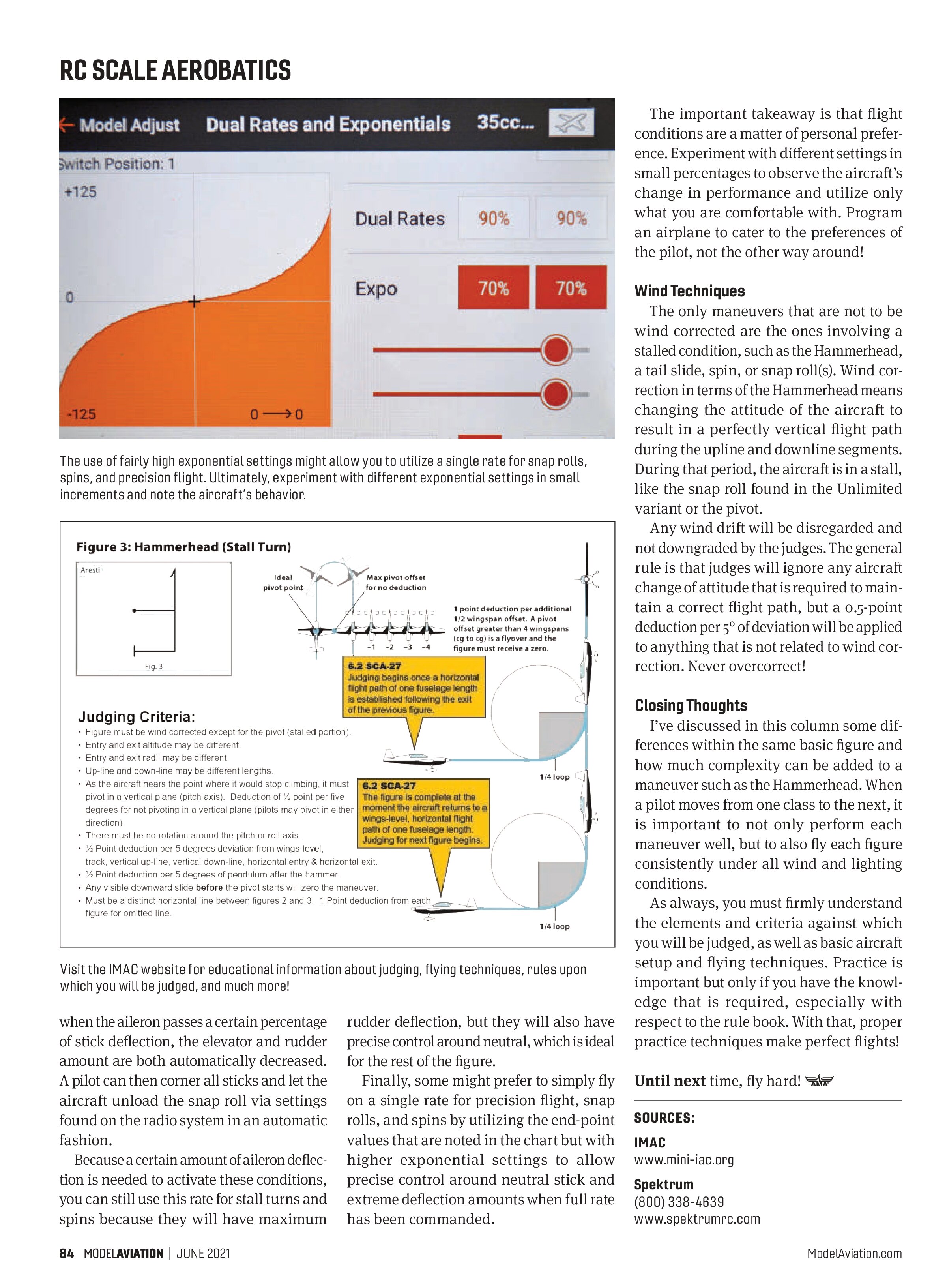
Finally, some might prefer to simply fly on a single rate for precision flight, snap rolls, and spins by utilizing the end-point values that are noted in the chart but with higher exponential settings to allow precise control around neutral stick and extreme deflection amounts when full rate has been commanded.
The important takeaway is that flight conditions are a matter of personal preference. Experiment with different settings in small percentages to observe the aircraft’s change in performance and utilize only what you are comfortable with. Program an airplane to cater to the preferences of the pilot, not the other way around!
Wind Techniques
The only maneuvers that are not to be wind corrected are the ones involving a stalled condition, such as the Hammerhead, a tail slide, spin, or snap roll(s). Wind correction in terms of the Hammerhead means changing the attitude of the aircraft to result in a perfectly vertical flight path during the upline and downline segments. During that period, the aircraft is in a stall, like the snap roll found in the Unlimited variant or the pivot.
Any wind drift will be disregarded and not downgraded by the judges. The general rule is that judges will ignore any aircraft change of attitude that is required to maintain a correct flight path, but a 0.5-point deduction per 5° of deviation will be applied to anything that is not related to wind correction. Never overcorrect!
Closing Thoughts
I’ve discussed in this column some differences within the same basic figure and how much complexity can be added to a maneuver such as the Hammerhead. When a pilot moves from one class to the next, it is important to not only perform each maneuver well, but to also fly each figure consistently under all wind and lighting conditions.
As always, you must firmly understand the elements and criteria against which you will be judged, as well as basic aircraft setup and flying techniques. Practice is important but only if you have the knowledge that is required, especially with respect to the rule book. With that, proper practice techniques make perfect flights!
Until next time, fly hard!
SOURCES:
IMAC
www.mini-iac.org
Spektrum
(800) 338-4639
www.spektrumrc.com