WHY FULL-SCALE AND RC HELICOPTERS DON’T HAVE A FLYBAR
By James Wang | heloeditor@gmail.com

THE RC HELICOPTERS that are on the market now all use a flybarless main rotor design. They used to have a flybar and control paddles to help improve stability and to increase control power.
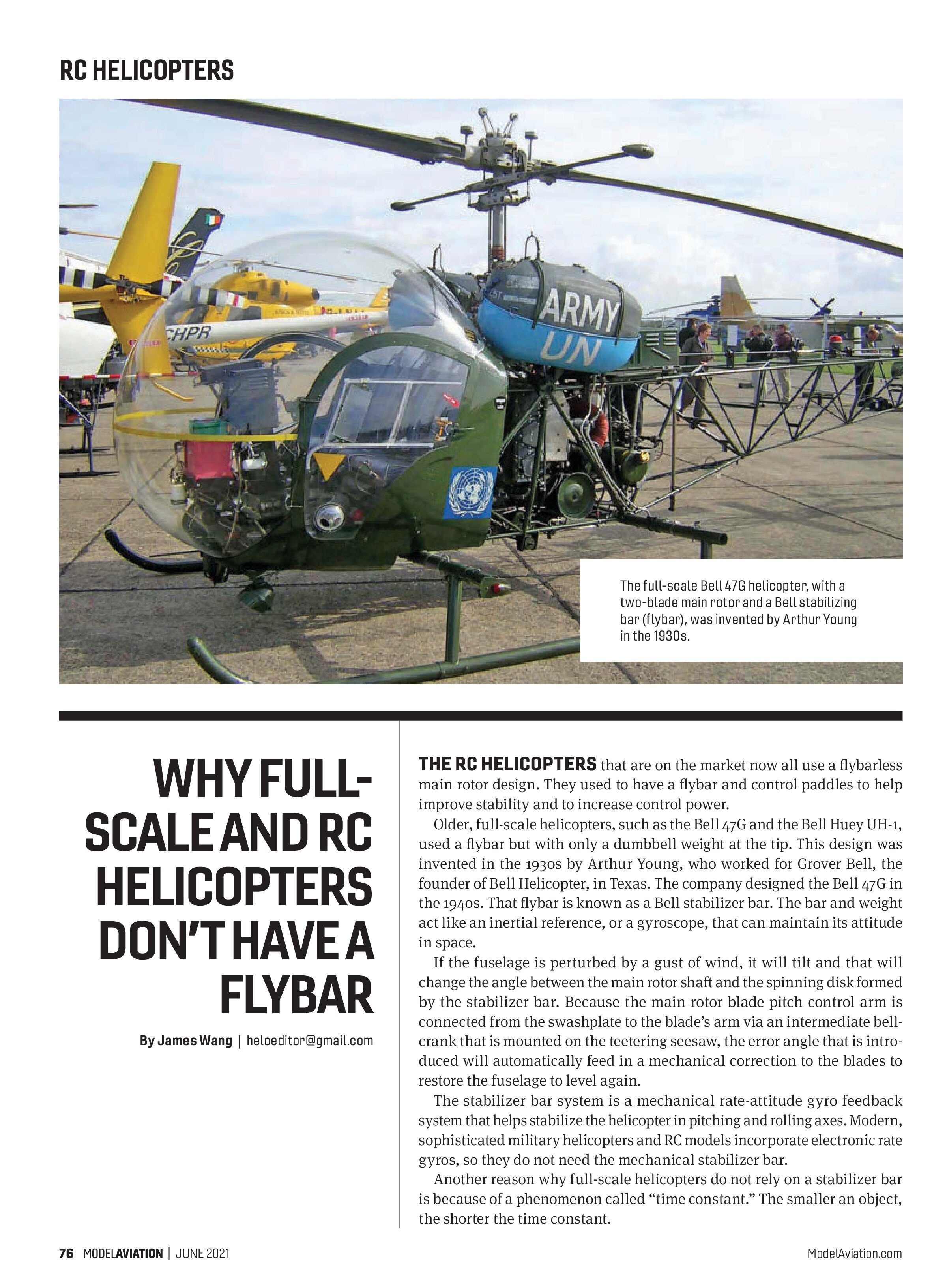
Older, full-scale helicopters, such as the Bell 47G and the Bell Huey UH-1, used a flybar but with only a dumbbell weight at the tip. This design was invented in the 1930s by Arthur Young, who worked for Grover Bell, the founder of Bell Helicopter, in Texas. The company designed the Bell 47G in the 1940s. That flybar is known as a Bell stabilizer bar. The bar and weight act like an inertial reference, or a gyroscope, that can maintain its attitude in space.
If the fuselage is perturbed by a gust of wind, it will tilt and that will change the angle between the main rotor shaft and the spinning disk formed by the stabilizer bar. Because the main rotor blade pitch control arm is connected from the swashplate to the blade’s arm via an intermediate bell-crank that is mounted on the teetering seesaw, the error angle that is introduced will automatically feed in a mechanical correction to the blades to restore the fuselage to level again.
The stabilizer bar system is a mechanical rate-attitude gyro feedback system that helps stabilize the helicopter in pitching and rolling axes. Modern, sophisticated military helicopters and RC models incorporate electronic rate gyros, so they do not need the mechanical stabilizer bar.
Another reason why full-scale helicopters do not rely on a stabilizer bar is because of a phenomenon called “time constant.” The smaller an object, the shorter the time constant.
For example, try to balance a long broomstick that is inverted in your palm. I bet you can easily master it. Now try balancing a pencil that is inverted in your palm—it is almost impossible. That is because the pencil is much smaller, has a faster time constant, and requires much faster reaction time. RC helicopters are smaller and have a shorter time constant than full-scale helicopters, which means things happen faster. A flybar helps slow down the time constant and makes RC helicopters manageable.
Larger full-scale helicopters, such as the Sikorsky CH-53E Super Stallion, are much more stable than a smaller one, such as the Robinson R22. Compare this with how an ocean-going tanker maneuvers slower than a small canoe. That is why we often hear that smaller RC aircraft are harder to learn to fly than larger RC aircraft.
The Horizon 60, the Kavan Lockheed 286L, the American RC Revolution 60 Rigid Rotor introduced in approximately 1976, and the Gorham Model Products (GMP) Legend introduced in 1986 were the first generation of flybarless RC helicopters. These two-blade, flybarless helicopters did not gain popularity because electronic flybarless gyros were not invented until 2005. Without an electronic gyro, flybarless helicopters diverge in hover and pitch up in fast forward flight. When pilots get used to their handling characteristics, flybarless models without an electronic flybarless gyro are manageable, although they require a high workload.
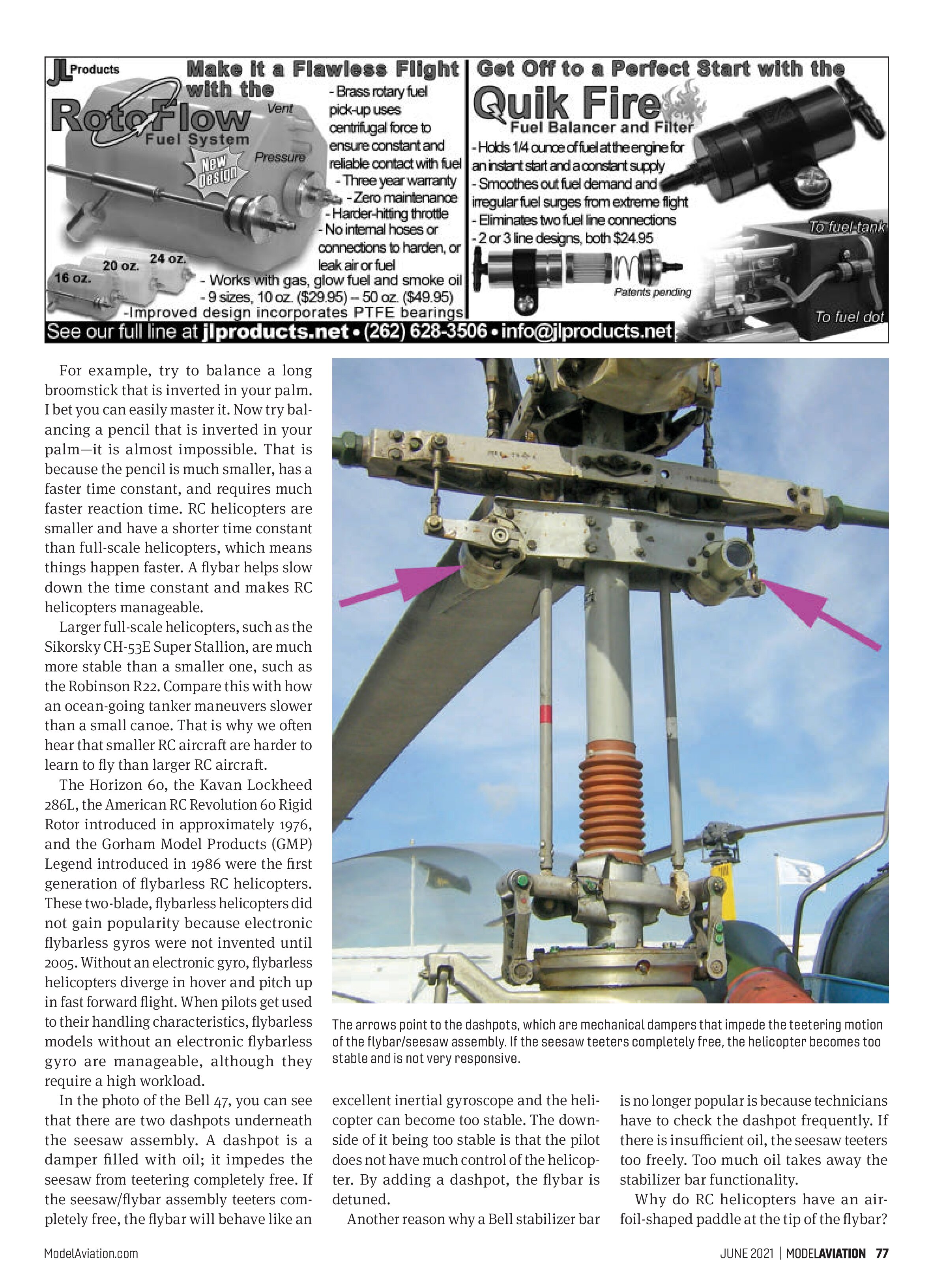
In the photo of the Bell 47, you can see that there are two dashpots underneath the seesaw assembly. A dashpot is a damper filled with oil; it impedes the seesaw from teetering completely free. If the seesaw/flybar assembly teeters completely free, the flybar will behave like an excellent inertial gyroscope and the helicopter can become too stable. The downside of it being too stable is that the pilot does not have much control of the helicopter. By adding a dashpot, the flybar is detuned.

Another reason why a Bell stabilizer bar is no longer popular is because technicians have to check the dashpot frequently. If there is insufficient oil, the seesaw teeters too freely. Too much oil takes away the stabilizer bar functionality.
Why do RC helicopters have an airfoil-shaped paddle at the tip of the flybar?


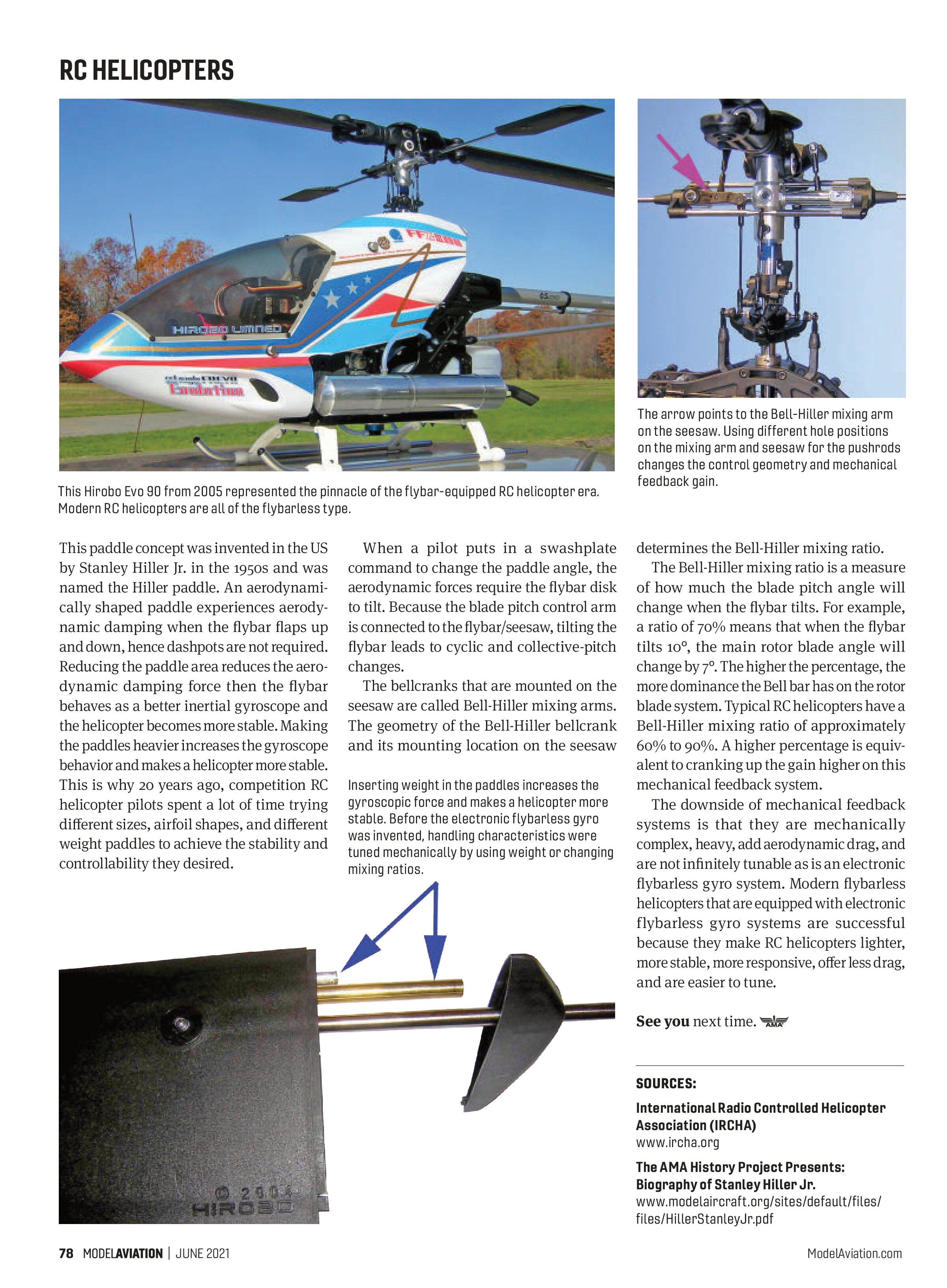
This paddle concept was invented in the US by Stanley Hiller Jr. in the 1950s and was named the Hiller paddle. An aerodynamically shaped paddle experiences aerodynamic damping when the flybar flaps up and down, hence dashpots are not required. Reducing the paddle area reduces the aerodynamic damping force then the flybar behaves as a better inertial gyroscope and the helicopter becomes more stable. Making the paddles heavier increases the gyroscope behavior and makes a helicopter more stable. This is why 20 years ago, competition RC helicopter pilots spent a lot of time trying different sizes, airfoil shapes, and different weight paddles to achieve the stability and controllability they desired.
When a pilot puts in a swashplate command to change the paddle angle, the aerodynamic forces require the flybar disk to tilt. Because the blade pitch control arm is connected to the flybar/seesaw, tilting the flybar leads to cyclic and collective-pitch changes.
The bellcranks that are mounted on the seesaw are called Bell-Hiller mixing arms. The geometry of the Bell-Hiller bellcrank and its mounting location on the seesaw determines the Bell-Hiller mixing ratio.
Inserting weight in the paddles increases the gyroscopic force and makes a helicopter more stable. Before the electronic flybarless gyro was invented, handling characteristics were tuned mechanically by using weight or changing mixing ratios.
The Bell-Hiller mixing ratio is a measure of how much the blade pitch angle will change when the flybar tilts. For example, a ratio of 70% means that when the flybar tilts 10°, the main rotor blade angle will change by 7°. The higher the percentage, the more dominance the Bell bar has on the rotor blade system. Typical RC helicopters have a Bell-Hiller mixing ratio of approximately 60% to 90%. A higher percentage is equivalent to cranking up the gain higher on this mechanical feedback system.
The downside of mechanical feedback systems is that they are mechanically complex, heavy, add aerodynamic drag, and are not infinitely tunable as is an electronic flybarless gyro system. Modern flybarless helicopters that are equipped with electronic flybarless gyro systems are successful because they make RC helicopters lighter, more stable, more responsive, offer less drag, and are easier to tune.
See you next time.
SOURCES:
International Radio Controlled Helicopter Association (IRCHA)
www.ircha.org
The AMA History Project Presents: Biography of Stanley Hiller Jr.
www.modelaircraft.org/sites/default/files/files/HillerStanleyJr.pdf