RC GIANT SCALE

BALSA USA
ORATEX AND
PLANETEX
By Sal Calvagna | rcgiants@optonline.net
WELCOME BACK. I dearly hope that all of my readers, your families, and friends are safe and healthy during the current health crisis. The COVID-19 pandemic has left too many of us with little to do outside the home.
On a positive note, however, modelers have had the opportunity to spend more time in their workshops practicing their art. I know it has afforded me a welcome opportunity to escape all of the problems of the world for hours at a time. I hope it has done the same for our members.
Covering
My first experience with using covering material from Balsa USA came approximately 37 years ago while I was stationed in the Philippines. I ordered a 1/3-scale Fly Baby biplane kit and enough Solartex fabric to complete it. I was amazed at how Solartex would stretch around a curve without a wrinkle and how strong it was compared with film covering. I was hooked.
Throughout the years, I must have used hundreds of feet of it to cover all of those World War I-type aircraft that I have built. Suddenly, Solarfilm, the manufacturer of Solartex and based in the United Kingdom, ceased operations. It was no longer available—a sad day for many Giant Scale modelers.
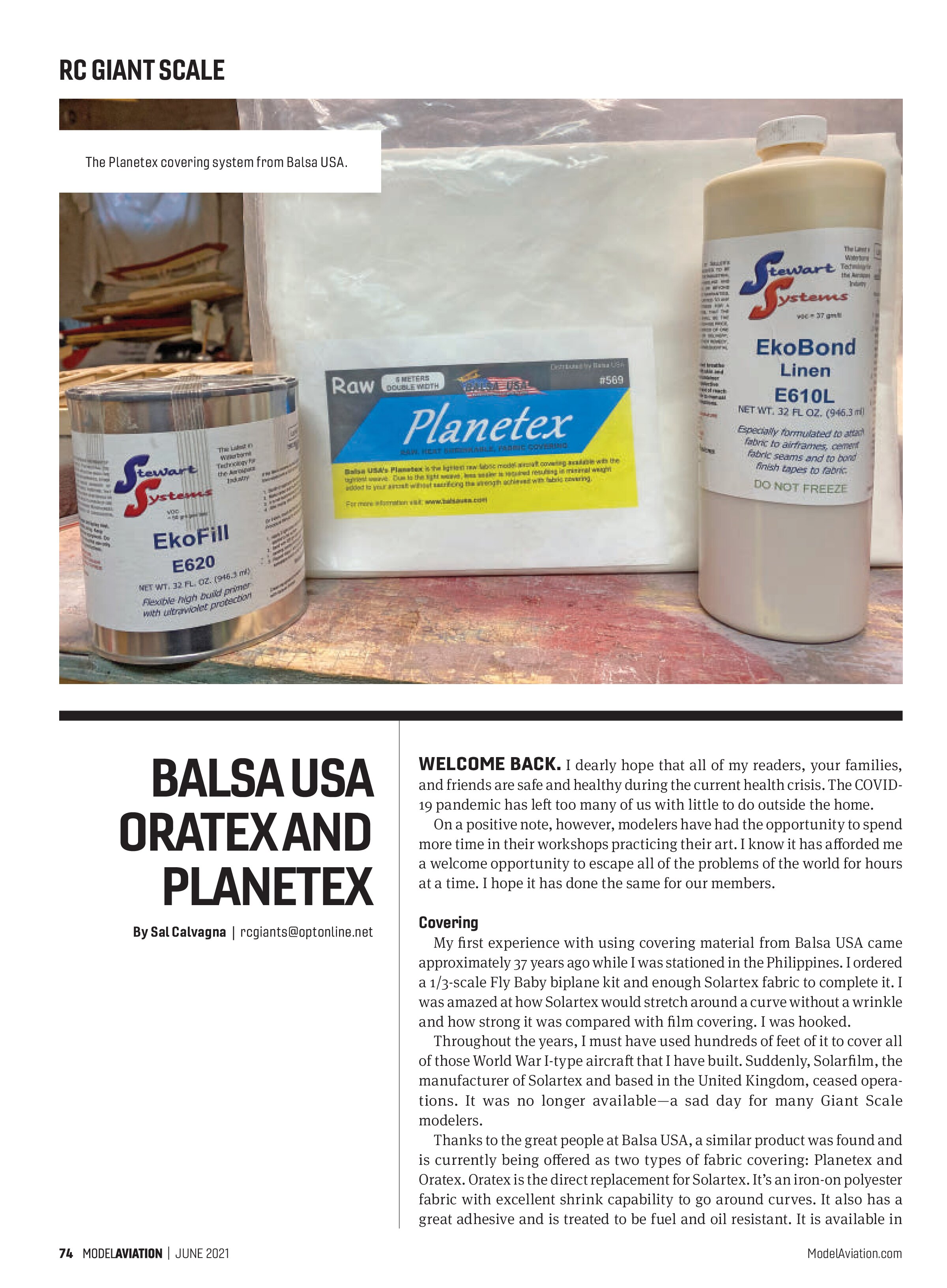
Thanks to the great people at Balsa USA, a similar product was found and is currently being offered as two types of fabric covering: Planetex and Oratex. Oratex is the direct replacement for Solartex. It’s an iron-on polyester fabric with excellent shrink capability to go around curves. It also has a great adhesive and is treated to be fuel and oil resistant. It is available in 2-meter or 5-meter rolls that are 24 inches in width. I can attest that it is an amazing product. It is now my new favorite covering material for its ease of use.


The Planetex covering system is a lightweight material with a tight weave and an amazing shrink rate. It requires slightly more work because the lightweight material does not have a glue backing or sealer, but the results are outstanding.
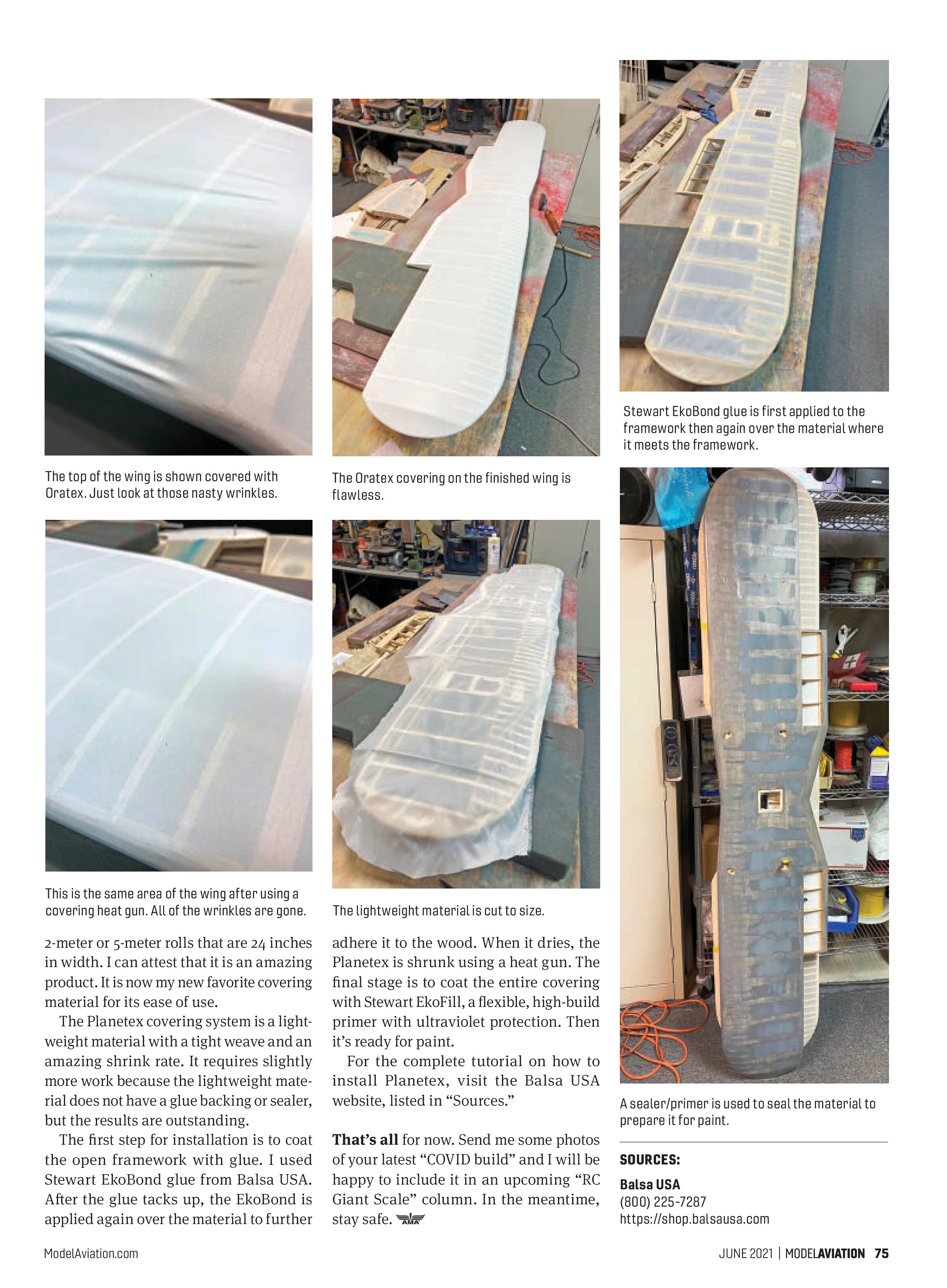
The first step for installation is to coat the open framework with glue. I used Stewart EkoBond glue from Balsa USA. After the glue tacks up, the EkoBond is applied again over the material to further adhere it to the wood. When it dries, the Planetex is shrunk using a heat gun. The final stage is to coat the entire covering with Stewart EkoFill, a flexible, high-build primer with ultraviolet protection. Then it’s ready for paint.
For the complete tutorial on how to install Planetex, visit the Balsa USA website, listed in “Sources.”
That’s all for now. Send me some photos of your latest “COVID build” and I will be happy to include it in an upcoming “RC Giant Scale” column. In the meantime, stay safe.
SOURCES:
Balsa USA
(800) 225-7287
https://shop.balsausa.com