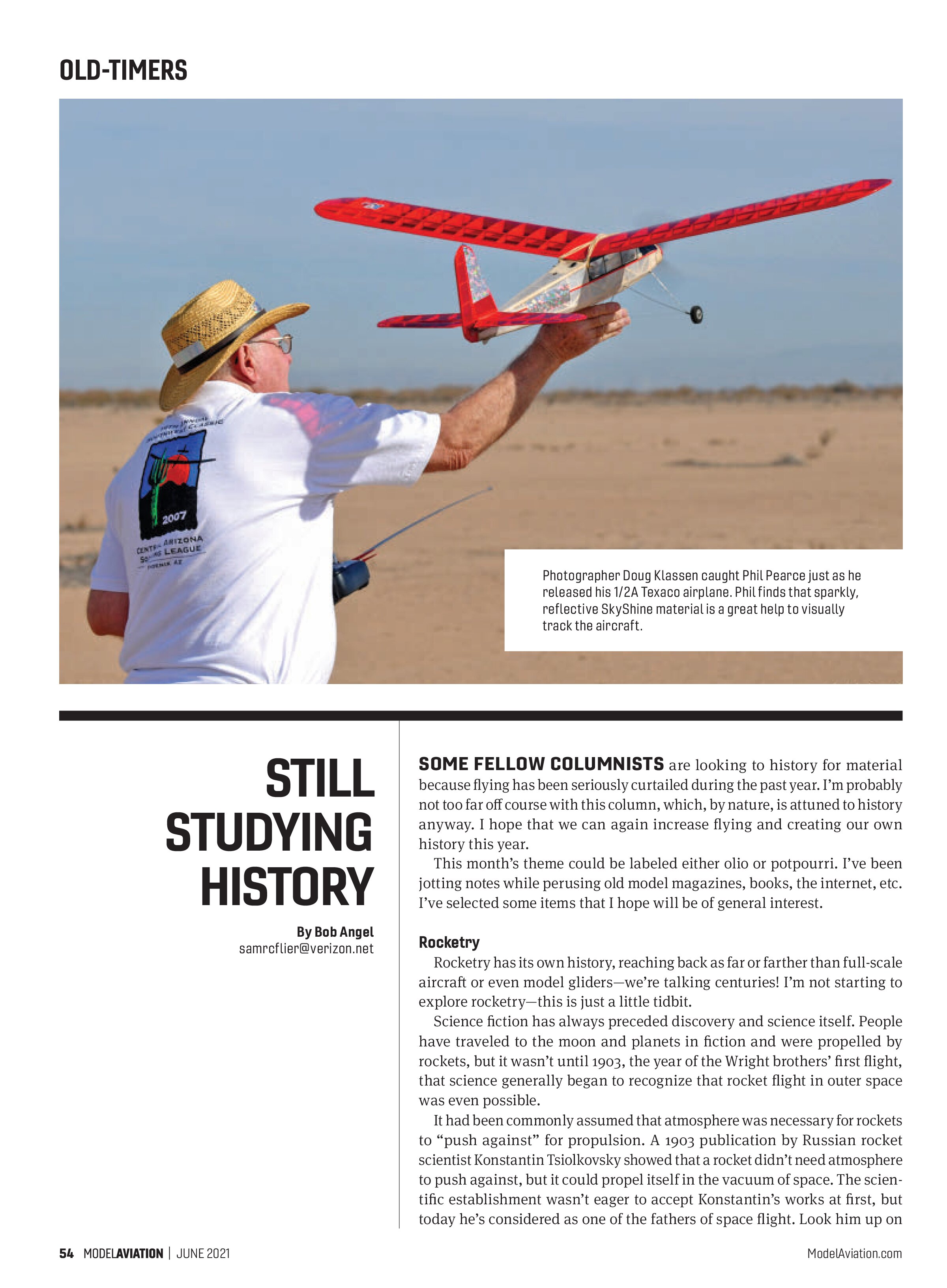
STILL STUDYING HISTORY
By Bob Angel
samrcflier@verizon.net
Some fellow columnists are looking to history for material because flying has been seriously curtailed during the past year. I’m probably not too far off course with this column, which, by nature, is attuned to history anyway. I hope that we can again increase flying and creating our own history this year.
This month’s theme could be labeled either olio or potpourri. I’ve been jotting notes while perusing old model magazines, books, the internet, etc. I’ve selected some items that I hope will be of general interest.
Rocketry
Rocketry has its own history, reaching back as far or farther than full-scale aircraft or even model gliders—we’re talking centuries! I’m not starting to explore rocketry—this is just a little tidbit.
Science fiction has always preceded discovery and science itself. People have traveled to the moon and planets in fiction and were propelled by rockets, but it wasn’t until 1903, the year of the Wright brothers’ first flight, that science generally began to recognize that rocket flight in outer space was even possible.
It had been commonly assumed that atmosphere was necessary for rockets to “push against” for propulsion. A 1903 publication by Russian rocket scientist Konstantin Tsiolkovsky showed that a rocket didn’t need atmosphere to push against, but it could propel itself in the vacuum of space. The scientific establishment wasn’t eager to accept Konstantin’s works at first, but today he’s considered as one of the fathers of space flight. Look him up on Wikipedia for an interesting biography and a part of space flight history.
The hesitation to believe that rocket propulsion is possible in space is puzzling because it’s a simple demonstration of Newton’s third law: For every action, there’s an equal and opposite reaction.
I suppose the common thought was that rocket propulsion was all, or at least largely, generated by the heating and expansion of surrounding air. Thinking about it though, when atmosphere is lacking, so is atmospheric drag. If all space had atmosphere, the amount of fuel and extra time required to get anywhere might prohibit serious space exploration.
1939 Air Trails “Dope Can”
It’s sad yet funny, but the little item below came from the November 1939 issue of the Air Trails “Dope Can” column that was edited by Gordon Light. It reminded me of a practice of my grade school buddies when their 15¢ warplane models wouldn’t fly worth a darn. They’d light them on fire, launch them from the window of our third-story apartment, and watch them go down in flames, just as in the wartime movie newsreels.
“A beginning modeler was upset by the fact that after several attempts, his first model refused to fly properly. Taking his friend’s suggestion, he put a big firecracker with an extended fuse in the fuselage and launched it with the rubber motor fully wound. It so happened that the firecracker placement corrected the center of gravity and the model began a beautiful climbout.
“The modeler silently prayed for the firecracker to fizzle out. It didn’t. There wasn’t a piece big enough to salvage.”
Mirror Model Flying Fair
It was just another contest, not a national one or anything, but you’d never have known it because it was probably the largest modeling event ever.
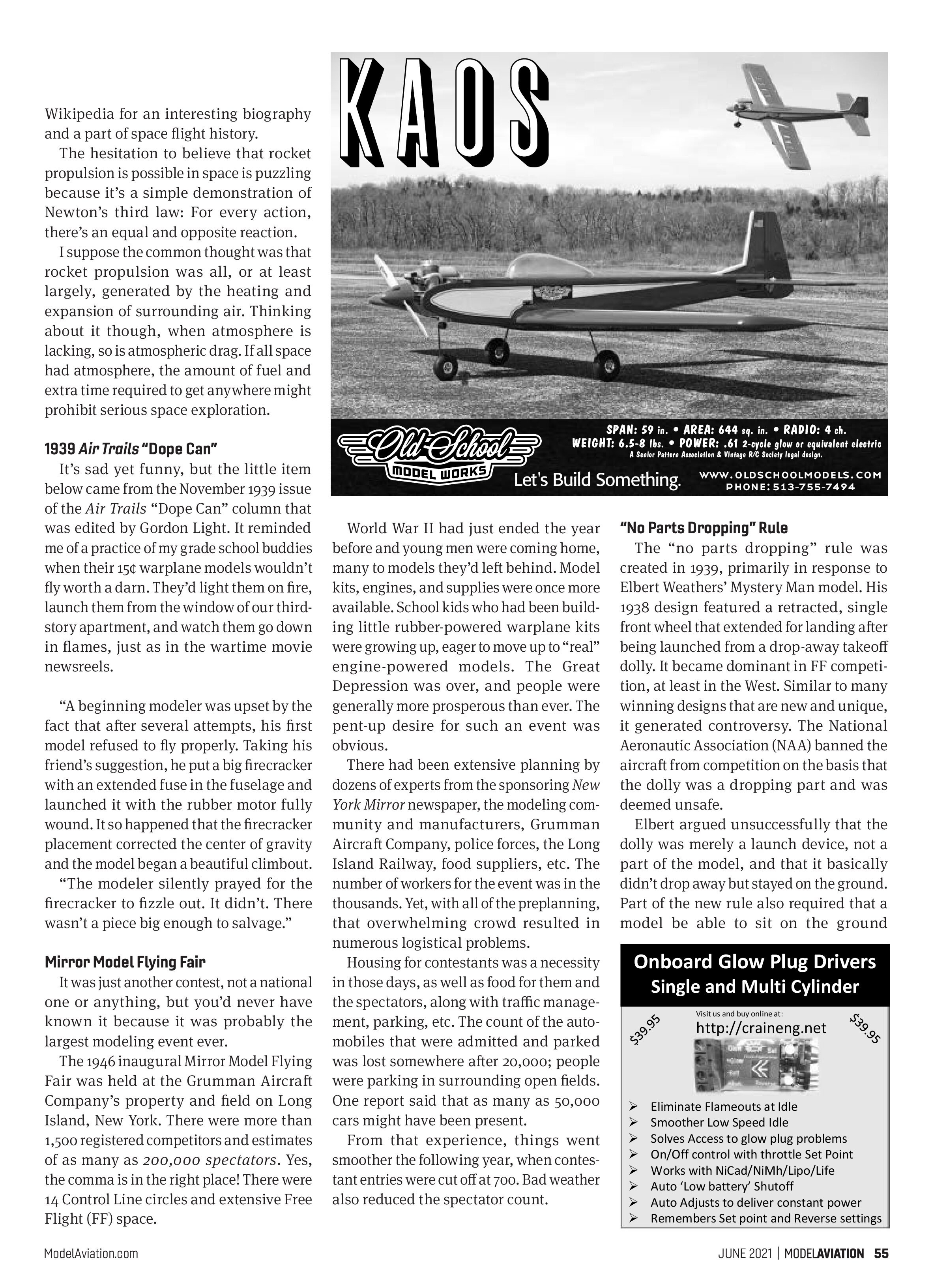
The 1946 inaugural Mirror Model Flying Fair was held at the Grumman Aircraft Company’s property and field on Long Island, New York. There were more than 1,500 registered competitors and estimates of as many as 200,000 spectators. Yes, the comma is in the right place! There were 14 Control Line circles and extensive Free Flight (FF) space.
World War II had just ended the year before and young men were coming home, many to models they’d left behind. Model kits, engines, and supplies were once more available. School kids who had been building little rubber-powered warplane kits were growing up, eager to move up to “real” engine-powered models. The Great Depression was over, and people were generally more prosperous than ever. The pent-up desire for such an event was obvious.
There had been extensive planning by dozens of experts from the sponsoring New York Mirror newspaper, the modeling community and manufacturers, Grumman Aircraft Company, police forces, the Long Island Railway, food suppliers, etc. The number of workers for the event was in the thousands. Yet, with all of the preplanning, that overwhelming crowd resulted in numerous logistical problems.
Housing for contestants was a necessity in those days, as well as food for them and the spectators, along with traffic management, parking, etc. The count of the automobiles that were admitted and parked was lost somewhere after 20,000; people were parking in surrounding open fields. One report said that as many as 50,000 cars might have been present.
From that experience, things went smoother the following year, when contestant entries were cut off at 700. Bad weather also reduced the spectator count.
“No Parts Dropping” Rule
The “no parts dropping” rule was created in 1939, primarily in response to Elbert Weathers’ Mystery Man model. His 1938 design featured a retracted, single front wheel that extended for landing after being launched from a drop-away takeoff dolly. It became dominant in FF competition, at least in the West. Similar to many winning designs that are new and unique, it generated controversy. The National Aeronautic Association (NAA) banned the aircraft from competition on the basis that the dolly was a dropping part and was deemed unsafe.
Elbert argued unsuccessfully that the dolly was merely a launch device, not a part of the model, and that it basically didn’t drop away but stayed on the ground. Part of the new rule also required that a model be able to sit on the ground

unassisted and take off normally. Compliance with that part of the rule was possible with wire wingtip skids or skids under a wide stabilizer, which in turn would still allow a single takeoff wheel. Leon Shulman’s Banshee design is an example.
Years later, Society of Antique Modelers (SAM) RC flying came along, which made it easier to take off with the single wheel extended, yet retractable and extendable again, for landing. SAM rules once more allowed the Mystery Man model in both FF and RC competitions, even allowing the takeoff dolly. Those rules also allowed two wheels to replace any original one-wheel design at the builder’s discretion.
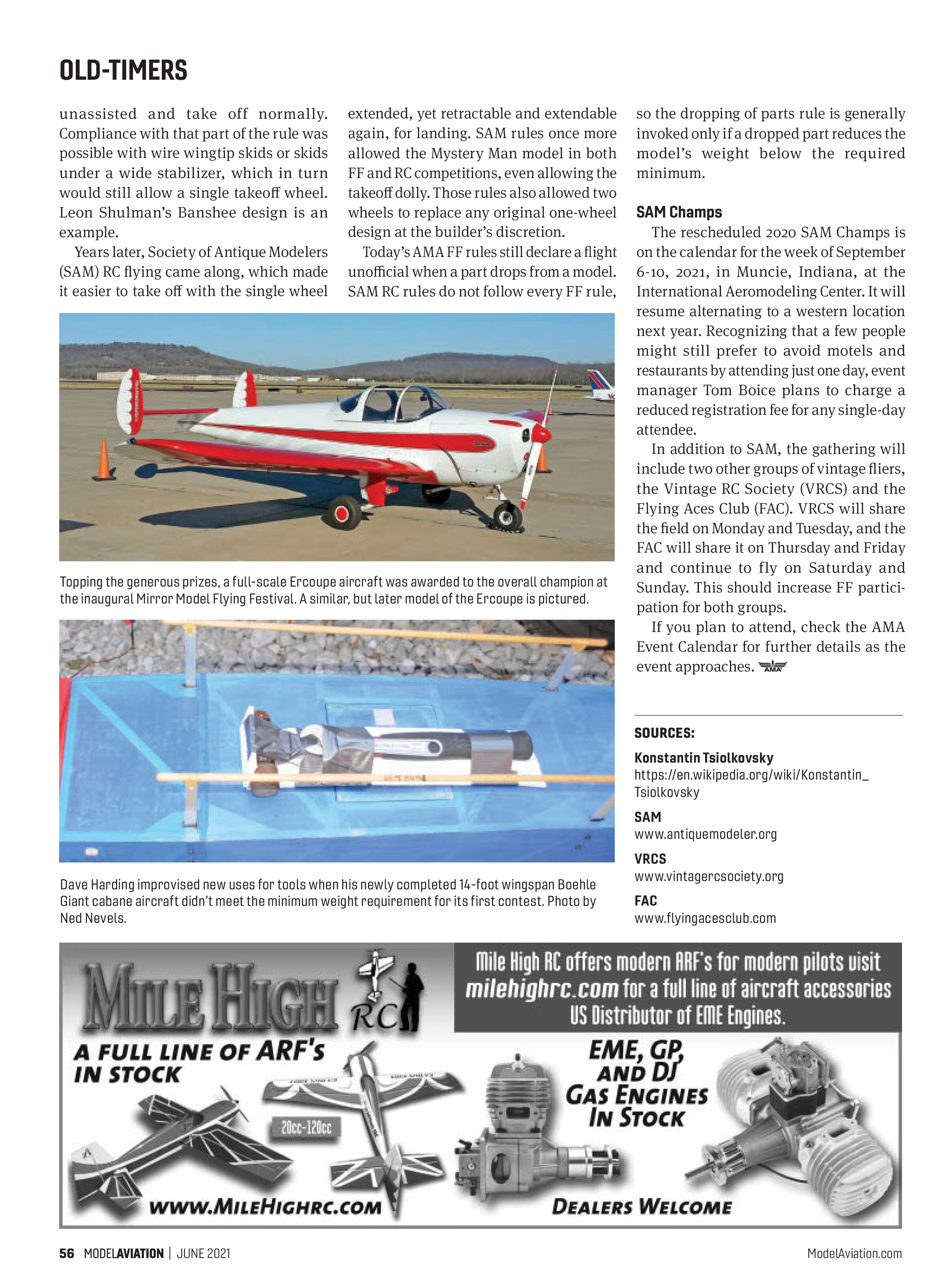
Today’s AMA FF rules still declare a flight unofficial when a part drops from a model. SAM RC rules do not follow every FF rule, so the dropping of parts rule is generally invoked only if a dropped part reduces the model’s weight below the required minimum.


SAM Champs
The rescheduled 2020 SAM Champs is on the calendar for the week of September 6-10, 2021, in Muncie, Indiana, at the International Aeromodeling Center. It will resume alternating to a western location next year. Recognizing that a few people might still prefer to avoid motels and restaurants by attending just one day, event manager Tom Boice plans to charge a reduced registration fee for any single-day attendee.
In addition to SAM, the gathering will include two other groups of vintage fliers, the Vintage RC Society (VRCS) and the Flying Aces Club (FAC). VRCS will share the field on Monday and Tuesday, and the FAC will share it on Thursday and Friday and continue to fly on Saturday and Sunday. This should increase FF participation for both groups.
If you plan to attend, check the AMA Event Calendar for further details as the event approaches.
SOURCES:
Konstantin Tsiolkovsky
https://en.wikipedia.org/wiki/Konstantin_Tsiolkovsky