FOCAL POINT
Interested in sharing your handiwork? Visit www.ModelAviation.com for submission guidelines.
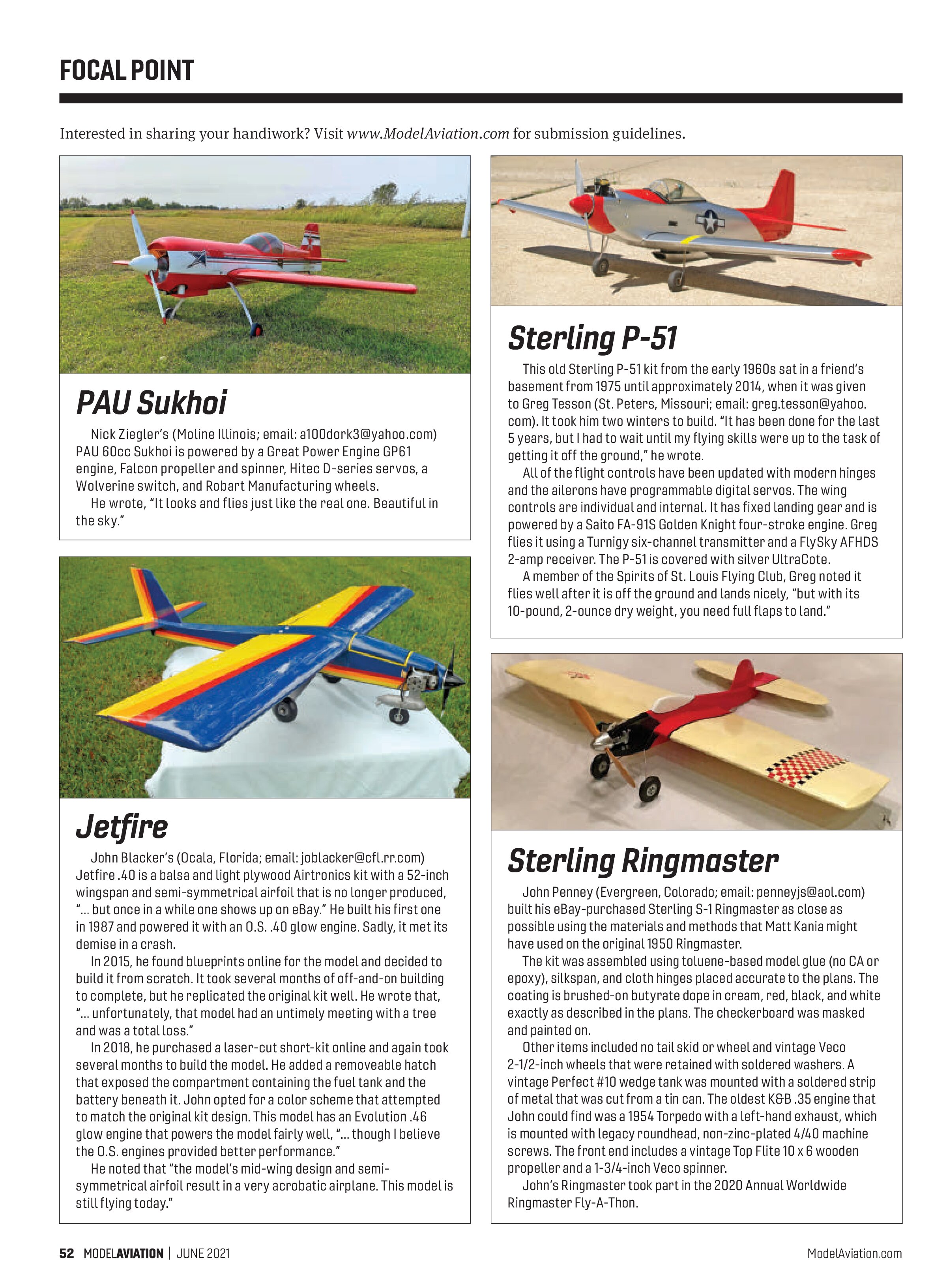
PAU Sukhoi
Nick Ziegler’s (Moline Illinois; email: a100dork3@yahoo.com) PAU 60cc Sukhoi is powered by a Great Power Engine GP61 engine, Falcon propeller and spinner, Hitec D-series servos, a Wolverine switch, and Robart Manufacturing wheels.
He wrote, “It looks and flies just like the real one. Beautiful in the sky.”

Jetfire
John Blacker’s (Ocala, Florida; email: joblacker@cfl.rr.com) Jetfire .40 is a balsa and light plywood Airtronics kit with a 52-inch wingspan and semi-symmetrical airfoil that is no longer produced, “... but once in a while one shows up on eBay.” He built his first one in 1987 and powered it with an O.S. .40 glow engine. Sadly, it met its demise in a crash.
In 2015, he found blueprints online for the model and decided to build it from scratch. It took several months of off-and-on building to complete, but he replicated the original kit well. He wrote that, “... unfortunately, that model had an untimely meeting with a tree and was a total loss.”
In 2018, he purchased a laser-cut short-kit online and again took several months to build the model. He added a removable hatch that exposed the compartment containing the fuel tank and the battery beneath it. John opted for a color scheme that attempted to match the original kit design. This model has an Evolution .46 glow engine that powers the model fairly well, “... though I believe the O.S. engines provided better performance.”
He noted that “the model’s mid-wing design and semi-symmetrical airfoil result in a very acrobatic airplane. This model is still flying today.”

Sterling P-51
This old Sterling P-51 kit from the early 1960s sat in a friend’s basement from 1975 until approximately 2014, when it was given to Greg Tesson (St. Peters, Missouri; email: greg.tesson@yahoo.com). It took him two winters to build. “It has been done for the last 5 years, but I had to wait until my flying skills were up to the task of getting it off the ground,” he wrote.
All of the flight controls have been updated with modern hinges and the ailerons have programmable digital servos. The wing controls are individual and internal. It has fixed landing gear and is powered by a Saito FA-91S Golden Knight four-stroke engine. Greg flies it using a Turnigy six-channel transmitter and a FlySky AFHDS 2-amp receiver. The P-51 is covered with silver UltraCote.
A member of the Spirits of St. Louis Flying Club, Greg noted it flies well after it is off the ground and lands nicely, “but with its 10-pound, 2-ounce dry weight, you need full flaps to land.”

Sterling Ringmaster
John Penney (Evergreen, Colorado; email: penneyjs@aol.com) built his eBay-purchased Sterling S-1 Ringmaster as close as possible using the materials and methods that Matt Kania might have used on the original 1950 Ringmaster.
The kit was assembled using tongue-based model glue (no CA or epoxy), silkspan, and cloth hinges placed accurate to the plans. The coating is brushed-on butyrate dope in cream, red, black, and white exactly as described in the plans. The checkerboard was masked and painted on.
Other items included no tail skid or wheel and vintage Veco 2-1/2-inch wheels that were retained with soldered washers. A vintage Perfect #10 wedge tank was mounted with a soldered strip of metal that was cut from a tin can. The oldest K&B .35 engine that John could find was a 1954 Torpedo with a left-hand exhaust, which is mounted with legacy roundhead, non-zinc-plated 4/40 machine screws. The front end includes a vintage Top Flite 10 x 6 wooden propeller and a 1-3/4-inch Veco spinner.
John’s Ringmaster took part in the 2020 Annual Worldwide Ringmaster Fly-A-Thon.

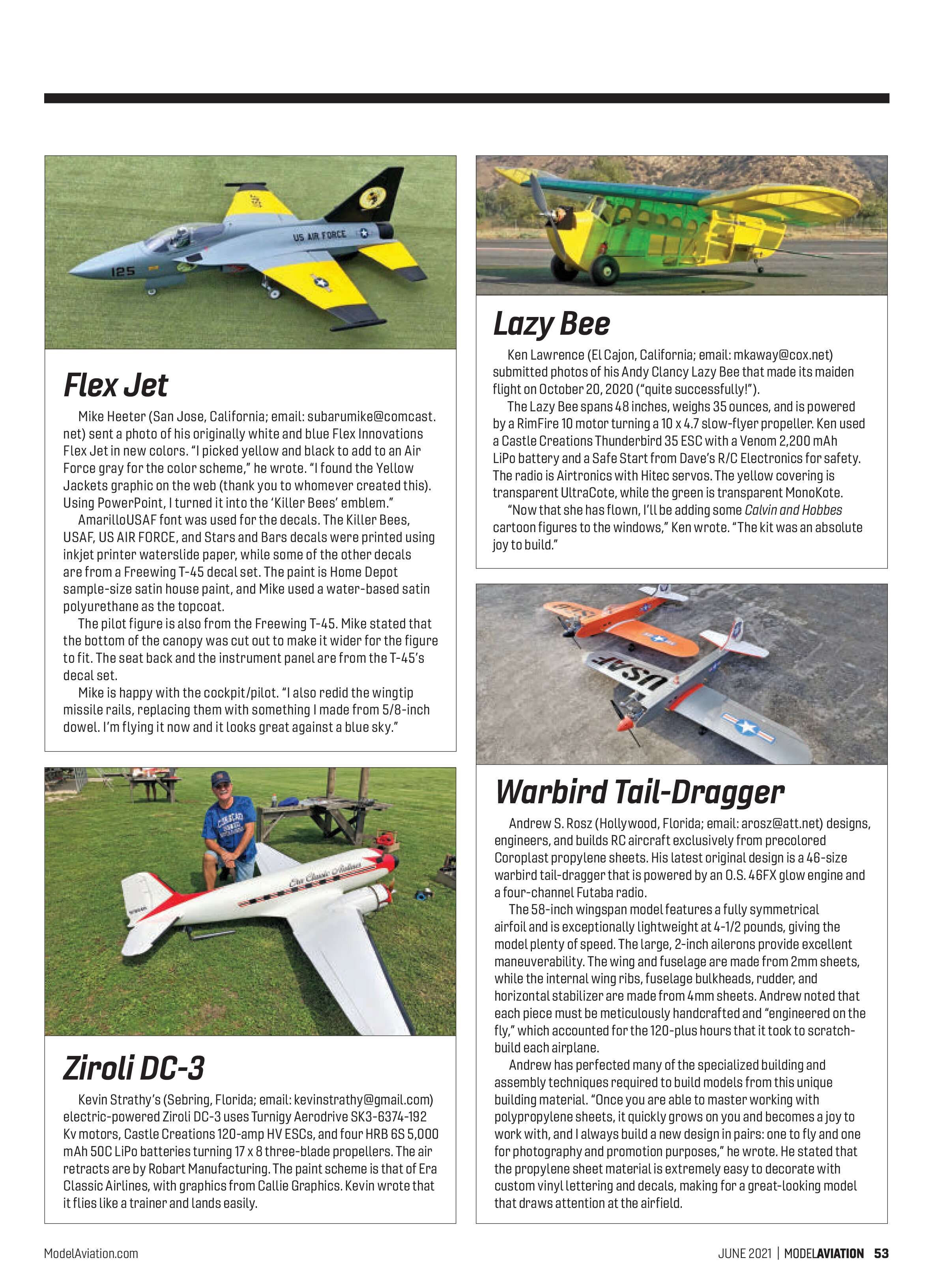
Flex Jet
Mike Heeter (San Jose, California; email: subarumike@comcast.net) sent a photo of his originally white and blue Flex Innovations Flex Jet in new colors. “I picked yellow and black to add to an Air Force gray for the color scheme,” he wrote. “I found the Yellow Jackets graphic on the web (thank you to whomever created this). Using PowerPoint, I tuned it into the ‘Killer Bees’ emblem.”
AmarilloUSAF font was used for the decals. The Killer Bees, USAF, US AIR FORCE, and Stars and Bars decals were printed using inkjet printer waterslide paper, while some of the other decals are from a Freewing T-45 decal set. The paint is Home Depot sample-size satin house paint, and Mike used a water-based satin polyurethane as the topcoat.
The pilot figure is also from the Freewing T-45. Mike stated that the bottom of the canopy was cut out to make it wider for the figure to fit. The seat back and the instrument panel are from the T-45’s decal set.
Mike is happy with the cockpit/pilot. “I also redid the wingtip missile rails, replacing them with something I made from 5/8-inch dowel. I’m flying it now and it looks great against a blue sky.”

Ziroli DC-3
Kevin Strathy’s (Sebring, Florida; email: kevinstrathy@gmail.com) electric-powered Ziroli DC-3 uses Turnigy Aerodrive SK3-6374-192 Kv motors, Castle Creations 120-amp HV ESCs, and four HRB 6S 5,000 mAh 50C LiPo batteries turning 17 x 8 three-blade propellers. The air retracts are by Robart Manufacturing. The paint scheme is that of Era Classic Airlines, with graphics from Callie Graphics. Kevin wrote that it flies like a trainer and lands easily.

Lazy Bee
Ken Lawrence (El Cajon, California; email: mkaway@cox.net) submitted photos of his Andy Clancy Lazy Bee that made its maiden flight on October 20, 2020 (“quite successfully!”).
The Lazy Bee spans 48 inches, weighs 35 ounces, and is powered by a RimFire 10 motor turning a 10 x 4.7 slow-flyer propeller. Ken used a Castle Creations Thunderbird 35 ESC with a Venom 2,200 mAh LiPo battery and a Safe Start from Dave’s R/C Electronics for safety. The radio is Airtronics with Hitec servos. The yellow covering is transparent UltraCote, while the green is transparent MonoKote.
“Now that she has flown, I’ll be adding some Calvin and Hobbes cartoon figures to the windows,” Ken wrote. “The kit was an absolute joy to build.”

Warbird Tail-Dragger
Andrew S. Rosz (Hollywood, Florida; email: arosz@att.net) designs, engineers, and builds RC aircraft exclusively from precolored Coroplast propylene sheets. His latest original design is a 46-size warbird tail-dragger that is powered by an O.S. 46FX glow engine and a four-channel Futaba radio.
The 58-inch wingspan model features a fully symmetrical airfoil and is exceptionally lightweight at 4-1/2 pounds, giving the model plenty of speed. The large, 2-inch ailerons provide excellent maneuverability. The wing and fuselage are made from 2mm sheets, while the internal wing ribs, fuselage bulkheads, rudder, and horizontal stabilizer are made from 4mm sheets. Andrew noted that each piece must be meticulously handcrafted and “engineered on the fly,” which accounted for the 120-plus hours that it took to scratch-build each airplane.
Andrew has perfected many of the specialized building and assembly techniques required to build models from this unique building material. “Once you are able to master working with polypropylene sheets, it quickly grows on you and becomes a joy to work with, and I always build a new design in pairs: one to fly and one for photography and promotion purposes,” he wrote. He stated that the propylene sheet material is extremely easy to decorate with custom vinyl lettering and decals, making for a great-looking model that draws attention at the airfield.