CRITICAL DATA: USING A WATTMETER
By Terry Dunn | terrydunn74@gmail.com

IN MY FEBRUARY 2021 COLUMN, I discussed wattmeters and urged all electric fliers to own one. I subsequently received letters from several readers who asked how to put this tool to use in a practical way. This time around, I will present an example of how I’ve used my wattmeter to improve the performance of a model.
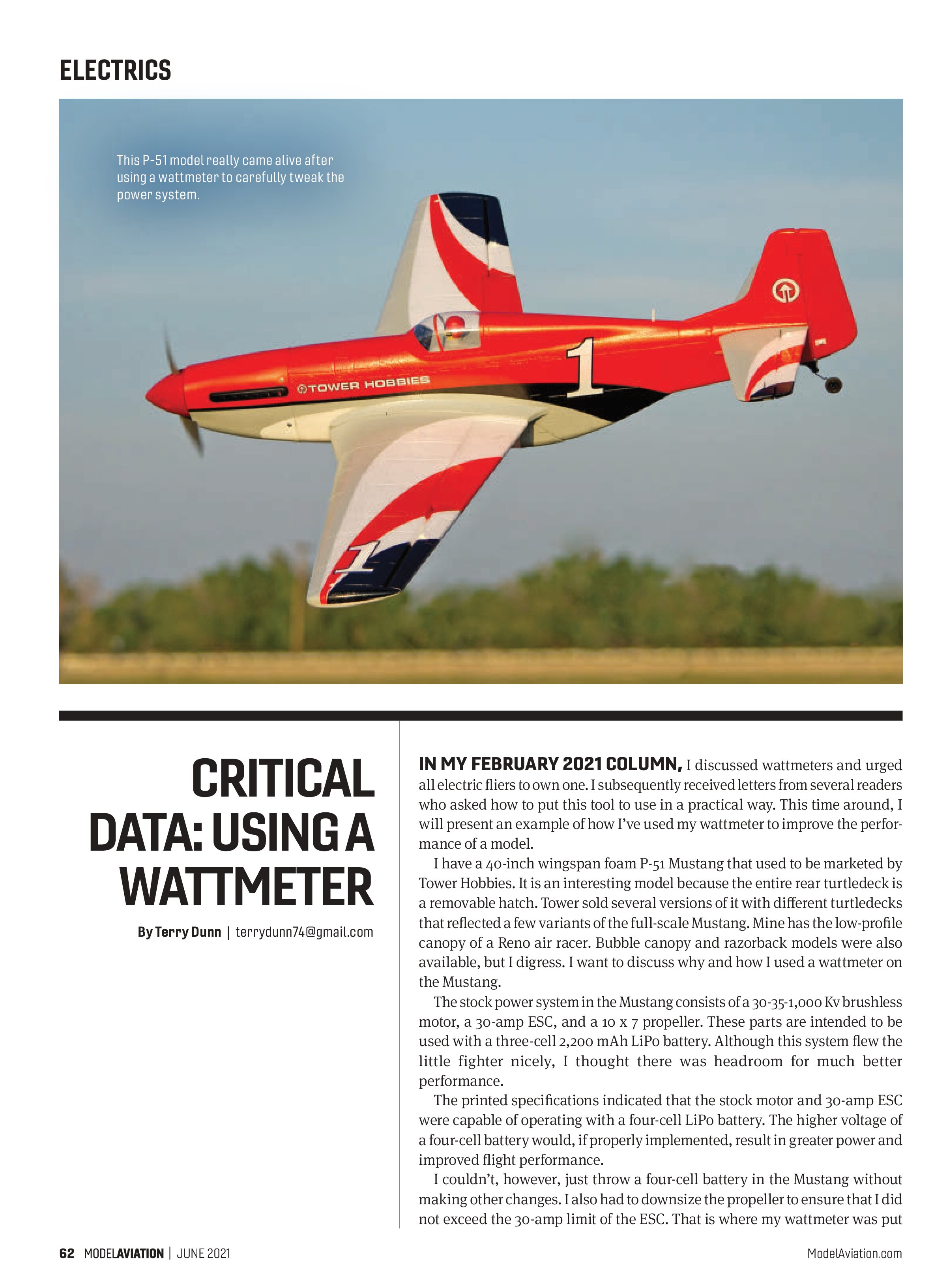
I have a 40-inch wingspan foam P-51 Mustang that used to be marketed by Tower Hobbies. It is an interesting model because the entire rear turtledeck is a removable hatch. Tower sold several versions of it with different turtledecks that reflected a few variants of the full-scale Mustang. Mine has the low-profile canopy of a Reno air racer. Bubble canopy and razorback models were also available, but I digress. I want to discuss why and how I used a wattmeter on the Mustang.
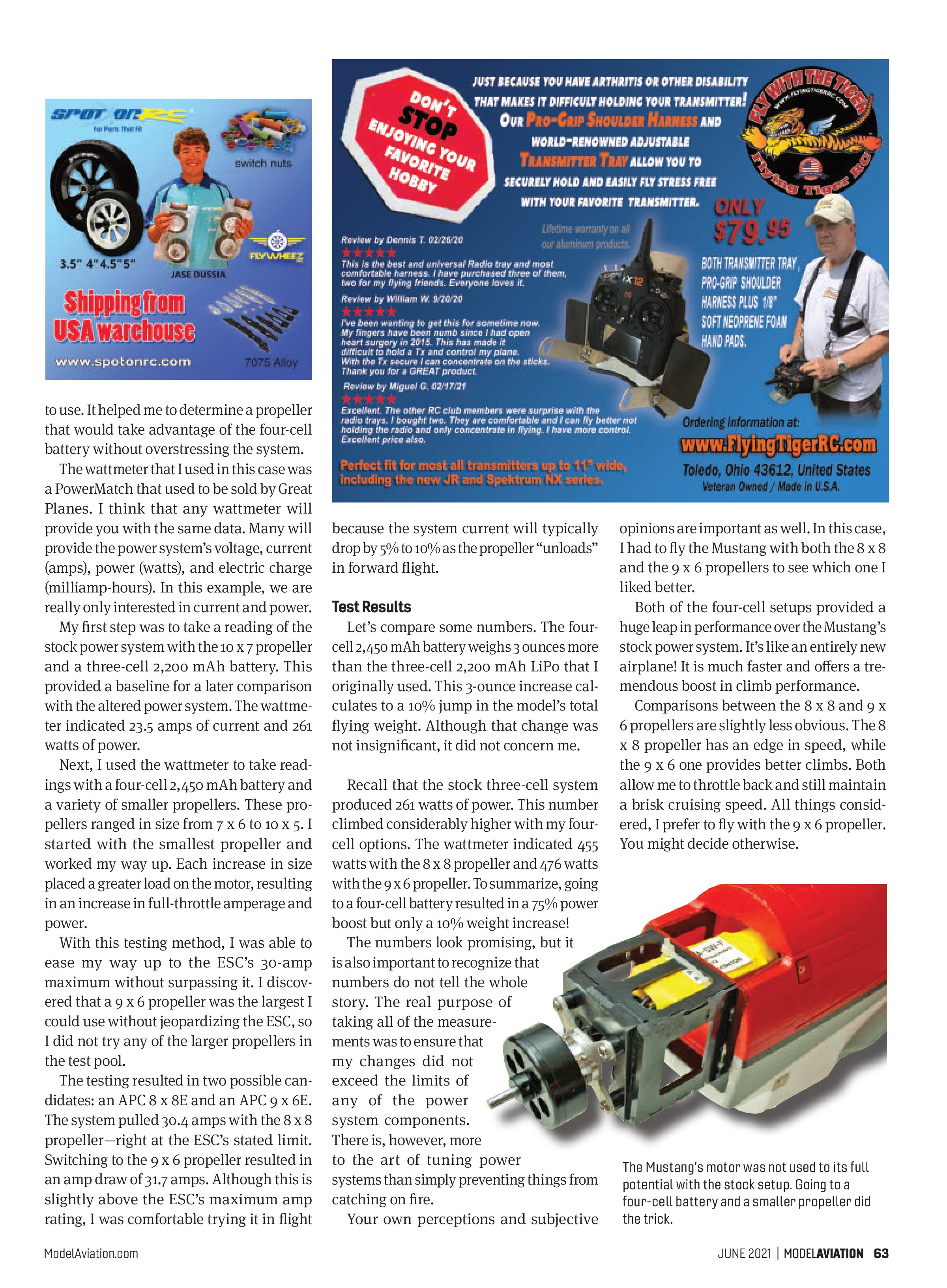
The stock power system in the Mustang consists of a 30-35-1,000 Kv brushless motor, a 30-amp ESC, and a 10 x 7 propeller. These parts are intended to be used with a three-cell 2,200 mAh LiPo battery. Although this system flew the little fighter nicely, I thought there was headroom for much better performance.
The printed specifications indicated that the stock motor and 30-amp ESC were capable of operating with a four-cell LiPo battery. The higher voltage of a four-cell battery would, if properly implemented, result in greater power and improved flight performance.
I couldn’t, however, just throw a four-cell battery in the Mustang without making other changes. I also had to downsize the propeller to ensure that I did not exceed the 30-amp limit of the ESC. That is where my wattmeter was put to use. It helped me to determine a propeller that would take advantage of the four-cell battery without overstressing the system.
The wattmeter that I used in this case was a PowerMatch that used to be sold by Great Planes. I think that any wattmeter will provide you with the same data. Many will provide the power system’s voltage, current (amps), power (watts), and electric charge (milliamp-hours). In this example, we are really only interested in current and power.
My first step was to take a reading of the stock power system with the 10 x 7 propeller and a three-cell 2,200 mAh battery. This provided a baseline for a later comparison with the altered power system. The wattmeter indicated 23.5 amps of current and 261 watts of power.
Next, I used the wattmeter to take readings with a four-cell 2,450 mAh battery and a variety of smaller propellers. These propellers ranged in size from 7 x 6 to 10 x 5. I started with the smallest propeller and worked my way up. Each increase in size placed a greater load on the motor, resulting in an increase in full-throttle amperage and power.
With this testing method, I was able to ease my way up to the ESC’s 30-amp maximum without surpassing it. I discovered that a 9 x 6 propeller was the largest I could use without jeopardizing the ESC, so I did not try any of the larger propellers in the test pool.
The testing resulted in two possible candidates: an APC 8 x 8E and an APC 9 x 6E. The system pulled 30.4 amps with the 8 x 8 propeller—right at the ESC’s stated limit. Switching to the 9 x 6 propeller resulted in an amp draw of 31.7 amps. Although this is slightly above the ESC’s maximum amp rating, I was comfortable trying it in flight because the system current will typically drop by 5% to 10% as the propeller “unloads” in forward flight.
Test Results
Let’s compare some numbers. The four-cell 2,450 mAh battery weighs 3 ounces more than the three-cell 2,200 mAh LiPo that I originally used. This 3-ounce increase calculates to a 10% jump in the model’s total flying weight. Although that change was not insignificant, it did not concern me.
Recall that the stock three-cell system produced 261 watts of power. This number climbed considerably higher with my four-cell options. The wattmeter indicated 455 watts with the 8 x 8 propeller and 476 watts with the 9 x 6 propeller. To summarize, going to a four-cell battery resulted in a 75% power boost but only a 10% weight increase!
The numbers look promising, but it is also important to recognize that the numbers do not tell the whole story. The real purpose of taking all of the measurements was to ensure that my changes did not exceed the limits of any of the power system components. There is, however, more to the art of tuning power systems than simply preventing things from catching on fire.
Your own perceptions and subjective opinions are important as well. In this case, I had to fly the Mustang with both the 8 x 8 and the 9 x 6 propellers to see which one I liked better.
Both of the four-cell setups provided a huge leap in performance over the Mustang’s stock power system. It’s like an entirely new airplane! It is much faster and offers a tremendous boost in climb performance.
Comparisons between the 8 x 8 and 9 x 6 propellers are slightly less obvious. The 8 x 8 propeller has an edge in speed, while the 9 x 6 one provides better climbs. Both allow me to throttle back and still maintain a brisk cruising speed. All things considered, I prefer to fly with the 9 x 6 propeller. You might decide otherwise.