THE DEAL WITH DRONES
IS DJI’S FPV DRONE THE BEST FOR BEGINNERS?
By Joshua Bardwell
joshuabardwell@fpvknowitall.com

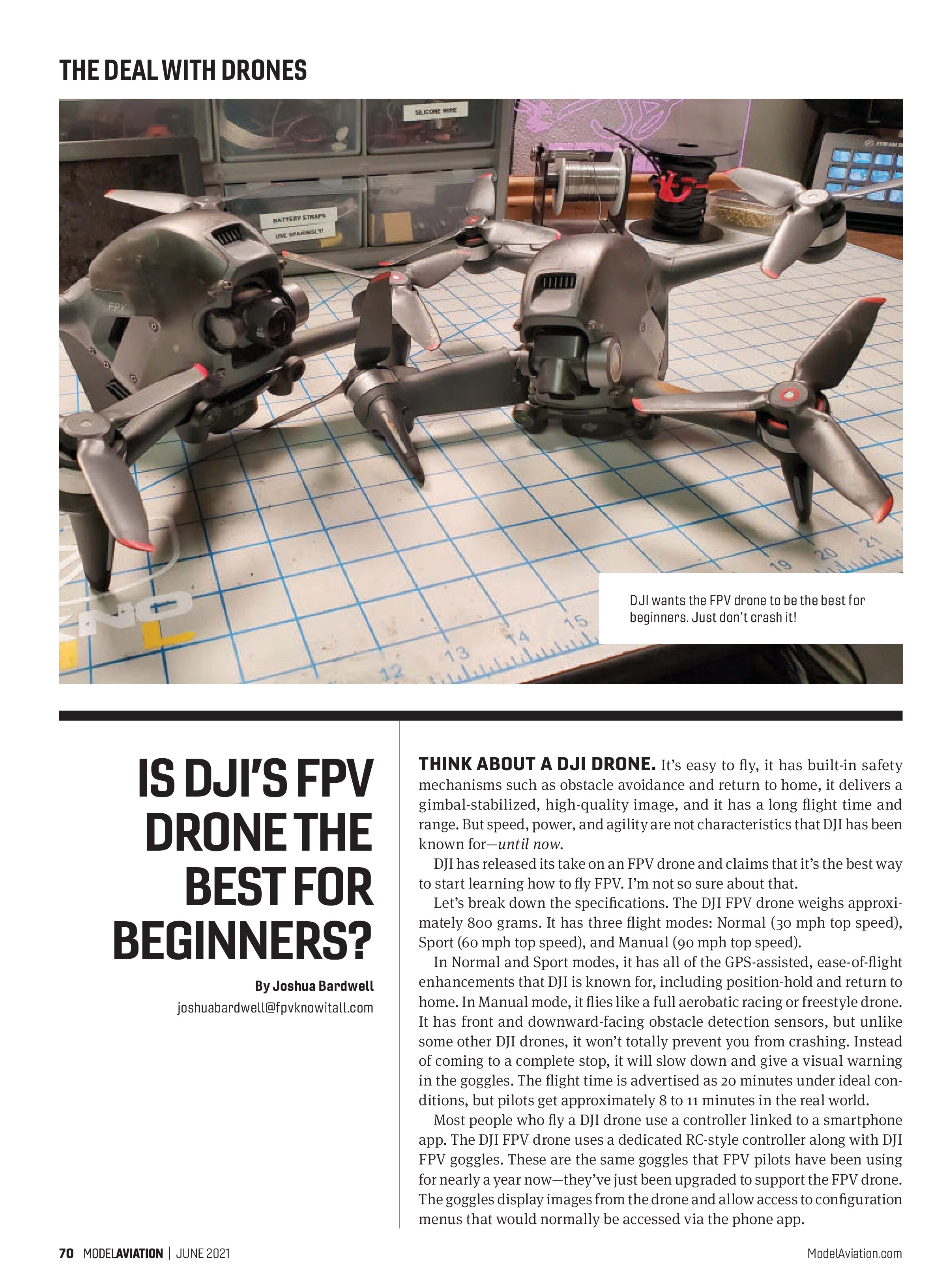
THINK ABOUT A DJI DRONE. It’s easy to fly, it has built-in safety mechanisms such as obstacle avoidance and return to home, it delivers a gimbal-stabilized, high-quality image, and it has a long flight time and range. But speed, power, and agility are not characteristics that DJI has been known for—until now.
DJI has released its take on an FPV drone and claims that it’s the best way to start learning how to fly FPV. I’m not so sure about that.
Let’s break down the specifications. The DJI FPV drone weighs approximately 800 grams. It has three flight modes: Normal (30 mph top speed), Sport (60 mph top speed), and Manual (90 mph top speed).
In Normal and Sport modes, it has all of the GPS-assisted, ease-of-flight enhancements that DJI is known for, including position-hold and return to home. In Manual mode, it flies like a full aerobatic racing or freestyle drone. It has front and downward-facing obstacle detection sensors, but unlike some other DJI drones, it won’t totally prevent you from crashing. Instead of coming to a complete stop, it will slow down and give a visual warning in the goggles. The flight time is advertised as 20 minutes under ideal conditions, but pilots get approximately 8 to 11 minutes in the real world.
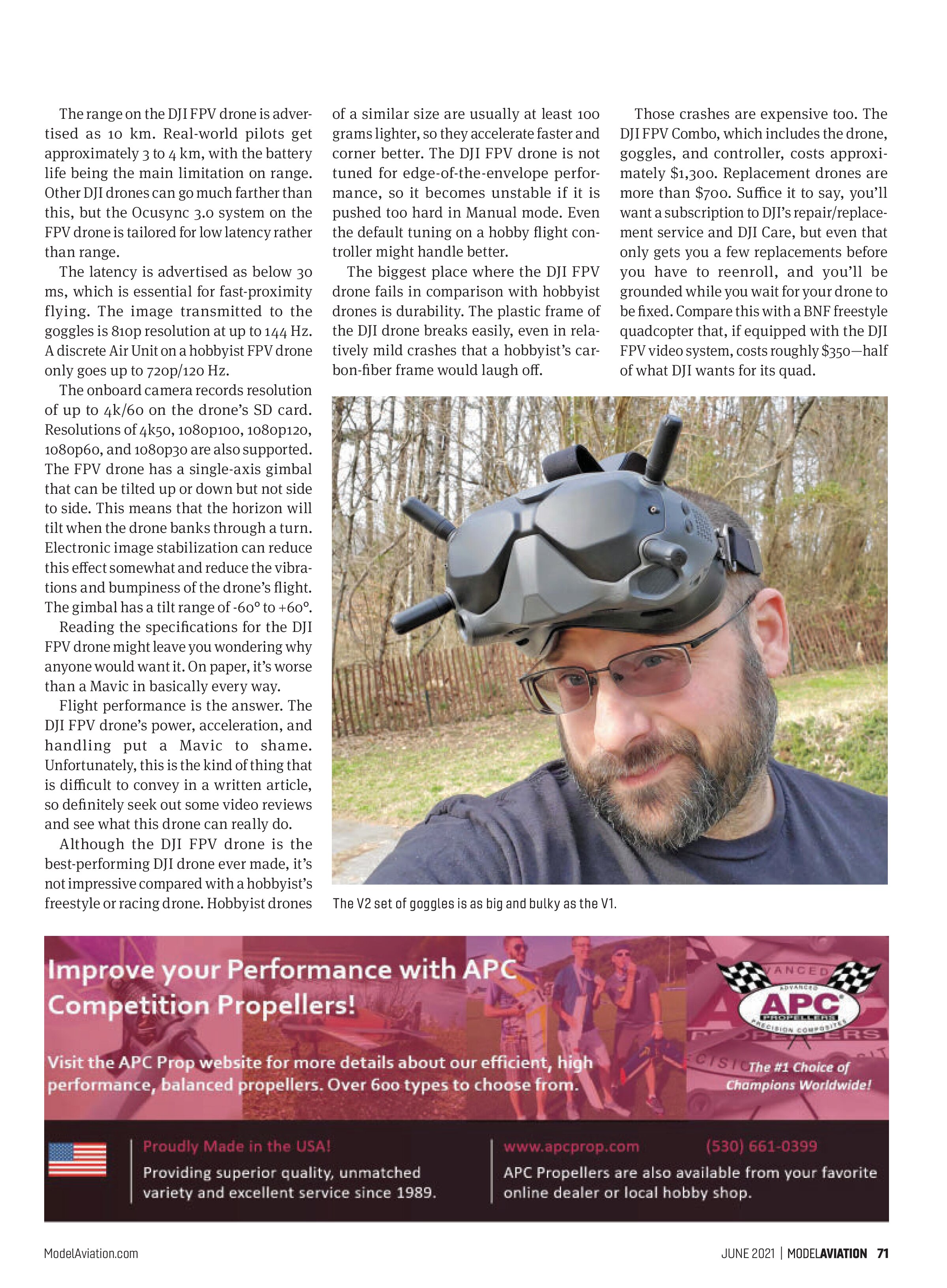
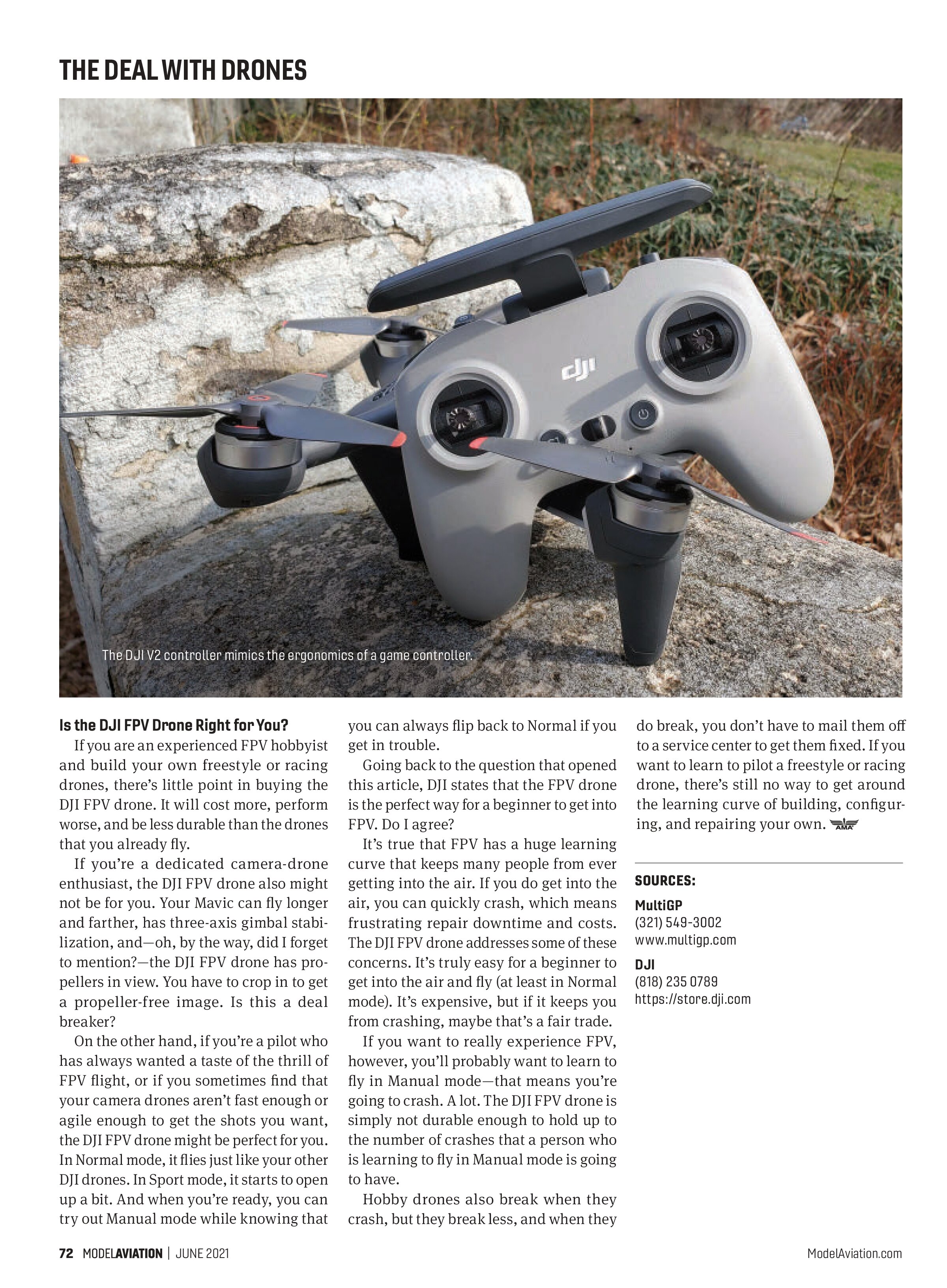
Most people who fly a DJI drone use a controller linked to a smartphone app. The DJI FPV drone uses a dedicated RC-style controller along with DJI FPV goggles. These are the same goggles that FPV pilots have been using for nearly a year now—they’ve just been upgraded to support the FPV drone. The goggles display images from the drone and allow access to configuration menus that would normally be accessed via the phone app.
The range on the DJI FPV drone is advertised as 10 km. Real-world pilots get approximately 3 to 4 km, with the battery life being the main limitation on range. Other DJI drones can go much farther than this, but the OcuSync 3.0 system on the FPV drone is tailored for low latency rather than range.
The latency is advertised as below 30 ms, which is essential for fast-proximity flying. The image transmitted to the goggles is 810p resolution at up to 144 Hz. A discrete Air Unit on a hobbyist FPV drone only goes up to 720p/120 Hz.
The onboard camera records resolution of up to 4k/60 on the drone’s SD card. Resolutions of 4k50, 1080p100, 1080p120, 1080p60, and 1080p30 are also supported. The FPV drone has a single-axis gimbal that can be tilted up or down but not side to side. This means that the horizon will tilt when the drone banks through a turn. Electronic image stabilization can reduce this effect somewhat and reduce the vibrations and bumpiness of the drone’s flight. The gimbal has a tilt range of -60° to +60°.
Reading the specifications for the DJI FPV drone might leave you wondering why anyone would want it. On paper, it’s worse than a Mavic in basically every way.
Flight performance is the answer. The DJI FPV drone’s power, acceleration, and handling put a Mavic to shame. Unfortunately, this is the kind of thing that is difficult to convey in a written article, so definitely seek out some video reviews and see what this drone can really do.
Although the DJI FPV drone is the best-performing DJI drone ever made, it’s not impressive compared with a hobbyist’s freestyle or racing drone. Hobbyist drones of a similar size are usually at least 100 grams lighter, so they accelerate faster and corner better. The DJI FPV drone is not tuned for edge-of-the-envelope performance, so it becomes unstable if it is pushed too hard in Manual mode. Even the default tuning on a hobby flight controller might handle better.
The biggest place where the DJI FPV drone fails in comparison with hobbyist drones is durability. The plastic frame of the DJI drone breaks easily, even in relatively mild crashes that a hobbyist’s carbon-fiber frame would laugh off.

Those crashes are expensive too. The DJI FPV Combo, which includes the drone, goggles, and controller, costs approximately $1,300. Replacement drones are more than $700. Suffice it to say, you’ll want a subscription to DJI’s repair/replacement service and DJI Care, but even that only gets you a few replacements before you have to reenroll, and you’ll be grounded while you wait for your drone to be fixed. Compare this with a BNF freestyle quadcopter that, if equipped with the DJI FPV video system, costs roughly $350—half of what DJI wants for its quad.

Is the DJI FPV Drone Right for You?
If you are an experienced FPV hobbyist and build your own freestyle or racing drones, there’s little point in buying the DJI FPV drone. It will cost more, perform worse, and be less durable than the drones that you already fly.
If you’re a dedicated camera-drone enthusiast, the DJI FPV drone also might not be for you. Your Mavic can fly longer and farther, has three-axis gimbal stabilization, and—oh, by the way, did I forget to mention?—the DJI FPV drone has propellers in view. You have to crop in to get a propeller-free image. Is this a deal breaker?
On the other hand, if you’re a pilot who has always wanted a taste of the thrill of FPV flight, or if you sometimes find that your camera drones aren’t fast enough or agile enough to get the shots you want, the DJI FPV drone might be perfect for you. In Normal mode, it flies just like your other DJI drones. In Sport mode, it starts to open up a bit. And when you’re ready, you can try out Manual mode while knowing that you can always flip back to Normal if you get in trouble.
Going back to the question that opened this article, DJI states that the FPV drone is the perfect way for a beginner to get into FPV. Do I agree?
It’s true that FPV has a huge learning curve that keeps many people from ever getting into the air. If you do get into the air, you can quickly crash, which means frustrating repair downtime and costs. The DJI FPV drone addresses some of these concerns. It’s truly easy for a beginner to get into the air and fly (at least in Normal mode). It’s expensive, but if it keeps you from crashing, maybe that’s a fair trade.
If you want to really experience FPV, however, you’ll probably want to learn to fly in Manual mode—that means you’re going to crash. A lot. The DJI FPV drone is simply not durable enough to hold up to the number of crashes that a person who is learning to fly in Manual mode is going to have.
Hobby drones also break when they crash, but they break less, and when they do break, you don’t have to mail them off to a service center to get them fixed. If you want to learn to pilot a freestyle or racing drone, there’s still no way to get around the learning curve of building, configuring, and repairing your own.
Sources:
MultiGP
(321) 549-3002
www.multigp.com
DJI
(818) 235 0789
https://store.dji.com