CONTROL LINE NAVY CARRIER


2020 POSTAL
CONTEST
By John Vlna | flyclcarrier@yahoo.com
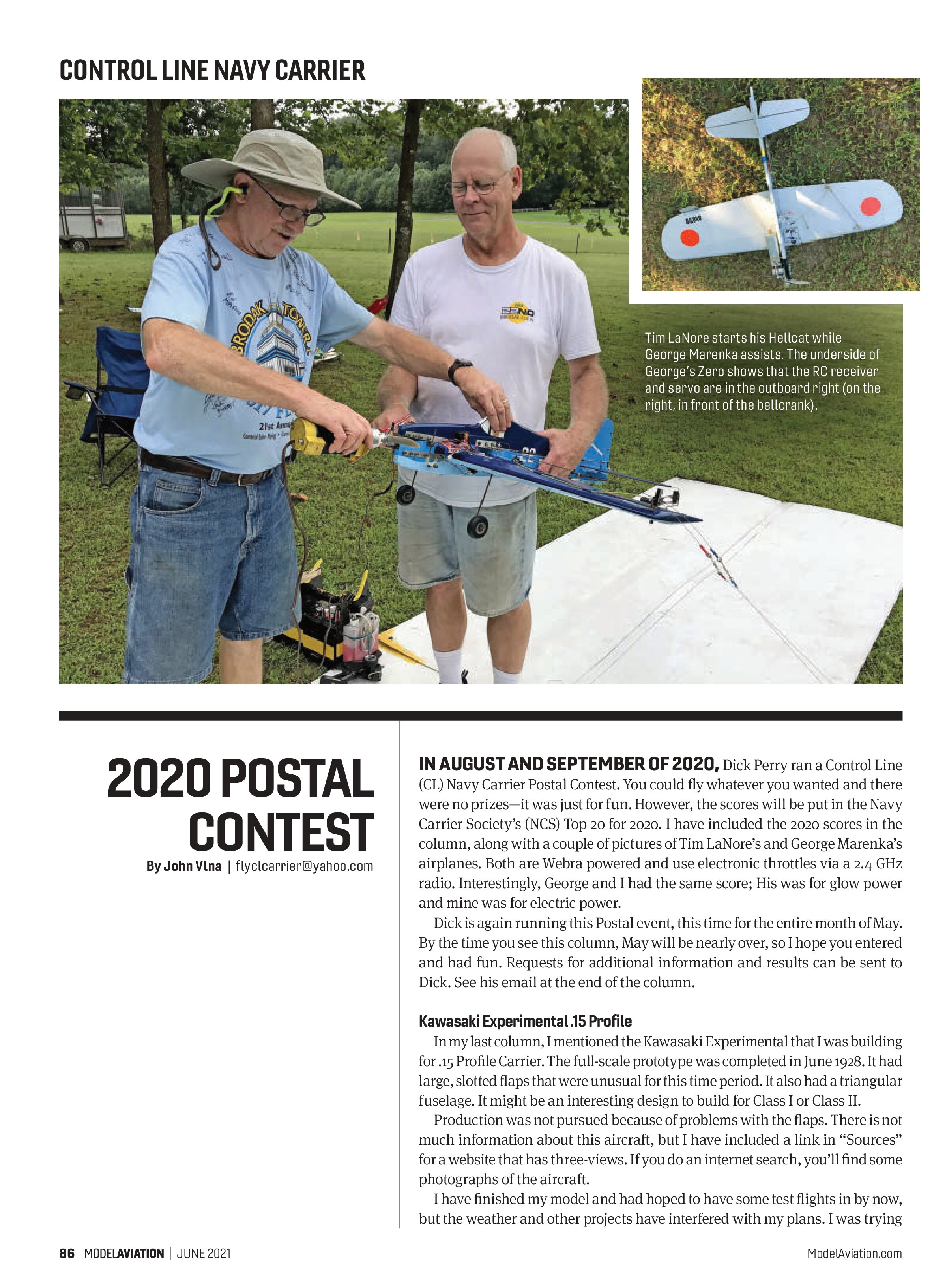
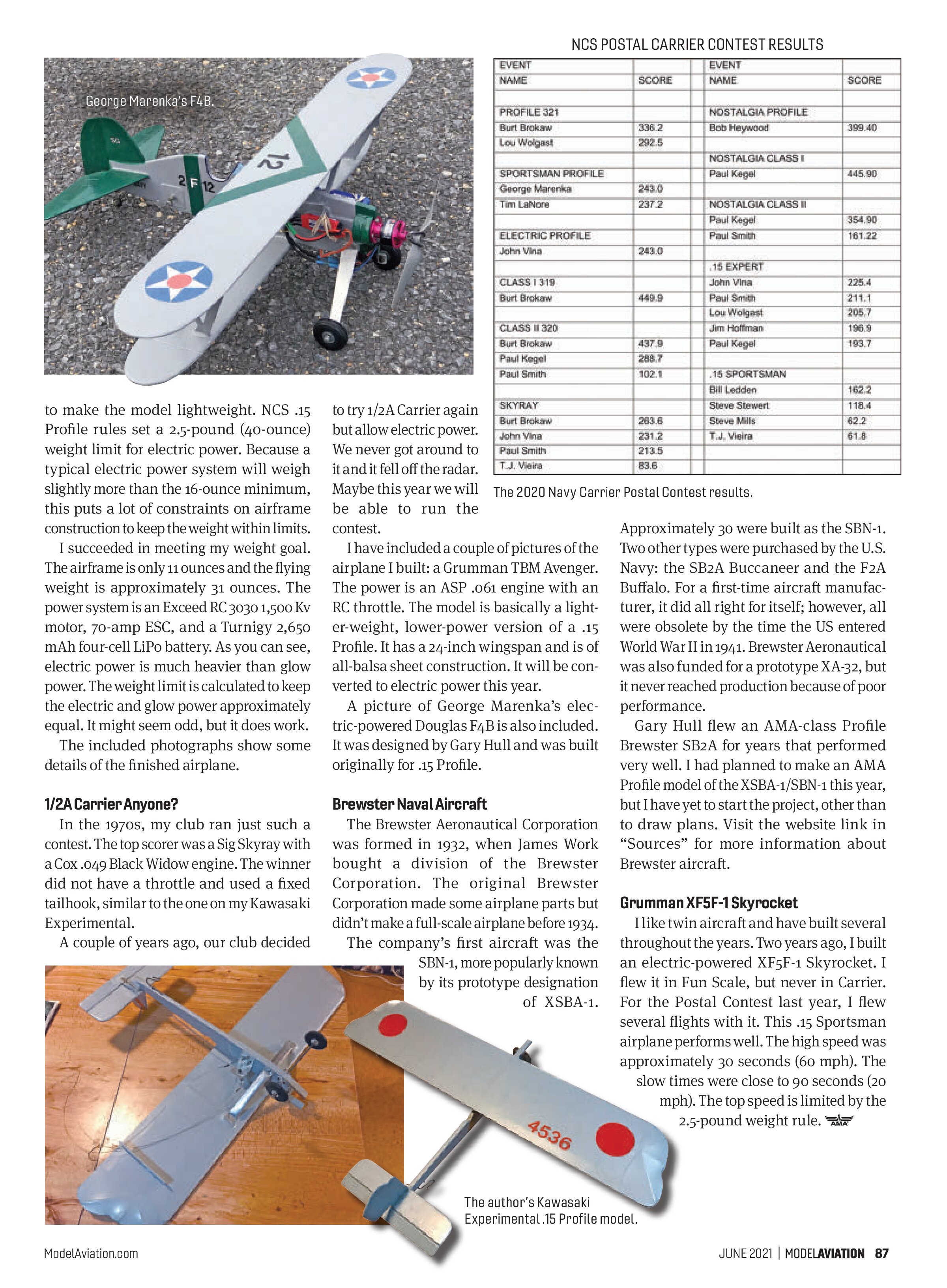
IN AUGUST AND SEPTEMBER OF 2020, Dick Perry ran a Control Line (CL) Navy Carrier Postal Contest. You could fly whatever you wanted and there were no prizes—it was just for fun. However, the scores will be put in the Navy Carrier Society’s (NCS) Top 20 for 2020. I have included the 2020 scores in the column, along with a couple of pictures of Tim LaNore’s and George Marenka’s airplanes. Both are Webra powered and use electronic throttles via a 2.4 GHz radio. Interestingly, George and I had the same score; His was for glow power and mine was for electric power.
Dick is again running this Postal event, this time for the entire month of May. By the time you see this column, May will be nearly over, so I hope you entered and had fun. Requests for additional information and results can be sent to Dick. See his email at the end of the column.
Kawasaki Experimental .15 Profile
In my last column, I mentioned the Kawasaki Experimental that I was building for .15 Profile Carrier. The full-scale prototype was completed in June 1928. It had large, slotted flaps that were unusual for this time period. It also had a triangular fuselage. It might be an interesting design to build for Class I or Class II.
Production was not pursued because of problems with the flaps. There is not much information about this aircraft, but I have included a link in “Sources” for a website that has three-views. If you do an internet search, you’ll find some photographs of the aircraft.
I have finished my model and had hoped to have some test flights in by now, but the weather and other projects have interfered with my plans. I was trying to make the model lightweight. NCS .15 Profile rules set a 2.5-pound (40-ounce) weight limit for electric power. Because a typical electric power system will weigh slightly more than the 16-ounce minimum, this puts a lot of constraints on airframe construction to keep the weight within limits.
I succeeded in meeting my weight goal. The airframe is only 11 ounces and the flying weight is approximately 31 ounces. The power system is an Exceed RC 3030 1,500 Kv motor, 70-amp ESC, and a Turnigy 2,650 mAh four-cell LiPo battery. As you can see, electric power is much heavier than glow power. The weight limit is calculated to keep the electric and glow power approximately equal. It might seem odd, but it does work.
The included photographs show some details of the finished airplane.
1/2A Carrier Anyone?
In the 1970s, my club ran just such a contest. The top scorer was a Sig Skyray with a Cox .049 Black Widow engine. The winner did not have a throttle and used a fixed tailhook, similar to the one on my Kawasaki Experimental.
A couple of years ago, our club decided to try 1/2A Carrier again but allow electric power. We never got around to it and it fell off the radar. Maybe this year we will be able to run the contest.
I have included a couple of pictures of the airplane I built: a Grumman TBM Avenger. The power is an ASP .061 engine with an RC throttle. The model is basically a lighter-weight, lower-power version of a .15 Profile. It has a 24-inch wingspan and is of all-balsa sheet construction. It will be converted to electric power this year.
A picture of George Marenka’s electric-powered Douglas F4B is also included. It was designed by Gary Hull and was built originally for .15 Profile.
Brewster Naval Aircraft
The Brewster Aeronautical Corporation was formed in 1932, when James Work bought a division of the Brewster Corporation. The original Brewster Corporation made some airplane parts but didn’t make a full-scale airplane before 1934. The company’s first aircraft was the SBN-1, more popularly known by its prototype designation of XSBA-1.

Approximately 30 were built as the SBN-1. Two other types were purchased by the U.S. Navy: the SB2A Buccaneer and the F2A Buffalo. For a first-time aircraft manufacturer, it did all right for itself; however, all were obsolete by the time the US entered World War II in 1941. Brewster Aeronautical was also funded for a prototype XA-32, but it never reached production because of poor performance.
Gary Hull flew an AMA-class Profile Brewster SB2A for years that performed very well. I had planned to make an AMA Profile model of the XSBA-1/SBN-1 this year, but I have yet to start the project, other than to draw plans. Visit the website link in “Sources” for more information about Brewster aircraft.
Grumman XF5F-1 Skyrocket
I like twin aircraft and have built several throughout the years. Two years ago, I built an electric-powered XF5F-1 Skyrocket. I flew it in Fun Scale, but never in Carrier. For the Postal Contest last year, I flew several flights with it. This .15 Sportsman airplane performs well. The high speed was approximately 30 seconds (60 mph). The slow times were close to 90 seconds (20 mph). The top speed is limited by the 2.5-pound weight rule.


Sources:
Dick Perry
tailhooker@comcast.net
Super-Hobby (Kawasaki Experimental Carrier)
https://bit.ly/2ZJIANC
Brewster Aeronautical Corporation
https://en.wikipedia.org/wiki/Brewster_Aeronautical_Corporation