BATTERY MAINTENANCE
Emerging from
long-term storage
By Greg Gimlick
Photos by the author
maelectrics@gimlick.com

What a long, strange trip it’s been ... With apologies and a nod to the Grateful Dead, the lyrics from one of the group’s songs certainly describe life for many of us during the last year or more. The pandemic affected everyone differently, and our extended break from flying pales by comparison to world issues, but I’ll leave that for the politicians and scientists to discuss.
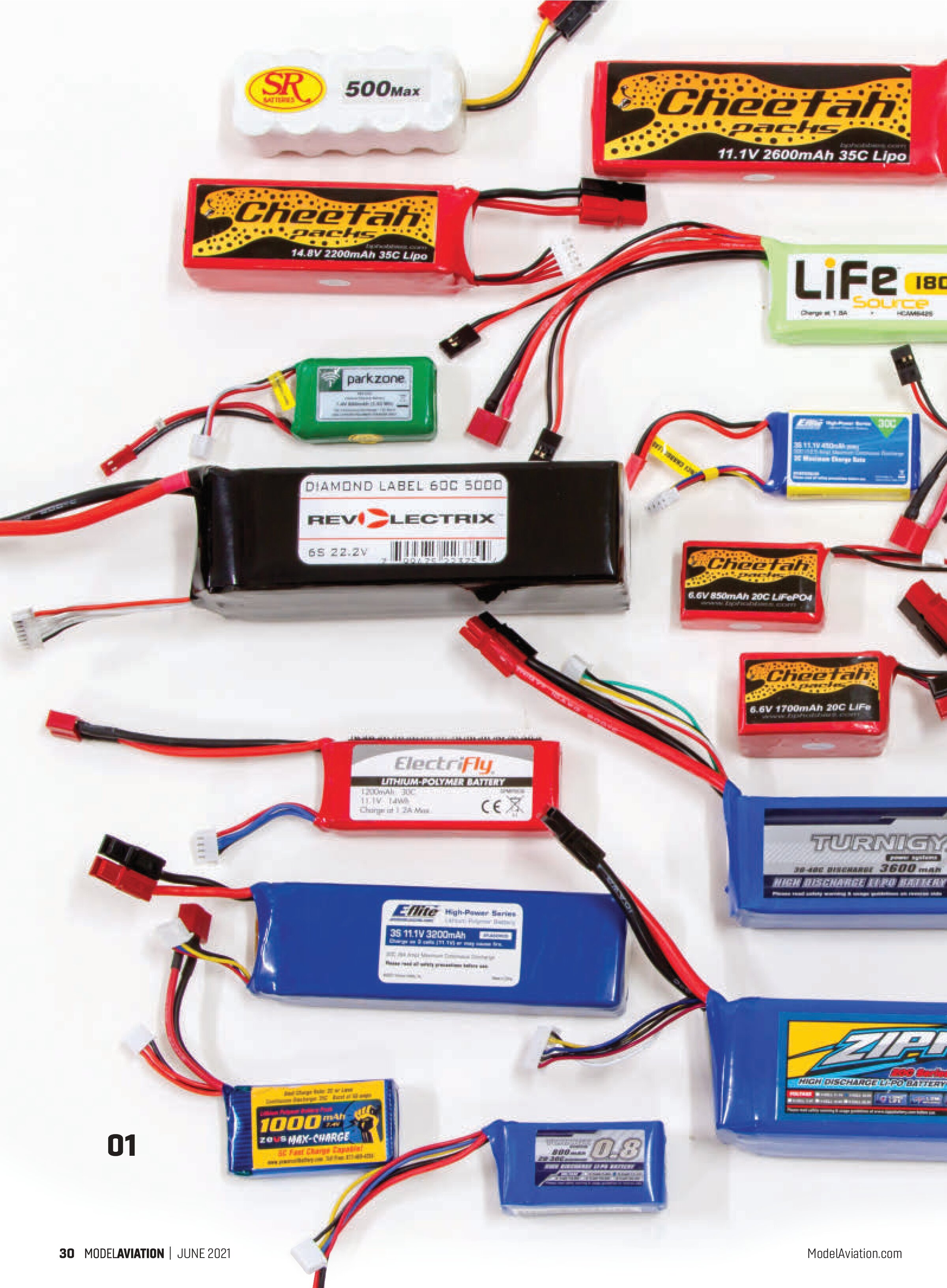
I’m going to address how to bring our electric-powered aircraft back from what might have been a much longer storage period than expected.


Did You Prepare?
In March 2020, I was still flying regularly and hadn’t put anything into storage mode beyond my usual routine. I always put LiPo packs into a storage charge mode if they’re going to be left for more than a few days.
The golden rule of thumb is to never leave packs fully charged or fully discharged. We can argue all day whether the “proper” charge is 3.8 volts per cell, 3.83, 3.85, etc., but the key is to balance them at roughly 3.8 volts per cell before you store them.
Most chargers/battery management systems have a safe and effective storage mode. If you don’t have one that does, you can always discharge them in a model until you reach your target voltage levels or build a discharger (see Terry Dunn’s April 2021 “Electrics” column in Model Aviation). It’s always best to balance them across the pack as closely as possible.
Something else I do when I put packs into long-term storage is check their internal resistance (IR) and log them into a notebook. I’ve become slack compared to my old routine, but I still think it’s important for long-term battery health. I check a pack’s IR when I get it new and periodically check it to gauge its health. I’m more conscientious about doing this with my 5S and 6S packs that are significantly more expensive than the smaller 2,200 mAh 3S packs, etc.
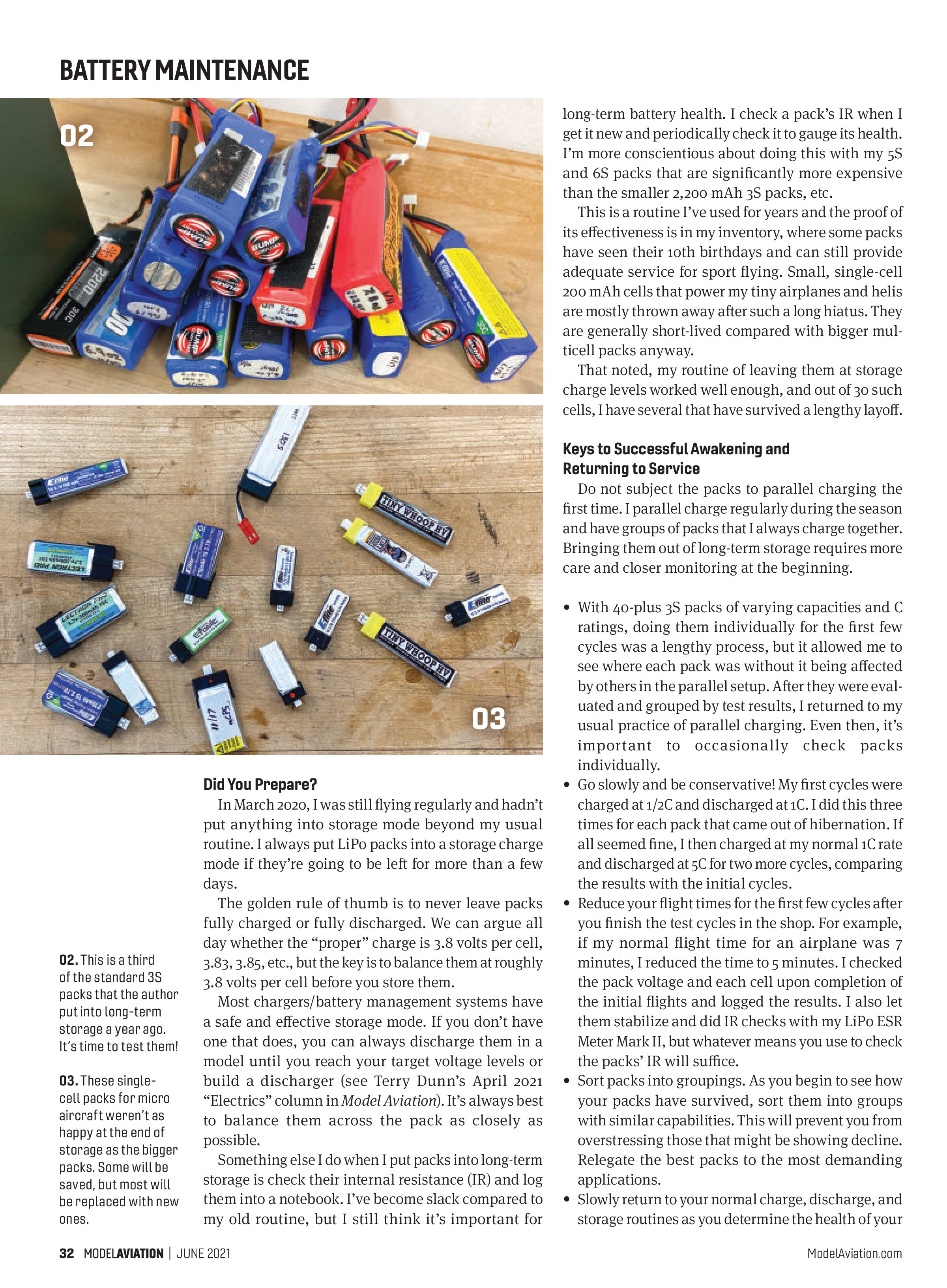
This is a routine I’ve used for years and the proof of its effectiveness is in my inventory, where some packs have seen their 10th birthdays and can still provide adequate service for sport flying. Small, single-cell 200 mAh cells that power my tiny airplanes and helis are mostly thrown away after such a long hiatus. They are generally short-lived compared with bigger multicell packs anyway.
That noted, my routine of leaving them at storage charge levels worked well enough, and out of 30 such cells, I have several that have survived a lengthy layoff.
Keys to Successful Awakening and Returning to Service
Do not subject the packs to parallel charging the first time. I parallel charge regularly during the season and have groups of packs that I always charge together. Bringing them out of long-term storage requires more care and closer monitoring at the beginning.
- With 40-plus 3S packs of varying capacities and C ratings, doing them individually for the first few cycles was a lengthy process, but it allowed me to see where each pack was without it being affected by others in the parallel setup. After they were evaluated and grouped by test results, I returned to my usual practice of parallel charging. Even then, it’s important to occasionally check packs individually.
- Go slowly and be conservative! My first cycles were charged at 1/2C and discharged at 1C. I did this three times for each pack that came out of hibernation. If all seemed fine, I then charged at my normal 1C rate and discharged at 5C for two more cycles, comparing the results with the initial cycles.
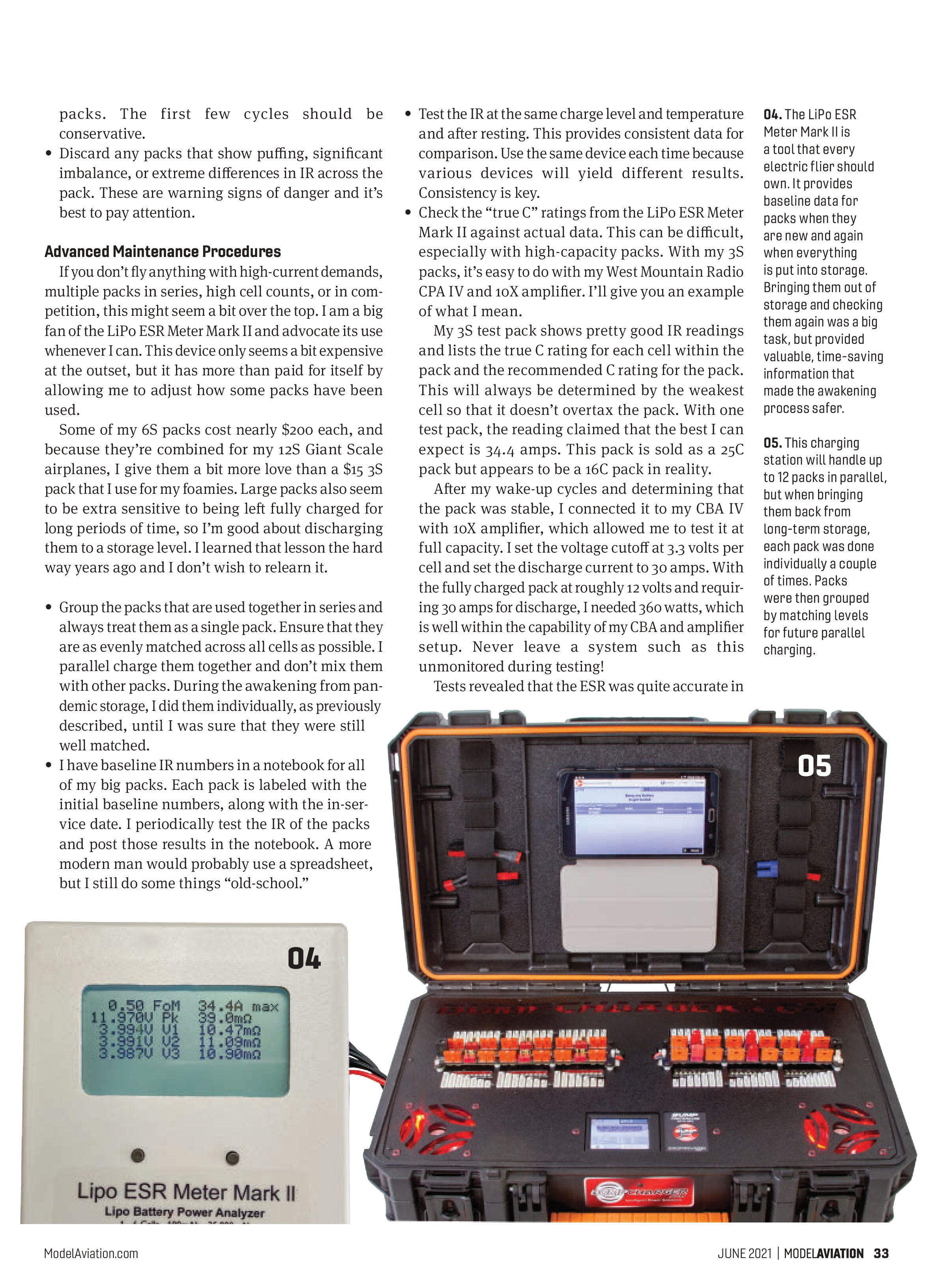
- Reduce your flight times for the first few cycles after you finish the test cycles in the shop. For example, if my normal flight time for an airplane was 7 minutes, I reduced the time to 5 minutes. I checked the pack voltage and each cell upon completion of the initial flights and logged the results. I also let them stabilize and did IR checks with my LiPo ESR Meter Mark II, but whatever means you use to check the packs’ IR will suffice.
- Sort packs into groupings. As you begin to see how your packs have survived, sort them into groups with similar capabilities. This will prevent you from overstressing those that might be showing decline. Relegate the best packs to the most demanding applications.
- Slowly return to your normal charge, discharge, and storage routines as you determine the health of your packs. The first few cycles should be conservative.
- Discard any packs that show puffing, significant imbalance, or extreme differences in IR across the pack. These are warning signs of danger and it’s best to pay attention.
Advanced Maintenance Procedures
If you don’t fly anything with high-current demands, multiple packs in series, high cell counts, or in competition, this might seem a bit over the top. I am a big fan of the LiPo ESR Meter Mark II and advocate its use whenever I can. This device only seems a bit expensive at the outset, but it has more than paid for itself by allowing me to adjust how some packs have been used.
Some of my 6S packs cost nearly $200 each, and because they’re combined for my 12S Giant Scale airplanes, I give them a bit more love than a $15 3S pack that I use for my foamies. Large packs also seem to be extra sensitive to being left fully charged for long periods of time, so I’m good about discharging them to a storage level. I learned that lesson the hard way years ago and I don’t wish to relearn it.
- Group the packs that are used together in series and always treat them as a single pack. Ensure that they are as evenly matched across all cells as possible. I parallel charge them together and don’t mix them with other packs. During the awakening from pandemic storage, I did them individually, as previously described, until I was sure that they were still well matched.
- I have baseline IR numbers in a notebook for all of my big packs. Each pack is labeled with the initial baseline numbers, along with the in-service date. I periodically test the IR of the packs and post those results in the notebook. A more modern man would probably use a spreadsheet, but I still do some things “old-school.”

- Test the IR at the same charge level and temperature and after resting. This provides consistent data for comparison. Use the same device each time because various devices will yield different results. Consistency is key.
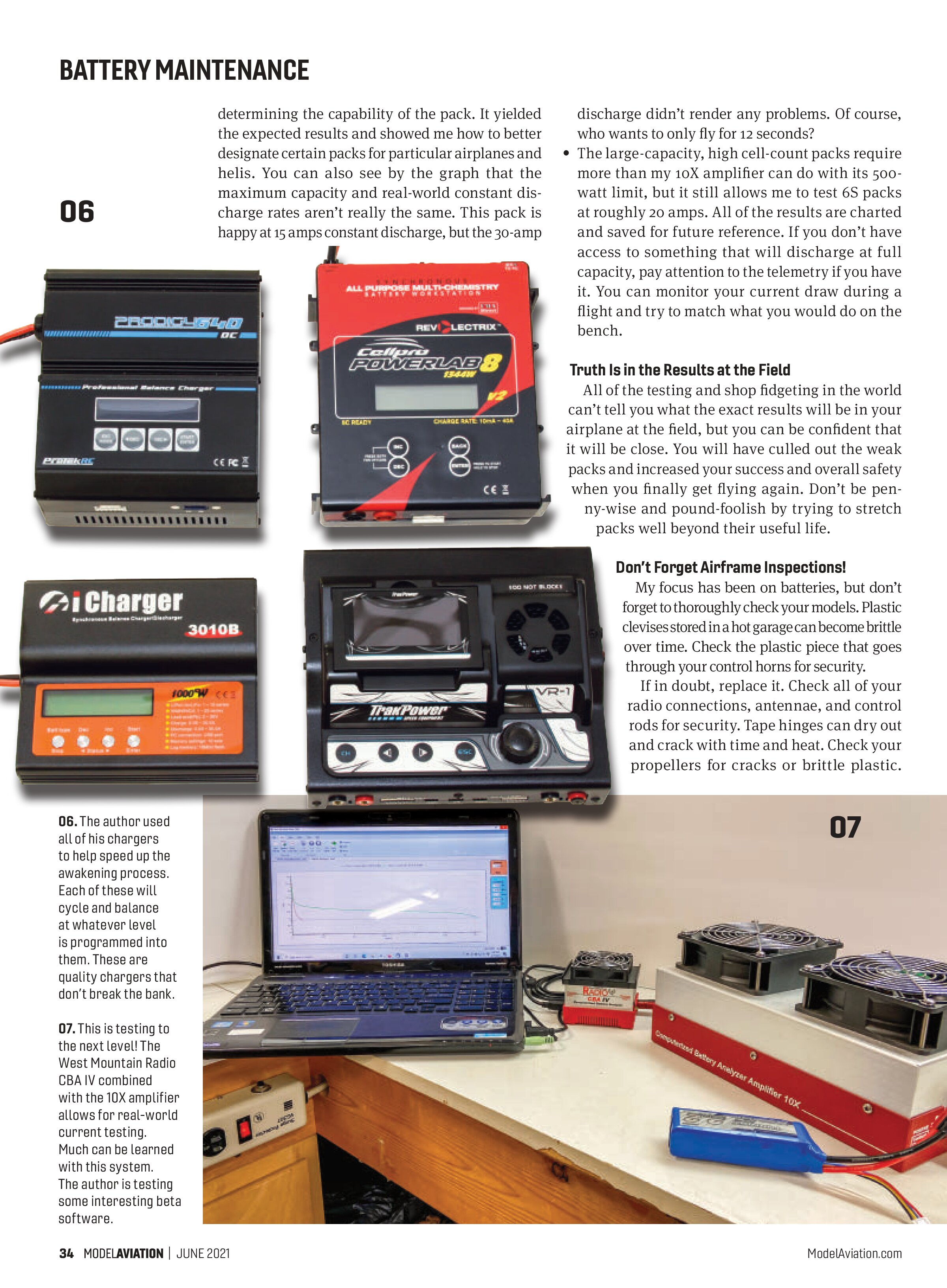
- Check the “true C” ratings from the LiPo ESR Meter Mark II against actual data. This can be difficult, especially with high-capacity packs. With my 3S packs, it’s easy to do with my West Mountain Radio CPA IV and 10X amplifier. I’ll give you an example of what I mean.
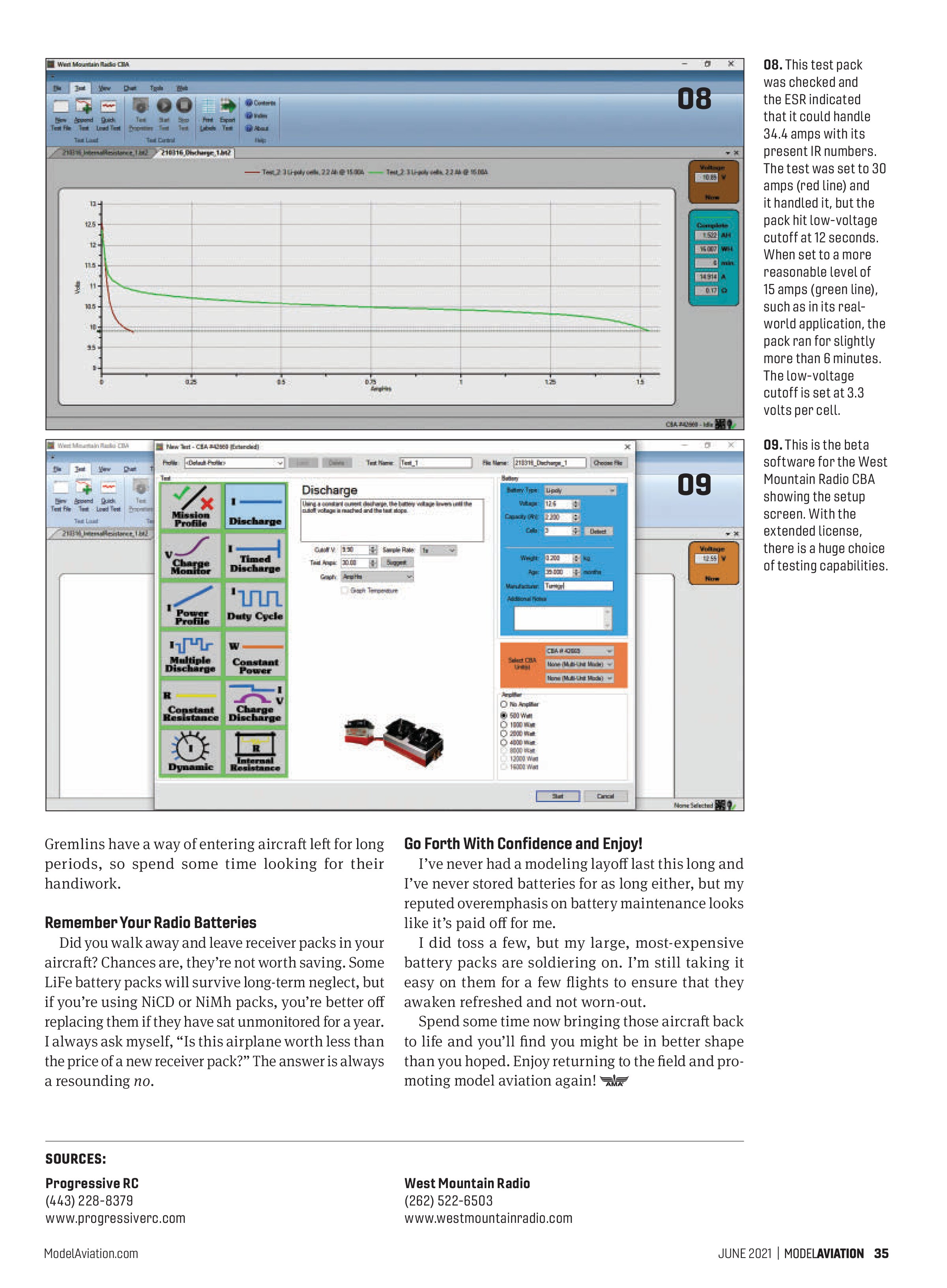
My 3S test pack shows pretty good IR readings and lists the true C rating for each cell within the pack and the recommended C rating for the pack. This will always be determined by the weakest cell so that it doesn’t overtax the pack. With one test pack, the reading claimed that the best I can expect is 34.4 amps. This pack is sold as a 25C pack but appears to be a 16C pack in reality.
After my wake-up cycles and determining that the pack was stable, I connected it to my CBA IV with 10X amplifier, which allowed me to test it at full capacity. I set the voltage cutoff at 3.3 volts per cell and set the discharge current to 30 amps. With the fully charged pack at roughly 12 volts and requiring 30 amps for discharge, I needed 360 watts, which is well within the capability of my CBA and amplifier setup. Never leave a system such as this unmonitored during testing!
Tests revealed that the ESR was quite accurate in

determining the capability of the pack. It yielded the expected results and showed me how to better designate certain packs for particular airplanes and helis. You can also see by the graph that the maximum capacity and real-world constant discharge rates aren’t really the same. This pack is happy at 15 amps constant discharge, but the 30-amp discharge didn’t render any problems. Of course, who wants to only fly for 12 seconds?
- The large-capacity, high cell-count packs require more than my 10X amplifier can do with its 500-watt limit, but it still allows me to test 6S packs at roughly 20 amps. All of the results are charted and saved for future reference. If you don’t have access to something that will discharge at full capacity, pay attention to the telemetry if you have it. You can monitor your current draw during a flight and try to match what you would do on the bench.
Truth Is in the Results at the Field
All of the testing and shop fidgeting in the world can’t tell you what the exact results will be in your airplane at the field, but you can be confident that it will be close. You will have culled out the weak packs and increased your success and overall safety when you finally get flying again. Don’t be penny-wise and pound-foolish by trying to stretch packs well beyond their useful life.
Don’t Forget Airframe Inspections!
My focus has been on batteries, but don’t forget to thoroughly check your models. Plastic clevises stored in a hot garage can become brittle over time. Check the plastic piece that goes through your control horns for security.
If in doubt, replace it. Check all of your radio connections, antennae, and control rods for security. Tape hinges can dry out and crack with time and heat. Check your propellers for cracks or brittle plastic.


Gremlins have a way of entering aircraft left for long periods, so spend some time looking for their handiwork.
Remember Your Radio Batteries
Did you walk away and leave receiver packs in your aircraft? Chances are, they’re not worth saving. Some LiFe battery packs will survive long-term neglect, but if you’re using NiCd or NiMh packs, you’re better off replacing them if they have sat unmonitored for a year. I always ask myself, “Is this airplane worth less than the price of a new receiver pack?” The answer is always a resounding no.


Go Forth With Confidence and Enjoy!
I’ve never had a modeling layoff last this long and I’ve never stored batteries for as long either, but my reputed overemphasis on battery maintenance looks like it’s paid off for me.
I did toss a few, but my large, most-expensive battery packs are soldiering on. I’m still taking it easy on them for a few flights to ensure that they awaken refreshed and not worn-out.
Spend some time now bringing those aircraft back to life and you’ll find you might be in better shape than you hoped. Enjoy returning to the field and promoting model aviation again!
SOURCES:
Progressive RC
(443) 228-8379
www.progressiverc.com
West Mountain Radio
(262) 522-6503
www.westmountainradio.com