AMA AND ITS PARTNERS
HELP SHAPE LAW

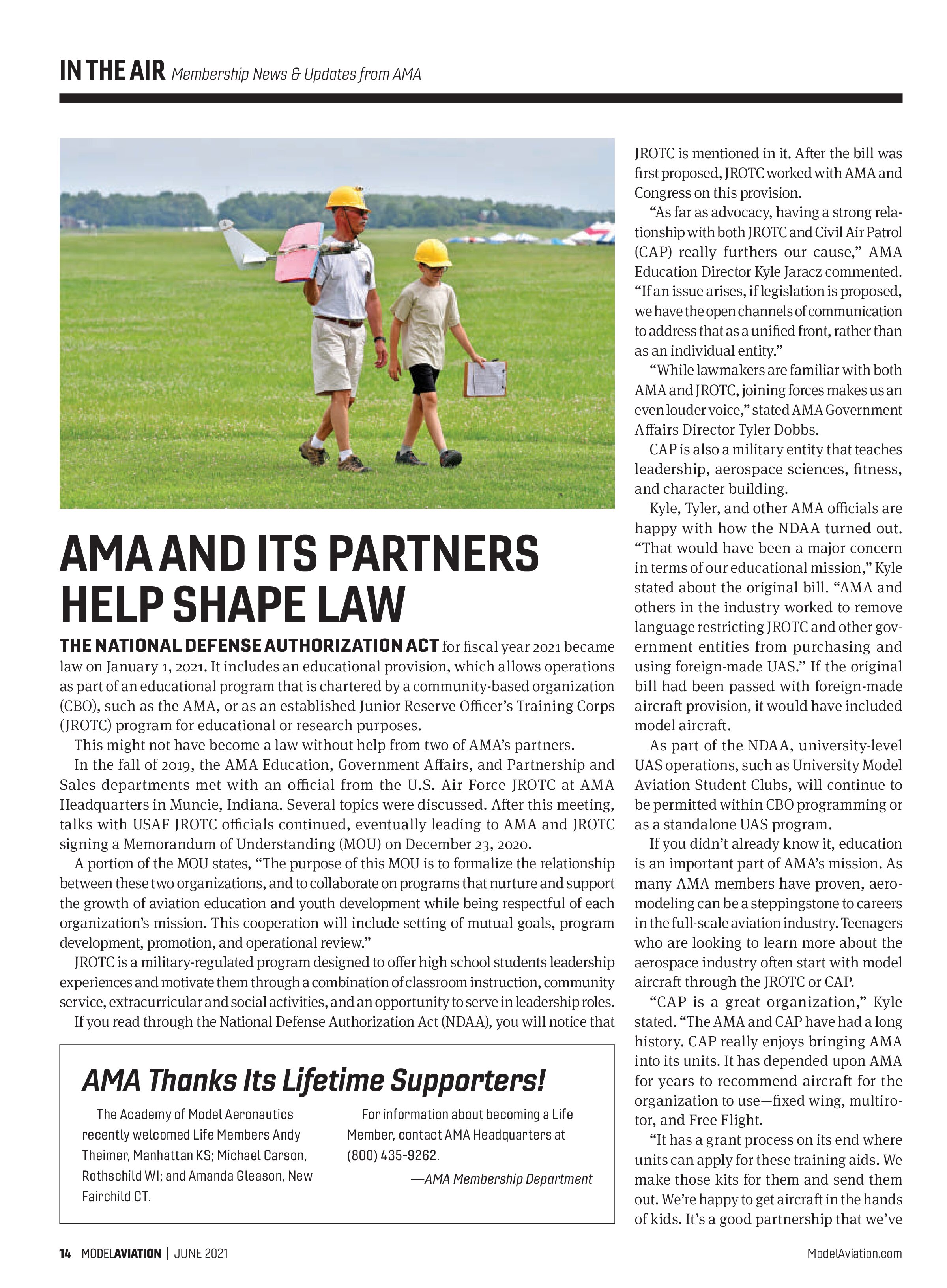
THE NATIONAL DEFENSE AUTHORIZATION ACT for fiscal year 2021 became law on January 1, 2021. It includes an educational provision, which allows operations as part of an educational program that is chartered by a community-based organization (CBO), such as the AMA, or as an established Junior Reserve Officer’s Training Corps (JROTC) program for educational or research purposes.
This might not have become a law without help from two of AMA’s partners.
In the fall of 2019, the AMA Education, Government Affairs, and Partnership and Sales departments met with an official from the U.S. Air Force JROTC at AMA Headquarters in Muncie, Indiana. Several topics were discussed. After this meeting, talks with USAF JROTC officials continued, eventually leading to AMA and JROTC signing a Memorandum of Understanding (MOU) on December 23, 2020.
A portion of the MOU states, “The purpose of this MOU is to formalize the relationship between these two organizations, and to collaborate on programs that nurture and support the growth of aviation education and youth development while being respectful of each organization’s mission. This cooperation will include setting of mutual goals, program development, promotion, and operational review.”
JROTC is a military-regulated program designed to offer high school students leadership experiences and motivate them through a combination of classroom instruction, community service, extracurricular and social activities, and an opportunity to serve in leadership roles.
If you read through the National Defense Authorization Act (NDAA), you will notice that JROTC is mentioned in it. After the bill was first proposed, JROTC worked with AMA and Congress on this provision.
“As far as advocacy, having a strong relationship with both JROTC and Civil Air Patrol (CAP) really furthers our cause,” AMA Education Director Kyle Jaracz commented.
“If an issue arises, if legislation is proposed, we have the open channels of communication to address that as a unified front, rather than as an individual entity.”
“While lawmakers are familiar with both AMA and JROTC, joining forces makes us an even louder voice,” stated AMA Government Affairs Director Tyler Dobbs.
CAP is also a military entity that teaches leadership, aerospace sciences, fitness, and character building.
Kyle, Tyler, and other AMA officials are happy with how the NDAA turned out. “That would have been a major concern in terms of our educational mission,” Kyle stated about the original bill. “AMA and others in the industry worked to remove language restricting JROTC and other government entities from purchasing and using foreign-made UAS.” If the original bill had been passed with foreign-made aircraft provision, it would have included model aircraft.
As part of the NDAA, university-level UAS operations, such as University Model Aviation Student Clubs, will continue to be permitted within CBO programming or as a standalone UAS program.
If you didn’t already know it, education is an important part of AMA’s mission. As many AMA members have proven, aeromodeling can be a steppingstone to careers in the full-scale aviation industry. Teenagers who are looking to learn more about the aerospace industry often start with model aircraft through JROTC or CAP.
“CAP is a great organization,” Kyle stated. “The AMA and CAP have had a long history. CAP really enjoys bringing AMA into its units. It has depended upon AMA for years to recommend aircraft for the organization to use—fixed wing, multirotor, and Free Flight.
“It has a grant process on its end where units can apply for these training aids. We make those kits for them and send them out. We’re happy to get aircraft in the hands of kids. It’s a good partnership that we’ve developed,” he added.
Kyle explained that CAP units use the aircraft in conjunction with aviation education. The cadets learn the basics of flight, participate in team aircraft building, and use flight simulators. Some of the units travel to model aviation club fields, flying sites, and classrooms in an effort to interest other youth in aviation. “It’s something that definitely encourages a love of aviation,” Kyle said.
CAP units have helped out at the AMA Nats. Nearly each summer, CAP cadets can be found at the RC Combat event, where they time for the pilots and cook meals for them.
AMA’s relationship with CAP has a long history. In January 2011, AMA signed an MOU with CAP. Later that year, AMA members were asked to support CAP in its effort to get World War II volunteers recognized with a group Congressional Gold Medal.
Some AMA members have mentioned being linked with CAP in their AMA History Project biographies. The late Alvin Davis, for example, began working for CAP in 1942. His job was to promote model aviation among its cadets.
Today, educating youth about the hobby is something that continues in the CAP, JROTC, and through EAA. “We can all mutually support each other,” Kyle noted. “We all have a goal of enjoying aviation. That mission is one that is shared, offering education and inspiration that furthers the cause of aviation for the entire country.”
In the MOU that AMA signed with the USAF JROTC, it is stated that “AMA has a mission to foster and promote all phases of model aviation and community, and the Air Force JROTC has a mission to develop citizens of character dedicated to serving their nation and community.”
If you are a part of JROTC or CAP and would like to team up with an AMA club, use the club finder at www.modelaircraft.org/club-finder.
—by Rachelle Haughn
MODEL AVIATION HAS BEEN an important part of aeronautical research from the beginning, and for the military, models went hand in hand with new aircraft designs. After World War II, the hobby and sport of aeromodeling also entered the military world.
The Navy Nats immediately come to mind, but it was the U.S. Air Force that first created a competitive aeromodeling program for its service members.
Modeler Lt. Harry Vogler, who had directed the aircraft division of the Boys Club of Pittsburgh, was the chairman of the Allegheny Mountains Area Model Competitions, and was also the director of the Jr. Division of the Aero Club of Pittsburgh, spearheaded this effort.
The first events were held in 1951 and represented a tiered competitive aeromodeling program. Contests were first held at the Air Force Base level with

winners moving up to contests at the various commands. The winners at the Command level then attended the Air Force World-Wide Model Airplane Championships, held July 16-21, 1951, at Sheppard Air Force Base in Texas. The top 20 competitors then represented the Air Force at the Nats that were held at the Dallas Naval Air Station, July 23-29.
This progressive level of competition eventually


paid off, with an Air Force team crowned National Team Champions from 1963 to 1966.
In 1957, the All Army Airplane Meet was announced. It was to be conducted in much the same fashion. The program was part of the U.S. Army’s craft program and was designed to provide recreation and entertainment for the troops, encourage formation of model clubs, and stimulate interest in Army aviation. Some of the posts planned advanced clinics during which model flying and contest operations were discussed, in addition to running the actual contest.
For the Army event, each area level command could enter a 12-man team for the All Army finals. Events included gas-powered and hand-launched gliders but not rubber-powered aircraft. Each area level could also enter three aircraft for a “special scale models of Army aircraft” event. Models could have a wingspan of 12 to 24 inches and had to represent aircraft or helicopters currently in use.
Judging took place in Washington, D.C. The three winning models were kept by the Army and placed on display in the Pentagon. It is unclear how long the Air Force and Army contests continued.
If you have any information about these programs, competed, or have a family member who competed in any of the Air Force or Army meets or were a part of the military teams that competed at the Nats, we would love to hear from you.
As an aside, in 1954, A2C Robert D. Lutker, USAF, won the 1954 World Championship Control Line (CL) Speed Contest at The Hague, Netherlands. The US was represented at the meet by an FAI team composed of Air Force personnel who were stationed in Europe.
In 1955, finances did not permit transportation of a CL Speed team to the World Championships in France. The U.S. Air Force once again provided the Speed team from among its men in Europe.
—by Michael Smith, National Model Aviation Museum Director
SOURCES:
Russ Nichols, “AMA Official News.” Model Airplane News, August 1951, p 36.
Russ Nichols, “AMA Official News.” Model Airplane News, September 1951, p 32.
Bill Winter, “MAN at Work.” Model Airplane News, March 1957, p 7.
Willis Brown and Dick Black, The History of the AMA, Academy of Model Aeronautics, 1966.