VINTAGE VIEWPOINT

HALE
WALLACE
By Bob Noll | bobrc@aol.com
I MENTIONED IN MY LAST COLUMN that Hale Wallace was a friend of mine and that we were in the same RC club at the time that he was on the US Scale World Championship team. Hale’s son, Scott, is now a fellow member of the Aeroguidance Society and sent me the following information about his dad’s experience in Scale modeling, and why Hale moved from Scale models to full-scale aircraft.
“Here’s some of the back story of the Chipmunk. He [Hale] flew his scratch-built P-63 to second place at the 1969 Nats at Willow Grove [Pennsylvania] to earn his place on the US Scale team. He originally wanted to build an F-82 Twin Mustang for the World Championships, but he had noted how well [Maxey] Hester’s Zlin flew at the Nats and decided that a similar aerobatic model was a better choice. We planned our Christmas vacation in 1969 to Florida so that he could take hundreds of photos of Bill Lumley’s full-scale aircraft.
“The Chipmunk was successfully test-flown just once prior to the world championship, and then placed fourth. It could have placed higher but had a poor first flight because of world championship jitters, but he had the highest flight score of the meet on his second flight. The USA team placed second to Great Britain.
“The 1971 Nats at Glenview, Illinois, was again the contest to select the US Scale team. The Chipmunk had the highest Scale static points. Halfway through its first flight, it rolled over and went in, totaling the aircraft. Radio interference was the cause. Had the first flight been completed, he would have had enough points to make the team, and he had already decided on a new model for the next world championship.
“Instead, he concluded that rather than putting 2,000 hours into a model, he would put 3,000 into building a full-scale aircraft. He began construction of his first Skybolt that winter and took flying lessons at Chenango Bridge Airport [in Binghamton, New York].”
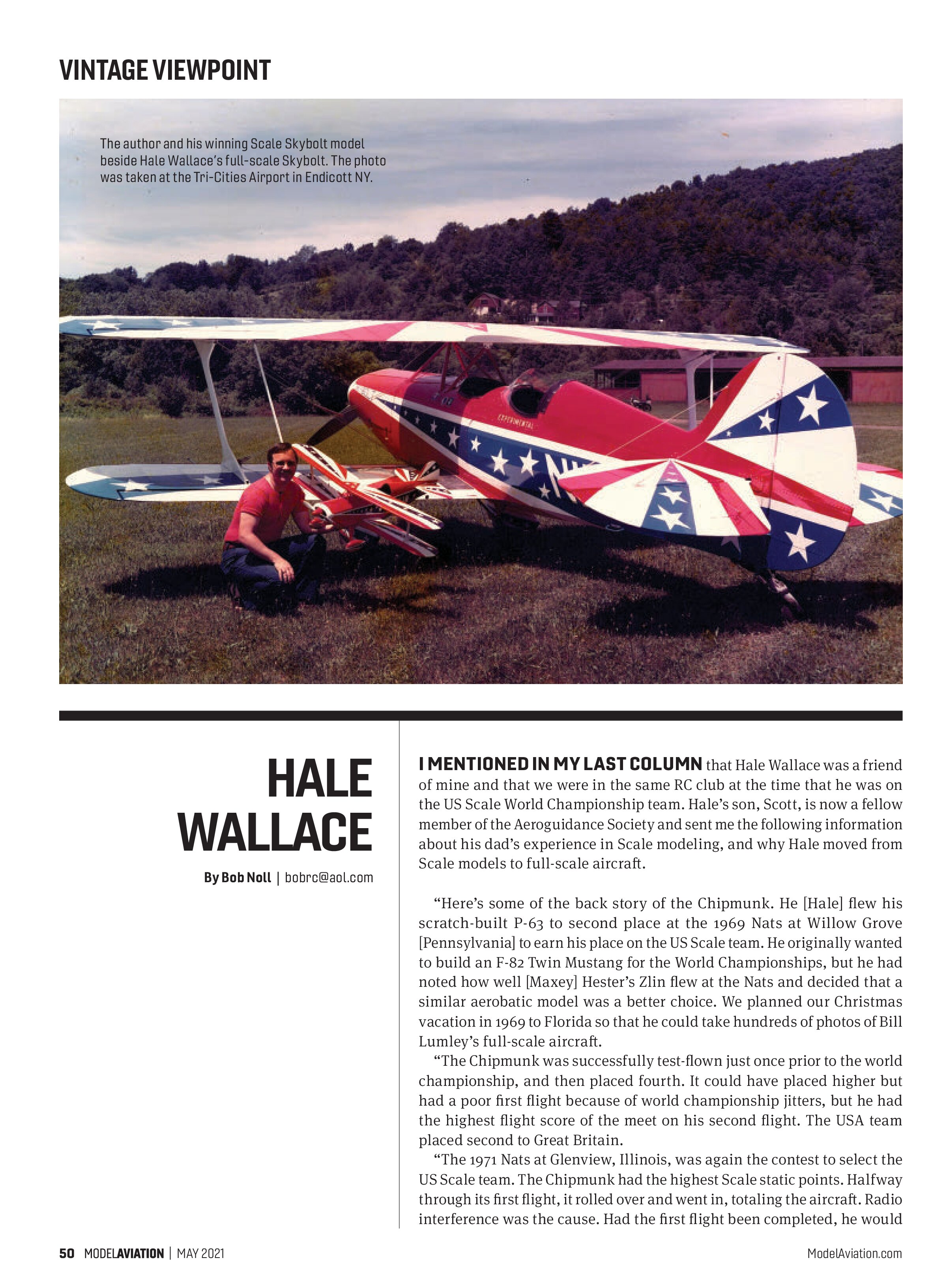
I was so blown away by the beautiful color scheme that Hale chose that I decided to build a Scale model of his Skybolt. Who doesn’t like red, white, and blue? Hale gave me a copy of a three-view drawing that came with his airplanes that he purchased from Lamar Steen, who designed the full-scale Skybolt and provided some parts to builders.
I flew my Skybolt to fourth place at the Scale Nats and many other contests before giving it to Scott so that he has a fond memory of his dad, who passed away in July 2000.
Fifty Years Ago: February 1971
Now it’s time to check my magazine files to see what was being printed about RC 50 years ago.
Flying Models had an article about the 1970 RC Masters Tournament that was held in Memphis, Tennessee. This event would select the three-person team to represent the US at the 1971 World Championships in Cranfield, England. The team consisted of Jim Whitley and his Daddy Rabbit; Phil Kraft and his Kwik Fli IV; and Ron Chidgey, who flew his Tiger Tail. Phil’s Kwik Fli IV had a new tapered wing that used the same fuselage from his Kwik Fli III.
Also in that issue were plans for the Prancer, a 12-foot wingspan sailplane with a fiberglass pod-and-boom fuselage. It was powered by an O.S. Max .30 engine. Dick Allen, a fellow Aeroguidance Society club member, had his Kandid Kondor published. It was a modified Bong Bomber that hauled an Instamatic 154 camera.
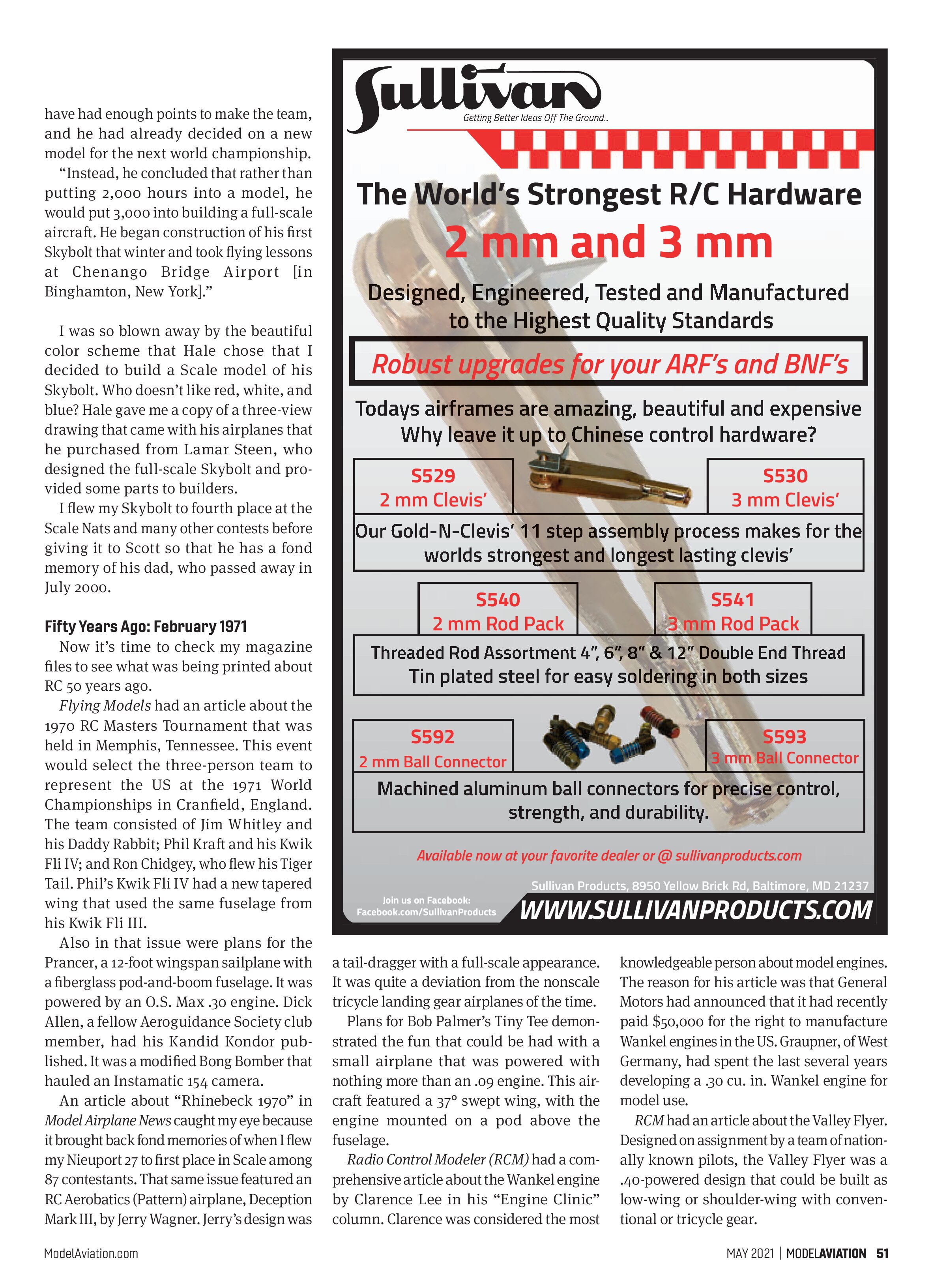
An article about “Rhinebeck 1970” in Model Airplane News caught my eye because it brought back fond memories of when I flew my Nieuport 27 to first place in Scale among 87 contestants. That same issue featured an RC Aerobatics (Pattern) airplane, Deception Mark III, by Jerry Wagner. Jerry’s design was a tail-dragger with a full-scale appearance. It was quite a deviation from the nonscale tricycle landing gear airplanes of the time.
Plans for Bob Palmer’s Tiny Tee demonstrated the fun that could be had with a small airplane that was powered with nothing more than an .09 engine. This aircraft featured a 37° swept wing, with the engine mounted on a pod above the fuselage.
Radio Control Modeler (RCM) had a comprehensive article about the Wankel engine by Clarence Lee in his “Engine Clinic” column. Clarence was considered the most knowledgeable person about model engines. The reason for his article was that General Motors had announced that it had recently paid $50,000 for the right to manufacture Wankel engines in the US. Graupner, of West Germany, had spent the last several years developing a .30 cu. in. Wankel engine for model use.
RCM had an article about the Valley Flyer. Designed on assignment by a team of nationally known pilots, the Valley Flyer was a .40-powered design that could be built as low-wing or shoulder-wing with conventional or tricycle gear.


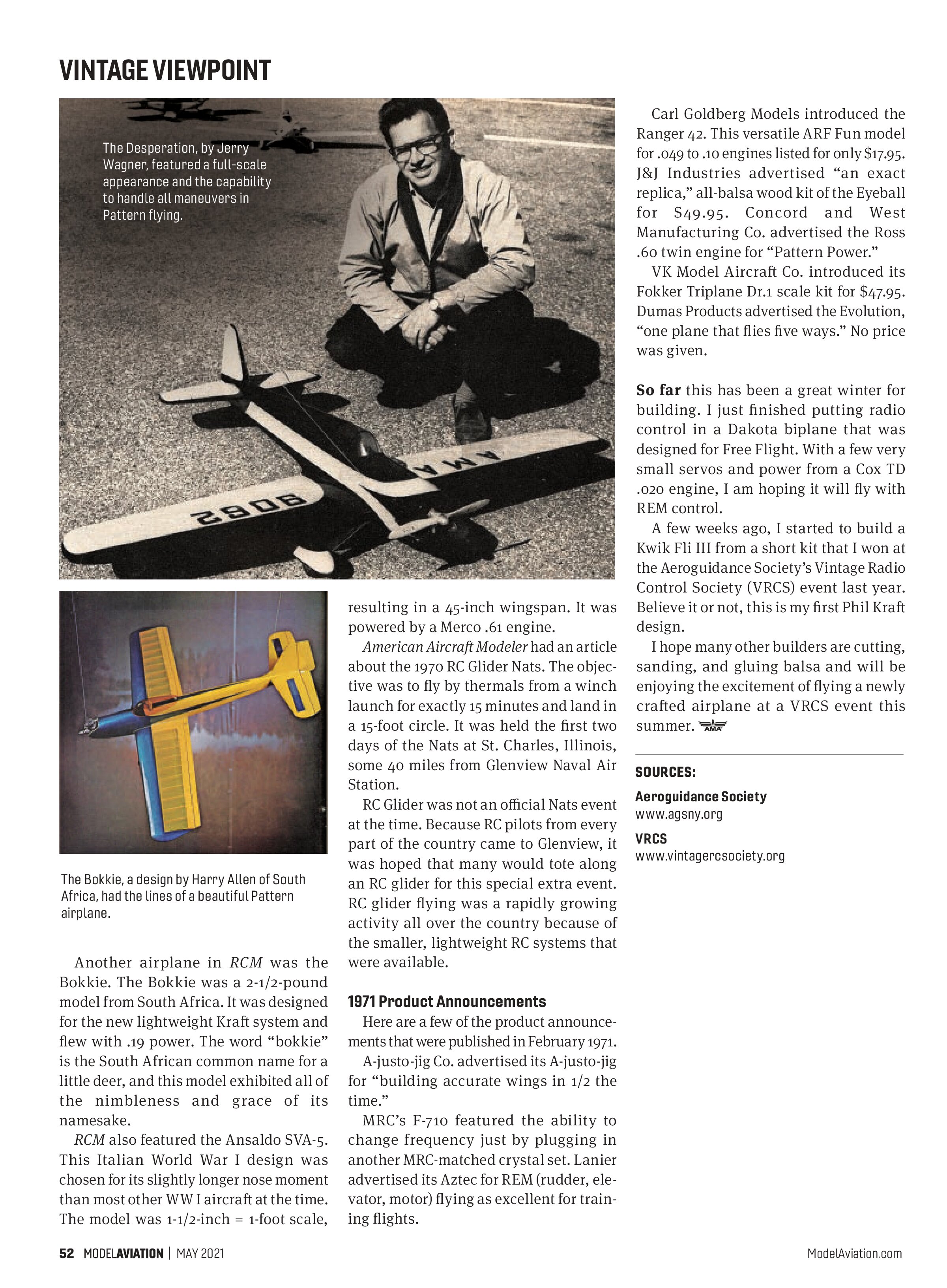
Another airplane in RCM was the Bokkie. The Bokkie was a 2-1/2-pound model from South Africa. It was designed for the new lightweight Kraft system and flew with .19 power. The word “bokkie” is the South African common name for a little deer, and this model exhibited all of the nimbleness and grace of its namesake.
RCM also featured the Ansaldo SVA-5. This Italian World War I design was chosen for its slightly longer nose moment than most other WW I aircraft at the time. The model was 1-1/2-inch = 1-foot scale, resulting in a 45-inch wingspan. It was powered by a Merco .61 engine.
American Aircraft Modeler had an article about the 1970 RC Glider Nats. The objective was to fly by thermals from a winch launch for exactly 15 minutes and land in a 15-foot circle. It was held the first two days of the Nats at St. Charles, Illinois, some 40 miles from Glenview Naval Air Station.
RC Glider was not an official Nats event at the time. Because RC pilots from every part of the country came to Glenview, it was hoped that many would tote along an RC glider for this special extra event. RC glider flying was a rapidly growing activity all over the country because of the smaller, lightweight RC systems that were available.
1971 Product Announcements
Here are a few of the product announcements that were published in February 1971.
A-justo-jig Co. advertised its A-justo-jig for “building accurate wings in 1/2 the time.”
MRC’s F-710 featured the ability to change frequency just by plugging in another MRC-matched crystal set. Lanier advertised its Aztec for REM (rudder, elevator, motor) flying as excellent for training flights.
Carl Goldberg Models introduced the Ranger 42. This versatile ARF Fun model for .049 to .10 engines listed for only $17.95. J&J Industries advertised “an exact replica,” all-balsa wood kit of the Eyeball for $49.95. Concord and West Manufacturing Co. advertised the Ross .60 twin engine for “Pattern Power.”
VK Model Aircraft Co. introduced its Fokker Triplane Dr.1 scale kit for $47.95. Dumas Products advertised the Evolution, “one plane that flies five ways.” No price was given.
So far this has been a great winter for building. I just finished putting radio control in a Dakota biplane that was designed for Free Flight. With a few very small servos and power from a Cox TD .020 engine, I am hoping it will fly with REM control.
A few weeks ago, I started to build a Kwik Fli III from a short kit that I won at the Aeroguidance Society’s Vintage Radio Control Society (VRCS) event last year. Believe it or not, this is my first Phil Kraft design.
I hope many other builders are cutting, sanding, and gluing balsa and will be enjoying the excitement of flying a newly crafted airplane at a VRCS event this summer.
SOURCES:
Aeroguidance Society
www.agsny.org