SAFETY COMES FIRST

WHEN TOOLS ATTACK!
By Dave Gee | safetycolumn@cs.com
WOULD YOUR HAND TOOLS turn against you and bite (or pinch or slice) the hand that feeds them? You betcha! Small tools are sometimes taken for granted. They seem harmless and tame compared to big, powered machinery. Don’t be fooled! These gadgets are all just waiting for an opportunity to betray their owner.
I was recently the victim of an unprovoked attack by my trusty razor blade holder, which had faithfully served me for decades before going rogue. My toolbox has a bit of magnetic material on the door to hold a pair of single-edge razor blades. (I use razor blades instead of a hobby knife.) While grabbing a ruler from its place on the toolbox door, my fingers brushed past the razor blade panel. I felt light contact but no wound was visible. Whew, a lucky escape!
Within a few moments, I noticed blood droplets on the workbench and knew that my close call was actually a direct hit. Ultra-sharp blades can make nice, clean cuts. So now, in addition to the discomfort of a healing injury and the bother of having a bandage on my fingertip, I must add the embarrassment of telling the story here, in the hope that some reader might learn from it and avoid his or her own incident. Carelessness is a never-ending gift.
We all know that the power and hand tools in our workshops can cause injury if they are not properly operated. What about modelers who don’t have a workshop? Some pilots buy their models already built, with no construction required. Even a ready-to-fly airplane or helicopter requires a little tweaking, and nearly everyone keeps a few small tools handy at the field.
A show of hands—who has ever pinched themselves with a pair of needle-nosed pliers? Aha! Some of you are raising bandaged fingers! Wire nippers (diagonal cutters) are another good opportunity to break some skin. If those can cut metal, they won’t have any problem nicking your finger. I’ve even run afoul of my little razor saw that has a model-size miter box for cutting precision angles.
While holding a piece of wood or aluminum tubing in place, it’s easy to lose track of the tiny, sharp saw teeth. A bit of my hand got included in their cutting work. Whose side are these tools on, anyway?
Poking Fun
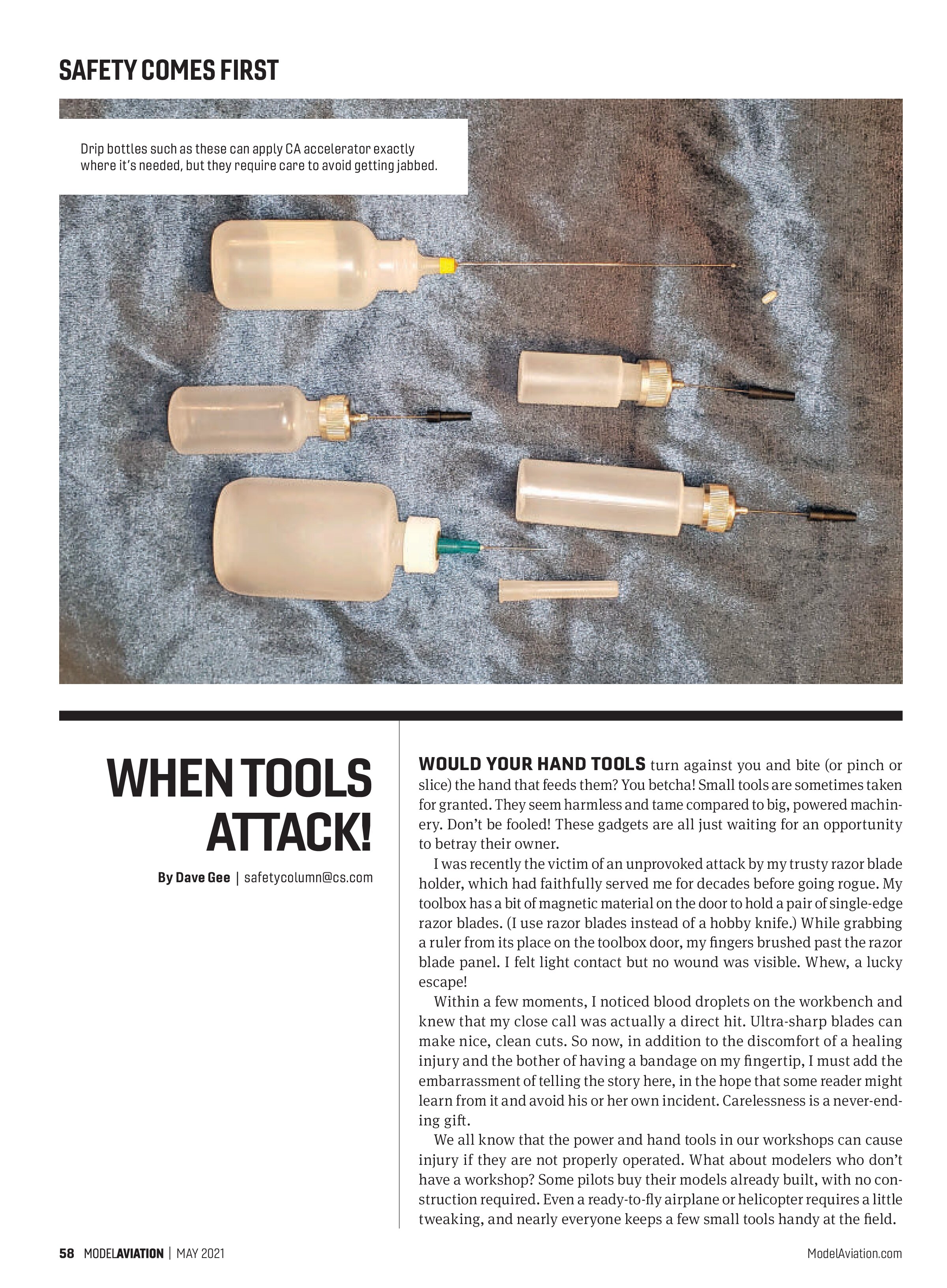
In a recent column, I mentioned the little drip bottles that some modelers use to apply accelerator or kicker to CA glue joints. Some readers asked for more information about these handy items.
A drip bottle allows precise amounts of kicker to be placed just where it is needed, without a spray of wasted product. The bottles have a very fine spout tube on the top. Choose tubing in 15-, 20-, or 25-gauge according to your personal preference and the amount of kicker that you want to apply.
Equipment dealers from various industries carry these multiuse containers. The medical type has a bit of flexible nylon tube at the top, and the industrial/hobby/kind has a tiny, rigid steel tube. Some users prefer the plastic tube, but a metal one is easier to cap and can be cleared of clogs by passing it through a flame.
But (and you knew there was a catch), having a needlelike piece of metal standing upright on your workbench can lead to

trouble. Each time I reach for the bottle is a chance to impale my hand. Maybe a series of tiny chemical injections would give me superpowers like in a comic book. Nope, but it does jangle my nerves each time I feel that jab!
After a few pokes, I’ve learned to be more careful, and now I hardly ever get skew-ered. Yes, it does take extra effort to safely use these drip bottles. Is it worth it? Absolutely! You’ll use less kicker, reduce fumes, and your glue joints will be neater and stronger.
Gyroscopics and Bloodshed
Paul Weissbrod is an experienced and careful modeler. Here’s his account of an incident that helped make him even more careful.
“At the time of the incident, I was doing a lot of my flying with small, foam aircraft over a soccer field. Landings broke a lot of propellers, even with a prop-saver hub.
“I bought a folding propeller to try out. After it was installed, I armed the motor, held the aircraft in a vertical orientation, and stayed out of the plane of the spinning propeller. I advanced the throttle. The propeller worked perfectly, spinning out from a folded state and producing good thrust.
“With the prop-saver-style hub, when I set up a new aircraft, I often test the retention provided by the O-ring by waggling the fuselage and watching the propeller
disc to make sure it follows the moving axis of the fuselage. I thought nothing of performing the same test with the new folding propeller.
“Not a good idea! When I twisted my wrist to run the test, I rediscovered some basic spinning-top physics. The blades did a dip like a calypso dancer’s skirt. This torque twisted the aircraft in an unexpected manner, allowing the dipping blades to neatly slice into the back of my hand.”
Paul’s wife is a nurse, and she provided first-aid, transportation to the doctor’s office, and even a bit of scolding for getting nicked in the first place. I appreciate his kind willingness to share this information with all of us!
Too Hard, Too Easy, or Just Right?
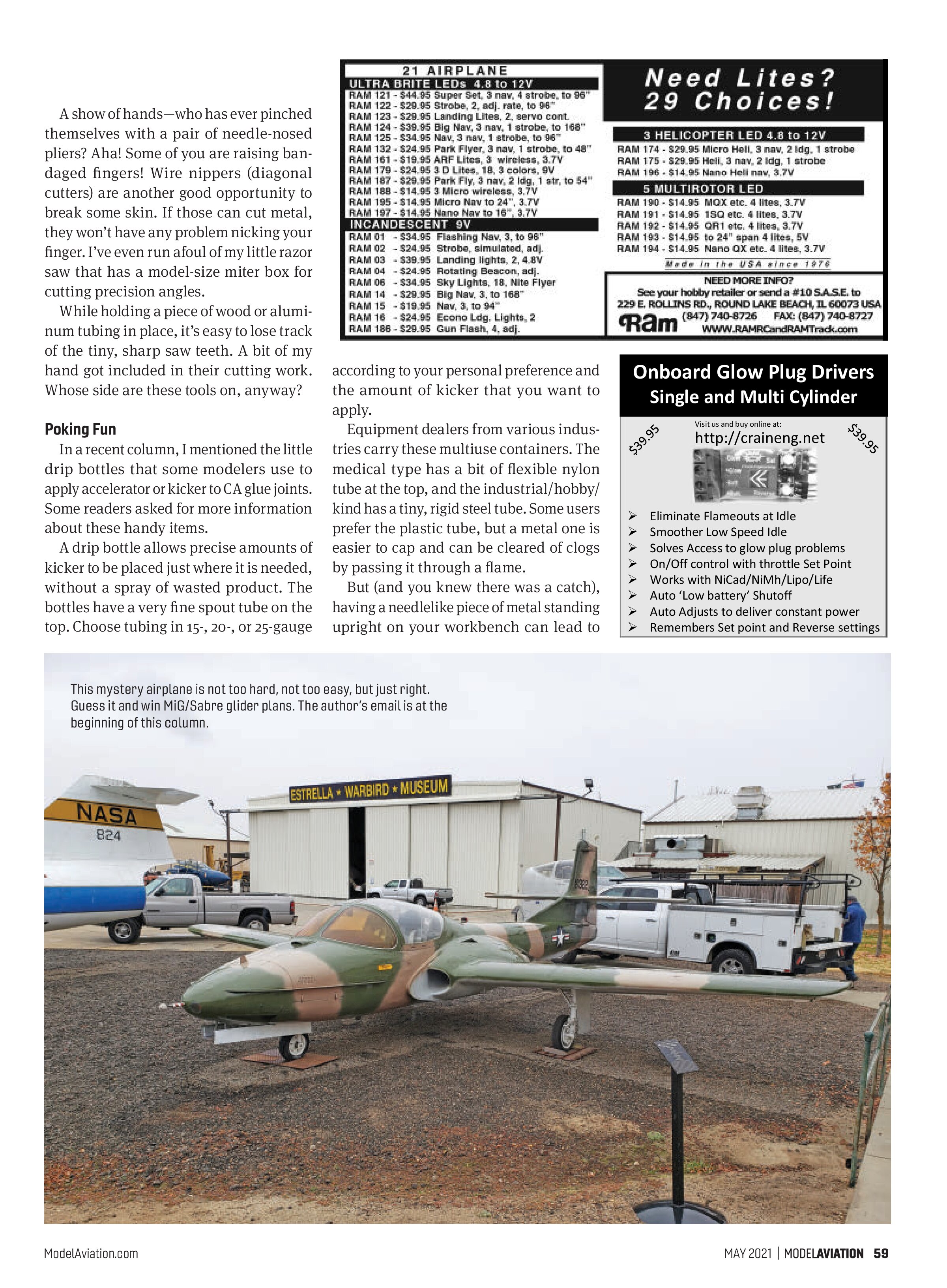
Readers disagree about how tough the mystery airplane should be to identify. We’ve had obscure aircraft and famous ones, so this time I’ll try for a middle ground.
Here is a widely used but often overlooked military aircraft that is known for success in a combat role, as well as decades of service as a trainer. It would make a nice RC or Free Flight (FF) model, but it is seldom seen at the flying field, which I think is a shame.
You can see this example in person at the marvelous Estrella Warbird Museum in Paso Robles, California. Its displays of aircraft, exotic cars, and military items are unsurpassed. I highly recommend a visit!
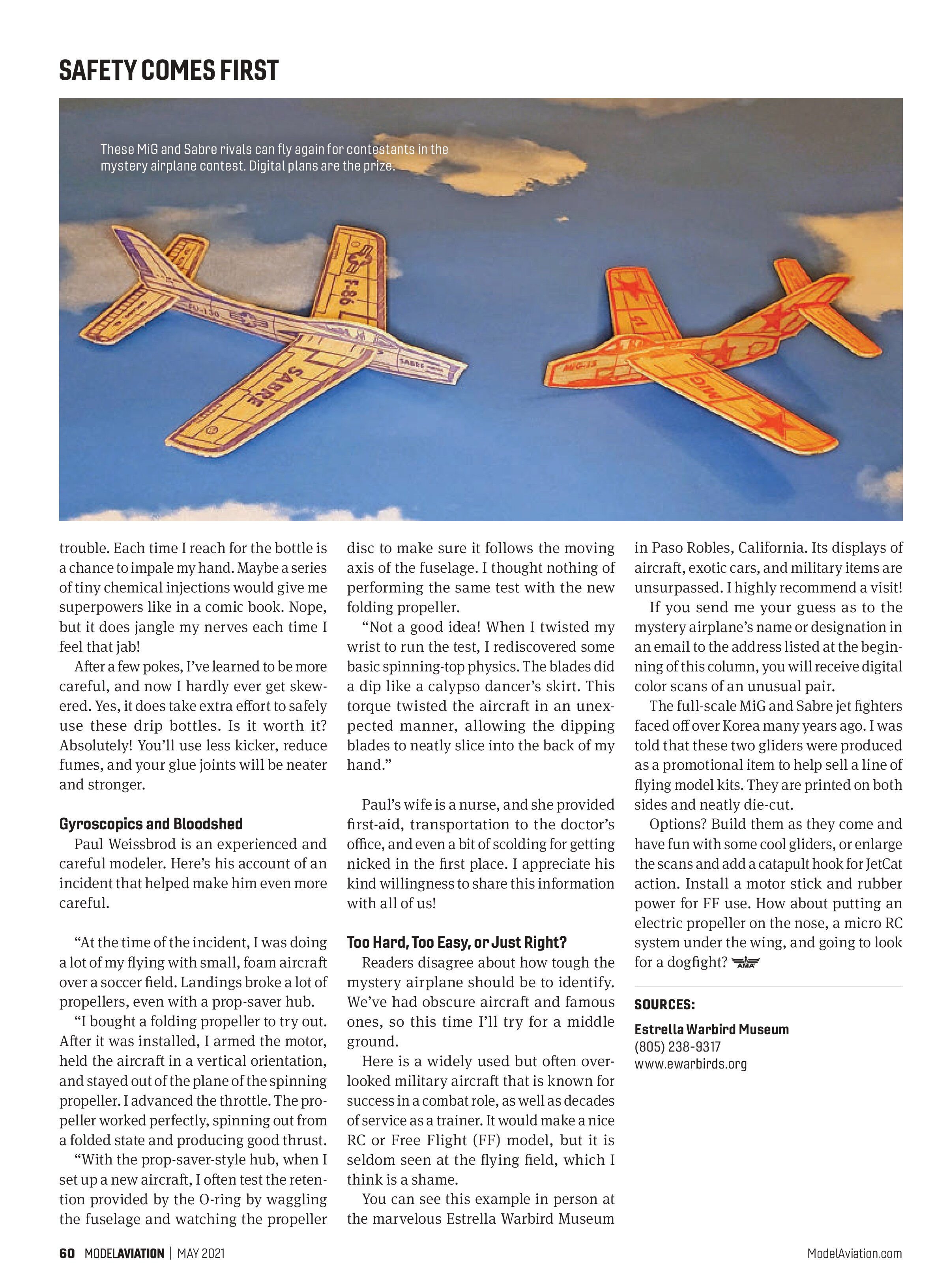
If you send me your guess as to the mystery airplane’s name or designation in an email to the address listed at the beginning of this column, you will receive digital color scans of an unusual pair.
The full-scale MiG and Sabre jet fighters faced off over Korea many years ago. I was told that these two gliders were produced as a promotional item to help sell a line of flying model kits. They are printed on both sides and neatly die-cut.
Options? Build them as they come and have fun with some cool gliders, or enlarge the scans and add a catapult hook for JetCat action. Install a motor stick and rubber power for FF use. How about putting an electric propeller on the nose, a micro RC system under the wing, and going to look for a dogfight?
SOURCES:
Estrella Warbird Museum
(805) 238-9317
www.ewarbirds.org