SOARING
IN WARM
AND SUNNY
FLORIDA
By Gordon Buckland | gordon@gatorf3b.com

EVEN WHEN WE KNEW COVID-19 was going to be a serious problem in March 2020, I don’t think many of us could have forecasted that we would be so restricted in our daily activities this much and for this long. We really expected that we would be back running contests and traveling again by now, but “normal” has simply not returned yet.
We held an annual four-day contest in central Florida early in 2020 to provide practice for the US Soaring team pilots and provide an opportunity to expand participation in FAI events for local pilots. We went ahead and planned the 2021 Warm and Sunny F3J and F5J contest in Florida for January 29-30, 2021, at the beautiful One Wing Low Squadron flying site at Kennyworld in Morriston, Florida, but COVID-19 took its toll, and the number of pilots who registered for the two events was disappointing.
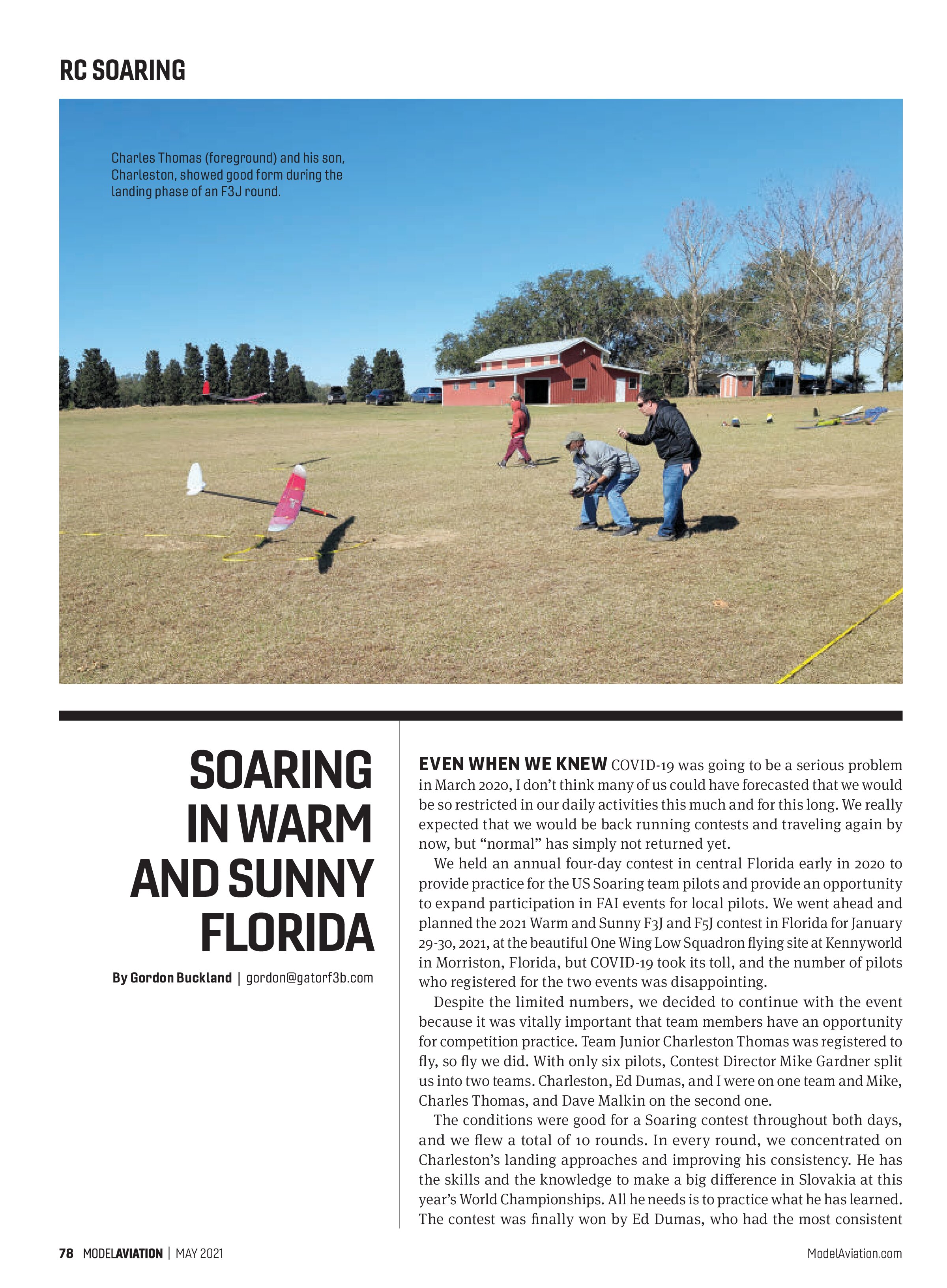
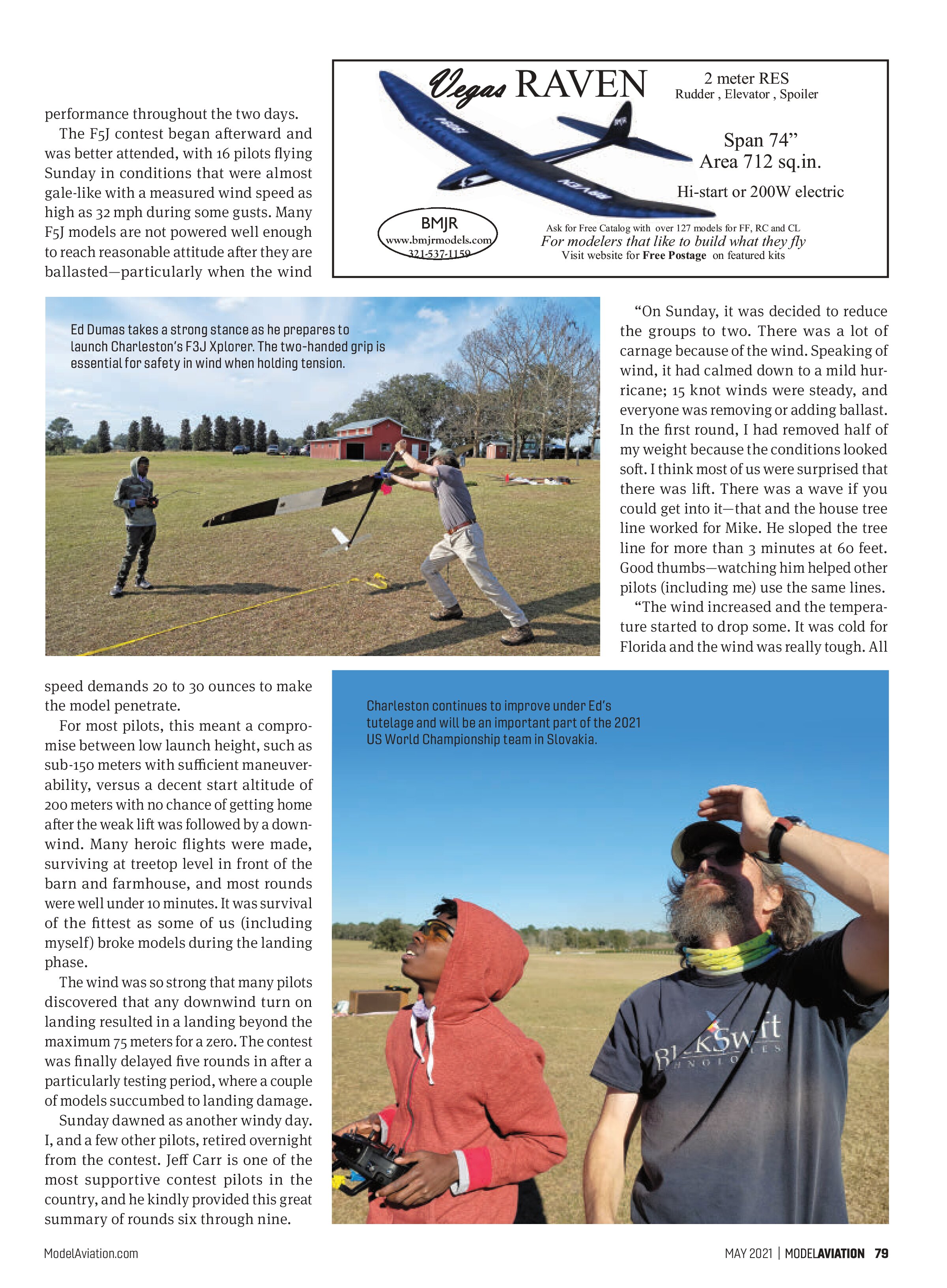
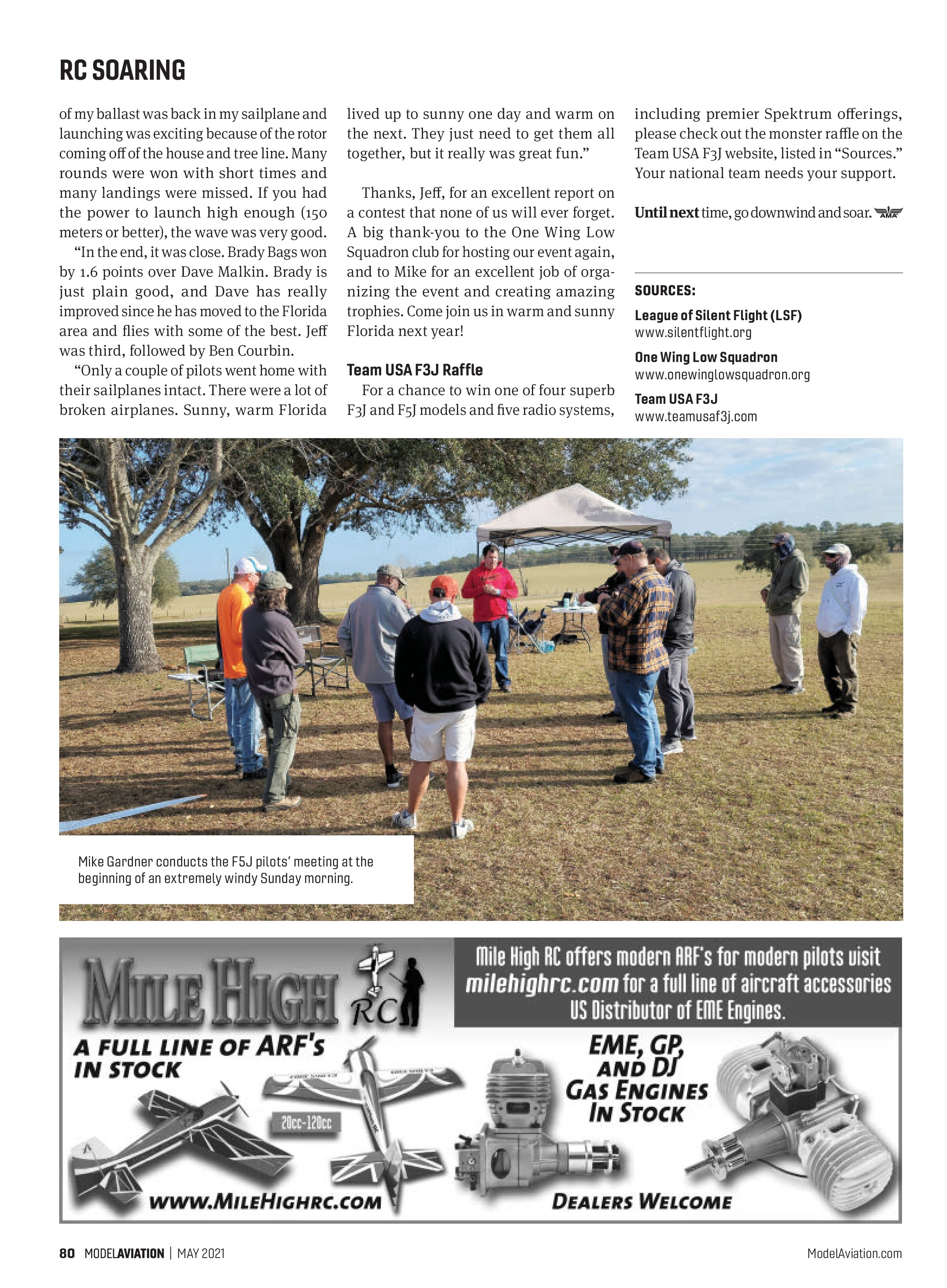
Despite the limited numbers, we decided to continue with the event because it was vitally important that team members have an opportunity for competition practice. Team Junior Charleston Thomas was registered to fly, so fly we did. With only six pilots, Contest Director Mike Gardner split us into two teams. Charleston, Ed Dumas, and I were on one team and Mike, Charles Thomas, and Dave Malkin on the second one.
The conditions were good for a Soaring contest throughout both days, and we flew a total of 10 rounds. In every round, we concentrated on Charleston’s landing approaches and improving his consistency. He has the skills and the knowledge to make a big difference in Slovakia at this year’s World Championships. All he needs is to practice what he has learned. The contest was finally won by Ed Dumas, who had the most consistent performance throughout the two days.
The F5J contest began afterward and was better attended, with 16 pilots flying Sunday in conditions that were almost gale-like with a measured wind speed as high as 32 mph during some gusts. Many F5J models are not powered well enough to reach reasonable attitude after they are ballasted—particularly when the wind speed demands 20 to 30 ounces to make the model penetrate.

For most pilots, this meant a compromise between low launch height, such as sub-150 meters with sufficient maneuverability, versus a decent start altitude of 200 meters with no chance of getting home after the weak lift was followed by a downwind. Many heroic flights were made, surviving at treetop level in front of the barn and farmhouse, and most rounds were well under 10 minutes. It was survival of the fittest as some of us (including myself) broke models during the landing phase.
The wind was so strong that many pilots discovered that any downwind turn on landing resulted in a landing beyond the maximum 75 meters for a zero. The contest was finally delayed five rounds in after a particularly testing period, where a couple of models succumbed to landing damage.
Sunday dawned as another windy day. I, and a few other pilots, retired overnight from the contest. Jeff Carr is one of the most supportive contest pilots in the country, and he kindly provided this great summary of rounds six through nine.

“On Sunday, it was decided to reduce the groups to two. There was a lot of carnage because of the wind. Speaking of wind, it had calmed down to a mild hurricane; 15 knot winds were steady, and everyone was removing or adding ballast. In the first round, I had removed half of my weight because the conditions looked soft. I think most of us were surprised that there was lift. There was a wave if you could get into it—that and the house tree line worked for Mike. He sloped the tree line for more than 3 minutes at 60 feet. Good thumbs—watching him helped other pilots (including me) use the same lines.
“The wind increased and the temperature started to drop some. It was cold for Florida and the wind was really tough. All
of my ballast was back in my sailplane and launching was exciting because of the rotor coming off of the house and tree line. Many rounds were won with short times and many landings were missed. If you had the power to launch high enough (150 meters or better), the wave was very good.
“In the end, it was close. Brady Bags won by 1.6 points over Dave Malkin. Brady is just plain good, and Dave has really improved since he has moved to the Florida area and flies with some of the best. Jeff was third, followed by Ben Courbin.
“Only a couple of pilots went home with their sailplanes intact. There were a lot of broken airplanes. Sunny, warm Florida
lived up to sunny one day and warm on the next. They just need to get them all together, but it really was great fun.”
Thanks, Jeff, for an excellent report on a contest that none of us will ever forget. A big thank-you to the One Wing Low Squadron club for hosting our event again, and to Mike for an excellent job of organizing the event and creating amazing trophies. Come join us in warm and sunny Florida next year!
Team USA F3J Raffle
For a chance to win one of four superb F3J and F5J models and five radio systems,
including premier Spektrum offerings, please check out the monster raffle on the Team USA F3J website, listed in “Sources.” Your national team needs your support.
Until next time, go downwind and soar.
SOURCES:
League of Silent Flight (LSF)
www.silentflight.org
One Wing Low Squadron
www.onewinglowsquadron.org
Team USA F3J
www.teamusaf3j.com