THE WHEELS TURN SLOWLY
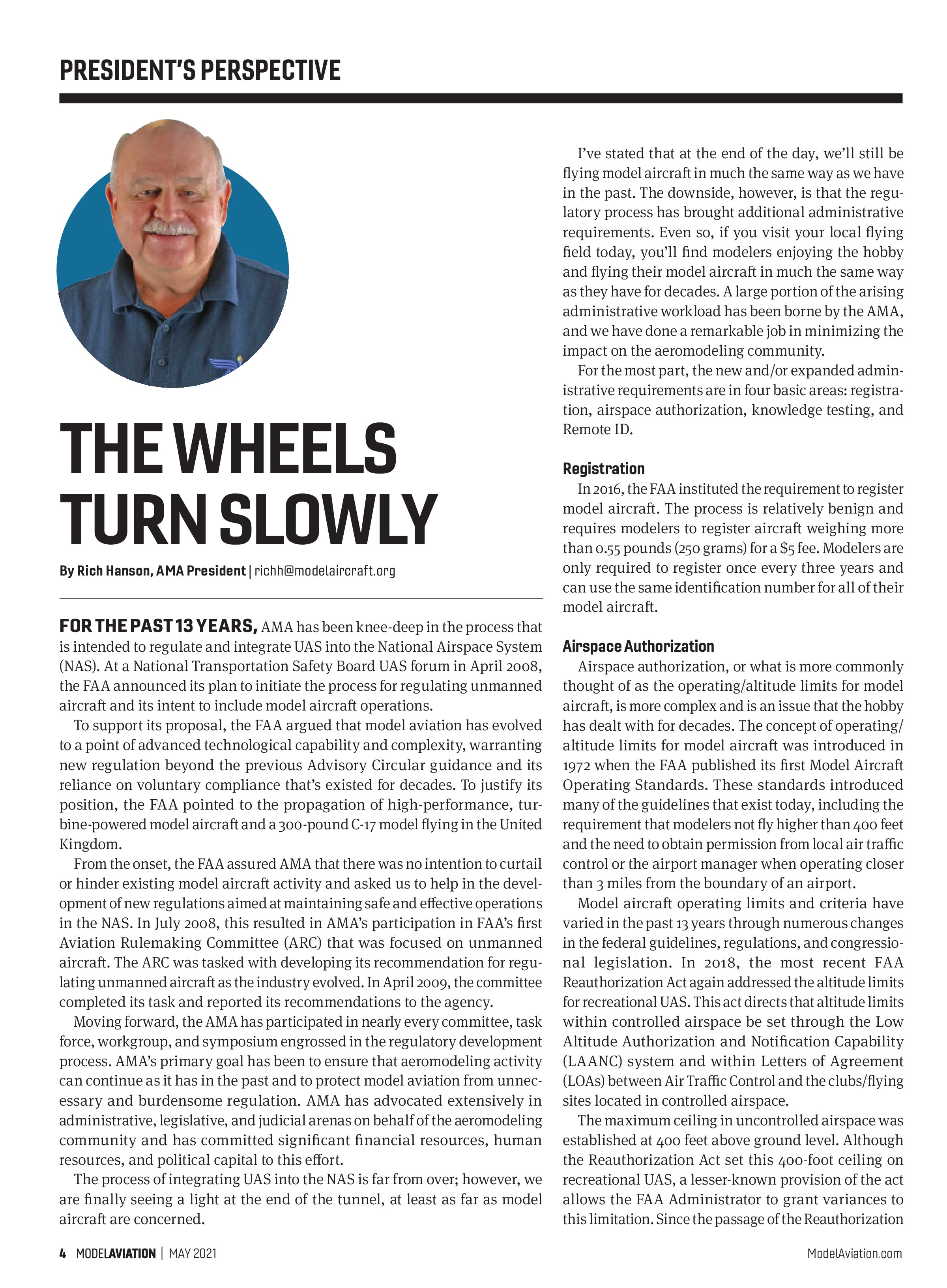
By Rich Hanson, AMA President | richh@modelaircraft.org

FOR THE PAST 13 YEARS, AMA has been knee-deep in the process that is intended to regulate and integrate UAS into the National Airspace System (NAS). At a National Transportation Safety Board UAS forum in April 2008, the FAA announced its plan to initiate the process for regulating unmanned aircraft and its intent to include model aircraft operations.
To support its proposal, the FAA argued that model aviation has evolved to a point of advanced technological capability and complexity, warranting new regulation beyond the previous Advisory Circular guidance and its reliance on voluntary compliance that’s existed for decades. To justify its position, the FAA pointed to the propagation of high-performance, turbine-powered model aircraft and a 300-pound C-17 model flying in the United Kingdom.
From the onset, the FAA assured AMA that there was no intention to curtail or hinder existing model aircraft activity and asked us to help in the development of new regulations aimed at maintaining safe and effective operations in the NAS. In July 2008, this resulted in AMA’s participation in FAA’s first Aviation Rulemaking Committee (ARC) that was focused on unmanned aircraft. The ARC was tasked with developing its recommendation for regulating unmanned aircraft as the industry evolved. In April 2009, the committee completed its task and reported its recommendations to the agency.
Moving forward, the AMA has participated in nearly every committee, task force, workgroup, and symposium engrossed in the regulatory development process. AMA’s primary goal has been to ensure that aeromodeling activity can continue as it has in the past and to protect model aviation from unnecessary and burdensome regulation. AMA has advocated extensively in administrative, legislative, and judicial arenas on behalf of the aeromodeling community and has committed significant financial resources, human resources, and political capital to this effort.
The process of integrating UAS into the NAS is far from over; however, we are finally seeing a light at the end of the tunnel, at least as far as model aircraft are concerned.
I’ve stated that at the end of the day, we’ll still be flying model aircraft in much the same way as we have in the past. The downside, however, is that the regulatory process has brought additional administrative requirements. Even so, if you visit your local flying field today, you’ll find modelers enjoying the hobby and flying their model aircraft in much the same way as they have for decades. A large portion of the arising administrative workload has been borne by the AMA, and we have done a remarkable job in minimizing the impact on the aeromodeling community.
For the most part, the new and/or expanded administrative requirements are in four basic areas: registration, airspace authorization, knowledge testing, and Remote ID.
Registration
In 2016, the FAA instituted the requirement to register model aircraft. The process is relatively benign and requires modelers to register aircraft weighing more than 0.55 pounds (250 grams) for a $5 fee. Modelers are only required to register once every three years and can use the same identification number for all of their model aircraft.
Airspace Authorization
Airspace authorization, or what is more commonly thought of as the operating/altitude limits for model aircraft, is more complex and is an issue that the hobby has dealt with for decades. The concept of operating/altitude limits for model aircraft was introduced in 1972 when the FAA published its first Model Aircraft Operating Standards. These standards introduced many of the guidelines that exist today, including the requirement that modelers not fly higher than 400 feet and the need to obtain permission from local air traffic control or the airport manager when operating closer than 3 miles from the boundary of an airport.
Model aircraft operating limits and criteria have varied in the past 13 years through numerous changes in the federal guidelines, regulations, and congressional legislation. In 2018, the most recent FAA Reauthorization Act again addressed the altitude limits for recreational UAS. This act directs that altitude limits within controlled airspace be set through the Low Altitude Authorization and Notification Capability (LAANC) system and within Letters of Agreement (LOAs) between Air Traffic Control and the clubs/flying sites located in controlled airspace.
The maximum ceiling in uncontrolled airspace was established at 400 feet above ground level. Although the Reauthorization Act set this 400-foot ceiling on recreational UAS, a lesser-known provision of the act allows the FAA Administrator to grant variances to this limitation. Since the passage of the Reauthorization Act, congressional and FAA leadership have assured us that this provision was intended to allow model aircraft to continue to operate as they have in the past and to allow operations above 400 feet when essential and safe to do so.
The authorization process in controlled airspace is generally settled. Altitude limits and allowances are established through a Safety Risk Management process and detailed in signed LOAs between the clubs and the local air traffic control authority.
AMA is currently working with the FAA on the process for obtaining airspace authorization for operations within uncontrolled (Class G) airspace. At this point, the process for uncontrolled airspace is not as refined as that for controlled airspace; nevertheless, we are confident that we will have a solution within the next 12 to 18 months.
Aeronautical Knowledge Test
The FAA Reauthorization Act of 2018 also established the requirement that all recreational UAS operators pass an aeronautical knowledge and safety test. Although this test is primarily focused on drone operations that are capable of navigating beyond visual line of sight (VLOS), the requirement is also applicable to pilots who fly traditional model aircraft. The FAA developed the test content with input from AMA and other stakeholders. It’s in the process of soliciting organizations that are interested in administering The Recreational UAS Safety Test (TRUST). When qualified organizations are selected, the FAA will make the test available through these approved administrators.
Although referred to and structured as a test, TRUST is meant to be more of an instructional tool. The online examination will consist of several multiple-choice questions and is designed to provide instructional input throughout the test, making it nearly impossible to fail.
We anticipate that it will be available mid-to-late summer 2021.
Remote ID
The Remote ID rule is intended to compel an unmanned aircraft to electronically provide its identity and location to others. Similar to AMA’s requirement that members put their AMA number on their aircraft, Remote ID serves as an electronic license plate, providing information that can be traced to the aircraft’s owner/operator.
When first proposed in the Notice of Proposed Rule Making (NPRM) in December 2019, the rule was extremely problematic and would have imposed significant hardships on the aeromodeling community. In response, the AMA launched an extensive campaign encouraging stakeholders and interested parties to respond to the NPRM with suggestions and comments.
More than 53,000 comments were submitted during its 60-day comment period. The FAA took notice, and when the Final Rule was published in January 2021, many of the issues were addressed and resolved.
Model aviation was not left unscathed; however, the impact on the modeling community is far less than initially proposed. Model aircraft are generally exempt from the rule provided they are operating at flying sites designated as FAA-Recognized Identification Areas (FRIAs). Model aircraft weighing more than 0.55 pounds (250 grams) that are flown at other safe locations will need to broadcast their identification using a small, lightweight module placed on or inside of the aircraft. This feature will likely be included in onboard electronics in the future. Technical specifications are still under development and it will be some time before the add-on modules are fully designed and available.
Compliance with the Remote ID rule is not required until September 16, 2023. In the interim, AMA will work with the FAA to establish the process for exempting AMA sanctioned events, designating AMA-affiliated flying sites as FRIAs, and ensuring that implementation of Remote ID does not unnecessarily impact the aeromodeling community.
The Wheels Turn Slowly
Regulatory development and implementation is long and arduous. It has not been easy, and it will be several years before we’ll see the full impact of integrating the emerging UAS technology into the NAS.
The rules, processes, and procedures that surround airspace authorization are complex and continue to consume much of AMA’s administrative efforts. We need help from our members and clubs to ensure that these efforts achieve the best possible outcome.
Although we are steadily working through the procedures and working closely with a small segment of the FAA staff, the group’s approaches, thoughts, and ideas continue to evolve. Few outside of this group are truly aware of the work that is taking place, and there are no definitive answers to many of the ancillary issues involved. Querying FAA field personnel or others outside of this group frequently results in misinformation, can hamper or derail the process, and often leads to additional work for AMA’s Government Affairs team.
This issue is important to our members and clubs and we want to provide the most timely, accurate, and complete information possible. Before you reach out to your nearby Flight Standards District Office, your local FAA Aviation Safety Inspector, or the UAS Integration Office, please call or email the AMA Government Affairs team, Tyler Dobbs (tylerd@modelaircraft.org) or Chrystal Pearson (chrystal@modelaircraft.org). They can give you as much current information as possible. Remember that there are questions for which we do not yet have a definitive answer.
Continue to follow AMA’s safety guidelines and operate your model aircraft in a safe and responsible manner. Always maintain VLOS, allowing you to clearly see your aircraft, know its orientation, and remain in control. Avoid manned aircraft and see and avoid all aircraft, people, and vulnerable property in accordance with AMA’s See and Avoid guidelines in AMA Document 540D.
We are on the backside of the regulatory process, and there’s reason for optimism. Although painfully slow, resolving and finalizing these remaining issues is progressing. It might take another year or two before Airspace Authorization and Remote ID are fully solidified, but I’m confident that we’ll continue to enjoy this great hobby and will be flying our model aircraft in much the same way as we have in the past for generations to come.