MICRO-FLYING

DR.1
CARTOON
SCALE KIT
By Joe Malinchak | joemal@echoes.net
I HAVE A SOFT SPOT FOR Cartoon Scale models because you can increase the size of the wing, tail, and fuselage to design a model that looks great and has improved flight characteristics. Throughout the years, I have built Cartoon Scale airplanes in many different sizes, including my 1.5-inch wingspan version of Gordon Johnson’s great-flying Cartoon Scale Fokker Dr.1 design.
Gordon’s Dr.1 can fly slower than a Vapor, is maneuverable, and can even do loops with the right motor installed. Because of its popularity, many have requested that the model be made into a kit. Gordon has decided to make some kits for those who are interested.
Cartoon Scale Fokker Dr.1 Kit
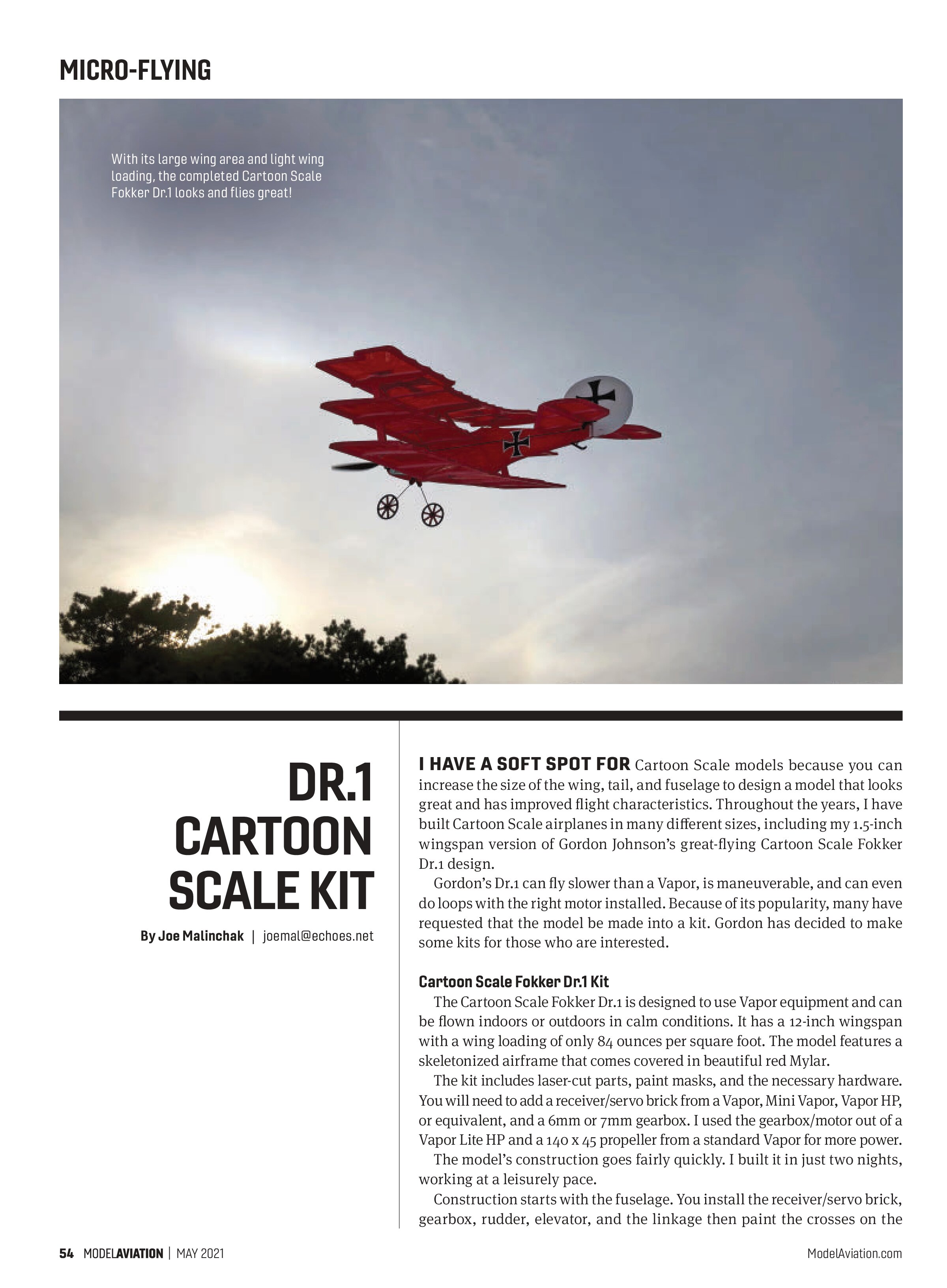
The Cartoon Scale Fokker Dr.1 is designed to use Vapor equipment and can be flown indoors or outdoors in calm conditions. It has a 12-inch wingspan with a wing loading of only 84 ounces per square foot. The model features a skeletonized airframe that comes covered in beautiful red Mylar.
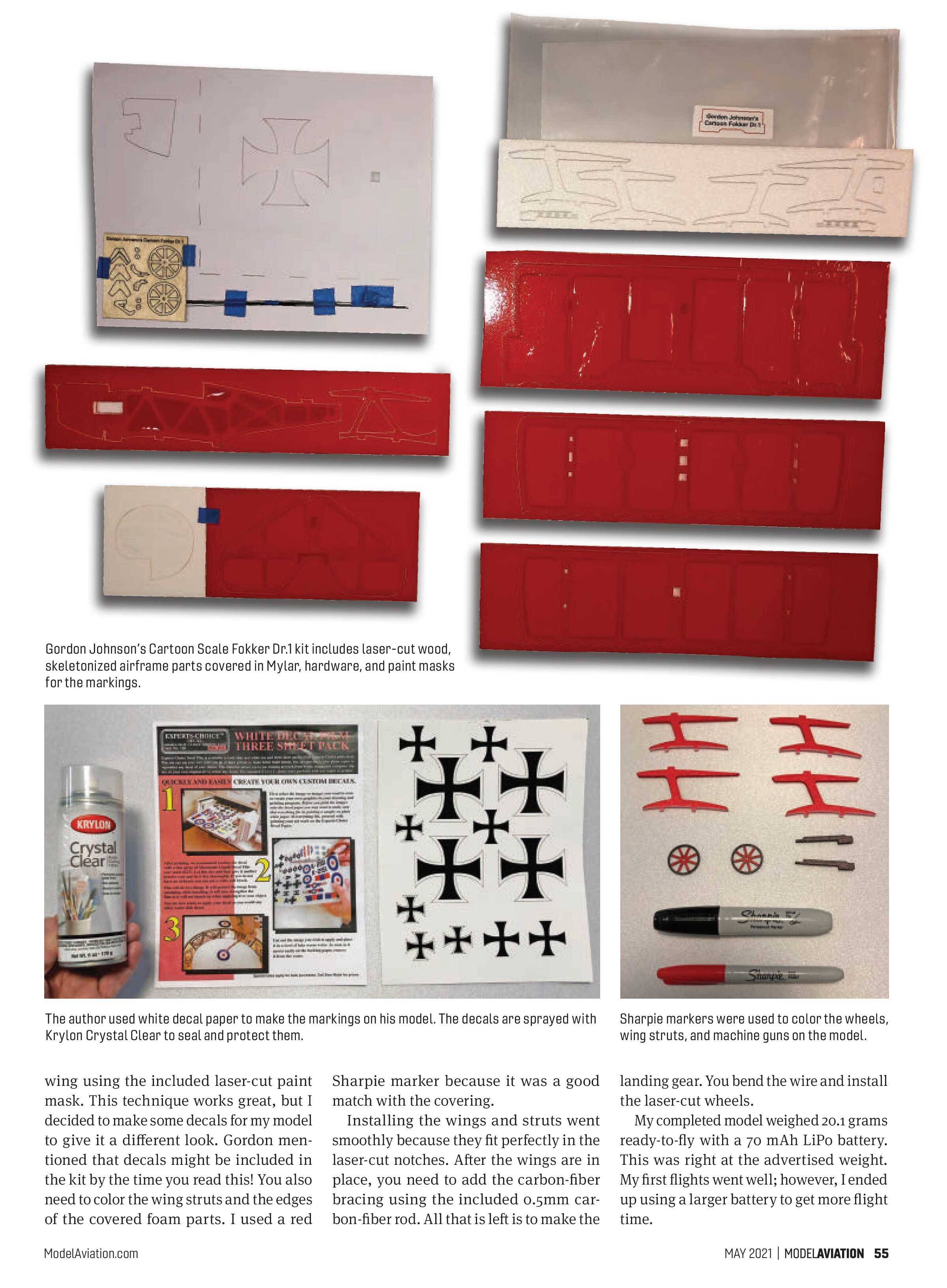
The kit includes laser-cut parts, paint masks, and the necessary hardware. You will need to add a receiver/servo brick from a Vapor, Mini Vapor, Vapor HP, or equivalent, and a 6mm or 7mm gearbox. I used the gearbox/motor out of a Vapor Lite HP and a 140 x 45 propeller from a standard Vapor for more power.
The model’s construction goes fairly quickly. I built it in just two nights, working at a leisurely pace.
Construction starts with the fuselage. You install the receiver/servo brick, gearbox, rudder, elevator, and the linkage then paint the crosses on the wing using the included laser-cut paint mask. This technique works great, but I decided to make some decals for my model to give it a different look. Gordon mentioned that decals might be included in the kit by the time you read this! You also need to color the wing struts and the edges of the covered foam parts. I used a red Sharpie marker because it was a good match with the covering.


Installing the wings and struts went smoothly because they fit perfectly in the laser-cut notches. After the wings are in place, you need to add the carbon-fiber bracing using the included 0.5mm carbon-fiber rod. All that is left is to make the landing gear. You bend the wire and install the laser-cut wheels.
My completed model weighed 20.1 grams ready-to-fly with a 70 mAh LiPo battery. This was right at the advertised weight. My first flights went well; however, I ended up using a larger battery to get more flight time.


This is a fun, easy-to-build model. If you are interested in purchasing one, please send Gordon an email for pricing and more information. His contact information is listed in “Sources.”
Micro Flier Radio Hip Hop System
The Hip Hop System was developed by Martin Newell, with help from Bob Selman and Dave Burley, and has had some significant upgrades throughout the years. It uses 900 MHz band frequency-hopping spread-spectrum and provides a reliable radio system to fly the smallest and lightest micro RC models.
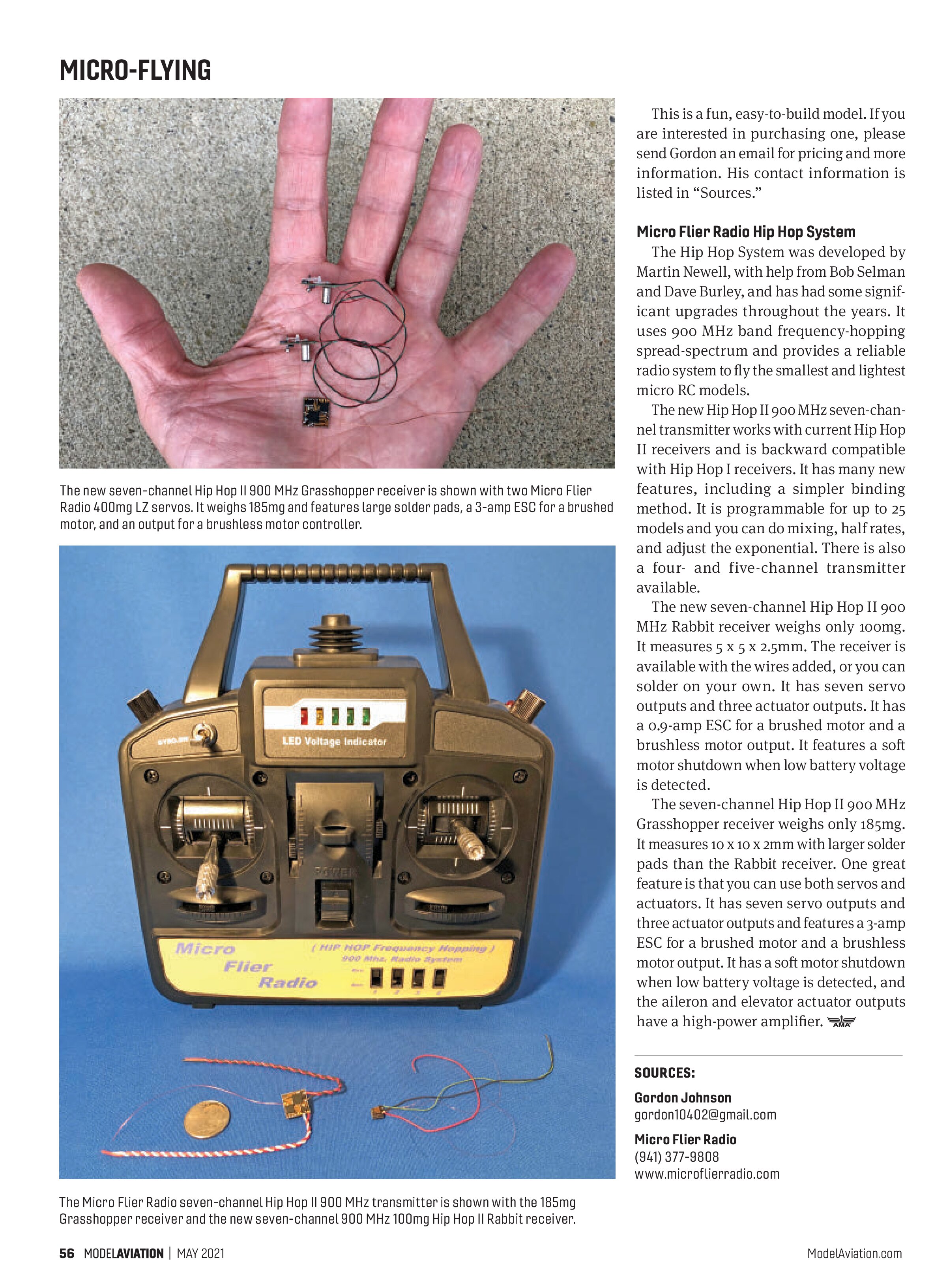
The new Hip Hop II 900 MHz seven-channel transmitter works with current Hip Hop II receivers and is backward compatible with Hip Hop I receivers. It has many new features, including a simpler binding method. It is programmable for up to 25 models and you can do mixing, half rates, and adjust the exponential. There is also a four- and five-channel transmitter available.
The new seven-channel Hip Hop II 900 MHz Rabbit receiver weighs only 100mg. It measures 5 X 5 X 2.5mm. The receiver is available with the wires added, or you can solder on your own. It has seven servo outputs and three actuator outputs. It has a 0.9-amp ESC for a brushed motor and a brushless motor output. It features a soft motor shutdown when low battery voltage is detected.
The seven-channel Hip Hop II 900 MHz Grasshopper receiver weighs only 185mg. It measures 10 X 10 X 2mm with larger solder pads than the Rabbit receiver. One great feature is that you can use both servos and actuators. It has seven servo outputs and three actuator outputs and features a 3-amp ESC for a brushed motor and a brushless motor output. It has a soft motor shutdown when low battery voltage is detected, and the aileron and elevator actuator outputs have a high-power amplifier.
SOURCES:
Gordon Johnson
gordon10402@gmail.com
Micro Flier Radio
(941) 377-9808
www.microflierradio.com