FOCAL POINT
Interested in sharing your handiwork? Visit www.ModelAviation.com for submission guidelines.

BVM 1:5.5 PNP F-18
Chris Gleason (New Fairfield, Connecticut; email: cavucustoms@
gmail.com) customized his BVM Jets 1:5.5 F-18 at his business, CAVU Customs.
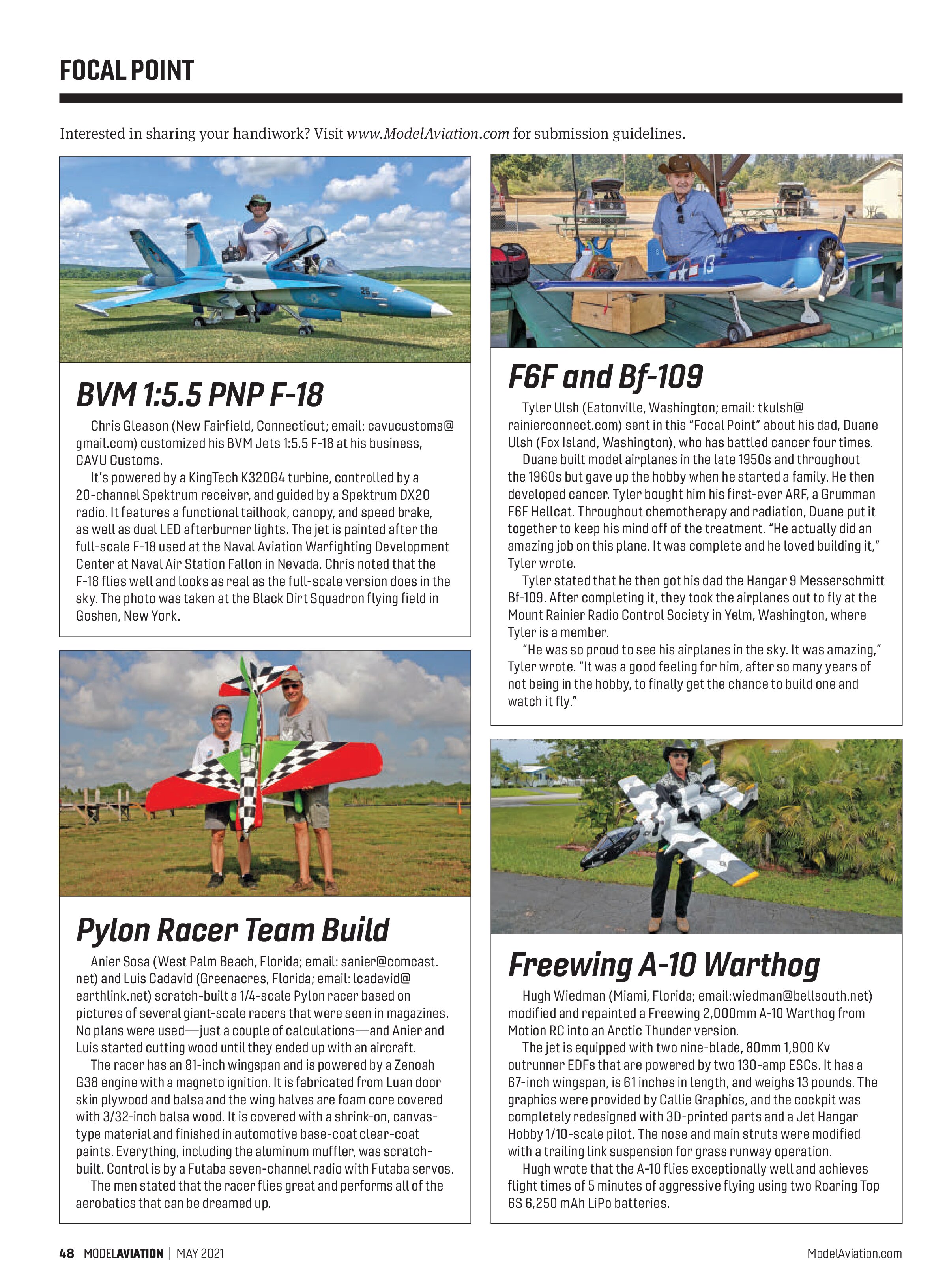
It’s powered by a KingTech K320G4 turbine, controlled by a 20-channel Spektrum receiver, and guided by a Spektrum DX20 radio. It features a functional tailhook, canopy, and speed brake, as well as dual LED afterburner lights. The jet is painted after the full-scale F-18 used at the Naval Aviation Warfighting Development Center at Naval Air Station Fallon in Nevada. Chris noted that the F-18 flies well and looks as real as the full-scale version does in the sky. The photo was taken at the Black Dirt Squadron flying field in Goshen, New York.

Pylon Racer Team Build
Anier Sosa (West Palm Beach, Florida; email: sanier@comcast.
net) and Luis Cadavid (Greenacres, Florida; email: lcadavid@
earthlink.net) scratch-built a 1/4-scale Pylon racer based on pictures of several giant-scale racers that were seen in magazines. No plans were used—just a couple of calculations—and Anier and Luis started cutting wood until they ended up with an aircraft.
The racer has an 81-inch wingspan and is powered by a Zenoah G38 engine with a magneto ignition. It is fabricated from Luan door skin plywood and balsa and the wing halves are foam core covered with 3/32-inch balsa wood. It is covered with a shrink-on, canvas-type material and finished in automotive base-coat clear-coat paints. Everything, including the aluminum muffler, was scratch-built. Control is by a Futaba seven-channel radio with Futaba servos.
The men stated that the racer flies great and performs all of the aerobatics that can be dreamed up.

F6F and Bf-109
Tyler Ulsh (Eatonville, Washington; email: tkulsh@
rainierconnect.com) sent in this “Focal Point” about his dad, Duane Ulsh (Fox Island, Washington), who has battled cancer four times.
Duane built model airplanes in the late 1950s and throughout the 1960s but gave up the hobby when he started a family. He then developed cancer. Tyler bought him his first-ever ARF, a Grumman F6F Hellcat. Throughout chemotherapy and radiation, Duane put it together to keep his mind off of the treatment. “He actually did an amazing job on this plane. It was complete and he loved building it,” Tyler wrote.
Tyler stated that he then got his dad the Hangar 9 Messerschmitt Bf-109. After completing it, they took the airplanes out to fly at the Mount Rainier Radio Control Society in Yelm, Washington, where Tyler is a member.
“He was so proud to see his airplanes in the sky. It was amazing,” Tyler wrote. “It was a good feeling for him, after so many years of not being in the hobby, to finally get the chance to build one and watch it fly.”

Freewing A-10 Warthog
Hugh Wiedman (Miami, Florida; email:wiedman@bellsouth.net) modified and repainted a Freewing 2,000mm A-10 Warthog from Motion RC into an Arctic Thunder version.
The jet is equipped with two nine-blade, 80mm 1,900 Kv outrunner EDFs that are powered by two 130-amp ESCs. It has a 67-inch wingspan, is 61 inches in length, and weighs 13 pounds. The graphics were provided by Callie Graphics, and the cockpit was completely redesigned with 3D-printed parts and a Jet Hangar Hobby 1/10-scale pilot. The nose and main struts were modified with a trailing link suspension for grass runway operation.
Hugh wrote that the A-10 flies exceptionally well and achieves flight times of 5 minutes of aggressive flying using two Roaring Top 6S 6,250 mAh LiPo batteries.

Manx
In approximately 2019, Dik Lang (Port Townsend, Washington; email: diklang32@hotmail.com) was given a 2-meter Dave’s Aircraft Works Schweizer TG-3 Slope glider that had belonged to a flying friend, Mitch Poling, who had passed away. “Mitch collected [and flew] lots of models and was evidently instrumental in getting our hobby of electric flight off the ground with another renowned RC flier, Keith Sparks,” Dik stated.
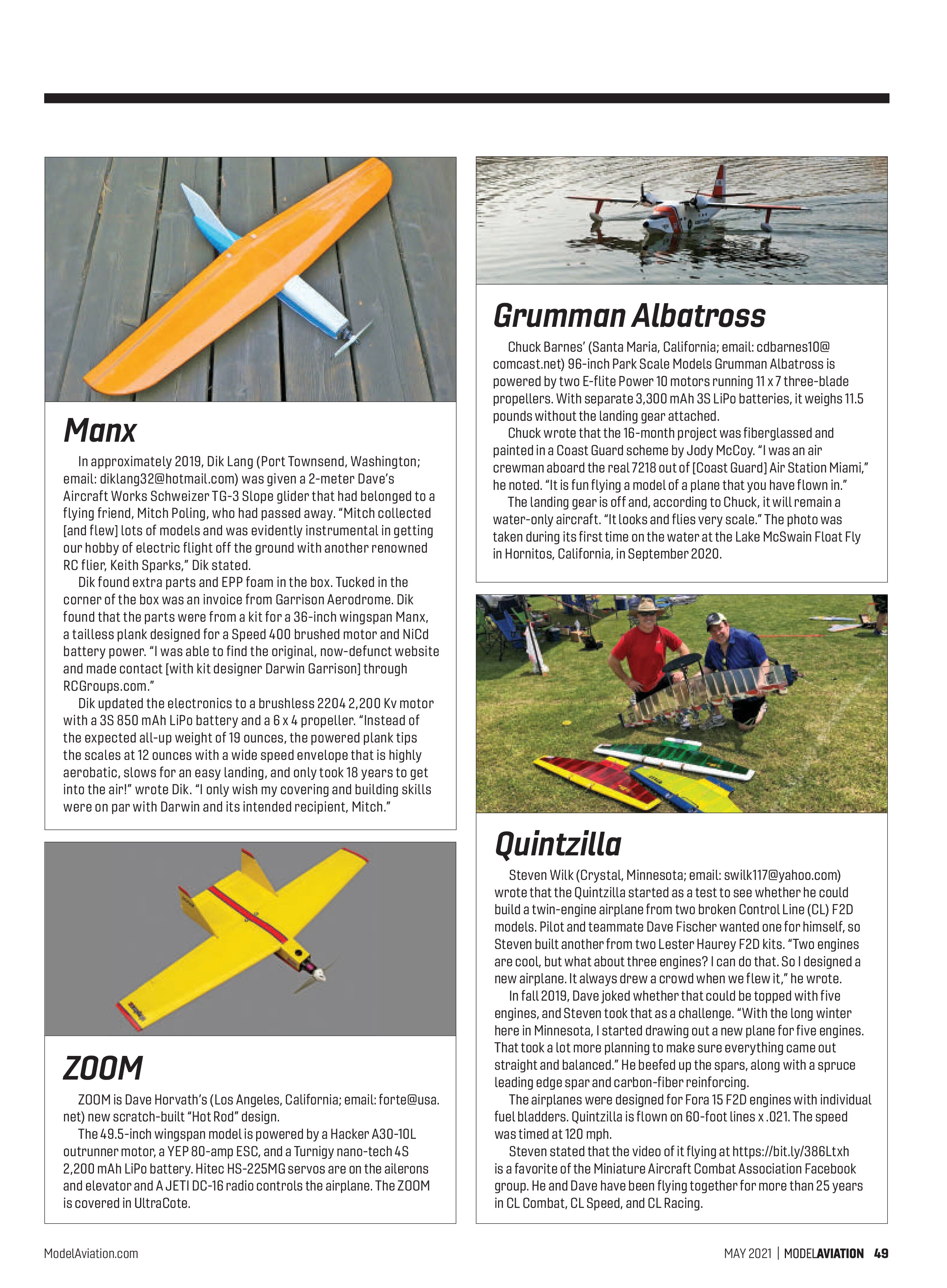
Dik found extra parts and EPP foam in the box. Tucked in the corner of the box was an invoice from Grainger Aerodrome. Dik found that the parts were from a kit for a 36-inch wingspan Manx, a tailless plank designed for a Speed 400 brushed motor and NiCd battery power. “I was able to find the original, now-defunct website and made contact [with kit designer Darwin Garrison] through RCGroups.com.”
Dik updated the electronics to a brushless 2204 2,200 Kv motor with a 3S 850 mAh LiPo battery and a 6 x 4 propeller. “Instead of the expected all-up weight of 19 ounces, the powered plank tips the scales at 12 ounces with a wide speed envelope that is highly aerobatic, slows for an easy landing, and only took 18 years to get into the air!” wrote Dik. “I only wish my covering and building skills were on par with Darwin and its intended recipient, Mitch.”

ZOOM
ZOOM is Dave Horvath’s (Los Angeles, California; email: forte@usa.
net) new scratch-built “Hot Rod” design.
The 49.5-inch wingspan model is powered by a Hacker A30-10L outrunner motor, a YEP 80-amp ESC, and a Turnigy nano-tech 4S 2,200 mAh LiPo battery. Hitec HS-225MG servos are on the ailerons and elevator and a JETI DC-16 radio controls the airplane. The ZOOM is covered in UltraCote.

Grumman Albatross
Chuck Barnes’ (Santa Maria, California; email: cdbarnes10@
comcast.net) 96-inch Park Scale Models Grumman Albatross is powered by two E-flite Power 10 motors running 11 x 7 three-blade propellers. With separate 3,300 mAh 3S LiPo batteries, it weighs 11.5 pounds without the landing gear attached.
Chuck wrote that the 16-month project was fiberglassed and painted in a Coast Guard scheme by Jody McCoy. “I was an air crewman aboard the real 7218 out of [Coast Guard] Air Station Miami,” he noted. “It is fun flying a model of a plane that you have flown in.”
The landing gear is off and, according to Chuck, it will remain a water-only aircraft. “It looks and flies very scale.” The photo was taken during its first time on the water at the Lake McSwain Float Fly in Hornitos, California, in September 2020.

Quintzilla
Steven Wilk (Crystal, Minnesota; email: swilk117@yahoo.com) wrote that the Quintzilla started as a test to see whether he could build a twin-engine airplane from two broken Control Line (CL) F2D models. Pilot and teammate Dave Fischer wanted one for himself, so Steven built another from two Lester Haurey F2D kits. “Two engines are cool, but what about three engines? I can do that. So I designed a new airplane. It always drew a crowd when we flew it,” he wrote.
In fall 2019, Dave joked whether that could be topped with five engines, and Steven took that as a challenge. “With the long winter here in Minnesota, I started drawing out a new plane for five engines. That took a lot more planning to make sure everything came out straight and balanced.” He beefed up the spars, along with a spruce leading edge spar and carbon-fiber reinforcing.
The airplanes were designed for Fora 15 F2D engines with individual fuel bladders. Quintzilla is flown on 60-foot lines x .021. The speed was timed at 120 mph.
Steven stated that the video of it flying at https://bit.ly/386Ltxh is a favorite of the Miniature Aircraft Combat Association Facebook group. He and Dave have been flying together for more than 25 years in CL Combat, CL Speed, and CL Racing.