Born to Fly
MY FIRST SOLO RC FLIGHT—AND CRASH
By Jim Graham | jimtgraham@yahoo.com


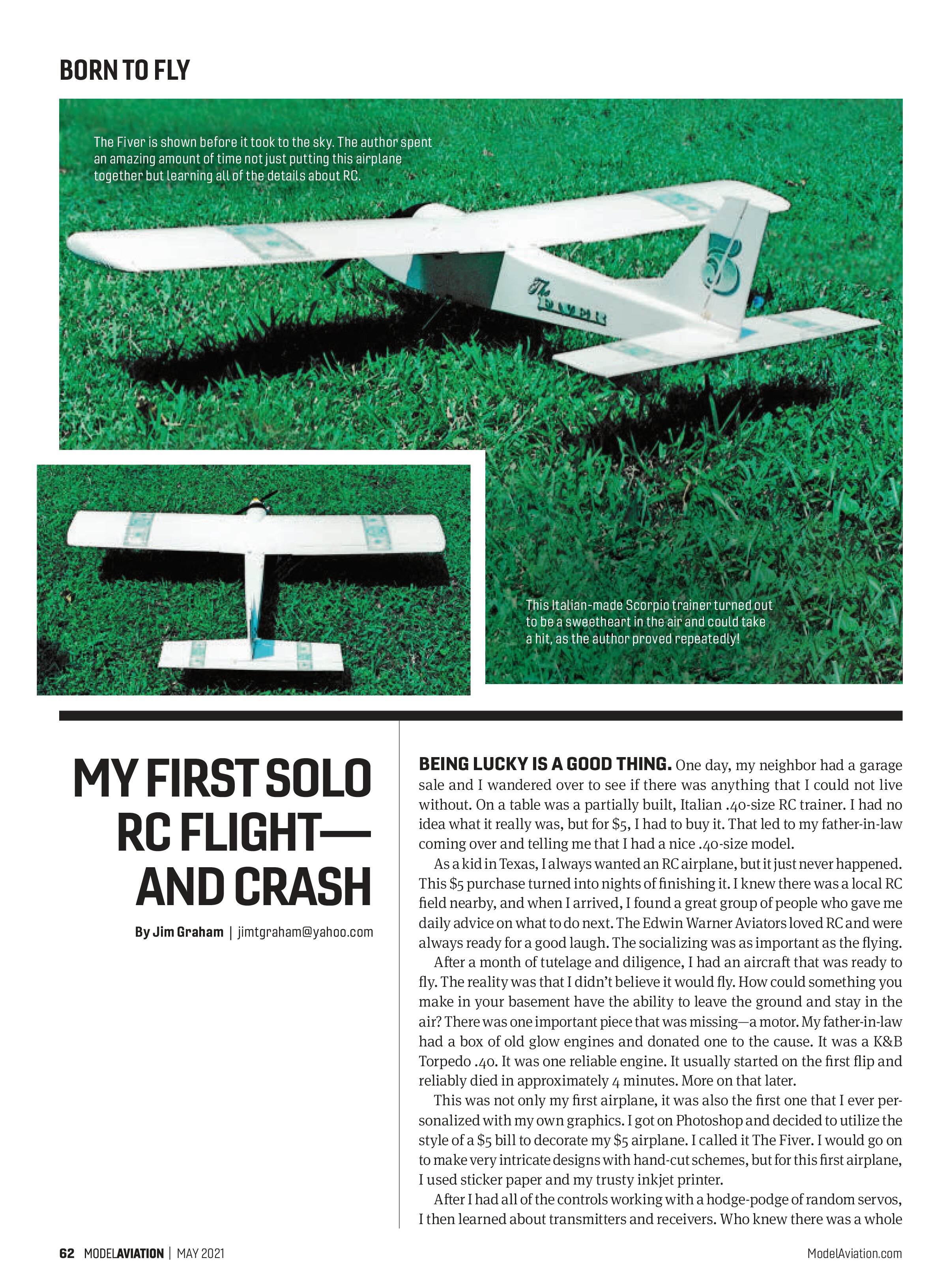
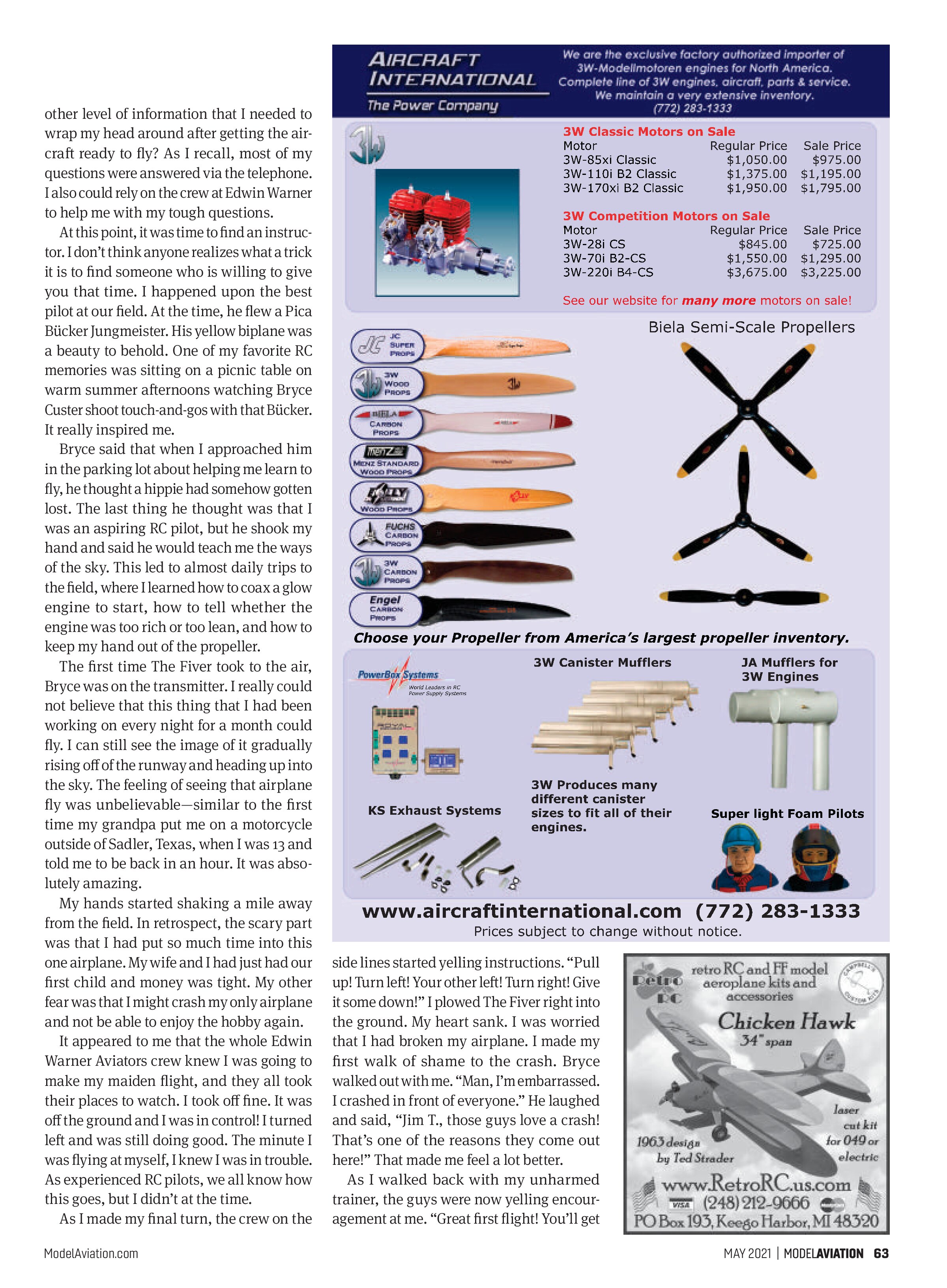
BEING LUCKY IS A GOOD THING. One day, my neighbor had a garage sale and I wandered over to see if there was anything that I could not live without. On a table was a partially built, Italian .40-size RC trainer. I had no idea what it really was, but for $5, I had to buy it. That led to my father-in-law coming over and telling me that I had a nice .40-size model.
As a kid in Texas, I always wanted an RC airplane, but it just never happened. This $5 purchase turned into nights of finishing it. I knew there was a local RC field nearby, and when I arrived, I found a great group of people who gave me daily advice on what to do next. The Edwin Warner Aviators loved RC and were always ready for a good laugh. The socializing was as important as the flying.
After a month of tutelage and diligence, I had an aircraft that was ready to fly. The reality was that I didn’t believe it would fly. How could something you make in your basement have the ability to leave the ground and stay in the air? There was one important piece that was missing—a motor. My father-in-law had a box of old glow engines and donated one to the cause. It was a K&B Torpedo .40. It was one reliable engine. It usually started on the first flip and reliably died in approximately 4 minutes. More on that later.
This was not only my first airplane, it was also the first one that I ever personalized with my own graphics. I got on Photoshop and decided to utilize the style of a $5 bill to decorate my $5 airplane. I called it The Fiver. I would go on to make very intricate designs with hand-cut schemes, but for this first airplane, I used sticker paper and my trusty inkjet printer.
After I had all of the controls working with a hodge-podge of random servos, I then learned about transmitters and receivers. Who knew there was a whole other level of information that I needed to wrap my head around after getting the aircraft ready to fly? As I recall, most of my questions were answered via the telephone. I also could rely on the crew at Edwin Warner to help me with my tough questions.
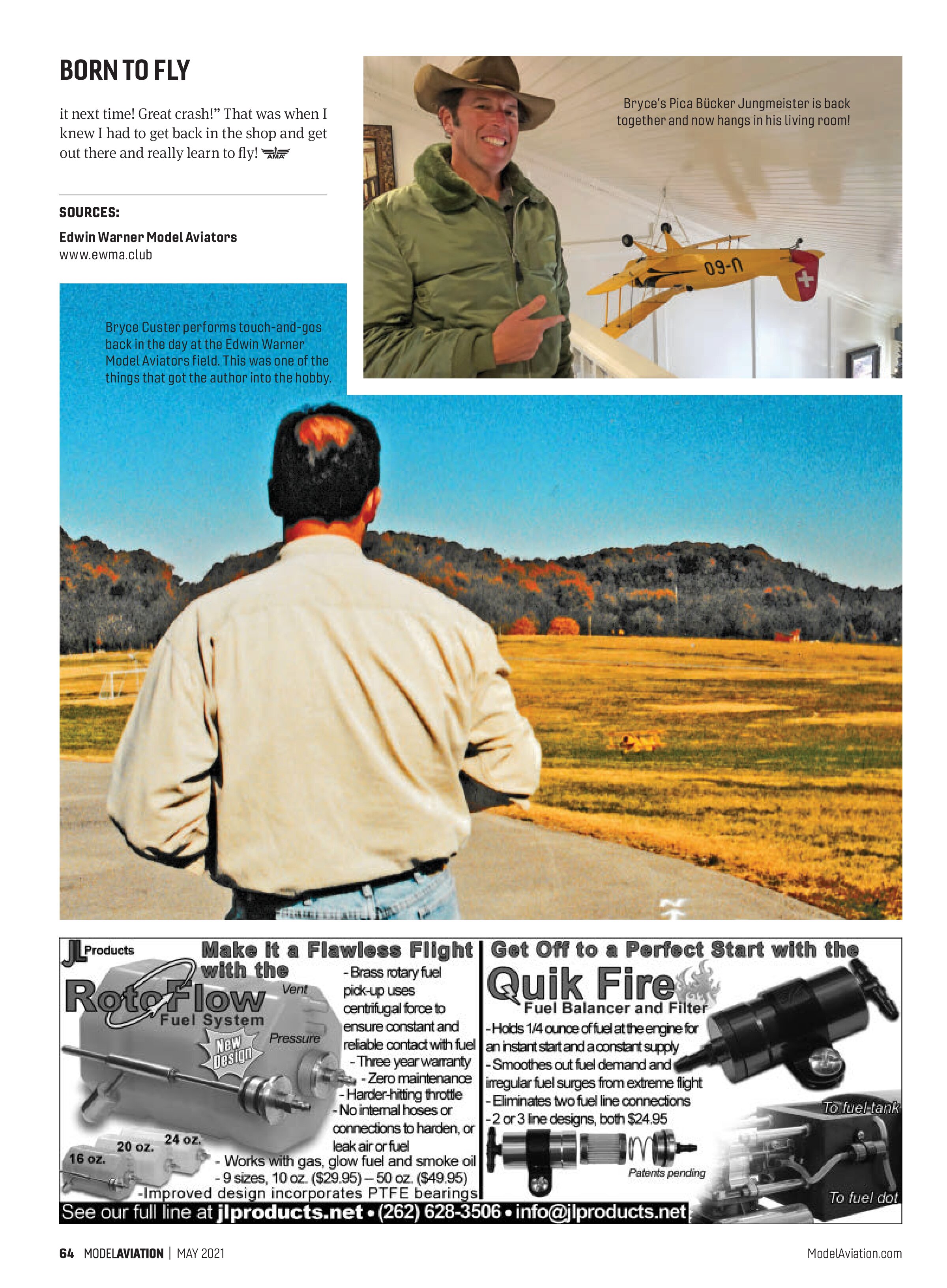
At this point, it was time to find an instructor. I don’t think anyone realizes what a trick it is to find someone who is willing to give you that time. I happened upon the best pilot at our field. At the time, he flew a Pica Bücker Jungmeister. His yellow biplane was a beauty to behold. One of my favorite RC memories was sitting on a picnic table on warm summer afternoons watching Bryce Custer shoot touch-and-gos with that Bücker. It really inspired me.
Bryce said that when I approached him in the parking lot about helping me learn to fly, he thought a hippie had somehow gotten lost. The last thing he thought was that I was an aspiring RC pilot, but he shook my hand and said he would teach me the ways of the sky. This led to almost daily trips to the field, where I learned how to coax a glow engine to start, how to tell whether the engine was too rich or too lean, and how to keep my hand out of the propeller.
The first time The Fiver took to the air, Bryce was on the transmitter. I really could not believe that this thing that I had been working on every night for a month could fly. I can still see the image of it gradually rising off of the runway and heading up into the sky. The feeling of seeing that airplane fly was unbelievable—similar to the first time my grandpa put me on a motorcycle outside of Sadler, Texas, when I was 13 and told me to be back in an hour. It was absolutely amazing.
My hands started shaking a mile away from the field. In retrospect, the scary part was that I had put so much time into this one airplane. My wife and I had just had our first child and money was tight. My other fear was that I might crash my only airplane and not be able to enjoy the hobby again.
It appeared to me that the whole Edwin Warner Aviators crew knew I was going to make my maiden flight, and they all took their places to watch. I took off fine. It was off the ground and I was in control! I turned left and was still doing good. The minute I was flying at myself, I knew I was in trouble. As experienced RC pilots, we all know how this goes, but I didn’t at the time.
As I made my final turn, the crew on the side lines started yelling instructions. “Pull up! Turn left! Your other left! Turn right! Give it some down!” I plowed The Fiver right into the ground. My heart sank. I was worried that I had broken my airplane. I made my first walk of shame to the crash. Bryce walked out with me. “Man, I’m embarrassed. I crashed in front of everyone.” He laughed and said, “Jim T., those guys love a crash! That’s one of the reasons they come out here!” That made me feel a lot better.
As I walked back with my unharmed trainer, the guys were now yelling encouragement at me. “Great first flight! You’ll get
it next time! Great crash!” That was when I knew I had to get back in the shop and get out there and really learn to fly!

SOURCES:
Edwin Warner Model Aviators
www.ewma.club