INTERNATIONAL FLYING COMPETITION

DO YOU REMEMBER the Rolls-Royce Flying Bedstead?
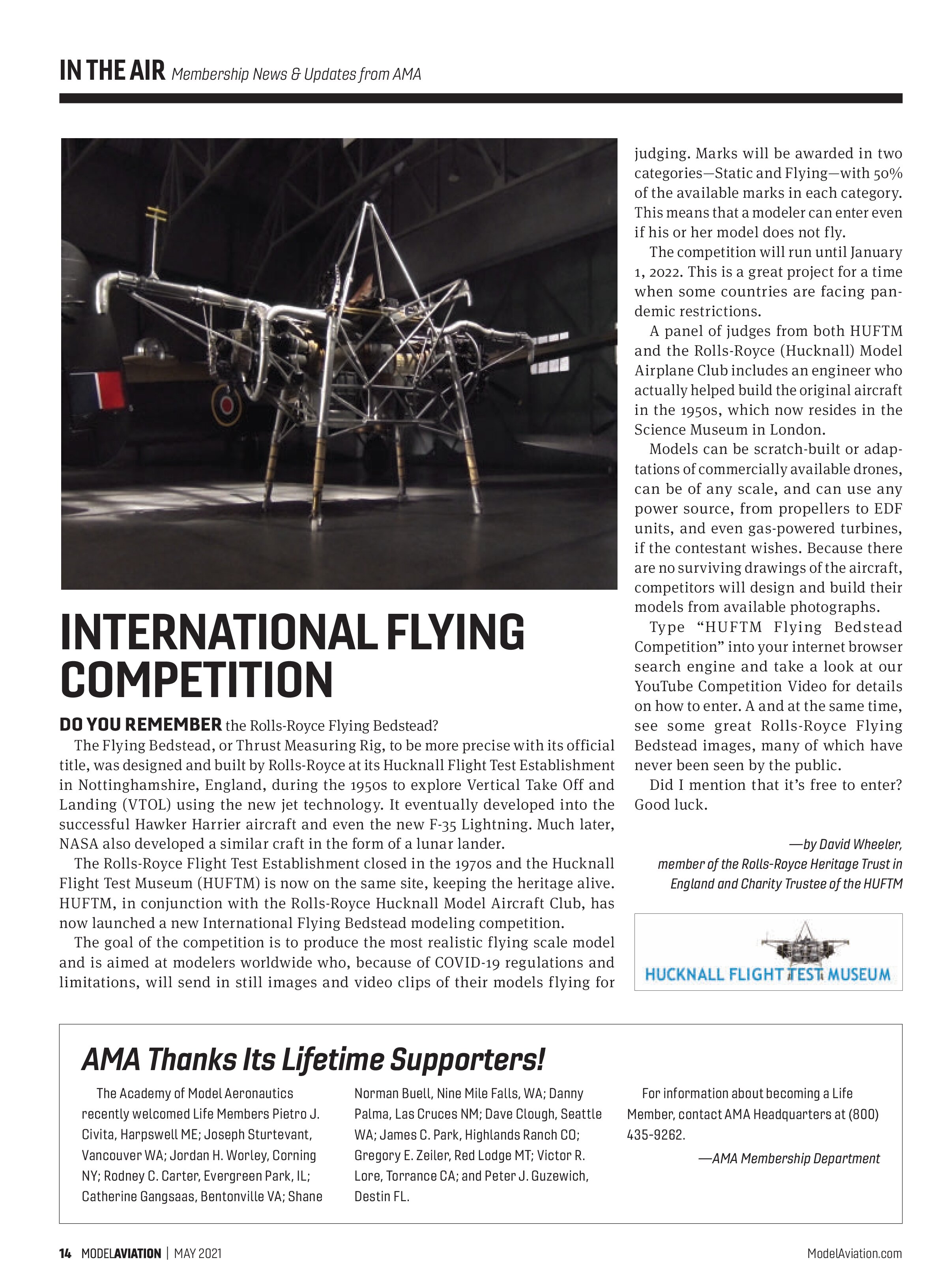
The Flying Bedstead, or Thrust Measuring Rig, to be more precise with its official title, was designed and built by Rolls-Royce at its Hucknall Flight Test Establishment in Nottinghamshire, England, during the 1950s to explore Vertical Take Off and Landing (VTOL) using the new jet technology. It eventually developed into the successful Hawker Harrier aircraft and even the new F-35 Lightning. Much later, NASA also developed a similar craft in the form of a lunar lander.
The Rolls-Royce Flight Test Establishment closed in the 1970s and the Hucknall Flight Test Museum (HUFTM) is now on the same site, keeping the heritage alive. HUFTM, in conjunction with the Rolls-Royce Hucknall Model Aircraft Club, has now launched a new International Flying Bedstead modeling competition.
The goal of the competition is to produce the most realistic flying scale model and is aimed at modelers worldwide who, because of COVID-19 regulations and limitations, will send in still images and video clips of their models flying for judging. Marks will be awarded in two categories—Static and Flying—with 50% of the available marks in each category. This means that a modeler can enter even if his or her model does not fly.
The competition will run until January 1, 2022. This is a great project for a time when some countries are facing pandemic restrictions.
A panel of judges from both HUFTM and the Rolls-Royce (Hucknall) Model Airplane Club includes an engineer who actually helped build the original aircraft in the 1950s, which now resides in the Science Museum in London.
Models can be scratch-built or adaptations of commercially available drones, can be of any scale, and can use any power source, from propellers to EDF units, and even gas-powered turbines, if the contestant wishes. Because there are no surviving drawings of the aircraft, competitors will design and build their models from available photographs.
Type “HUFTM Flying Bedstead Competition” into your internet browser search engine and take a look at our YouTube Competition Video for details on how to enter. A and at the same time, see some great Rolls-Royce Flying Bedstead images, many of which have never been seen by the public.
Did I mention that it’s free to enter? Good luck.
—by David Wheeler,
member of the Rolls-Royce Heritage Trust in England and Charity Trustee of the HUFTM
AMA Thanks Its Lifetime Supporters!
The Academy of Model Aeronautics recently welcomed Life Members Pietro J. Civita, Harpswell ME; Joseph Sturtevant, Vancouver WA; Jordan H. Worley, Corning NY; Rodney C. Carter, Evergreen Park, IL; Catherine Gangsaas, Bentonville VA; Shane Norman Buell, Nine Mile Falls, WA; Danny Palma, Las Cruces NM; Dave Clough, Seattle WA; James C. Park, Highlands Ranch CO; Gregory E. Zeiler, Red Lodge MT; Victor R. Lore, Torrance CA; and Peter J. Guzewich, Destin FL.
For information about becoming a Life Member, contact AMA Headquarters at (800) 435-9262.
—AMA Membership Department
Esquire RC on Sale Until May 31
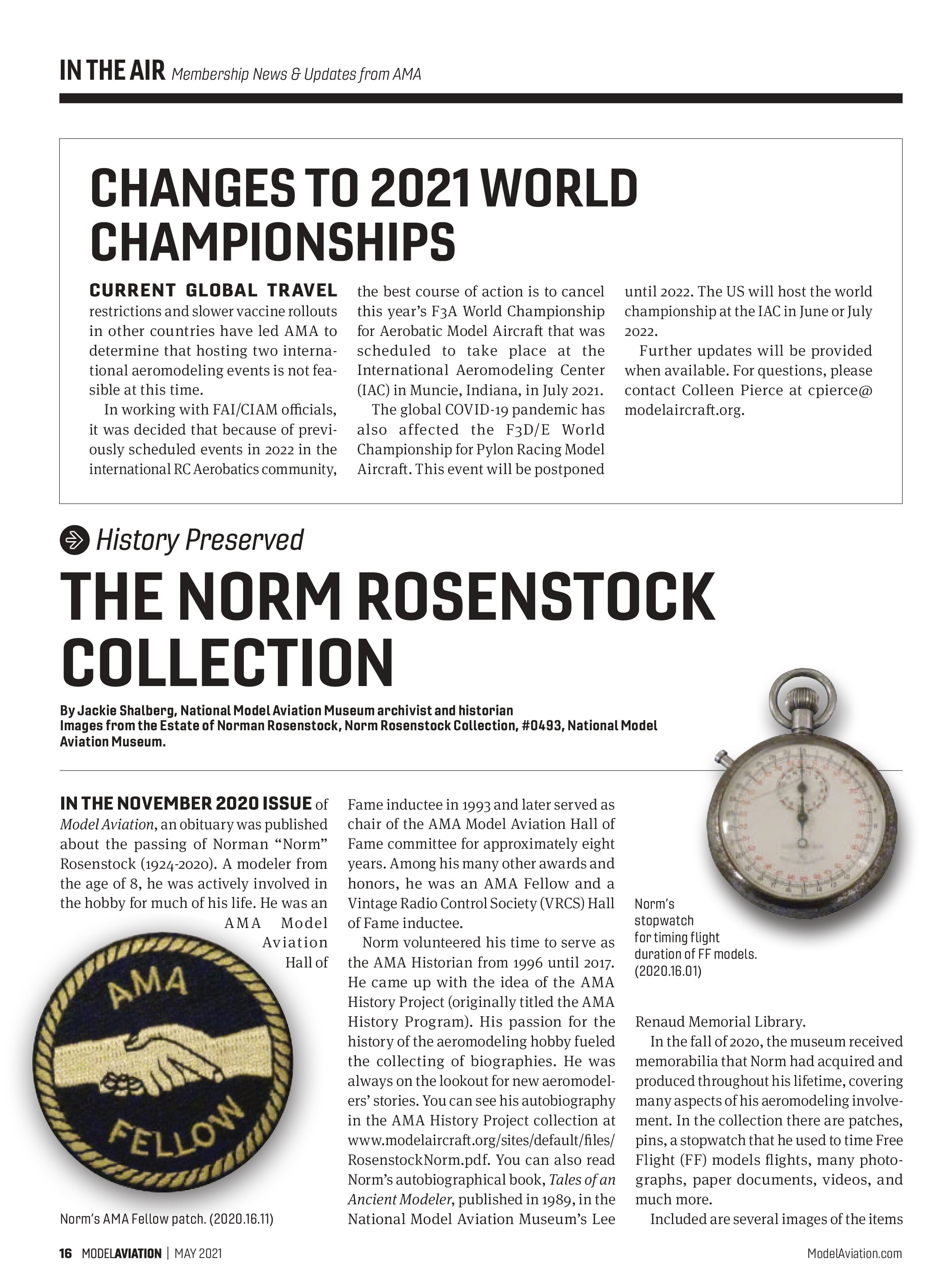
AMA PLANS SERVICE houses all plans formerly sold through Model Builder magazine, Bill Northrop’s Plan Service, and the Scratch Builder’s Almanac. There are more than 18,000 plans in the collection.
From Model Builder magazine comes the Esquire RC, an exquisite example of the Golden Age of RC. The 50-1/2-inch aircraft was originally kitted by Midwest.
You can order plans for the Esquire RC, plans number 9862 (SKU: MB9862), through plans.modelaircraft.org for $20 using the discount code Esquire20.

KIDS IN UGANDA LEARN TO FLY
“THE LOVE OF AVIATION knows no borders.”

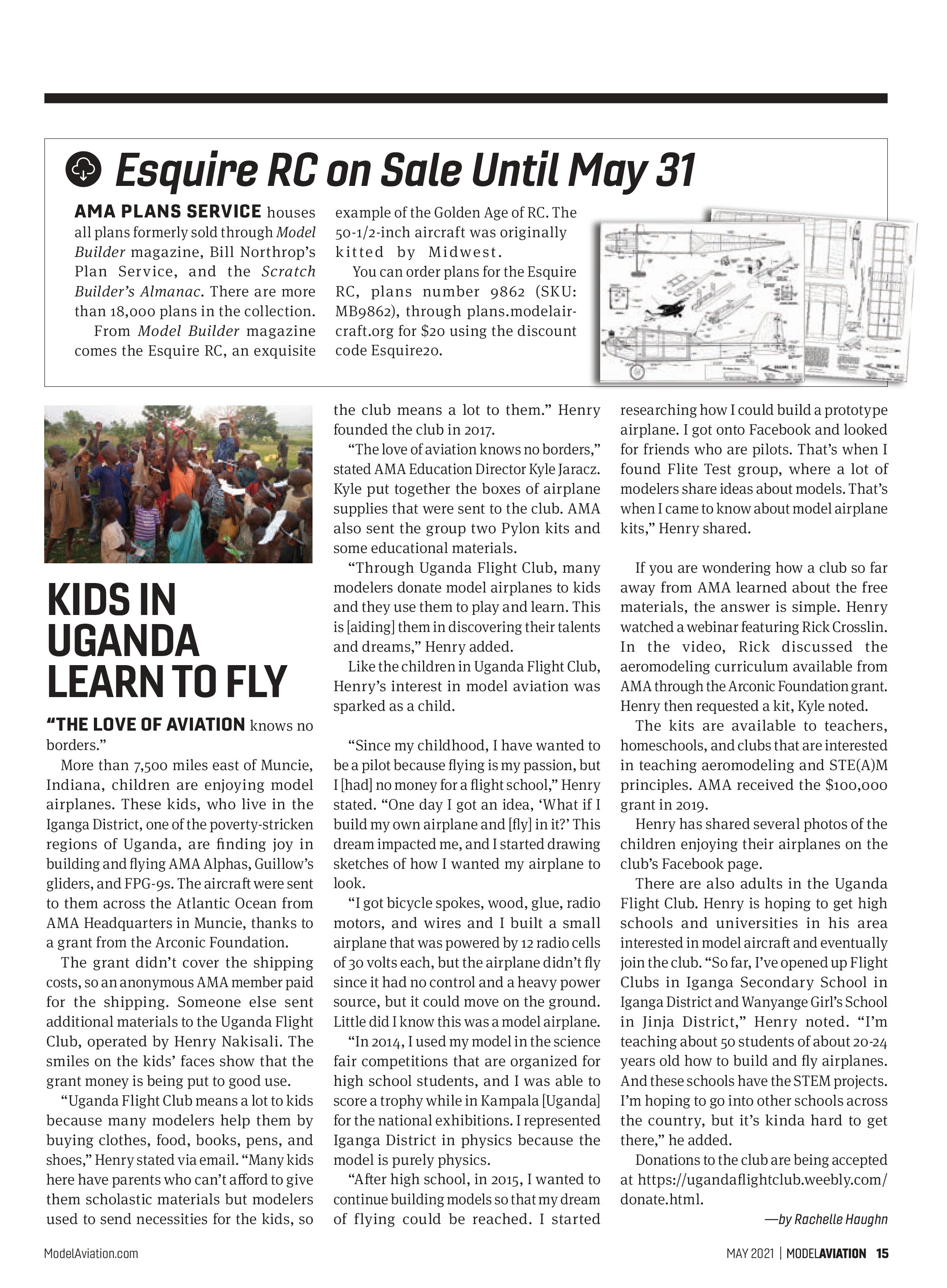
More than 7,500 miles east of Muncie, Indiana, children are enjoying model airplanes. These kids, who live in the Iganga District, one of the poverty-stricken regions of Uganda, are finding joy in building and flying AMA Alphas, Guillow’s gliders, and FPG-9s. The aircraft were sent to them across the Atlantic Ocean from AMA Headquarters in Muncie, thanks to a grant from the Arconic Foundation.
The grant didn’t cover the shipping costs, so an anonymous AMA member paid for the shipping. Someone else sent additional materials to the Uganda Flight Club, operated by Henry Nakisali. The smiles on the kids’ faces show that the grant money is being put to good use.
“Uganda Flight Club means a lot to kids because many modelers help them by buying clothes, food, books, pens, and shoes,” Henry stated via email. “Many kids here have parents who can’t afford to give them scholastic materials but modelers used to send necessities for the kids, so the club means a lot to them.” Henry founded the club in 2017.
“The love of aviation knows no borders,” stated AMA Education Director Kyle Jaracz. Kyle put together the boxes of airplane supplies that were sent to the club. AMA also sent the group two Pylon kits and some educational materials.
“Through Uganda Flight Club, many modelers donate model airplanes to kids and they use them to play and learn. This is [aiding] them in discovering their talents and dreams,” Henry added.
Like the children in Uganda Flight Club, Henry’s interest in model aviation was sparked as a child.
“Since my childhood, I have wanted to be a pilot because flying is my passion, but I [had] no money for a flight school,” Henry stated. “One day I got an idea, ‘What if I build my own airplane and [fly] in it?’ This dream impacted me, and I started drawing sketches of how I wanted my airplane to look.
“I got bicycle spokes, wood, glue, radio motors, and wires and I built a small airplane that was powered by 12 radio cells of 30 volts each, but the airplane didn’t fly since it had no control and a heavy power source, but it could move on the ground. Little did I know this was a model airplane.
“In 2014, I used my model in the science fair competitions that are organized for high school students, and I was able to score a trophy while in Kampala [Uganda] for the national exhibitions. I represented Iganga District in physics because the model is purely physics.
“After high school, in 2015, I wanted to continue building models so that my dream of flying could be reached. I started researching how I could build a prototype airplane. I got onto Facebook and looked for friends who are pilots. That’s when I found Flite Test group, where a lot of modelers share ideas about models. That’s when I came to know about model airplane kits,” Henry shared.
If you are wondering how a club so far away from AMA learned about the free materials, the answer is simple. Henry watched a webinar featuring Rick Crosslin. In the video, Rick discussed the aeromodeling curriculum available from AMA through the Arconic Foundation grant. Henry then requested a kit, Kyle noted.
The kits are available to teachers, homeschools, and clubs that are interested in teaching aeromodeling and STE(A)M principles. AMA received the $100,000 grant in 2019.
Henry has shared several photos of the children enjoying their airplanes on the club’s Facebook page.
There are also adults in the Uganda Flight Club. Henry is hoping to get high schools and universities in his area interested in model aircraft and eventually join the club. “So far, I’ve opened up Flight Clubs in Iganga Secondary School in Iganga District and Wanyange Girl’s School in Jinja District,” Henry noted. “I’m teaching about 50 students of about 20-24 years old how to build and fly airplanes. And these schools have the STEM projects. I’m hoping to go into other schools across the country, but it’s kinda hard to get there,” he added.
Donations to the club are being accepted at https://ugandaflightclub.weebly.com/donate.html.
—by Rachelle Haughn
CHANGES TO 2021 WORLD CHAMPIONSHIPS
CURRENT GLOBAL TRAVEL restrictions and slower vaccine rollouts in other countries have led AMA to determine that hosting two international aeromodeling events is not feasible at this time.
In working with FAI/CIAM officials, it was decided that because of previously scheduled events in 2022 in the international RC Aerobatics community, the best course of action is to cancel this year’s F3A World Championship for Aerobatic Model Aircraft that was scheduled to take place at the International Aeromodeling Center (IAC) in Muncie, Indiana, in July 2021.
The global COVID-19 pandemic has also affected the F3D/E World Championship for Pylon Racing Model Aircraft. This event will be postponed until 2022. The US will host the world championship at the IAC in June or July 2022.
Further updates will be provided when available. For questions, please contact Colleen Pierce at cpierce@modelaircraft.org.
History Preserved
THE NORM ROSENSTOCK COLLECTION
By Jackie Shalberg, National Model Aviation Museum archivist and historian
Images from the Estate of Norman Rosenstock, Norm Rosenstock Collection, #0493, National Model Aviation Museum.
IN THE NOVEMBER 2020 ISSUE of Model Aviation, an obituary was published about the passing of Norman “Norm” Rosenstock (1924-2020). A modeler from the age of 8, he was actively involved in the hobby for much of his life. He was an AMA Model Aviation Hall of Fame inductee in 1993 and later served as chair of the AMA Model Aviation Hall of Fame committee for approximately eight years. Among his many other awards and honors, he was an AMA Fellow and a Vintage Radio Control Society (VRCS) Hall of Fame inductee.


Norm volunteered his time to serve as the AMA Historian from 1996 until 2017. He came up with the idea of the AMA History Project (originally titled the AMA History Program). His passion for the history of the aeromodeling hobby fueled the collecting of biographies. He was always on the lookout for new aeromodelers’ stories. You can see his autobiography in the AMA History Project collection at www.modelaircraft.org/sites/default/files/RosenstockNorm.pdf. You can also read Norm’s autobiographical book, Tales of an Ancient Modeler, published in 1989, in the National Model Aviation Museum’s Lee Renaud Memorial Library.
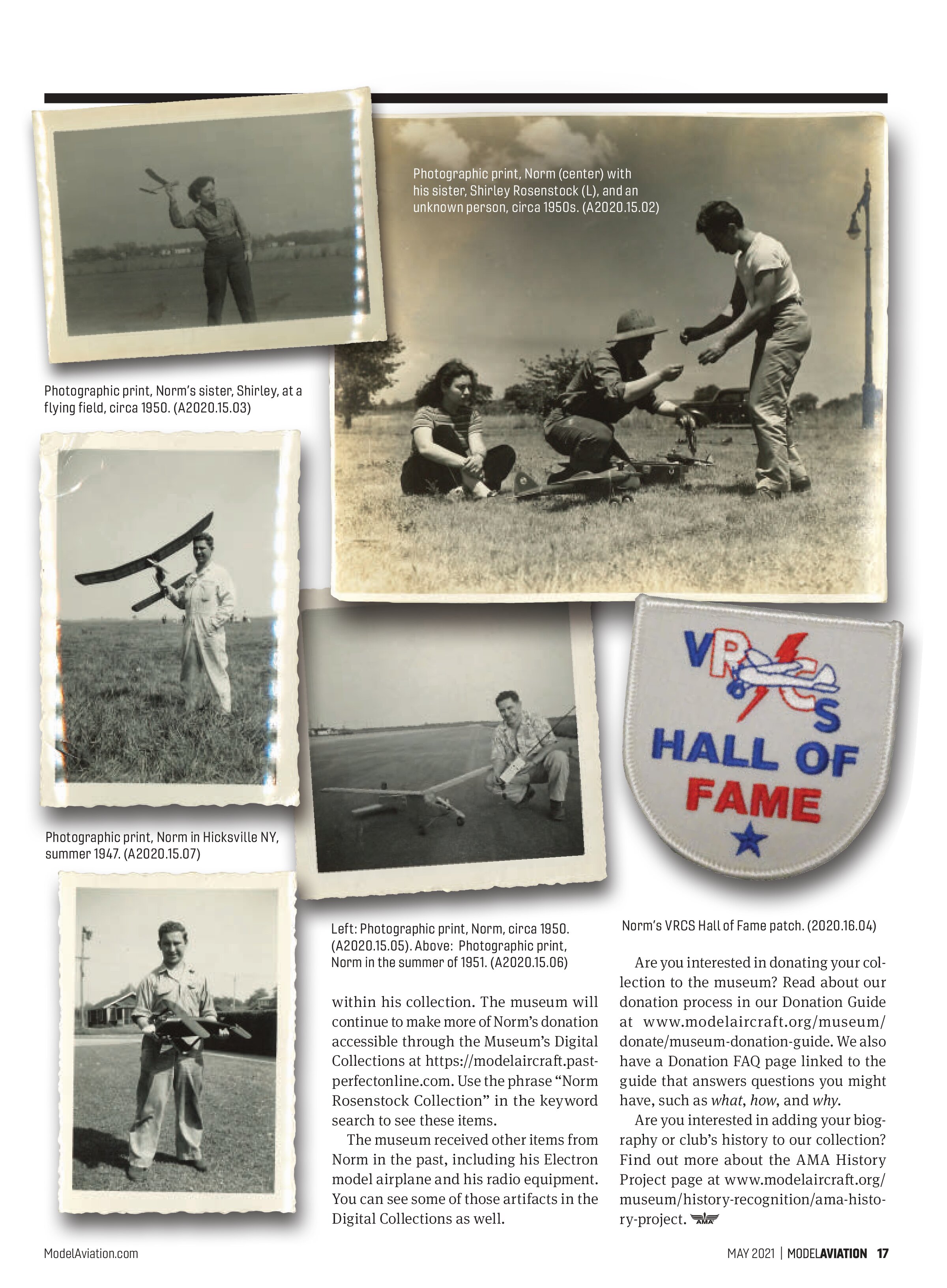
In the fall of 2020, the museum received memorabilia that Norm had acquired and produced throughout his lifetime, covering many aspects of his aeromodeling involvement. In the collection there are patches, pins, a stopwatch that he used to time Free Flight (FF) models flights, many photographs, paper documents, videos, and much more.
Included are several images of the items within his collection. The museum will continue to make more of Norm’s donation accessible through the Museum’s Digital Collections at https://modelaircraft.pastperfectonline.com. Use the phrase “Norm Rosenstock Collection” in the keyword search to see these items.
The museum received other items from Norm in the past, including his Electron model airplane and his radio equipment. You can see some of those artifacts in the Digital Collections as well.


Are you interested in donating your collection to the museum? Read about our donation process in our Donation Guide at www.modelaircraft.org/museum/donate/museum-donation-guide. We also have a Donation FAQ page linked to the guide that answers questions you might have, such as what, how, and why.
Are you interested in adding your biography or club’s history to our collection? Find out more about the AMA History Project page at www.modelaircraft.org/museum/history-recognition/ama-history-project.