DRONES ON
PARADE AT A
VIRTUAL CES
By Patrick Sherman
lucidity@roswellflighttestcrew.com

IF YOU WANT TO SEE THE FUTURE as it will manifest itself in our daily lives throughout the next few years, there is only one place to be: the Consumer Electronics Show (CES), held each January in Las Vegas. If this were a typical year, I would describe how the vast area of the show floor could encompass Rhode Island and how attendees outnumber the entire Russian Armed Forces.
Neither of those assertions is actually true, by the way, but overblown descriptions of the scope and scale of CES are part of the fun when it comes to reporting from the show. Of course, CES 2021 took place under the dark shadow of the COVID-19 pandemic and so, similar to the rest of our lives throughout this accursed interval, it was held online. The entire event was likely shrunk down to a few cubic yards of high-performance computer servers somewhere in the Utah desert.
Nevertheless, there were some interesting developments in the world of UAS—otherwise known as drones. As I sit here on my couch, literally wearing a bathrobe and bedroom slippers, let’s check out the latest and greatest.
A Global Marketplace
The selection of exhibitors that specialize in UAS was likely smaller than it would have been if the show were held in person, but it still reflected the global reach of the industry. China was well represented, but there were also companies from France, Italy, Russia, and Canada.
One exhibitor that is immediately familiar to RC hobbyists everywhere is Futaba. Renowned for its high-quality RC transmitters, it was not a surprise to find the company listed among drone-related manufacturers.
Although Futaba is known almost exclusively as an RC company in the US, its footprint in Japan and elsewhere in the world is quite a bit larger. It makes touchscreens, tool-and-die equipment, molding machines, and industrial electronics, among other products. At CES, the company was not showing off its controllers but rather its prowess as an original equipment manufacturer for digital displays and capacitive-touch panels for other companies to integrate into their own products. No part of its presentation was aimed at the consumer, which is what the C in CES stands for after all.
This was a common trend among UAS-related companies at this year’s CES. Virtually all of the aircraft manufacturers that participated in the show had products aimed at professional and industrial users rather than consumers and hobbyists.
DJI, the globally recognized drone manufacturer, did not have a presence at this all-digital venue, and neither did any of its rivals that also regularly appear, such as Autel Robotics, PowerVision, XDynamics, or Zero Zero Technology.
How Do You Say “Swarm” in French?
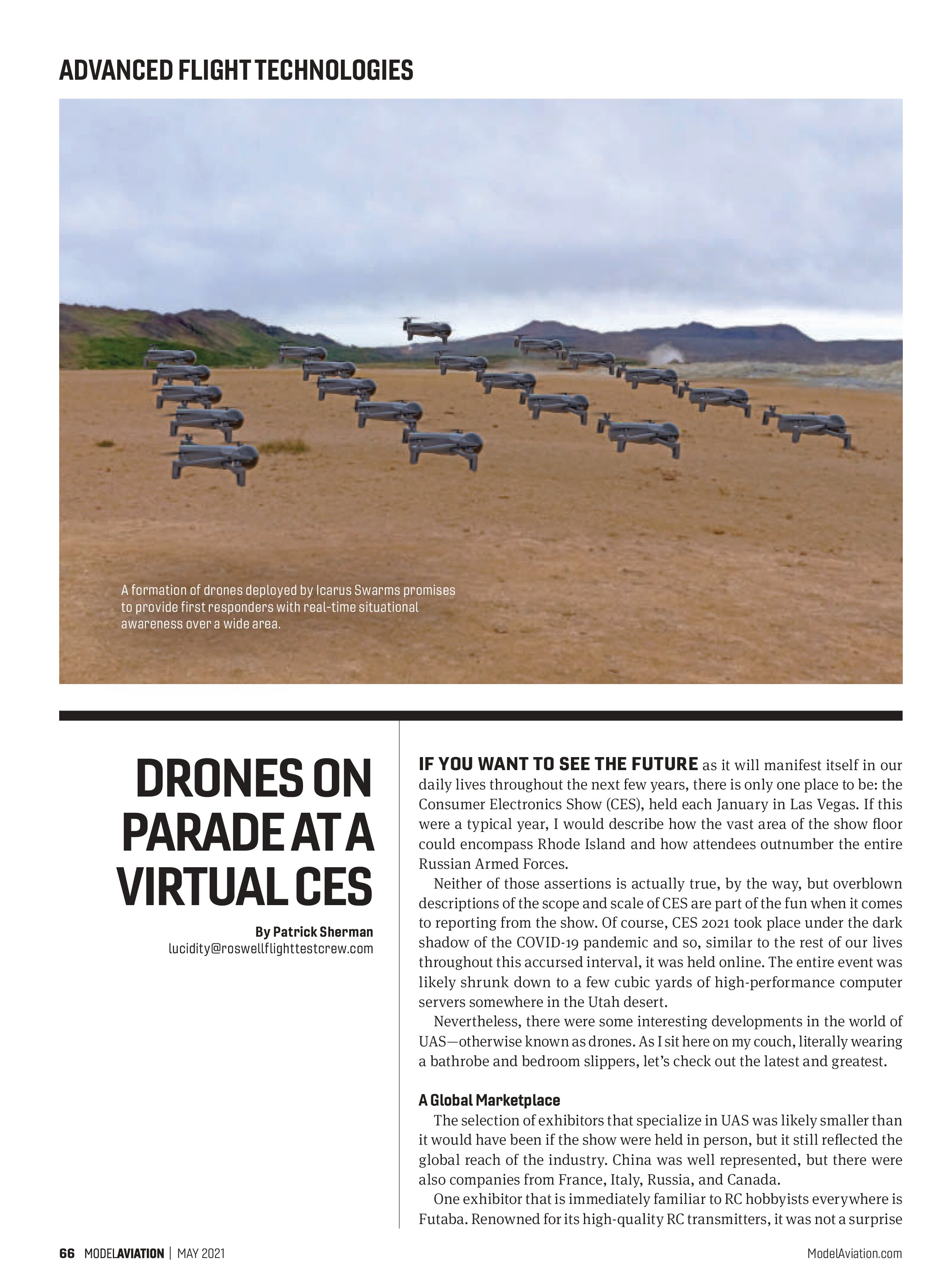
One of the most ambitious new UAS products on display at CES came courtesy of French manufacturer Icarus Swarms. As the name suggests, the company’s product is not a single UAS but a whole fleet of them that deploy and work together as an integrated unit. This same basic capability has, of course, been around for several years with the drone light shows that Intel and others have orchestrated at high-profile events such as the Olympics.
Icarus has set its sights quite a bit higher than pretty lights. Designed for use primarily by law enforcement and other first responders, this swarm is capable of carrying a plethora of sensors, including thermal and visible-light cameras and radiation detectors, as well as loudspeakers, radio relays, and radio-frequency jamming equipment. The concept is that this swarm can provide comprehensive, real-time situational awareness across a wide area rather than the much narrower perspective provided by a single aircraft.
Instead of designing and building its own aircraft, Icarus relies on the proven Anafi platform from Parrot, a company also based in France. Although the technology is no doubt impressive—and the sight of dozens of individual aircraft ascending in waves is slightly terrifying—regulatory hurdles remain, at least in the US.
Under 14 CFR Part 107, which governs nonrecreational UAS operations, each individual aircraft must have its own Remote Pilot in Command (RPIC). Drone swarms are explicitly prohibited under the current rules. However, a waiver is available to this rule, and the regulations continue to evolve to keep pace with technology, so it is possible that the swarm might come soon to a public safety incident near you.
After having perused the company’s literature, I was left with just one question. They know that in Greek mythology Icarus crashed, right?
The Russians Are Coming!
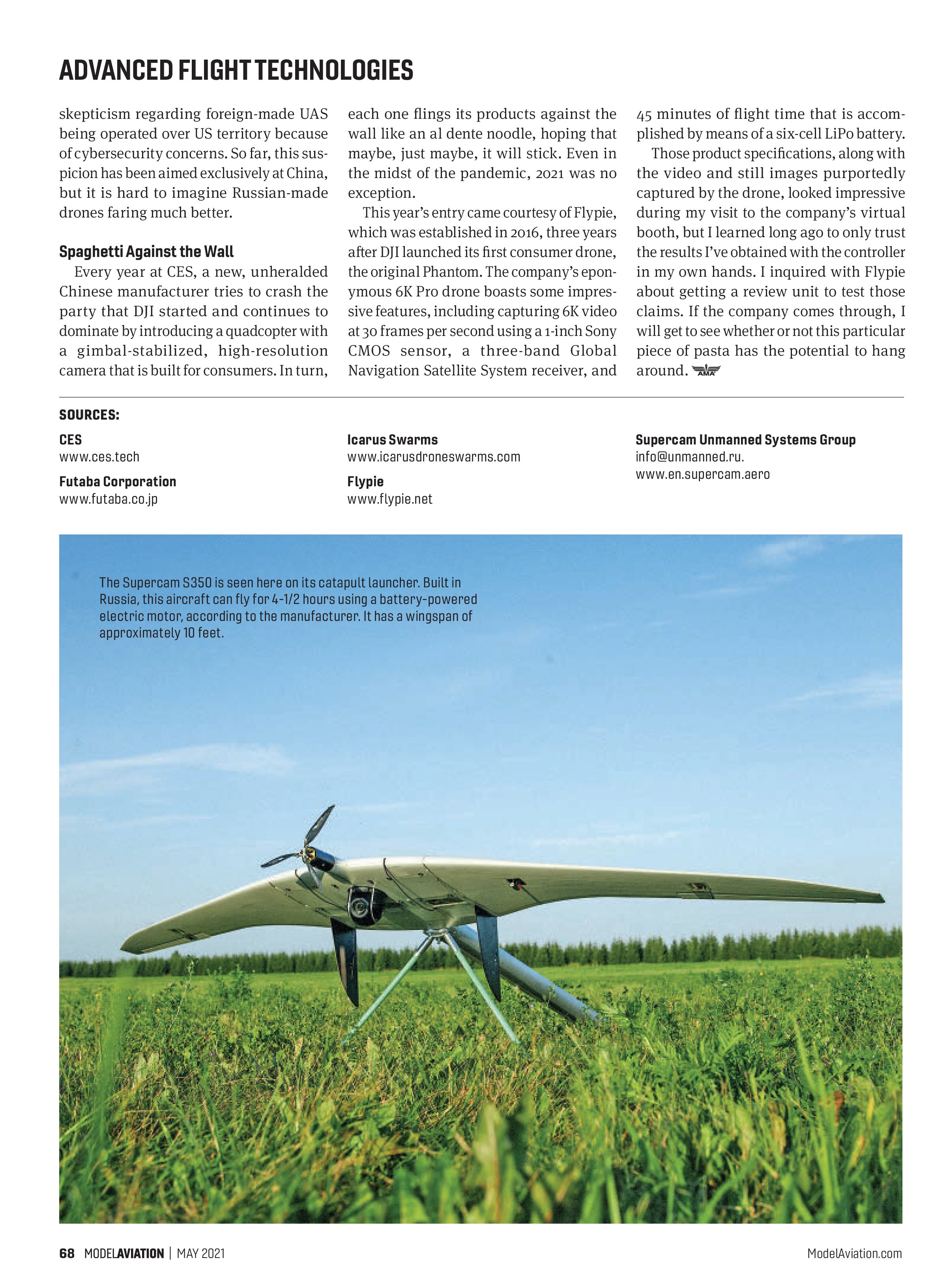
Despite the fact that I attend perhaps a half-dozen drone shows each year (when COVID-19 is not stalking the land), I have never before seen a Russian UAS manufacturer market its products in the US. That changed when I became acquainted with Supercam Unmanned Systems Group at CES. The company makes both fixed-wing and multirotor platforms but seems to specialize in different configurations of flying wings, including a vertical takeoff and landing (VTOL) model.
The target market for its systems is professional industrial and scientific users. The company cites detecting methane leaks from gas pipelines, wildlife conservation, arctic ice reconnaissance, and forest fire monitoring among its use cases. The optical and thermal imaging payloads that these platforms carry are enclosed in turrets that would not look out of place on the nose of an attack helicopter, albeit in miniature form.
With flight times ranging between 1 hour and 6 hours, these battery-powered aircraft are capable of flying upward of 60 mph and transmitting real-time video back to the ground control station at ranges in excess of 10 miles. Of course, these robust capabilities would mostly be wasted under Part 107, which requires the RPIC to maintain the aircraft in direct visual line of sight.
Given the current geopolitical circumstances, rules and regulations might be among the least of Supercam’s worries as it seeks to enter the US market. Various government agencies have voiced deep

skepticism regarding foreign-made UAS being operated over US territory because of cybersecurity concerns. So far, this suspicion has been aimed exclusively at China, but it is hard to imagine Russian-made drones faring much better.
Spaghetti Against the Wall
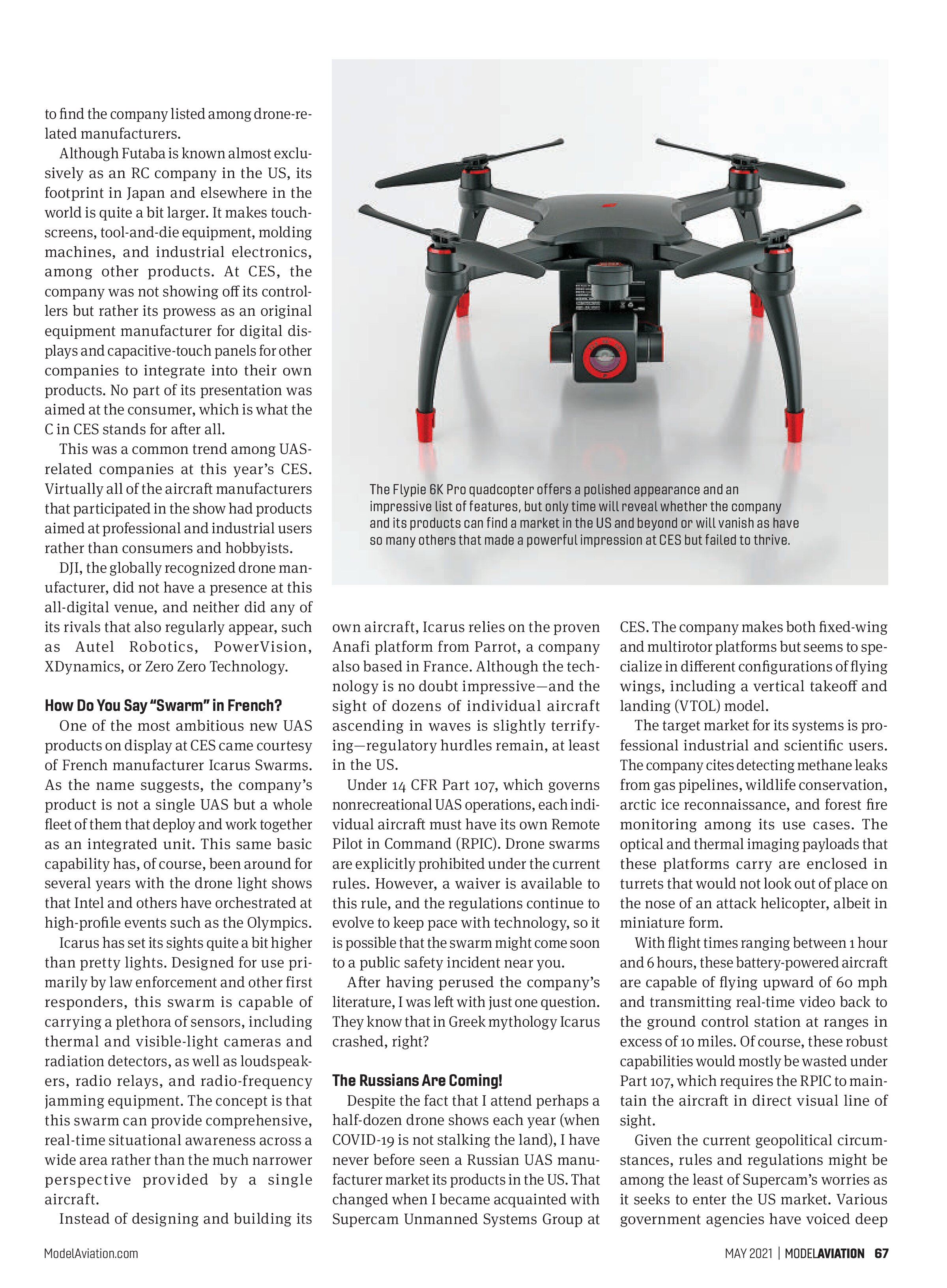
Every year at CES, a new, unheralded Chinese manufacturer tries to crash the party that DJI started and continues to dominate by introducing a quadcopter with a gimbal-stabilized, high-resolution camera that is built for consumers. In turn, each one flings its products against the wall like an al dente noodle, hoping that maybe, just maybe, it will stick. Even in the midst of the pandemic, 2021 was no exception.
This year’s entry came courtesy of Flypie, which was established in 2016, three years after DJI launched its first consumer drone, the original Phantom. The company’s eponymous 6K Pro drone boasts some impressive features, including capturing 6K video at 30 frames per second using a 1-inch Sony CMOS sensor, a three-band Global Navigation Satellite System receiver, and 45 minutes of flight time that is accomplished by means of a six-cell LiPo battery.
Those product specifications, along with the video and still images purportedly captured by the drone, looked impressive during my visit to the company’s virtual booth, but I learned long ago to only trust the results I’ve obtained with the controller in my own hands. I inquired with Flypie about getting a review unit to test those claims. If the company comes through, I will get to see whether or not this particular piece of pasta has the potential to hang around.
SOURCES:
CES
www.ces.tech
Futaba Corporation
www.futaba.co.jp
Icarus Swarms
www.icarusdroneswarms.com
Flypie
www.flypie.net
Supercam Unmanned Systems Group
info@unmanned.ru.
www.en.supercam.aero