TURBINELIKE
TIGER ARF
Toivo Mykkanen | toivo.mykkanen@gmail.com
Flying photo by Dave Schmeder

TOIVO MYKKANEN (Liberty Lake, Washington) sent in this story and photos for “Viewfinder,” stating, “[ARF] planes have certainly become popular with their ability to get a pilot flying quickly, but they can also be a platform for scratch-building ideas.”
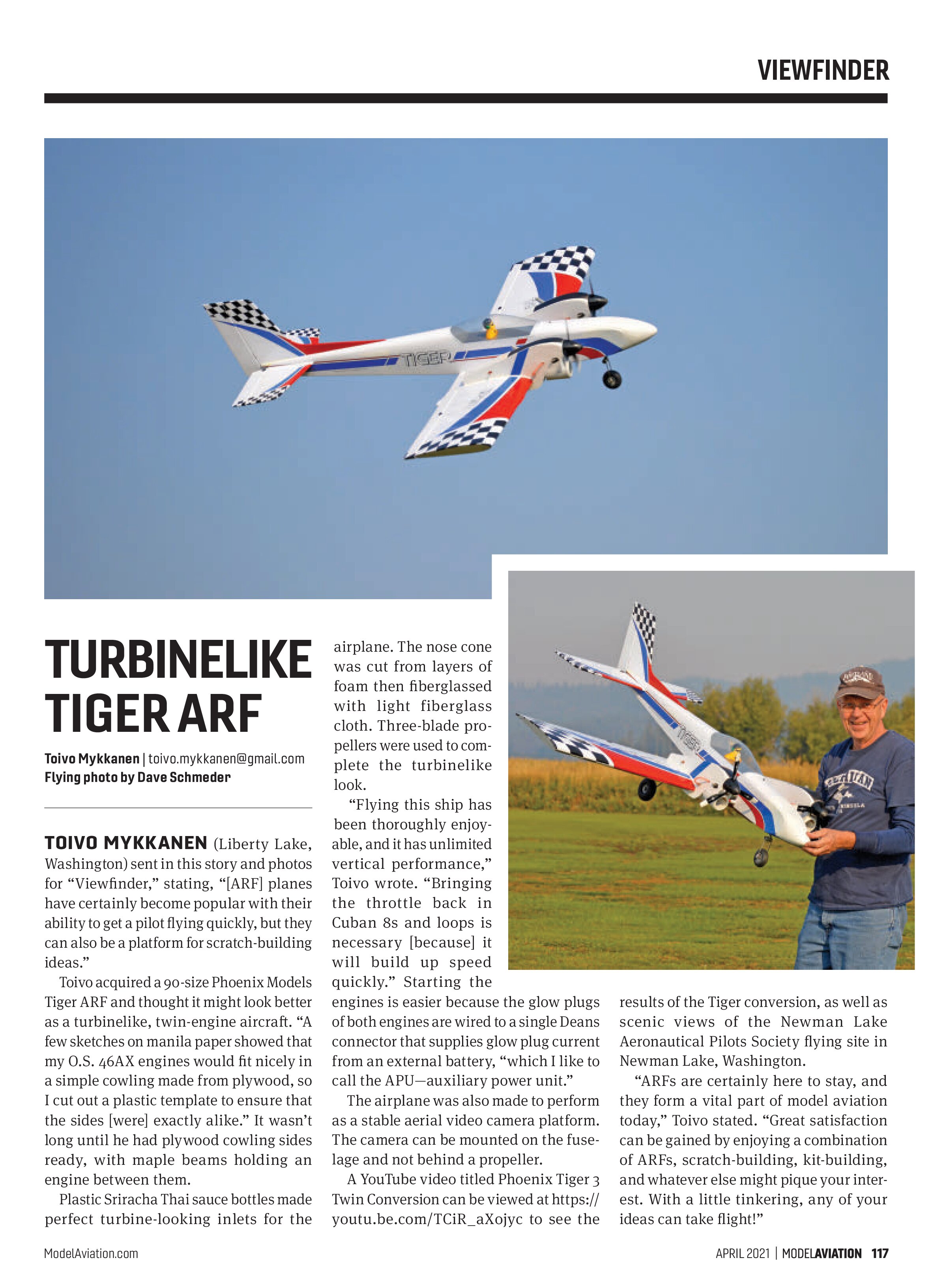
Toivo acquired a 90-size Phoenix Models Tiger ARF and thought it might look better as a turbinelike, twin-engine aircraft. “A few sketches on manila paper showed that my O.S. 46AX engines would fit nicely in a simple cowling made from plywood, so I cut out a plastic template to ensure that the sides [were] exactly alike.” It wasn’t long until he had plywood cowling sides ready, with maple beams holding an engine between them.
Plastic Sriracha Thai sauce bottles made perfect turbine-looking inlets for the

airplane. The nose cone was cut from layers of foam then fiberglassed with light fiberglass cloth. Three-blade propellers were used to complete the turbinelike look.
“Flying this ship has been thoroughly enjoyable, and it has unlimited vertical performance,” Toivo wrote. “Bringing the throttle back in Cuban 8s and loops is necessary [because] it will build up speed quickly.” Starting the engines is easier because the glow plugs of both engines are wired to a single Deans connector that supplies glow plug current from an external battery, “which I like to call the APU—auxiliary power unit.”
The airplane was also made to perform as a stable aerial video camera platform. The camera can be mounted on the fuselage and not behind a propeller.
A YouTube video titled Phoenix Tiger 3 Twin Conversion can be viewed at https://youtu.be/TCiR_aXojyc to see the results of the Tiger conversion, as well as scenic views of the Newman Lake Aeronautical Pilots Society flying site in Newman Lake, Washington.
“ARFs are certainly here to stay, and they form a vital part of model aviation today,” Toivo stated. “Great satisfaction can be gained by enjoying a combination of ARFs, scratch-building, kit-building, and whatever else might pique your interest. With a little tinkering, any of your ideas can take flight!”
REPLICA TARMAN
Photos provided by Max Blose
MAX BLOSE is a model aviation author, kit manufacturer, and recipient of several AMA awards, including an AMA Distinguished Service Award in 2008. He was a 2020 AMA Model Aviation Hall of Fame inductee and wrote to us about one of his designs. He stated:
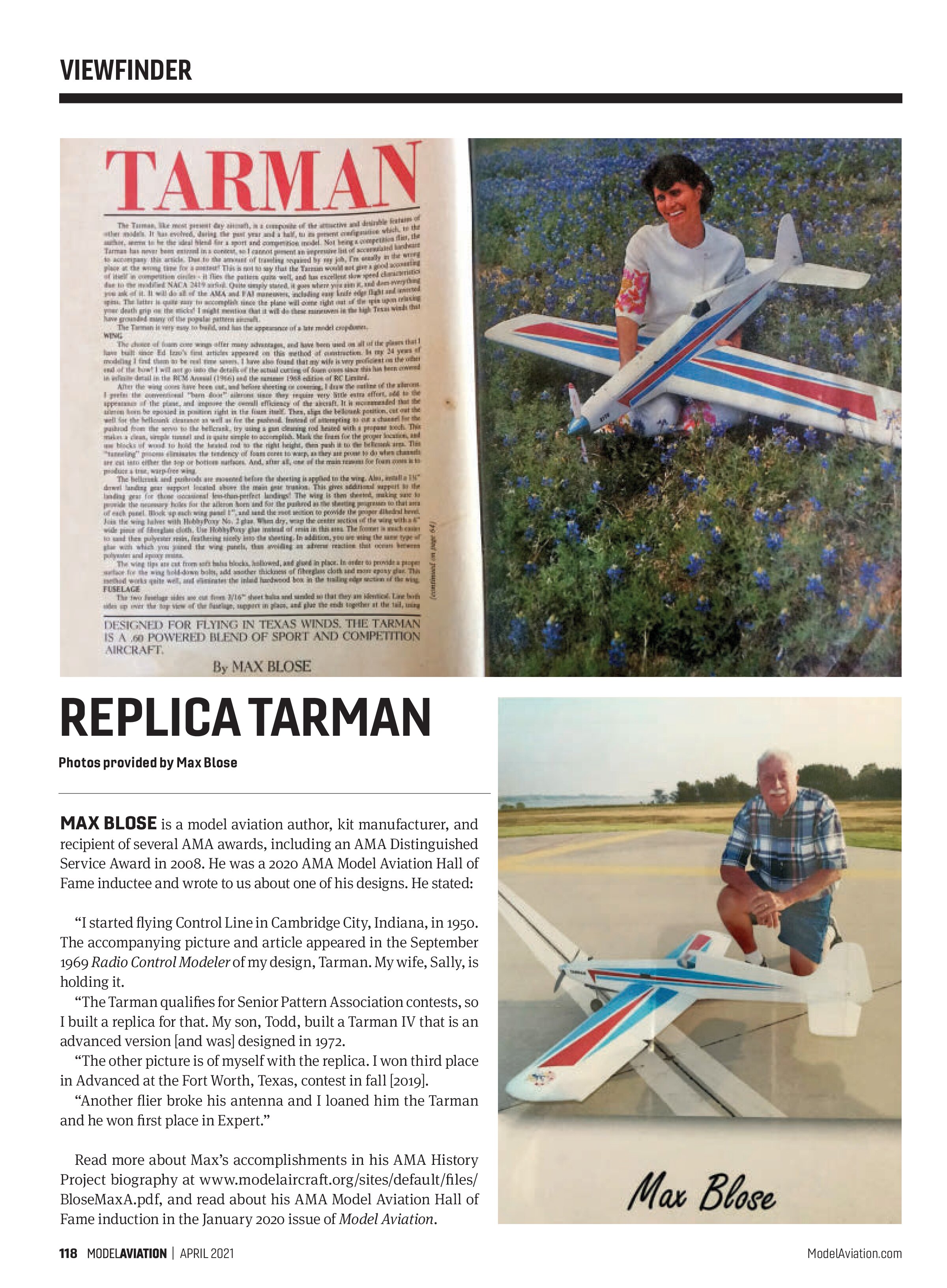
“I started flying Control Line in Cambridge City, Indiana, in 1950. The accompanying picture and article appeared in the September 1969 Radio Control Modeler of my design, Tarman. My wife, Sally, is holding it.
“The Tarman qualifies for Senior Pattern Association contests, so I built a replica for that. My son, Todd, built a Tarman IV that is an advanced version [and was] designed in 1972.
“The other picture is of myself with the replica. I won third place in Advanced at the Fort Worth, Texas, contest in fall [2019].
“Another flier broke his antenna and I loaned him the Tarman and he won first place in Expert.”
Read more about Max’s accomplishments in his AMA History Project biography at www.modelaircraft.org/sites/default/files/BloseMaxA.pdf, and read about his AMA Model Aviation Hall of Fame induction in the January 2020 issue of Model Aviation.


DAD AND SONS LEARN TO FLY
George Kopf | geo21100@aol.com
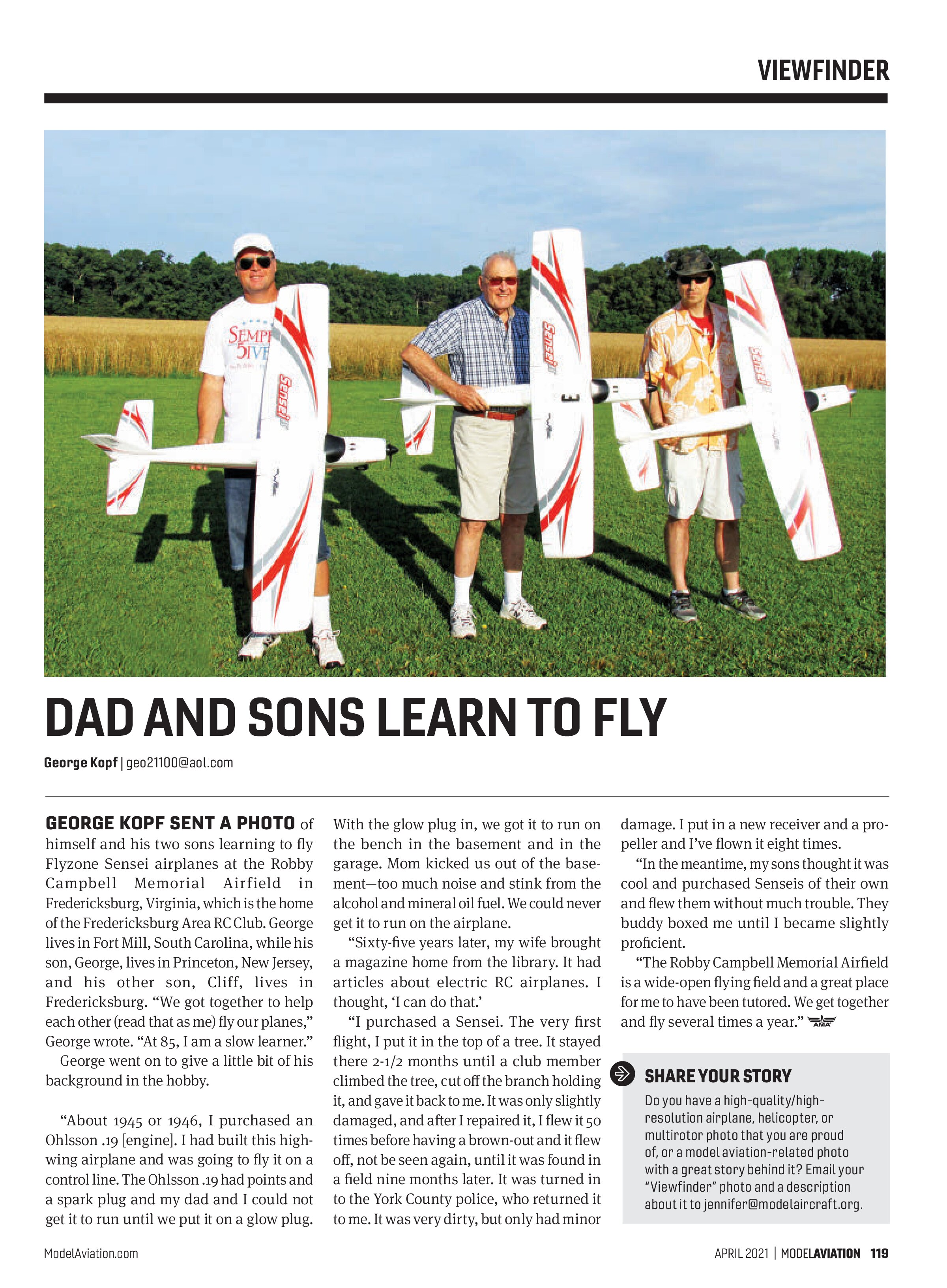
GEORGE KOPF SENT A PHOTO of himself and his two sons learning to fly Flyzone Sensei airplanes at the Robby Campbell Memorial Airfield in Fredericksburg, Virginia, which is the home of the Fredericksburg Area RC Club. George lives in Fort Mill, South Carolina, while his son, George, lives in Princeton, New Jersey, and his other son, Cliff, lives in Fredericksburg. “We got together to help each other (read that as me) fly our planes,” George wrote. “At 85, I am a slow learner.”
George went on to give a little bit of his background in the hobby.
“About 1945 or 1946, I purchased an Ohlsson .19 [engine]. I had built this high-wing airplane and was going to fly it on a control line. The Ohlsson .19 had points and a spark plug and my dad and I could not get it to run until we put it on a glow plug.
With the glow plug in, we got it to run on the bench in the basement and in the garage. Mom kicked us out of the basement—too much noise and stink from the alcohol and mineral oil fuel. We could never get it to run on the airplane.
“Sixty-five years later, my wife brought a magazine home from the library. It had articles about electric RC airplanes. I thought, ‘I can do that.’
“I purchased a Sensei. The very first flight, I put it in the top of a tree. It stayed there 2-1/2 months until a club member climbed the tree, cut off the branch holding it, and gave it back to me. It was only slightly damaged, and after I repaired it, I flew it 50 times before having a brown-out and it flew off, not be seen again, until it was found in a field nine months later. It was turned in to the York County police, who returned it to me. It was very dirty, but only had minor damage. I put in a new receiver and a propeller and I’ve flown it eight times.
“In the meantime, my sons thought it was cool and purchased Senseis of their own and flew them without much trouble. They buddy boxed me until I became slightly proficient.
“The Robby Campbell Memorial Airfield is a wide-open flying field and a great place for me to have been tutored. We get together and fly several times a year.”